Thank you for visiting SNEWPapers!
Sign up free
Letter to Editor
August 25, 1802
The National Intelligencer And Washington Advertiser
Washington, District Of Columbia
What is this article about?
A letter critiquing Federalist principles that promote aristocracy and limit popular involvement in politics, advocating for broad suffrage, frequent elections, and republican virtues to protect liberty and equality against elitism.
Clipping
OCR Quality
95%
Excellent
Full Text
FOR THE NATIONAL INTELLIGENCER.
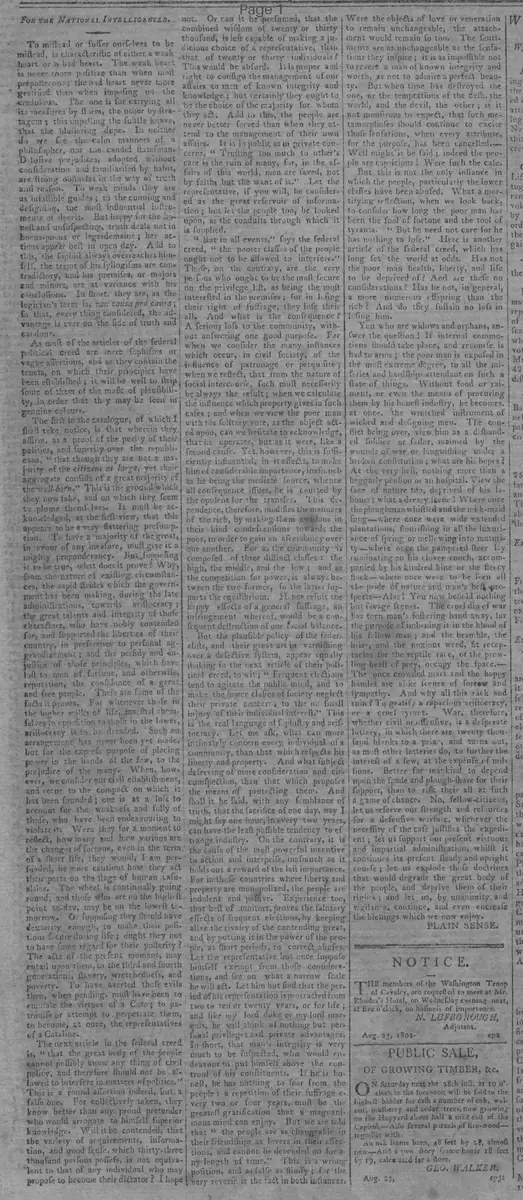
To mislead or suffer ourselves to be misled, is characteristic of either a weak heart or a bad heart. The weak heart is never more positive than when most preposterous; the bad heart never more gratified than when imposing on the credulous. The one is for carrying all it; measures by storm, the other by stratagem; this impelling the subtle knave, that the blustering dupe. In neither do we see the calm manners of a philosopher, nor the candid statesman.
Delusive prejudices, adopted without consideration and familiarized by habit, are strong obstacles in the way of truth and reason. To weak minds they are as infallible guides; to the cunning and designing, the most influential instruments of deceit. But happy for the honest and unsuspecting, truth deals not in hocus-pocus or legerdemain; her actions appear best in open day. Add to this, the sophist always overreaches himself, the terms of his syllogisms are contradictory, and his premises, or majors and minors, are at variance with his conclusions. In short, they are, as the logician's term is, non causa pro causa; so that, every thing considered, the advantage is ever on the side of truth and candour.
As most of the articles of the federal political creed are mere sophisms or vague assertions, and as they contain the tenets, on which their principles have been established; it will be well to strip some of them of the mask of plausibility, in order that they may be seen in genuine colours.
The first in the catalogue, of which I shall take notice, is that wherein they affirm, as a proof of the purity of their politics, and superiority over the republicans, "that though they are not a majority of the citizens at large, yet their aggregate consists of a great majority of the well-born." This is the ground which they now take, and on which they seem to plume themselves. It must be acknowledged, at the first view, that this appears to be a very flattering presumption. To have a majority of the great, in favour of any measure, must give it a mighty preponderancy. But supposing it to be true, what does it prove? Why, from the nature of existing circumstances, the rapid strides which the government has been making, during the late administrations, towards aristocracy; the great talents and integrity of those characters, who have nobly condescended for, and supported the liberties of their country, in preference to personal aggrandizement; and the perfidy and injustice of those principles, which have lost to men of fortune, and otherwise, reputation, the confidence of a great and free people. These are some of the facts it proves. For whenever those in the higher walks of life, may have themselves in opposition to those in the lower, aristocracy is to be dreaded. Such an arrangement has never been yet made, but as the express purpose of placing power in the hands of the few, to the prejudice of the many. When, however, we consider our civil establishment, and recur to the compact on which it has been founded; one is at a loss to account for the weakness and folly of those, who have been endeavouring to violate it. Were they for a moment to reflect, how many and how various are the changes of fortune, even in the term of a short life, they would, I am persuaded, be more cautious how they act their parts on the stage of human casualties. The wheel is continually going round, and those who are on the highest point to-day, may be on the lowest to-morrow. Or supposing they should have dexterity enough, to make their positions secure during life; ought they not to have some regard for their posterity? The acts of the present moment, may entail upon them, to the third and fourth generations, slavery, wretchedness, and poverty. To have averted those evils then, when pending. must have been to emulate the virtues of a Cato; to patronize or attempt to perpetuate them, to become, at once, the representatives of a Cataline.
The next article in the federal creed is, "that the great body of the people cannot possibly know any thing of civil policy, and therefore should not be allowed to interfere in matters of politics." This is a round assertion indeed, but a false one. For collectively taken, they know better than any proud pretender who would arrogate to himself superior knowledge. Will it be contended, that the variety of acquirements, information, and good sense, which thirty-three thousand persons possess, is not equivalent to that of any individual who may propose to become their dictator? I hope not. Or can it be presumed, that the combined wisdom of twenty or thirty thousand, is less capable of making a judicious choice of a representative, than that of twenty or thirty individuals? This would be absurd. It is proper and right to consign the management of our affairs to men of known integrity and knowledge; but certainly they ought to be the choice of the majority for whom they act. Add to this, the people are never better served than when they attend to the management of their own affairs. It is in public as in private concerns, "Trusting too much to others care is the ruin of many, for, in the affairs of this world, men are saved, not by faith but the want of it." Let the representative, if you will, be considered as the great reservoir of information; but let the people too, be looked upon, as the conduits through which it is supplied.
But in all events, says the federal creed, "the poorer classes of the people ought not to be allowed to interfere." Those, on the contrary, are the very persons who ought to be the most secure on the privilege left, as being the most interested in the premises; or in losing their right of suffrage, they lose their all. And what is the consequence? A serious loss to the community, without answering one good purpose. For when we consider the many instances which occur, in civil society, of the influence of patronage or perquisite; when we reflect, that from the nature of social intercourse, such must necessarily be always the result; when we calculate the influence which property gives in such cases; and when we view the poor man with his solitary vote, as the object acted upon, can we hesitate to acknowledge, that he operates, but as it were, like a second cause. Yet, however, this is sufficiently influential, in its effects, to make him of considerable importance, inasmuch as he being the mediate source, whence all consequence issues, he is courted by the opulent for the transfer. This dependence, therefore, modifies the manners of the rich, by making them emulous in their kind condescensions towards the poor, in order to gain an ascendancy over one another. For as the community is composed of three distinct classes: the high, the middle, and the low; and as the competition for power, is always between the two former, so the latter supports the equilibrium. Hence result the happy effects of a general suffrage, an infringement whereof, would be a consequent destruction of our social balance.
But the plausible policy of the federalists, and their great art in varnishing over a defective system, appear equally striking in the next article of their political creed, to wit; "Frequent elections tend to agitate the public mind, and to make the lower classes of society neglect their private concerns to the no small injury of their individual interest." This is the real language of sophistry and aristocracy. Let me ask, what can more intimately concern every individual of a community, than that which respects his liberty and property. And what subject deserving of more consideration and circumspection, than that which proposes the means of protecting them. And shall it be said, with any semblance of truth, that the sacrifice of one day, nay I might say one hour, in every two years, can have the least possible tendency to estrange industry. On the contrary, it is the cause of the most powerful incentive to action and enterprise, inasmuch as it holds out a reward of the last importance. For in those countries where liberty and property are monopolized, the people are indolent and passive. Experience too, that best of monitors, proves the salutary effects of frequent elections, by keeping alive the rivalry of the contending great, and by putting it in the power of the people, at short periods, to correct abuses. Let the representative but once suppose himself exempt from those considerations, and see on what a narrow scale he will act. Let him but find that the period of his representation is protracted from two to ten or twenty years, or for life; and like my lord duke or my lord marquis, he will think of nothing but personal privileges and private advantages. In short, that man's integrity is very much to be suspected, who would endeavour to put himself above the control of his constituents. If he is honest, he has nothing to fear from the people: a repetition of their suffrage every two or four years, must be the greatest gratification that a magnanimous mind can enjoy. But we are told that "the people are as changeable in their friendships as lovers in their affections, and cannot be depended on for any length of time." This is a wrong position, and as false as flimsy; for the reverse is the case? in both instances
Were the objects of love or veneration to remain unchangeable, the attachment would remain so too. The sentiments are as unchangeable as the sensations they inspire; it is as impossible not to revere a man of known integrity and worth, as not to admire a perfect beauty. But when time has destroyed the one, or the temptations of the flesh, the world, and the devil, the other: is it not monstrous to expect, that such metamorphoses should continue to excite those sensations, when every attribute. for the purpose, has been cancelled.-- Well might'it be said; indeed the people are capricious! Were such the case. But this is not the only instance in which the people, particularly the lower classes have been abused. What a mortifying reflection, when we look back, to consider how long the poor man has been the fool of fortune and the tool of tyrants. "But he need not care for he has nothing to lose." .Here is another article of the federal creed, which has long set the world at odds. Has not the poor man health, liberty, and life to be deprived of? And are these no considerations? Has he not, in general, a more numerous offspring than the rich? And do they sustain no loss in losing him.
You who are widows and orphans, answer the question! If internal commotions should take place, and recourse is had to arms; the poor man is exposed in the most extreme degree, to all the miseries and hardships attendant on such a state of things. Without food or raiment, or even the means of procuring them by his honest industry, he becomes, at once, the wretched instrument of wicked and designing men. The conflict being over, view him as a disbanded soldier or sailor, maimed by the wounds of war or languishing under a broken constitution; what are his hopes? At the very best, nothing more than a beggarly pension or an hospital. View the face of nature too, deprived of his labours; what a dreary scene! Where once the ploughman whistled and the milk-maid sung-where once were wide extended plantations, flourishing in all the luxuriance of spring or mellowing into maturity-where once the pampered steer lay ruminating on his clover couch, accompanied by his kindred kine or the fleecy flock-where once were to be seen all the pride of nature and man's best prospects-Alas! You now behold nothing but savage scenes. The cruel din of war has torn man's fostering hand away, for the purpose of imbruing it in the blood of his fellow man; and the bramble, the brier, and the noxious weed, fit receptacles for the reptile race, or the prowling beast of prey, occupy the place.- The once crowded mart and the happy hamlet are alike scenes of sorrow and sympathy. And why all this rack and ruin? To gratify; a rapacious aristocracy, or a cruel tyrant. War, therefore, whether civil or offensive, is a desperate lottery, in which there are twenty thousand blanks to a prize, and turns out, as most other lotteries do, to further the interest of a few, at the expense of millions. Better for mankind to depend upon the spade and plough-share for their support, than to risk their all at such a game of chance. No, fellow-citizens, let us reserve our strength and resources for a defensive warfare, whenever the necessity of the case justifies the expedient; let us support our present virtuous and impartial administration, whilst it continues its present steady and upright course; let us explode those doctrines that would degrade the great body of the people, and deprive them of their rights; and let us, by unanimity and vigilance, continue, and even increase the blessings which we now enjoy.
PLAIN SENSE.
To mislead or suffer ourselves to be misled, is characteristic of either a weak heart or a bad heart. The weak heart is never more positive than when most preposterous; the bad heart never more gratified than when imposing on the credulous. The one is for carrying all it; measures by storm, the other by stratagem; this impelling the subtle knave, that the blustering dupe. In neither do we see the calm manners of a philosopher, nor the candid statesman.
Delusive prejudices, adopted without consideration and familiarized by habit, are strong obstacles in the way of truth and reason. To weak minds they are as infallible guides; to the cunning and designing, the most influential instruments of deceit. But happy for the honest and unsuspecting, truth deals not in hocus-pocus or legerdemain; her actions appear best in open day. Add to this, the sophist always overreaches himself, the terms of his syllogisms are contradictory, and his premises, or majors and minors, are at variance with his conclusions. In short, they are, as the logician's term is, non causa pro causa; so that, every thing considered, the advantage is ever on the side of truth and candour.
As most of the articles of the federal political creed are mere sophisms or vague assertions, and as they contain the tenets, on which their principles have been established; it will be well to strip some of them of the mask of plausibility, in order that they may be seen in genuine colours.
The first in the catalogue, of which I shall take notice, is that wherein they affirm, as a proof of the purity of their politics, and superiority over the republicans, "that though they are not a majority of the citizens at large, yet their aggregate consists of a great majority of the well-born." This is the ground which they now take, and on which they seem to plume themselves. It must be acknowledged, at the first view, that this appears to be a very flattering presumption. To have a majority of the great, in favour of any measure, must give it a mighty preponderancy. But supposing it to be true, what does it prove? Why, from the nature of existing circumstances, the rapid strides which the government has been making, during the late administrations, towards aristocracy; the great talents and integrity of those characters, who have nobly condescended for, and supported the liberties of their country, in preference to personal aggrandizement; and the perfidy and injustice of those principles, which have lost to men of fortune, and otherwise, reputation, the confidence of a great and free people. These are some of the facts it proves. For whenever those in the higher walks of life, may have themselves in opposition to those in the lower, aristocracy is to be dreaded. Such an arrangement has never been yet made, but as the express purpose of placing power in the hands of the few, to the prejudice of the many. When, however, we consider our civil establishment, and recur to the compact on which it has been founded; one is at a loss to account for the weakness and folly of those, who have been endeavouring to violate it. Were they for a moment to reflect, how many and how various are the changes of fortune, even in the term of a short life, they would, I am persuaded, be more cautious how they act their parts on the stage of human casualties. The wheel is continually going round, and those who are on the highest point to-day, may be on the lowest to-morrow. Or supposing they should have dexterity enough, to make their positions secure during life; ought they not to have some regard for their posterity? The acts of the present moment, may entail upon them, to the third and fourth generations, slavery, wretchedness, and poverty. To have averted those evils then, when pending. must have been to emulate the virtues of a Cato; to patronize or attempt to perpetuate them, to become, at once, the representatives of a Cataline.
The next article in the federal creed is, "that the great body of the people cannot possibly know any thing of civil policy, and therefore should not be allowed to interfere in matters of politics." This is a round assertion indeed, but a false one. For collectively taken, they know better than any proud pretender who would arrogate to himself superior knowledge. Will it be contended, that the variety of acquirements, information, and good sense, which thirty-three thousand persons possess, is not equivalent to that of any individual who may propose to become their dictator? I hope not. Or can it be presumed, that the combined wisdom of twenty or thirty thousand, is less capable of making a judicious choice of a representative, than that of twenty or thirty individuals? This would be absurd. It is proper and right to consign the management of our affairs to men of known integrity and knowledge; but certainly they ought to be the choice of the majority for whom they act. Add to this, the people are never better served than when they attend to the management of their own affairs. It is in public as in private concerns, "Trusting too much to others care is the ruin of many, for, in the affairs of this world, men are saved, not by faith but the want of it." Let the representative, if you will, be considered as the great reservoir of information; but let the people too, be looked upon, as the conduits through which it is supplied.
But in all events, says the federal creed, "the poorer classes of the people ought not to be allowed to interfere." Those, on the contrary, are the very persons who ought to be the most secure on the privilege left, as being the most interested in the premises; or in losing their right of suffrage, they lose their all. And what is the consequence? A serious loss to the community, without answering one good purpose. For when we consider the many instances which occur, in civil society, of the influence of patronage or perquisite; when we reflect, that from the nature of social intercourse, such must necessarily be always the result; when we calculate the influence which property gives in such cases; and when we view the poor man with his solitary vote, as the object acted upon, can we hesitate to acknowledge, that he operates, but as it were, like a second cause. Yet, however, this is sufficiently influential, in its effects, to make him of considerable importance, inasmuch as he being the mediate source, whence all consequence issues, he is courted by the opulent for the transfer. This dependence, therefore, modifies the manners of the rich, by making them emulous in their kind condescensions towards the poor, in order to gain an ascendancy over one another. For as the community is composed of three distinct classes: the high, the middle, and the low; and as the competition for power, is always between the two former, so the latter supports the equilibrium. Hence result the happy effects of a general suffrage, an infringement whereof, would be a consequent destruction of our social balance.
But the plausible policy of the federalists, and their great art in varnishing over a defective system, appear equally striking in the next article of their political creed, to wit; "Frequent elections tend to agitate the public mind, and to make the lower classes of society neglect their private concerns to the no small injury of their individual interest." This is the real language of sophistry and aristocracy. Let me ask, what can more intimately concern every individual of a community, than that which respects his liberty and property. And what subject deserving of more consideration and circumspection, than that which proposes the means of protecting them. And shall it be said, with any semblance of truth, that the sacrifice of one day, nay I might say one hour, in every two years, can have the least possible tendency to estrange industry. On the contrary, it is the cause of the most powerful incentive to action and enterprise, inasmuch as it holds out a reward of the last importance. For in those countries where liberty and property are monopolized, the people are indolent and passive. Experience too, that best of monitors, proves the salutary effects of frequent elections, by keeping alive the rivalry of the contending great, and by putting it in the power of the people, at short periods, to correct abuses. Let the representative but once suppose himself exempt from those considerations, and see on what a narrow scale he will act. Let him but find that the period of his representation is protracted from two to ten or twenty years, or for life; and like my lord duke or my lord marquis, he will think of nothing but personal privileges and private advantages. In short, that man's integrity is very much to be suspected, who would endeavour to put himself above the control of his constituents. If he is honest, he has nothing to fear from the people: a repetition of their suffrage every two or four years, must be the greatest gratification that a magnanimous mind can enjoy. But we are told that "the people are as changeable in their friendships as lovers in their affections, and cannot be depended on for any length of time." This is a wrong position, and as false as flimsy; for the reverse is the case? in both instances
Were the objects of love or veneration to remain unchangeable, the attachment would remain so too. The sentiments are as unchangeable as the sensations they inspire; it is as impossible not to revere a man of known integrity and worth, as not to admire a perfect beauty. But when time has destroyed the one, or the temptations of the flesh, the world, and the devil, the other: is it not monstrous to expect, that such metamorphoses should continue to excite those sensations, when every attribute. for the purpose, has been cancelled.-- Well might'it be said; indeed the people are capricious! Were such the case. But this is not the only instance in which the people, particularly the lower classes have been abused. What a mortifying reflection, when we look back, to consider how long the poor man has been the fool of fortune and the tool of tyrants. "But he need not care for he has nothing to lose." .Here is another article of the federal creed, which has long set the world at odds. Has not the poor man health, liberty, and life to be deprived of? And are these no considerations? Has he not, in general, a more numerous offspring than the rich? And do they sustain no loss in losing him.
You who are widows and orphans, answer the question! If internal commotions should take place, and recourse is had to arms; the poor man is exposed in the most extreme degree, to all the miseries and hardships attendant on such a state of things. Without food or raiment, or even the means of procuring them by his honest industry, he becomes, at once, the wretched instrument of wicked and designing men. The conflict being over, view him as a disbanded soldier or sailor, maimed by the wounds of war or languishing under a broken constitution; what are his hopes? At the very best, nothing more than a beggarly pension or an hospital. View the face of nature too, deprived of his labours; what a dreary scene! Where once the ploughman whistled and the milk-maid sung-where once were wide extended plantations, flourishing in all the luxuriance of spring or mellowing into maturity-where once the pampered steer lay ruminating on his clover couch, accompanied by his kindred kine or the fleecy flock-where once were to be seen all the pride of nature and man's best prospects-Alas! You now behold nothing but savage scenes. The cruel din of war has torn man's fostering hand away, for the purpose of imbruing it in the blood of his fellow man; and the bramble, the brier, and the noxious weed, fit receptacles for the reptile race, or the prowling beast of prey, occupy the place.- The once crowded mart and the happy hamlet are alike scenes of sorrow and sympathy. And why all this rack and ruin? To gratify; a rapacious aristocracy, or a cruel tyrant. War, therefore, whether civil or offensive, is a desperate lottery, in which there are twenty thousand blanks to a prize, and turns out, as most other lotteries do, to further the interest of a few, at the expense of millions. Better for mankind to depend upon the spade and plough-share for their support, than to risk their all at such a game of chance. No, fellow-citizens, let us reserve our strength and resources for a defensive warfare, whenever the necessity of the case justifies the expedient; let us support our present virtuous and impartial administration, whilst it continues its present steady and upright course; let us explode those doctrines that would degrade the great body of the people, and deprive them of their rights; and let us, by unanimity and vigilance, continue, and even increase the blessings which we now enjoy.
PLAIN SENSE.
What sub-type of article is it?
Persuasive
Political
Social Critique
What themes does it cover?
Politics
Constitutional Rights
Social Issues
What keywords are associated?
Federalists
Republicans
Aristocracy
Suffrage
Elections
Popular Sovereignty
Social Classes
Liberty
Property
What entities or persons were involved?
Plain Sense.
For The National Intelligencer.
Letter to Editor Details
Author
Plain Sense.
Recipient
For The National Intelligencer.
Main Argument
the letter refutes federalist claims favoring aristocracy, limited suffrage, and infrequent elections, arguing that broad popular participation in politics protects liberty, maintains social balance, and prevents elite domination.
Notable Details
Critiques Federalist Creed Articles
References Cato And Cataline
Discusses Wheel Of Fortune And Posterity
Quotes On Trusting Others
Analogy To Lovers' Affections
Depicts Impacts Of War On The Poor