Thank you for visiting SNEWPapers!
Sign up free
The Evansville Journal
Evansville, Vanderburgh County, Indiana
What is this article about?
In Evansville, 1870, the city sues performer Louis Haselmayer for refusing a $10 license for shows at the Opera House, set by acting Mayor Van Riper. Defense challenges the exemption's rescission and Van Riper's authority post-Mayor Walker's death. Recorder sides with city; appeal to circuit court.
Merged-components note: Sequential reading orders (22,23) continuing the legal case on the mayor's authority, forming one coherent story.
Clipping
OCR Quality
Full Text
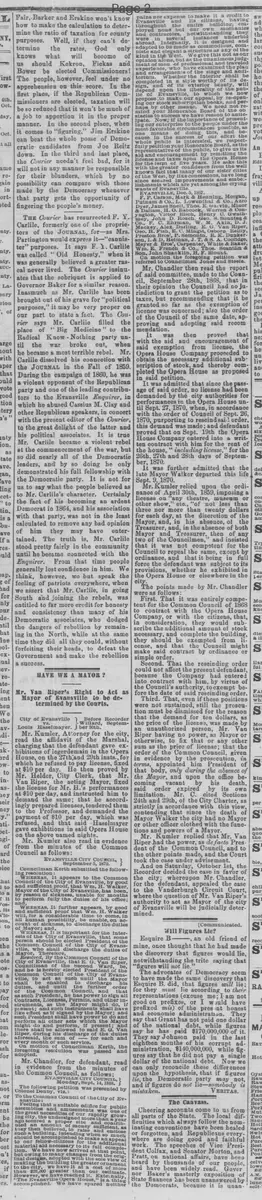
Mr. Van Riper's Right to Act as
Mayor of Evansville to be de-
termined by the Courts.
City of Evansville
Before Recorder
vs.
Louis Haselmayer. Willard, Septem-
ber 30th.
Mr. Kumler, Attorney for the city,
read the affidavit of the Marshal,
charging that the defendant gave ex-
hibitions of legerdemain in the Opera
House, on the 27th and 29th insts., for
which he refused to pay license, fixed
at $10 per day. He then proved by
Mr. Helder, City Clerk, that Mr.
Van Riper, the acting Mayor, fixed
the license for Mr. H.'s performances
at $10 per day, and instructed him to
demand the same; that he accord-
ingly prepared licenses, tendered them
to the Professor, and demanded the
payment of $10 per day, which was
refused, and that said Haselmayer
gave exhibitions in said Opera House
on the above named nights.
Mr. Kumler also read in evidence
from the minutes of the Common
Council as follows:
Evansville City Council,
September 5, 1870.
Councilman Kerth submitted the follow-
ing resolution:
WHEREAS, It appears to the Common
Council of the City of Evansville, by good
and sufficient proof, that Wm. H. Walker,
Mayor of the City of Evansville, has been,
by reason of sickness, unable for months
to perform fully the duties of his office;
and
WHEREAS, It further appears, by good
and sufficient proof that Wm. H. Walker
will, for a considerable time to come, in
all human possibility, be unable, on ac-
count of sickness, to discharge the duties
of Mayor; and,
WHEREAS, It is important for the inter-
est of the City of Evansville, that some
person should Common Council of the City of Evans-
vIlle, who shall discharge the duties of
Mayor. Therefore,
Resolved, By the Common Council of the
City of Evansville, that E. G. Van Riper,
Councilman of the Second Ward, be,
and he is hereby elected President of the
Common Council of the City of Evans-
vIlle, to act as such until the Mayor
shall be enabled to discharge his
duties, and until the further order
of the Common Council, and that
as such President, he has power to sign all
Contracts, Licenses, Permits, and other in-
struments, as the Mayor might do, if
present; and such instruments shall have
like effect as if signed by the Mayor; and
such President shall have power to do and
perform all other acts which the Mayor
might do and perform, if present; and
there shall be allowed to said E. G. Van
Riper, during his discharge of the duties
aforesaid, the sum of for each and
every month of such service.
On motion of Councilman Kerth, the
foregoing resolution was passed and
adopted.
Mr. Chandler, for defendant, read
in evidence from the minutes of
the Common Council, as follows:
Evansville City Council,
Monday, Sept. 14, 1868.
The following petition was presented by
Colonel Denby, viz.:
To the Common Council of the City of Ev-
ansville:
Feeling that a suitable edifice for public
assemblies and amusements was one of
the great necessities of our rapidly grow-
ing city, the undersigned more than a year
ago secured proper uted an amount of money sufficient, as
they then believed to raise should
such building be accomplished intending
to make when an so much to our fellow-citizens for the additional
material aid necessary its
completion. We have now arrived at that point,
but owing to many changes from the
original designs adopted with the
sole view of making the building to the city, we have it at a cost of more
than $20,000 greater than our estimate.
However we have reached The
Evansville Opera House is thlug
accompllshed. We have spared neither
pains nor expense to make it a credit to
Evansville and its citizens. having
throughout the entire building, em-
ployed none but our own mechanics
and contractors, notwithstanding they
were in several instances underbid
abroad. Internally, it is designed and
adapted to be made as commodious, com-
plete and elegant a structure as any of the
kind in the West. We give this not as our
opinion alone, but as the unanimous judgment of men of professional experience, who have examined the plan
and arrangements of the stage and audi-
torium.
Whether the interior shall be
completed in a style worthy of its de-
sign, and of its exterior beauty, will
depend upon the liberality of the pub-
lic of Evansville, to which we now
propose to make our appeal, by re-open-
ing our stock subscription books, and per-
haps by other means. We need not re-
mind your Honorable Board of the ob-
stacles to success we have reason to antic-
ipate. Now, if the importance of present-
ing our enterprise to the people under the
most favorable circumstances possible, as
cause in the success of our effort the
one means of doing this, and be-
whole public is interested, we respect-
fully petition your Honorable Board, as the
representative of the public, to give us its
ald and encouragement by remitting the
license and taxes upon the Opera House
for the term of five years. He asks this
of the West, by like concessions, have long
known fact that many of our sister cities
with the greater confidence from the well
since secured improvements and embe-
lshments which are yet among the crying
wants of Evansville.
EVANSVILLE, Dec. 5, 1857.
F. P. Carson, Mark & Henning, Morgan,
Putnam & Co., L. Lowenthal & Co., Azro
Dyer, James Snell, Thos. E. Gavin, Minor
& Dallam, H. O. Babcock, Warren & Con-
yngton, Victor Bisch, Henry C. Gwath-
mey John Roach Geo Sonntag Co., F. C. Ehrman, W. M. Akin, D. J.
Mackey, Alex. Darling, E. G. Van Riper,
Geo. H. Fish, E. C. Mingst, Osborn Reiliy,
Preston Bros., P. Semonin, R. K. Dunker
son, I. & D. Heiman, J. T. & S. A. Coolidge,
Meyer & Bros., Carpenter, White & Baker,
Wm. E. French & Co., Thos. Seantlin &
Son, John Shanklin, H. F. Blount.
On motion the foregoing petition was
referred to Councilmen Jones and Steele.
Mr. Chandler then read the report
of said committee, made to the Coun-
cil, September 28th, 1868, that in
their opinion the Council had no ju-
risdiction to grant the petition as to
taxes, but recommending that it be
granted so far as the exemption of
license was concerned; also the order
of the Council of the same date, ap-
proving and adopting said recom-
mendation.
It was then proved that with the aid and encouragement of
said exemption from license, the
Opera House Company proceeded to
obtain the necessary additional sub-
scription of stock, and thereby com-
pleted the Opera House as proposed
in said petition.
It was admitted that since the pass-
age of said order, no license had been
demanded by the city authorities for
performances in the Opera House un-
tIl Sept. 27, 1870, when, in accordance
with the order of Council of Sept. 26,
1870, purporting to rescind said order,
this demand was made; and defendant
proved that on Sept. 19th the Opera
House Company entered into a writ-
ten contract with him for the rent of
the house, "including license," for the
26th, 27th and 28th days of Septem-
ber, 1870.
It was further admitted that the
late Mayor Walker departed this life
Sept. 9, 1870.
Mr. Kumler relied upon the ordi-
nance of April 30th, 1859, imposing a
license on "any theatre, museum or
other show," etc., "of not less than
three nor more than twenty dollars
for each day, at the discretion of the
Mayor, and, in his absence, of the
Treasurer, and, in the absence of both
Mayor and Treasurer, then of any
two of the Councilmen," and insisted
that it was not competent for the
Council to repeal the same, except by
ordinance, and that it being in full
force the defendant was subject to its
provisions, whether he exhibited in
the Opera House or elsewhere in the
city.
The points made by Mr. Chandler
were as follows:
First, That it was entirely compe-
tent for the Common Council of 1868
to contract with the Opera House
Company, or with the citizens, that,
in consideration they would sub-
scribe the additional amount of stock
necessary, and complete the building.
they should be exempted from li-
cese, and that the Council might
make said contract by ordinance or
simple order.
Second. That the rescinding order
could not affect the present defendant.
because the Company had entered
into contract with him, by virtue of
the Council's authority, to exempt be-
fore the date of said rescinding order.
Third. That, even if these positions
were not sustained, still the proscu-
tion must be dismissed for the reason
that the demand for ten dollars, as
the price of the license, was made by
an unauthorized person, Mr. Van
Riper having no power, as Mayor or
otherwise, to fix that or any other
sum as the price of license; that the
order of the Common Council, given
in evidence by the prosecution, in
terms, appointed him President of
that body, only during the absence of
the Mayor, and upon the office be-
coming vacant by his death,
said order expired by its own
limitation. Mr. C. cited Sections
24th and 29th, of the City Charter, as
strictly in accordance with this view.
contending that since the death of
Mayor Walker the city had no Mayor
or other officer clothed with the func-
tions and powers of a Mayor.
Mr. Kumler replied that Mr. Van
Riper had the power, as de facto Pres-
dent of the Common Council, and to
the other points made, and the Court
took the case under advisement.
And on Saturday, October 1st, the
Recorder decided the case in favor of
the city; whereupon Mr. Chandler,
for the defendant, appealed the case
to the Vanderburgh Circuit Court.
where the question of Mr. Van Riper's
authority to act as Mayor of the city
of Evansville will be judicially deter-
mined
What sub-type of article is it?
What themes does it cover?
What keywords are associated?
What entities or persons were involved?
Where did it happen?
Story Details
Key Persons
Location
Evansville
Event Date
September 1870
Story Details
City of Evansville prosecutes Louis Haselmayer for performing legerdemain exhibitions without paying a $10 daily license set by acting Mayor Van Riper. Defense argues exemption from prior council order for Opera House, invalid rescission, and Van Riper's lack of authority after Mayor Walker's death. Recorder rules for city; case appealed to determine Van Riper's mayoral powers.