Thank you for visiting SNEWPapers!
Sign up free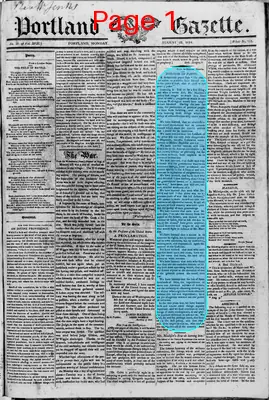
Editorial
August 22, 1814
Portland Gazette, And Maine Advertiser
Portland, Cumberland County, Maine
What is this article about?
Sarcastic editorial critiquing the Madison administration's War of 1812 policies, listing ironic 'lessons' learned about failed predictions, constitutional misinterpretations, press suppression, and fiscal extravagance.
Clipping
OCR Quality
98%
Excellent
Full Text
From the Delaware Gazette.
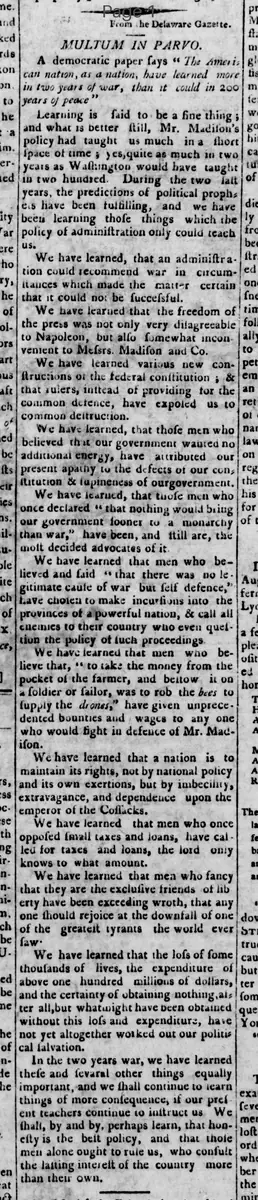
MULTUM IN PARVO.
A democratic paper says " The American nation, as a nation, have learned more in two years of war, than it could in 200 years of peace. Learning is said to be a fine thing; and what is better still, Mr. Madison's policy has taught us much in a short space of time; yes, quite as much in two years as Washington would have taught in two hundred. During the two last years, the predictions of political prophets have been fulfilling, and we have been learning those things which the policy of administration only could teach us.
We have learned, that an administration could recommend war in circumstances which made the matter certain that it could not be successful.
We have learned that the freedom of the press was not only very disagreeable to Napoleon, but also somewhat inconvenient to Messrs. Madison and Co.
We have learned various new constructions of the federal constitution; & that rulers, instead of providing for the common defence, have exposed us to common destruction.
We have learned, that those men who believed that our government wanted no additional energy, have attributed our present apathy to the defects of our constitution & supineness of our government.
We have learned, that those men who once declared " that nothing would bring our government sooner to a monarchy than war," have been, and still are, the most decided advocates of it.
We have learned that men who believed and said " that there was no legitimate cause of war but self defence." have chosen to make incursions into the provinces of a powerful nation, & call all enemies to their country who even question the policy of such proceedings.
We have learned that men who believe that, " to take the money from the pocket of the farmer, and bestow it on a soldier or sailor, was to rob the bees to supply the drones," have given unprecedented bounties and wages to any one who would fight in defence of Mr. Madison.
We have learned that a nation is to maintain its rights, not by national policy and its own exertions, but by imbecility, extravagance, and dependence upon the emperor of the Cossacks.
We have learned that men who once opposed small taxes and loans, have called for taxes and loans, the lord only knows to what amount.
We have learned that men who fancy that they are the exclusive friends of liberty have been exceeding wroth, that any one should rejoice at the downfall of one of the greatest tyrants the world ever saw:
We have learned that the loss of some thousands of lives, the expenditure of above one hundred millions of dollars, and the certainty of obtaining nothing, after all, but what might have been obtained without this loss and expenditure, have not yet altogether worked out our political salvation.
In the two years war, we have learned these and several other things equally important, and we shall continue to learn things of more consequence, if our present teachers continue to instruct us. We shall, by and by, perhaps learn, that honesty is the best policy, and that those men alone ought to rule us, who consult the lasting interest of the country more than their own.
MULTUM IN PARVO.
A democratic paper says " The American nation, as a nation, have learned more in two years of war, than it could in 200 years of peace. Learning is said to be a fine thing; and what is better still, Mr. Madison's policy has taught us much in a short space of time; yes, quite as much in two years as Washington would have taught in two hundred. During the two last years, the predictions of political prophets have been fulfilling, and we have been learning those things which the policy of administration only could teach us.
We have learned, that an administration could recommend war in circumstances which made the matter certain that it could not be successful.
We have learned that the freedom of the press was not only very disagreeable to Napoleon, but also somewhat inconvenient to Messrs. Madison and Co.
We have learned various new constructions of the federal constitution; & that rulers, instead of providing for the common defence, have exposed us to common destruction.
We have learned, that those men who believed that our government wanted no additional energy, have attributed our present apathy to the defects of our constitution & supineness of our government.
We have learned, that those men who once declared " that nothing would bring our government sooner to a monarchy than war," have been, and still are, the most decided advocates of it.
We have learned that men who believed and said " that there was no legitimate cause of war but self defence." have chosen to make incursions into the provinces of a powerful nation, & call all enemies to their country who even question the policy of such proceedings.
We have learned that men who believe that, " to take the money from the pocket of the farmer, and bestow it on a soldier or sailor, was to rob the bees to supply the drones," have given unprecedented bounties and wages to any one who would fight in defence of Mr. Madison.
We have learned that a nation is to maintain its rights, not by national policy and its own exertions, but by imbecility, extravagance, and dependence upon the emperor of the Cossacks.
We have learned that men who once opposed small taxes and loans, have called for taxes and loans, the lord only knows to what amount.
We have learned that men who fancy that they are the exclusive friends of liberty have been exceeding wroth, that any one should rejoice at the downfall of one of the greatest tyrants the world ever saw:
We have learned that the loss of some thousands of lives, the expenditure of above one hundred millions of dollars, and the certainty of obtaining nothing, after all, but what might have been obtained without this loss and expenditure, have not yet altogether worked out our political salvation.
In the two years war, we have learned these and several other things equally important, and we shall continue to learn things of more consequence, if our present teachers continue to instruct us. We shall, by and by, perhaps learn, that honesty is the best policy, and that those men alone ought to rule us, who consult the lasting interest of the country more than their own.
What sub-type of article is it?
Partisan Politics
War Or Peace
Press Freedom
What keywords are associated?
Madison Administration
War Of 1812
Political Lessons
Freedom Of Press
Federal Constitution
Taxes And Loans
Napoleon Downfall
What entities or persons were involved?
Mr. Madison
Washington
Napoleon
Emperor Of The Cossacks
Editorial Details
Primary Topic
Critique Of Madison's War Policy
Stance / Tone
Sarcastic Criticism
Key Figures
Mr. Madison
Washington
Napoleon
Emperor Of The Cossacks
Key Arguments
Administration Recommended Unwinnable War
Freedom Of Press Inconvenient To Madison
New Constructions Of Federal Constitution Expose To Destruction
Advocates Of War Despite Past Anti War Stance
Incursions Into Provinces Not Self Defense
Unprecedented Bounties Contradict Anti Military Spending Views
Dependence On Foreign Emperor Instead Of National Policy
Increased Taxes And Loans Despite Opposition
Anger At Rejoicing Napoleon's Downfall
War Costs Yield No Gains