Thank you for visiting SNEWPapers!
Sign up free
Story
April 13, 1910
The Manning Times
Manning, Clarendon County, South Carolina
What is this article about?
An explanation of how a fish's tail acts like wings, enabling rapid but short bursts of speed through water via muscle and body flexion, unlike birds in air; its power shown when fish strike out of water.
Clipping
OCR Quality
92%
Excellent
Full Text
The Tail of a Fish.
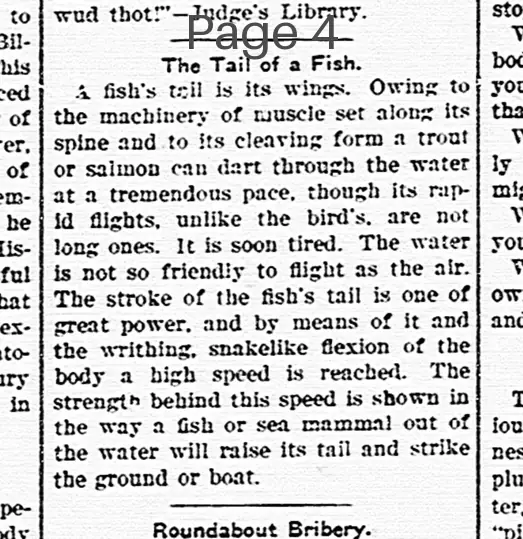
A fish's tail is its wings. Owing to the machinery of muscle set along its spine and to its cleaving form, a trout or salmon can dart through the water at a tremendous pace. Though its rapid flights, unlike the bird's, are not long ones. It is soon tired. The water is not so friendly to flight as the air. The stroke of the fish's tail is one of great power, and by means of it and the writhing, snakelike flexion of the body a high speed is reached. The strength behind this speed is shown in the way a fish or sea mammal out of the water will raise its tail and strike the ground or boat.
A fish's tail is its wings. Owing to the machinery of muscle set along its spine and to its cleaving form, a trout or salmon can dart through the water at a tremendous pace. Though its rapid flights, unlike the bird's, are not long ones. It is soon tired. The water is not so friendly to flight as the air. The stroke of the fish's tail is one of great power, and by means of it and the writhing, snakelike flexion of the body a high speed is reached. The strength behind this speed is shown in the way a fish or sea mammal out of the water will raise its tail and strike the ground or boat.
What sub-type of article is it?
Curiosity
What themes does it cover?
Nature
What keywords are associated?
Fish Tail
Swimming Propulsion
Animal Strength
Aquatic Movement
Where did it happen?
Water
Story Details
Location
Water
Story Details
Describes the fish's tail as wings for propulsion, allowing trout and salmon to dart quickly but tire soon, with power demonstrated out of water.