Thank you for visiting SNEWPapers!
Sign up free
Gazette Of The United States
Philadelphia, Philadelphia County, Pennsylvania
What is this article about?
In 'The Defence No. X' by Camillus, the author concludes analysis of the Jay Treaty's third article, arguing it limits rights to inland trade and navigation between U.S. and British North American territories, refuting claims of opening U.S. Atlantic ports to unrestricted British sea commerce without reciprocity. Special provisions for the Mississippi are noted.
Merged-components note: Continuation of the same editorial piece 'THE DEFENCE. No. X.' across pages, with sequential reading order.
Clippings
1 of 2
OCR Quality
Full Text
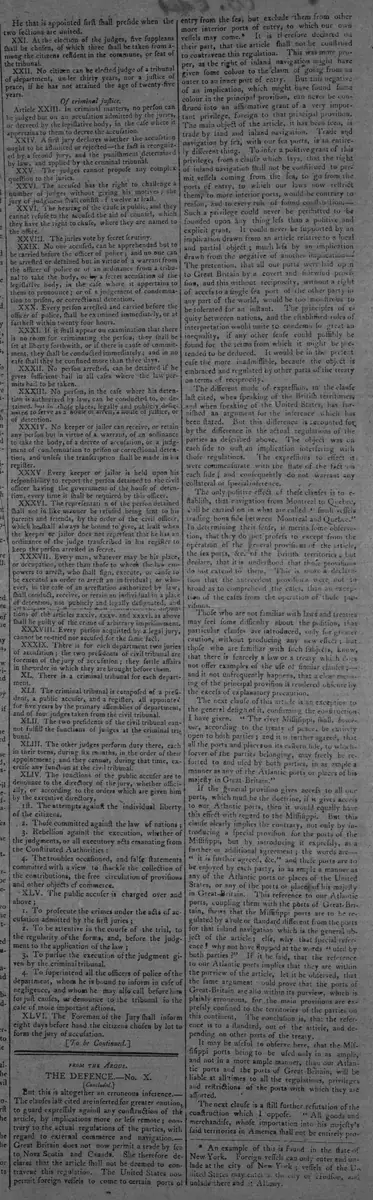
THE DEFENCE. No. X.
[Concluded.]
But this is altogether an erroneous inference.—
The clauses last cited are inserted for greater caution,
to guard expressly against any construction of the
article, by implications more or less remote; con-
trary to the actual regulations of the parties, with
regard to external commerce and navigation.—
Great Britain does not now permit a trade by sea
to Nova Scotia and Canada. She therefore de-
clares that the article shall not be deemed to con-
travene this regulation. The United States now
permit foreign vessels to come to certain ports of
entry from the sea, but exclude them from other
more interior ports of entry, to which our own
vessels may come.* It is therefore declared on
their part, that the article shall not be construed
to contravene this regulation. This was more pro-
per, as the right of inland navigation might have
given some colour to the claim of going from an
outer to an inner port of entry. But this negative
of an implication, which might have found some
colour in the principal provision, can never be con-
strued into an affirmative grant of a very impor-
tant privilege, foreign to that principal provision.
The main object of the article, it has been seen, is
trade by land and inland navigation. Trade and
navigation by sea, with our sea ports, is an entire-
ly different thing. To infer a positive grant of this
privilege, from a clause which says, that the right
of inland navigation shall not be construed to per-
mit vessels coming from the sea, to go from the
ports of entry, to which our laws now restrict
them, to more interior ports, would be contrary to
reason, and to every rule of sound construction.—
Such a privilege could never be permitted to be
founded upon any thing less than a positive and
explicit grant. It could never be supported by an
implication drawn from an article relative to a local
and partial object; much less by an implication
drawn from the negative of another implication—
The pretension, that all our ports were laid open
to Great Britain by a covert and unwarrantied pro-
vision, and this without reciprocity, without a right
of access to a single sea port of the other party in
any part of the world, would be too monstrous to
be tolerated for an instant. The principles of e-
quity between nations, and the established rules of
interpretation would unite to condemn so great an
inequality, if any other sense could possibly be
found for the terms from which it might be pre-
tended to be deduced. It would be in the present
case the more inadmissible, because the object is
embraced and regulated by other parts of the treaty
on terms of reciprocity.
The different mode of expression, in the clause
last cited, when speaking of the British territories,
and when speaking of the United States, has fur-
nished an argument for the inference which has
been stated. But this difference is accounted for
by the difference in the actual regulations of the
parties as described above. The object was on
each side to shut out an implication interfering with
those regulations. The expressions to effect it.
were commensurate with the state of the fact on
each side; and consequently do not warrant any
collateral or special inference.
The only positive effect of these clauses is to es-
tablish, that navigation from Montreal to Quebec,
shall be carried on in what are called small vessels
trading bona fide between Montreal and Quebec."
In determining their sense, it merits some obser-
vation, that they do not profess to except from the
operation of the general provisions of the article,
the sea ports, &c. of the British territories; but
declare, that it is understood that those provisions
do not extend to them. This is more a declara-
tion that the antecedent provisions were not so
broad as to comprehend the cases, than an exemp-
tion of the cases from the operation of those pro-
visions.
Those who are not familiar with laws and treaties
may feel some difficulty about the position, that
particular clauses are introduced, only for greater
caution, without producing any new effect; but.
those who are familiar with such subjects, know,
that there is scarcely a law or a treaty which does
not offer examples of the use of similar clauses;—
and it not unfrequently happens, that a clear mean-
ing of the principal provision is rendered obscure by
the excess of explanatory precaution.
The next clause of this article is an exception to
the general design of it, confirming the construction
I have given. "The river Mississippi, shall, howe-
ver, according to the treaty of peace, be entirely
open to both parties; and it is further agreed, that
all the ports and places on its eastern side, to which-
soever of the parties belonging, may freely be re-
sorted to and used by both parties, in as ample a
manner as any of the Atlantic ports or places of his
majesty in Great-Britain."
If the general provision gives access to all our
ports, which must be the doctrine, if it gives access
to our Atlantic ports, then it would equally have
this effect with regard to the Mississippi. But this
clause clearly implies the contrary, not only by in-
troducing a special provision for the ports of the
Mississippi, but by introducing it expressly, as a
further or additional agreement; the words are—
"it is further agreed, &c." and these ports are to
be enjoyed by each party, in as ample a manner as
any of the Atlantic ports or places of the United
States, or any of the ports or places of his majesty
in Great-Britain. This reference to our Atlantic
ports, coupling them with the ports of Great-Bri-
tain, shews that the Mississippi ports are to be re-
gulated by a rule or standard different from the ports
for that inland navigation which is the general ob-
ject of the article; else, why that special refer-
ence! why not have stopped at the words "used by
both parties?" If it be said, that the reference
to our Atlantic ports implies that they are within
the purview of the article, let it be observed, that
the same argument would prove that the ports of
Great-Britain are also within its purview, which is
plainly erroneous, for the main provisions are ex-
pressly confined to the territories of the parties on
this continent. The conclusion is, that the refer-
ence is to a standard, out of the article, and de-
pending on other parts of the treaty.
It may be useful to observe here, that the Mis-
sissippi ports being to be used only in as ample,
and not in a more ample manner, than our Atlan-
tic ports and the ports of Great-Britain, will be
liable at all times to all the regulations, privileges
and restrictions of the ports with which they are
assorted.
The next clause is a still further refutation of the
construction which I oppose. "All goods and
merchandize, whose importation into his majesty's
said territories in America shall not be entirely pro-
* An example of this is found in the state of
New York. Foreign vessels can only enter and un-
lade at the city of New York; vessels of the U.
nited States may enter at the city of Hudson, and
if I unlade there and at Albany.
Prohibited, may freely, for the purposes of commerce, be carried into the same in the manner aforesaid by the citizens of the United States; and such goods and merchandise shall be subject to no higher or other duties than would be payable by his majesty's subjects on the importation of the same from Europe into the said territories: and in like manner, all goods and merchandise, whose importation into the United States shall not be wholly prohibited, may freely, for the purposes of commerce, be carried into the same in the manner aforesaid, subject to no higher or other duties than would be payable by the citizens of the United States, on the importation of the same in American vessels into the Atlantic ports of the said States: and all goods not prohibited to be exported from the said territories respectively, may, in like manner, be carried out of the same by the two parties, respectively paying duty as aforesaid."
The words "in the manner aforesaid." occur twice in these clauses, and their equivalent, "in like manner" once. What is the meaning of this so often repeated phrase? It cannot be presumed that it would have been inserted so frequently without having to perform some office of consequence. I answer, that it is evidently the substitute for these other words of the main provision, "by land and inland navigation." This is "the manner aforesaid;" this is the channel, through which goods and merchandizes passing, would be subject to no other or higher duties than would be payable in the British territories by British subjects, if imported from Europe, in the territories of the United States; by citizens of the United States, if brought by American vessels into our Atlantic ports. No other reasonable use can be made of the terms. If they are denied this sense, they had much better been omitted, as being not only useless, but as giving cause to suppose a restriction of what, it is pretended, was designed to be general—a right of importing in every way, and into all ports of the United States, goods and merchandise, if not entirely prohibited, on paying the same duties as are payable by our own citizens when brought in our own vessels.
These words, "whose importation into the United States shall not be entirely prohibited," is a further key to the true sense of the article. They are equivalent to these other words, "whose importation into all parts of the United States shall not be prohibited." The design of this clause is to prevent importation, through the particular channels contemplated by the article, being obstructed by a partial or by any other than a general prohibition. As long as certain goods may be introduced into the U. S. through the Atlantic ports; they may also be brought into them through the channels designated by this article, that is, by land and inland navigation. The making a prohibition in the given case to depend on a general prohibition, is conclusive to prove, that the article contemplates only particular channels. On any other supposition the clause is nonsense. The true reading, then, of this part of the article, must be as follows: -
"Goods and merchandise, whose importation into all parts of the United States shall not be prohibited, may freely, for the purposes of commerce, be carried into the same in manner aforesaid, that is, by land and inland navigation, from the territories of his Britannic majesty on the continent of America."
There are still other expressions in the article, which are likewise an index to its meaning. They are these, "would be payable by the citizens of the United States on the importation of the same in American vessels into the Atlantic ports of the said States." This reference to a rate of duties, which would be payable on importation into the Atlantic ports, as a rule or guide for the rate of duties, which is to prevail in the case meant to be comprehended in the article, is full evidence that importation in the Atlantic ports is not included in that case. The mention of importation in American vessels confirms this conclusion, as it shows that the article itself contemplates that the discrimination made by our existing laws may continue. But the matter is put out of all doubt by those parts of the fifteenth article which reserves to the British government the right of imposing such duty as may be adequate to countervail the difference of duty now payable on the importation of European and Asiatic goods, when imported into the United States in British and in American vessels. And which stipulate that "the United States will not increase the now subsisting difference between the duties payable on the importation of any articles in British or in American vessels."
This is demonstration, that the treaty contemplates, as consistent with it, a continuance of the present difference of duties on importations in American and British vessels, and consequently that the third article which stipulates equal duties, as to the cases within it, does not extend to importations into our Atlantic ports, but is confined to importations by land and inland navigation. Though this article be of temporary duration, yet as an evidence of the sense of parties, it will always serve as a rule of construction for every part of the instrument.
These different views of the article establish beyond the possibility of doubt, that, except with regard to the Mississippi, inland trade and navigation are its sole objects—that it grants no right or privilege whatever in our Atlantic ports—and that with regard to the ports of the Mississippi, it only establishes this principle, that Great-Britain shall always enjoy there the same privileges which by treaty or law she is allowed to have in our Atlantic ports.
I remark incidentally, for a purpose which will appear hereafter, that as far as this article is concerned, we are free to prohibit the importation into the United States at large of any British article whatever, though we cannot prohibit its importation partially, that is merely from her territories in our neighborhood by land or inland navigation, but we may prohibit the importation by sea from those territories; nor is there any other part of the treaty by which this is prevented.
The remaining clauses of this article establish the following points: "That no duty of entry shall be levied by either party on peltries brought by land or inland navigation, into the respective territories;" that Indians passing and repassing with their own goods shall pay no impost or duty upon them, but goods in bales, or other large packages, unusual among Indians, shall not be considered as their goods, that tolls and rates of ferriage shall be the same on both sides as are paid by natives—that no duties shall be paid by either party on the mere transit of goods across portages and carrying places from one part to another of the territory of the same party, that the respective governments will promote friendship, good neighbourhood and amicable intercourse, by causing speedy and impartial justice to be done, and necessary protection to be extended to all who may be concerned therein.
I shall conclude this paper with an observation or two on the meaning of the terms, inland navigation. These terms have no technical meaning defined in the laws of either country, nor have they any precise meaning assigned by the law of nations. They, however, ex vi termini, exclude navigation from the sea: and as a general rule, I should say, that inland navigation begins there, where sea navigation ends. Where is this? I answer at the ports of entry from the sea. By the laws of Great Britain and of the United States, all rivers are arms of the sea, as far as the ordinary tides flow. It would be a consequence of this principle, that sea navigation would reach to the head of tide water. But some more obvious and notorious rule ought to govern the interpretation of national compacts. The ports of entry from the sea are conceived to be the proper rule.
In the case under consideration, the general spirit of the article may require that all the waters which divide the territories of the parties should be in their whole extent common to both. As to other communicating waters accessible under the article, the reciprocal limit of the right will be the ports of entry from the sea. This is to be understood with the exception of the Mississippi, to the ports of which access from the sea is granted under the qualification which has been pointed out.
CAMILLUS.
What sub-type of article is it?
What keywords are associated?
What entities or persons were involved?
Editorial Details
Primary Topic
Interpretation Of The Third Article Of The Jay Treaty On Inland Commerce And Navigation
Stance / Tone
Defensive Refutation Of Claims For Unrestricted British Sea Trade Access To U.S. Ports
Key Figures
Key Arguments