Thank you for visiting SNEWPapers!
Sign up free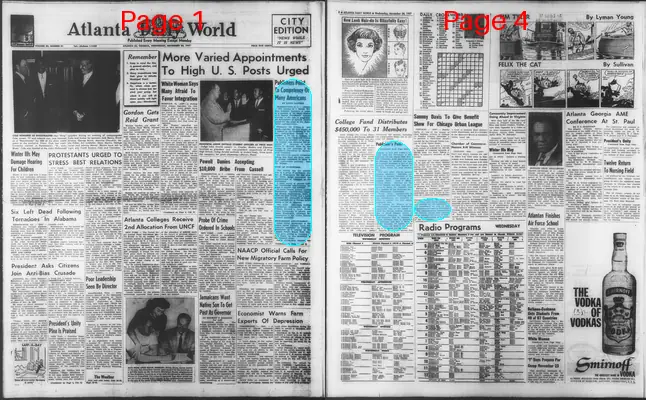
Editorial
November 20, 1957
Atlanta Daily World
Atlanta, Fulton County, Georgia
What is this article about?
Louis Lautier critiques the Eisenhower Administration's appointment of J. Ernest Wilkins to the Civil Rights Commission, highlighting criticism over the lack of geographical diversity among top African American appointees, mostly from Illinois, amid Senate opposition.
Merged-components note: Continuation of editorial on publishers' point from page 1 to page 4.
Clippings
1 of 2
OCR Quality
95%
Excellent
Full Text
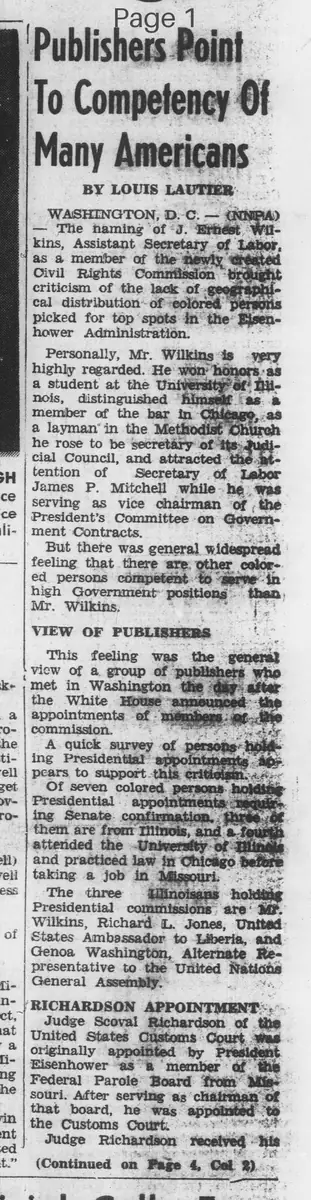
Publishers Point To Competency Of Many Americans
BY LOUIS LAUTIER
WASHINGTON, D.C. — (NNPA)
The naming of J. Ernest Wilkins, Assistant Secretary of Labor, as a member of the newly created Civil Rights Commission brought criticism of the lack of geographical distribution of colored persons picked for top spots in the Eisenhower Administration.
Personally, Mr. Wilkins is very highly regarded. He won honors as a student at the University of Illinois, distinguished himself as a member of the bar in Chicago, as a layman in the Methodist Church he rose to be secretary of its Judicial Council, and attracted the attention of Secretary of Labor James P. Mitchell while he was serving as vice chairman of the President's Committee on Government Contracts.
But there was general widespread feeling that there are other colored persons competent to serve in high Government positions than Mr. Wilkins.
VIEW OF PUBLISHERS
This feeling was the general view of a group of publishers who met in Washington the day after the White House announced the appointments of members of the commission.
A quick survey of persons holding Presidential appointments appears to support this criticism.
Of seven colored persons holding Presidential appointments requiring Senate confirmation: three of them are from Illinois, and a fourth attended the University of Illinois and practiced law in Chicago before taking a job in Missouri.
The three Illinoisans holding Presidential commissions are: Mr. Wilkins, Richard L. Jones, United States Ambassador to Liberia, and Geneva Washington, Alternate Representative to the United Nations General Assembly.
RICHARDSON APPOINTMENT
Judge Scovel Richardson of the United States Customs Court was originally appointed by President Eisenhower as a member of the Federal Parole Board from Missouri. After serving as chairman of that board, he was appointed to the Customs Court
Judge Richardson received his (Continued on Page 4, Col 2)
Publisher's Point
(Continued from Page One)
bachelor of arts and master's degrees from the University of Illinois and his law degree from Howard University. After practicing law in Chicago, he accepted the post of associate professor of law at the Lincoln, University Law School in St. Louis where he later became dean.
The only other colored persons holding statutory positions are Walter A. Gordon, Governor of the Virgin Islands, whose home is in Almeda, Calif.: Leon P. Miller, United States Attorney for the Virgin Islands, and Brig. Gen. Benjamin O. Davis, Sr. (retired). who is a member of the American Battle Monuments Commission.
These seven appointments to statutory positions. requiring Senate confirmation, are relatively so small in number that they almost approach zero.
In naming Mr. Wilkins to the Commission, President Eisenhower apparently had an eye peeled toward the Senate Judicial Committee, of which Senator James O. Eastland, Dixiecrat, is chairman, and Senators Olin D. Johnson of South Carolina John L. McClellan of Arkansas, and Sam J. Ervin of North Carolina. all hostile to the civil rights bill while it was pending in Congress. are members.
Reports already are abroad that Eastland, Johnston, McClellan and Ervin have their knives unsheathed and whetted for the appointees to the Commission as soon as their nominations are sent to the Senate.
The Administration reasoned that Mr. Wilkins. having been confirmed as Assistant Secretary of Labor, can win confirmation as a member of the Commission.
BY LOUIS LAUTIER
WASHINGTON, D.C. — (NNPA)
The naming of J. Ernest Wilkins, Assistant Secretary of Labor, as a member of the newly created Civil Rights Commission brought criticism of the lack of geographical distribution of colored persons picked for top spots in the Eisenhower Administration.
Personally, Mr. Wilkins is very highly regarded. He won honors as a student at the University of Illinois, distinguished himself as a member of the bar in Chicago, as a layman in the Methodist Church he rose to be secretary of its Judicial Council, and attracted the attention of Secretary of Labor James P. Mitchell while he was serving as vice chairman of the President's Committee on Government Contracts.
But there was general widespread feeling that there are other colored persons competent to serve in high Government positions than Mr. Wilkins.
VIEW OF PUBLISHERS
This feeling was the general view of a group of publishers who met in Washington the day after the White House announced the appointments of members of the commission.
A quick survey of persons holding Presidential appointments appears to support this criticism.
Of seven colored persons holding Presidential appointments requiring Senate confirmation: three of them are from Illinois, and a fourth attended the University of Illinois and practiced law in Chicago before taking a job in Missouri.
The three Illinoisans holding Presidential commissions are: Mr. Wilkins, Richard L. Jones, United States Ambassador to Liberia, and Geneva Washington, Alternate Representative to the United Nations General Assembly.
RICHARDSON APPOINTMENT
Judge Scovel Richardson of the United States Customs Court was originally appointed by President Eisenhower as a member of the Federal Parole Board from Missouri. After serving as chairman of that board, he was appointed to the Customs Court
Judge Richardson received his (Continued on Page 4, Col 2)
Publisher's Point
(Continued from Page One)
bachelor of arts and master's degrees from the University of Illinois and his law degree from Howard University. After practicing law in Chicago, he accepted the post of associate professor of law at the Lincoln, University Law School in St. Louis where he later became dean.
The only other colored persons holding statutory positions are Walter A. Gordon, Governor of the Virgin Islands, whose home is in Almeda, Calif.: Leon P. Miller, United States Attorney for the Virgin Islands, and Brig. Gen. Benjamin O. Davis, Sr. (retired). who is a member of the American Battle Monuments Commission.
These seven appointments to statutory positions. requiring Senate confirmation, are relatively so small in number that they almost approach zero.
In naming Mr. Wilkins to the Commission, President Eisenhower apparently had an eye peeled toward the Senate Judicial Committee, of which Senator James O. Eastland, Dixiecrat, is chairman, and Senators Olin D. Johnson of South Carolina John L. McClellan of Arkansas, and Sam J. Ervin of North Carolina. all hostile to the civil rights bill while it was pending in Congress. are members.
Reports already are abroad that Eastland, Johnston, McClellan and Ervin have their knives unsheathed and whetted for the appointees to the Commission as soon as their nominations are sent to the Senate.
The Administration reasoned that Mr. Wilkins. having been confirmed as Assistant Secretary of Labor, can win confirmation as a member of the Commission.
What sub-type of article is it?
Social Reform
Partisan Politics
What keywords are associated?
Civil Rights Commission
Eisenhower Appointments
Colored Persons
Geographical Distribution
Senate Confirmation
African American Officials
What entities or persons were involved?
J. Ernest Wilkins
Eisenhower Administration
James P. Mitchell
Richard L. Jones
Geneva Washington
Scovel Richardson
Walter A. Gordon
Leon P. Miller
Benjamin O. Davis Sr.
James O. Eastland
Olin D. Johnston
John L. Mcclellan
Sam J. Ervin
Editorial Details
Primary Topic
Criticism Of Lack Of Geographical Diversity In African American Appointments To Eisenhower Administration
Stance / Tone
Critical Of Appointment Choices And Political Maneuvering
Key Figures
J. Ernest Wilkins
Eisenhower Administration
James P. Mitchell
Richard L. Jones
Geneva Washington
Scovel Richardson
Walter A. Gordon
Leon P. Miller
Benjamin O. Davis Sr.
James O. Eastland
Olin D. Johnston
John L. Mcclellan
Sam J. Ervin
Key Arguments
Widespread Feeling That Other Competent Colored Persons Exist Beyond Wilkins For High Positions
Survey Shows Three Of Seven Senate Confirmed Colored Appointees From Illinois
Fourth Appointee Also Tied To Illinois Education And Practice
Only Seven Such Appointments Total, Nearly Insignificant
Eisenhower Chose Wilkins To Ease Senate Confirmation Due To Prior Approval And Southern Senators' Hostility