Thank you for visiting SNEWPapers!
Sign up free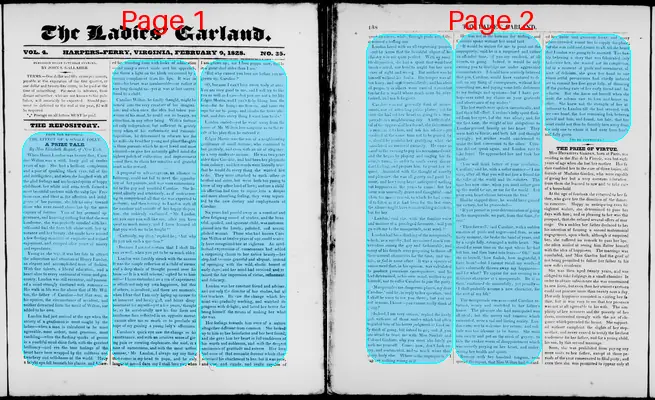
Literary
February 9, 1828
The Ladies' Garland
Harpers Ferry, Jefferson County, West Virginia
What is this article about?
Henry Landon, a romantic gentleman, decides to educate young Caroline Milton to become his ideal wife. After six years, their bond strains when Caroline insists on attending a masquerade against his wishes, leading to a prideful breakup. She later marries another in haste, regretting her folly and facing lasting misery.
Merged-components note: Continuation of the same prize tale 'THE EFFECT OF A SINGLE FOLLY' across pages 1 and 2; text flows directly.
Clippings
1 of 2
OCR Quality
98%
Excellent
Full Text
FROM THE MEMORIAL.
THE EFFECT OF A SINGLE FOLLY.
A PRIZE TALE
By Miss Elizabeth Bogart, of New York.
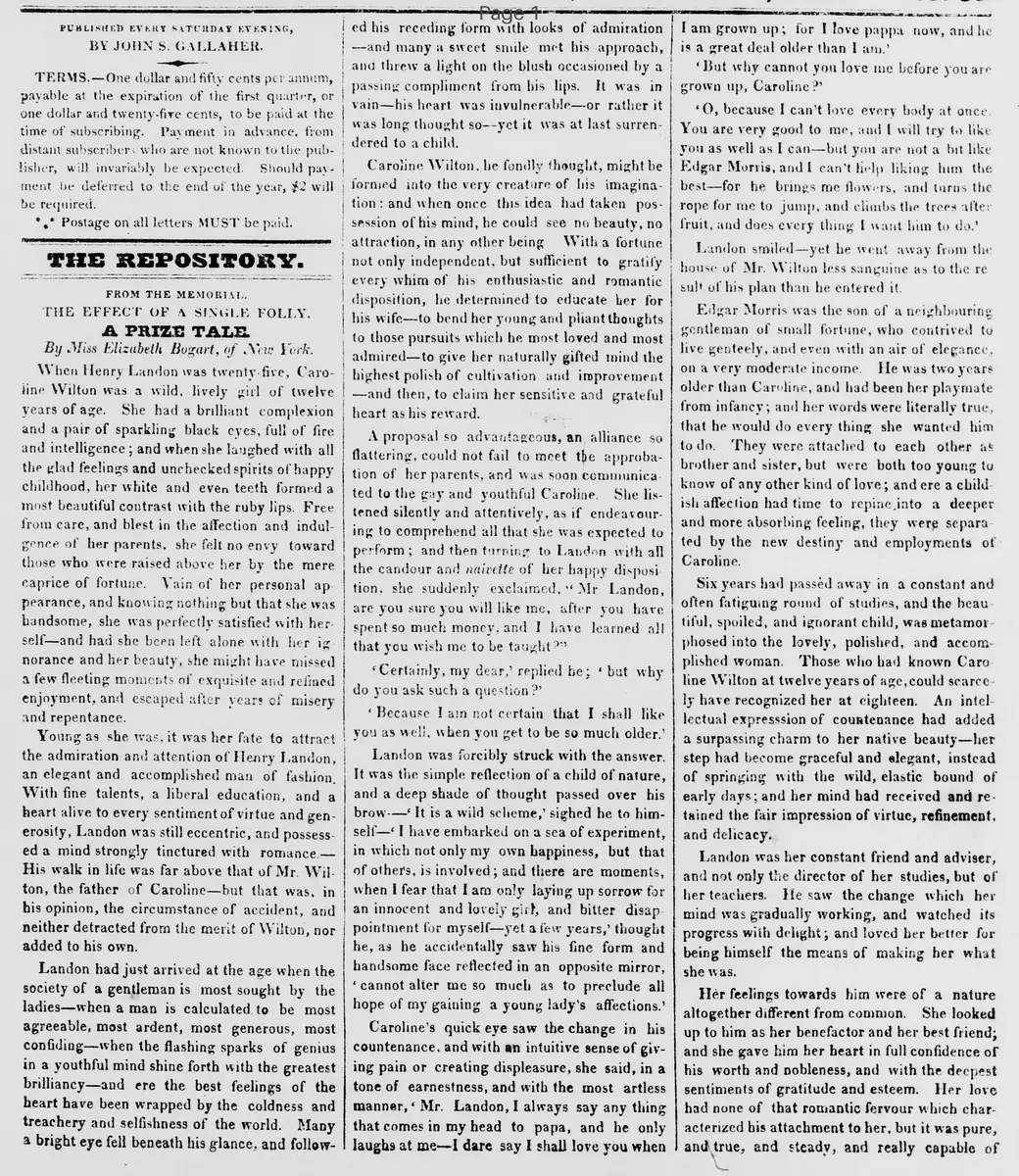
When Henry Landon was twenty-five, Caroline Milton was a wild, lively girl of twelve years of age. She had a brilliant complexion and a pair of sparkling black eyes, full of fire and intelligence; and when she laughed with all the glad feelings and unchecked spirits of happy childhood, her white and even teeth formed a most beautiful contrast with the ruby lips. Free from care, and blest in the affection and indulgence of her parents, she felt no envy toward those who were raised above her by the mere caprice of fortune. Vain of her personal appearance, and knowing nothing but that she was handsome, she was perfectly satisfied with herself—and had she been left alone with her ignorance and her beauty, she might have missed a few fleeting moments of exquisite and refined enjoyment, and escaped after years of misery and repentance.
Young as she was, it was her fate to attract the admiration and attention of Henry Landon, an elegant and accomplished man of fashion. With fine talents, a liberal education, and a heart alive to every sentiment of virtue and generosity, Landon was still eccentric, and possessed a mind strongly tinctured with romance.—His walk in life was far above that of Mr. Milton, the father of Caroline—but that was, in his opinion, the circumstance of accident, and neither detracted from the merit of Milton, nor added to his own.
Landon had just arrived at the age when the society of a gentleman is most sought by the ladies—when a man is calculated to be most agreeable, most ardent, most generous, most confiding—when the flashing sparks of genius in a youthful mind shine forth with the greatest brilliancy—and ere the best feelings of the heart have been wrapped by the coldness and treachery and selfishness of the world. Many a bright eye fell beneath his glance, and followed his receding form with looks of admiration—and many a sweet smile met his approach, and threw a light on the blush occasioned by a passing compliment from his lips. It was in vain—his heart was invulnerable—or rather it was long thought so—yet it was at last surrendered to a child.
Caroline Milton, he fondly thought, might be formed into the very creature of his imagination: and when once this idea had taken possession of his mind, he could see no beauty, no attraction, in any other being. With a fortune not only independent, but sufficient to gratify every whim of his enthusiastic and romantic disposition, he determined to educate her for his wife—to bend her young and pliant thoughts to those pursuits which he most loved and most admired—to give her naturally gifted mind the highest polish of cultivation and improvement—and then, to claim her sensitive and grateful heart as his reward.
A proposal so advantageous, an alliance so flattering, could not fail to meet the approbation of her parents, and was soon communicated to the gay and youthful Caroline. She listened silently and attentively, as if endeavouring to comprehend all that she was expected to perform; and then turning to Landon with all the candour and naivete of her happy disposition, she suddenly exclaimed, "Mr. Landon, are you sure you will like me, after you have spent so much money, and I have learned all that you wish me to be taught?"
"Certainly, my dear," replied he; "but why do you ask such a question?"
"Because I am not certain that I shall like you as well, when you get to be so much older."
Landon was forcibly struck with the answer. It was the simple reflection of a child of nature, and a deep shade of thought passed over his brow—"It is a wild scheme," sighed he to himself—"I have embarked on a sea of experiment, in which not only my own happiness, but that of others, is involved; and there are moments, when I fear that I am only laying up sorrow for an innocent and lovely girl, and bitter disappointment for myself—yet a few years," thought he, as he accidentally saw his fine form and handsome face reflected in an opposite mirror, "cannot alter me so much as to preclude all hope of my gaining a young lady's affections."
Caroline's quick eye saw the change in his countenance, and with an intuitive sense of giving pain or creating displeasure, she said, in a tone of earnestness, and with the most artless manner, "Mr. Landon, I always say anything that comes in my head to papa, and he only laughs at me—I dare say I shall love you when I am grown up; for I love pappa now, and he is a great deal older than I am."
"But why cannot you love me before you are grown up, Caroline?"
"O, because I can't love everybody at once. You are very good to me, and I will try to like you as well as I can—but you are not a bit like Edgar Morris, and I can't help liking him the best—for he brings me flowers, and turns the rope for me to jump, and climbs the trees after fruit, and does everything I want him to do."
Landon smiled—yet he went away from the house of Mr. Milton less sanguine as to the result of his plan than he entered it.
Edgar Morris was the son of a neighbouring gentleman of small fortune, who contrived to live genteelly, and even with an air of elegance, on a very moderate income. He was two years older than Caroline, and had been her playmate from infancy; and her words were literally true, that he would do everything she wanted him to do. They were attached to each other as brother and sister, but were both too young to know of any other kind of love; and ere a childish affection had time to ripen into a deeper and more absorbing feeling, they were separated by the new destiny and employments of Caroline.
Six years had passed away in a constant and often fatiguing round of studies, and the beautiful, spoiled, and ignorant child, was metamorphosed into the lovely, polished, and accomplished woman. Those who had known Caroline Milton at twelve years of age, could scarcely have recognized her at eighteen. An intellectual expression of countenance had added a surpassing charm to her native beauty—her step had become graceful and elegant, instead of springing with the wild, elastic bound of early days; and her mind had received and retained the fair impression of virtue, refinement, and delicacy.
Landon was her constant friend and adviser, and not only the director of her studies, but of her teachers. He saw the change which her mind was gradually working, and watched its progress with delight; and loved her better for being himself the means of making her what she was.
Her feelings towards him were of a nature altogether different from common. She looked up to him as her benefactor and her best friend: and she gave him her heart in full confidence of his worth and nobleness, and with the deepest sentiments of gratitude and esteem. Her love had none of that romantic fervour which characterized his attachment to her, but it was pure, and true, and steady, and really capable of
great sacrifices, while, through pride and folly, it refused a trifling one.
Landon loved with an all engrossing passion—yet he knew that the beautiful object of his idolatry was not quite perfect. With an amiable disposition, she had a spirit that would not brook control, nor bend to aught but her own sense of right and wrong. But neither was he himself without his faults. His temper was often hasty, and sometimes difficult; and his ideas of propriety in others were carried somewhat too far for a world where much must be overlooked, and much forgiven.
Caroline was not generally fond of amusements, nor of attending public places; but for once she had set her heart on going to a masquerade in a neighbouring city. A little doubtful of the approval of her friend, she determined to mention it to him, and ask his advice—yet resolved at the same time not to be guided by it, should he prohibit her gratifying what she considered an innocent curiosity. He came as usual in the evening to pay his accustomed visit, and she began by playing and singing his favourite tunes, in order to soothe every discordant feeling, and prepare him to grant her request. Animated with the thought of novelty and pleasure, she was all gayety and good humour, and her young heart anticipated nothing but happiness in the years to come: but her lover was unusually grave and thoughtful—and when the music ceased, to which he had seemed to listen as if it had been for the last time, the silence might have remained long unbroken, but for her.
'Landon,' said she, with the familiar voice and manner of a privileged favourite, 'will you go with me to the masquerade, next week?'
Landon had been thinking of the masquerade, which, as a novelty, had occasioned much conversation among the gay and fashionable, and many of his friends were preparing to throw off their natural characters for the time, and sustain, or fail in some other. It was a species of amusement that, in his opinion, was calculated to produce pernicious consequences; and he had determined, in his own mind, neither to go himself, nor to suffer Caroline to join the party.
'Masquerades are dangerous places, my dear Caroline,' said he, in reply to her question, 'and I shall be sorry to see you there; but you are not serious, I know—you cannot really think of going?'
'Indeed, I am very serious,' replied the lively girl, with one of those smiles which had often beguiled him of his better judgment—'I not only think of going, but intend to go; and if you are afraid to trust me with Miss Sinclair and Colonel Graham, why you must absolutely go with me yourself. Come, now, don't look angry, and sentimental, and so much wiser than every body else. Where is the impropriety? I can see nothing wrong in it.'
He was not in the humour for trifling, and Caroline spoke without her usual tact:
'It would be useless for me to point out the impropriety,' said he in a surprised and rather an offended tone, 'if you are resolved, at all events, on going. Indeed, it would be only causing you to disoblige me under aggravated circumstances. I should have scarcely believed that you, Caroline, would have ventured to decide on any thing of consequence, without first consulting me, and paying some little deference to my feelings and opinions—but I have perhaps over rated my claims on your gratitude and observance of my wishes.'
The last words were spoken sarcastically, and had their full effect. Caroline's lofty spirit flashed from her eyes, but she was silent; and, for the first time, the weight of her obligations to Landon pressed heavily on her heart. They were both to blame, and both felt and thought wrongly; yet neither would condescend to make the first concession to the other. Caroline did not speak again, and Landon rose to take leave. He approached her and took her hand—
'You will think better of your resolution, Caroline,' said he, with a softer manner—'I am sure, after all, that you will not lose a friend for the sake of the world and its votaries. The time has now come, when you must either give up the world for me, or me for the world. Let your own heart choose between the two.'
Had he stopped there, he would have gained the victory, but he proceeded—
'If you persist in your determination of going to the masquerade, we part, from that time, for ever.'
'Then farewell,' said Caroline, with a sudden emotion of pride and anger—and thus, in one hasty moment, she broke the band of years, and by a single folly, estranged a noble heart. She stood for some time on the spot where he had left her, and then burst into tears.—'Oh!' said she to herself, how foolish, how ungrateful, I have been!—but I cannot recall my words—I have voluntarily thrown away my happiness—and for what? To appear for one evening in a fictitious character at a masquerade. Be it so then,' continued she mournfully, yet proudly—'I shall probably assume a new character, for the rest of my life.'
The masquerade was over—and Caroline returned, weary and wretched to her father's house. The pleasure she had anticipated was all ideal: but the misery and remorse which succeeded, were a sad and lasting reality. Landon came not to welcome her return, and solitude was too irksome to be borne. She went into society and put on the mask of gayety, to hide the canker-worm of disappointment which was secretly preying on her heart, and undermining her health and spirits.
Rumour with her hundred tongues, soon spread the report, that Miss Wilton had discarded her noble and generous lover, and many others crowded round her to supply his place: but she was cold and distant to all, till she heard that Landon was going to be married. Too hastily believing a story that was fabricated only to deceive her, she waited not its completion, but in a moment of pride and resentment. almost of delirium. she gave her hand to one whose artful persuasions had chiefly induced her to commit her first great folly, of throwing off the guiding care of her early friend and benefactor. But she knew not herself when she made the solemn vow to love and honor another. She knew not the strength of her attachment to Landon till she had severed, with her own hand, the last remaining link, between herself and him, and found, too late, that her heart could not thus be forcibly torn away from the only one to whom it had ever been freely and fully given.
[To be continued.]
THE EFFECT OF A SINGLE FOLLY.
A PRIZE TALE
By Miss Elizabeth Bogart, of New York.
When Henry Landon was twenty-five, Caroline Milton was a wild, lively girl of twelve years of age. She had a brilliant complexion and a pair of sparkling black eyes, full of fire and intelligence; and when she laughed with all the glad feelings and unchecked spirits of happy childhood, her white and even teeth formed a most beautiful contrast with the ruby lips. Free from care, and blest in the affection and indulgence of her parents, she felt no envy toward those who were raised above her by the mere caprice of fortune. Vain of her personal appearance, and knowing nothing but that she was handsome, she was perfectly satisfied with herself—and had she been left alone with her ignorance and her beauty, she might have missed a few fleeting moments of exquisite and refined enjoyment, and escaped after years of misery and repentance.
Young as she was, it was her fate to attract the admiration and attention of Henry Landon, an elegant and accomplished man of fashion. With fine talents, a liberal education, and a heart alive to every sentiment of virtue and generosity, Landon was still eccentric, and possessed a mind strongly tinctured with romance.—His walk in life was far above that of Mr. Milton, the father of Caroline—but that was, in his opinion, the circumstance of accident, and neither detracted from the merit of Milton, nor added to his own.
Landon had just arrived at the age when the society of a gentleman is most sought by the ladies—when a man is calculated to be most agreeable, most ardent, most generous, most confiding—when the flashing sparks of genius in a youthful mind shine forth with the greatest brilliancy—and ere the best feelings of the heart have been wrapped by the coldness and treachery and selfishness of the world. Many a bright eye fell beneath his glance, and followed his receding form with looks of admiration—and many a sweet smile met his approach, and threw a light on the blush occasioned by a passing compliment from his lips. It was in vain—his heart was invulnerable—or rather it was long thought so—yet it was at last surrendered to a child.
Caroline Milton, he fondly thought, might be formed into the very creature of his imagination: and when once this idea had taken possession of his mind, he could see no beauty, no attraction, in any other being. With a fortune not only independent, but sufficient to gratify every whim of his enthusiastic and romantic disposition, he determined to educate her for his wife—to bend her young and pliant thoughts to those pursuits which he most loved and most admired—to give her naturally gifted mind the highest polish of cultivation and improvement—and then, to claim her sensitive and grateful heart as his reward.
A proposal so advantageous, an alliance so flattering, could not fail to meet the approbation of her parents, and was soon communicated to the gay and youthful Caroline. She listened silently and attentively, as if endeavouring to comprehend all that she was expected to perform; and then turning to Landon with all the candour and naivete of her happy disposition, she suddenly exclaimed, "Mr. Landon, are you sure you will like me, after you have spent so much money, and I have learned all that you wish me to be taught?"
"Certainly, my dear," replied he; "but why do you ask such a question?"
"Because I am not certain that I shall like you as well, when you get to be so much older."
Landon was forcibly struck with the answer. It was the simple reflection of a child of nature, and a deep shade of thought passed over his brow—"It is a wild scheme," sighed he to himself—"I have embarked on a sea of experiment, in which not only my own happiness, but that of others, is involved; and there are moments, when I fear that I am only laying up sorrow for an innocent and lovely girl, and bitter disappointment for myself—yet a few years," thought he, as he accidentally saw his fine form and handsome face reflected in an opposite mirror, "cannot alter me so much as to preclude all hope of my gaining a young lady's affections."
Caroline's quick eye saw the change in his countenance, and with an intuitive sense of giving pain or creating displeasure, she said, in a tone of earnestness, and with the most artless manner, "Mr. Landon, I always say anything that comes in my head to papa, and he only laughs at me—I dare say I shall love you when I am grown up; for I love pappa now, and he is a great deal older than I am."
"But why cannot you love me before you are grown up, Caroline?"
"O, because I can't love everybody at once. You are very good to me, and I will try to like you as well as I can—but you are not a bit like Edgar Morris, and I can't help liking him the best—for he brings me flowers, and turns the rope for me to jump, and climbs the trees after fruit, and does everything I want him to do."
Landon smiled—yet he went away from the house of Mr. Milton less sanguine as to the result of his plan than he entered it.
Edgar Morris was the son of a neighbouring gentleman of small fortune, who contrived to live genteelly, and even with an air of elegance, on a very moderate income. He was two years older than Caroline, and had been her playmate from infancy; and her words were literally true, that he would do everything she wanted him to do. They were attached to each other as brother and sister, but were both too young to know of any other kind of love; and ere a childish affection had time to ripen into a deeper and more absorbing feeling, they were separated by the new destiny and employments of Caroline.
Six years had passed away in a constant and often fatiguing round of studies, and the beautiful, spoiled, and ignorant child, was metamorphosed into the lovely, polished, and accomplished woman. Those who had known Caroline Milton at twelve years of age, could scarcely have recognized her at eighteen. An intellectual expression of countenance had added a surpassing charm to her native beauty—her step had become graceful and elegant, instead of springing with the wild, elastic bound of early days; and her mind had received and retained the fair impression of virtue, refinement, and delicacy.
Landon was her constant friend and adviser, and not only the director of her studies, but of her teachers. He saw the change which her mind was gradually working, and watched its progress with delight; and loved her better for being himself the means of making her what she was.
Her feelings towards him were of a nature altogether different from common. She looked up to him as her benefactor and her best friend: and she gave him her heart in full confidence of his worth and nobleness, and with the deepest sentiments of gratitude and esteem. Her love had none of that romantic fervour which characterized his attachment to her, but it was pure, and true, and steady, and really capable of
great sacrifices, while, through pride and folly, it refused a trifling one.
Landon loved with an all engrossing passion—yet he knew that the beautiful object of his idolatry was not quite perfect. With an amiable disposition, she had a spirit that would not brook control, nor bend to aught but her own sense of right and wrong. But neither was he himself without his faults. His temper was often hasty, and sometimes difficult; and his ideas of propriety in others were carried somewhat too far for a world where much must be overlooked, and much forgiven.
Caroline was not generally fond of amusements, nor of attending public places; but for once she had set her heart on going to a masquerade in a neighbouring city. A little doubtful of the approval of her friend, she determined to mention it to him, and ask his advice—yet resolved at the same time not to be guided by it, should he prohibit her gratifying what she considered an innocent curiosity. He came as usual in the evening to pay his accustomed visit, and she began by playing and singing his favourite tunes, in order to soothe every discordant feeling, and prepare him to grant her request. Animated with the thought of novelty and pleasure, she was all gayety and good humour, and her young heart anticipated nothing but happiness in the years to come: but her lover was unusually grave and thoughtful—and when the music ceased, to which he had seemed to listen as if it had been for the last time, the silence might have remained long unbroken, but for her.
'Landon,' said she, with the familiar voice and manner of a privileged favourite, 'will you go with me to the masquerade, next week?'
Landon had been thinking of the masquerade, which, as a novelty, had occasioned much conversation among the gay and fashionable, and many of his friends were preparing to throw off their natural characters for the time, and sustain, or fail in some other. It was a species of amusement that, in his opinion, was calculated to produce pernicious consequences; and he had determined, in his own mind, neither to go himself, nor to suffer Caroline to join the party.
'Masquerades are dangerous places, my dear Caroline,' said he, in reply to her question, 'and I shall be sorry to see you there; but you are not serious, I know—you cannot really think of going?'
'Indeed, I am very serious,' replied the lively girl, with one of those smiles which had often beguiled him of his better judgment—'I not only think of going, but intend to go; and if you are afraid to trust me with Miss Sinclair and Colonel Graham, why you must absolutely go with me yourself. Come, now, don't look angry, and sentimental, and so much wiser than every body else. Where is the impropriety? I can see nothing wrong in it.'
He was not in the humour for trifling, and Caroline spoke without her usual tact:
'It would be useless for me to point out the impropriety,' said he in a surprised and rather an offended tone, 'if you are resolved, at all events, on going. Indeed, it would be only causing you to disoblige me under aggravated circumstances. I should have scarcely believed that you, Caroline, would have ventured to decide on any thing of consequence, without first consulting me, and paying some little deference to my feelings and opinions—but I have perhaps over rated my claims on your gratitude and observance of my wishes.'
The last words were spoken sarcastically, and had their full effect. Caroline's lofty spirit flashed from her eyes, but she was silent; and, for the first time, the weight of her obligations to Landon pressed heavily on her heart. They were both to blame, and both felt and thought wrongly; yet neither would condescend to make the first concession to the other. Caroline did not speak again, and Landon rose to take leave. He approached her and took her hand—
'You will think better of your resolution, Caroline,' said he, with a softer manner—'I am sure, after all, that you will not lose a friend for the sake of the world and its votaries. The time has now come, when you must either give up the world for me, or me for the world. Let your own heart choose between the two.'
Had he stopped there, he would have gained the victory, but he proceeded—
'If you persist in your determination of going to the masquerade, we part, from that time, for ever.'
'Then farewell,' said Caroline, with a sudden emotion of pride and anger—and thus, in one hasty moment, she broke the band of years, and by a single folly, estranged a noble heart. She stood for some time on the spot where he had left her, and then burst into tears.—'Oh!' said she to herself, how foolish, how ungrateful, I have been!—but I cannot recall my words—I have voluntarily thrown away my happiness—and for what? To appear for one evening in a fictitious character at a masquerade. Be it so then,' continued she mournfully, yet proudly—'I shall probably assume a new character, for the rest of my life.'
The masquerade was over—and Caroline returned, weary and wretched to her father's house. The pleasure she had anticipated was all ideal: but the misery and remorse which succeeded, were a sad and lasting reality. Landon came not to welcome her return, and solitude was too irksome to be borne. She went into society and put on the mask of gayety, to hide the canker-worm of disappointment which was secretly preying on her heart, and undermining her health and spirits.
Rumour with her hundred tongues, soon spread the report, that Miss Wilton had discarded her noble and generous lover, and many others crowded round her to supply his place: but she was cold and distant to all, till she heard that Landon was going to be married. Too hastily believing a story that was fabricated only to deceive her, she waited not its completion, but in a moment of pride and resentment. almost of delirium. she gave her hand to one whose artful persuasions had chiefly induced her to commit her first great folly, of throwing off the guiding care of her early friend and benefactor. But she knew not herself when she made the solemn vow to love and honor another. She knew not the strength of her attachment to Landon till she had severed, with her own hand, the last remaining link, between herself and him, and found, too late, that her heart could not thus be forcibly torn away from the only one to whom it had ever been freely and fully given.
[To be continued.]
What sub-type of article is it?
Prose Fiction
What themes does it cover?
Moral Virtue
Love Romance
What keywords are associated?
Moral Tale
Romantic Folly
Pride And Regret
Masquerade Dispute
Hasty Marriage
Youthful Love
Education For Marriage
What entities or persons were involved?
By Miss Elizabeth Bogart, Of New York.
Literary Details
Title
The Effect Of A Single Folly.
Author
By Miss Elizabeth Bogart, Of New York.
Key Lines
"Mr. Landon, Are You Sure You Will Like Me, After You Have Spent So Much Money, And I Have Learned All That You Wish Me To Be Taught?"
"Because I Am Not Certain That I Shall Like You As Well, When You Get To Be So Much Older."
"Then Farewell," Said Caroline, With A Sudden Emotion Of Pride And Anger—And Thus, In One Hasty Moment, She Broke The Band Of Years, And By A Single Folly, Estranged A Noble Heart.
"Oh!" Said She To Herself, How Foolish, How Ungrateful, I Have Been!—But I Cannot Recall My Words—I Have Voluntarily Thrown Away My Happiness—And For What? To Appear For One Evening In A Fictitious Character At A Masquerade.