Thank you for visiting SNEWPapers!
Sign up free
Southern Christian Advocate
Charleston, Charleston County, South Carolina
What is this article about?
A UK House of Commons Select Committee report reveals inadequate education for poor children in England and Wales' large towns, with provision rates as low as 1 in 41 in places like Leeds, far behind near-universal access in New England and New York. Population data from 1831.
Clipping
OCR Quality
Full Text
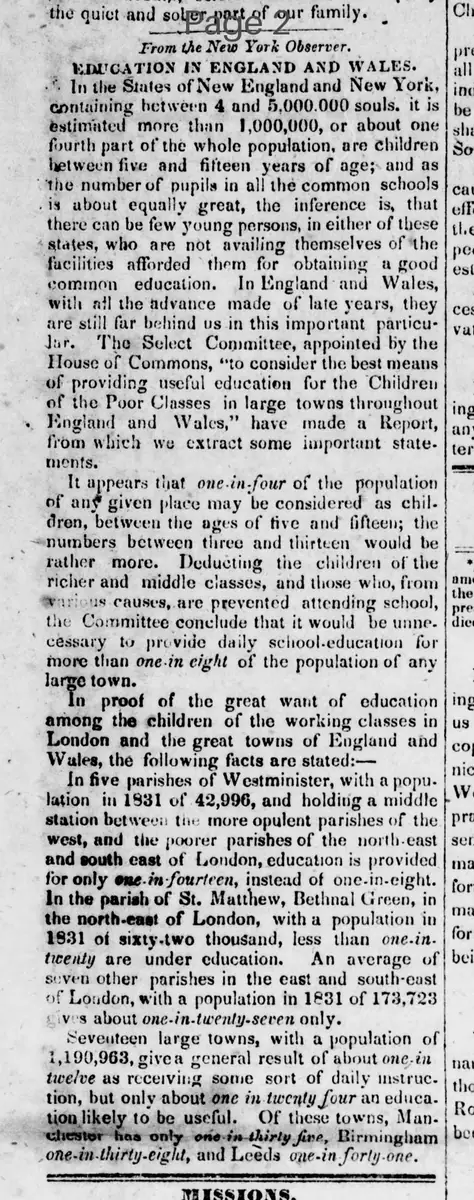
EDUCATION IN ENGLAND AND WALES.
In the States of New England and New York containing between 4 and 5,000,000 souls, it is estimated more than 1,000,000, or about one fourth part of the whole population, are children between five and fifteen years of age; and as the number of pupils in all the common schools is about equally great, the inference is, that there can be few young persons, in either of these states, who are not availing themselves of the facilities afforded them for obtaining a good common education. In England and Wales, with all the advance made of late years, they are still far behind us in this important particular. The Select Committee, appointed by the House of Commons, "to consider the best means of providing useful education for the Children of the Poor Classes in large towns throughout England and Wales," have made a Report, from which we extract some important statements.
It appears that one in four of the population of any given place may be considered as children, between the ages of five and fifteen; the numbers between three and thirteen would be rather more. Deducting the children of the richer and middle classes, and those who, from various causes, are prevented attending school, the Committee conclude that it would be unnecessary to provide daily school-education for more than one in eight of the population of any large town.
In proof of the great want of education among the children of the working classes in London and the great towns of England and Wales, the following facts are stated:—
In five parishes of Westminster, with a population in 1831 of 42,996, and holding a middle station between the more opulent parishes of the west, and the poorer parishes of the north-east and south east of London, education is provided for only one in fourteen, instead of one in eight. In the parish of St. Matthew, Bethnal Green, in the north-east of London, with a population in 1831 of sixty-two thousand, less than one in twenty are under education. An average of seven other parishes in the east and south-east of London, with a population in 1831 of 173,723 was about one in twenty-seven only. Seventeen large towns, with a population of 1,190,963, give a general result of about one in twelve as receiving some sort of daily instruction, but only about one in twenty four an education likely to be useful. Of these towns, Manchester has only one in thirty five, Birmingham one in thirty-eight, and Leeds one in forty-one.
What sub-type of article is it?
What keywords are associated?
Where did it happen?
Foreign News Details
Primary Location
England And Wales
Event Date
1831
Outcome
education provided for only 1 in 8 to 1 in 41 of population in large towns, compared to near-universal in new england and new york.
Event Details
House of Commons Select Committee reports on inadequate schooling for poor children in large towns; statistics show low provision rates in London parishes and towns like Manchester, Birmingham, Leeds.