Thank you for visiting SNEWPapers!
Sign up free
Editorial
June 13, 1771
The Virginia Gazette
Richmond, Williamsburg, Richmond County, Virginia
What is this article about?
John Camm, a clergyman, responds to a protest by Rev. Samuel Henley and Rev. Thomas Gwatkin against a Virginia clergy convention's proposal for an American Episcopate. He defends the convention's legitimacy, argues it poses no threat to colonial rights or ties to Britain, and asserts it improves church governance without lay interference.
Clipping
OCR Quality
98%
Excellent
Full Text
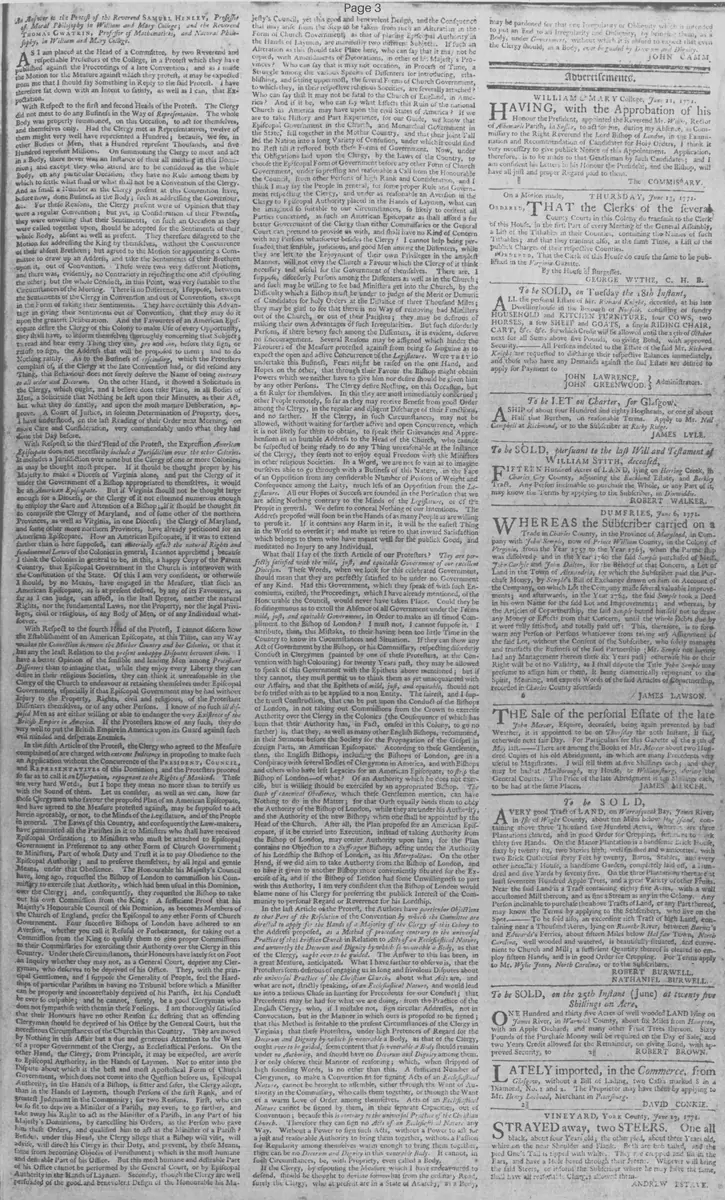
An Answer to the Protest of the Reverend Samuel Henley, Professor of Moral Philosophy in William and Mary College; and the Reverend Thomas Gwatkin, Professor of Mathematics, and Natural Philosophy, in William and Mary College.
As I am placed at the Head of a Committee, by two Reverend and respectable Professors of the College, in a Protest which they have published against the Proceedings of a late Convention; and as I made the Motion for the Measure against which they protest, it may be expected from me that I should say Something in Reply to the said Protest. I have therefore sat down with an Intent to satisfy, as well as I can, that Expectation.
With Respect to the first and second Heads of the Protest. The Clergy did not meet to do any Business in the Way of Representation. The whole Body was properly summoned, on this Occasion, to act for themselves, and themselves only. Had the Clergy met as Representatives, twelve of them might very well have represented a Hundred; because, we see, in other Bodies of Men, that a Hundred represent Thousands, and five Hundred represent Millions. On summoning the Clergy to meet and act in a Body, there never was an Instance of their all meeting in this Dominion; and except they who attend are to be considered as the whole Body, on any particular Occasion, they have no Rule among them by which to settle what shall or what shall not be a Convention of the Clergy. And as small a Number as the Clergy present at this Convention have, before now, done Business as the Body; such as addressing the Governor, &c. For these Reasons, the Clergy present were of Opinion that they were a regular Convention; but yet, in Consideration of their Fewness, they were unwilling that their Sentiments, on such an Occasion as they were called together upon, should be adopted for the Sentiments of their whole Body, absent as well as present. They therefore disagreed to the Motion for addressing the King by themselves, without the Concurrence of their absent Brethren; but agreed to the Motion for appointing a Committee to draw up an Address, and take the Sentiments of their Brethren upon it, out of Convention. These were two very different Motions, and there was, evidently, no Contrariety in rejecting the one and espousing the other; but the whole Conduct, in this Point, was very suitable to the Circumstances of the Meeting. There is no Difference, I suppose, between the Sentiments of the Clergy in Convention and out of Convention, except in the Form of taking their Sentiments. They have certainly this Advantage in giving their Sentiments out of Convention, that they may do it upon the greatest Deliberation. And the Favourers of an American Episcopate desire the Clergy of this Colony to make Use of every Opportunity, they shall have, to inform themselves thoroughly concerning that Subject; to read and hear every Thing they can, pro and con, before they sign, or refuse to sign, the Address that will be proposed to them; and to do Nothing rashly. As to the Business of rescinding, which the Protesters complain of, if the Clergy at the late Convention had, or did rescind any Thing, this Behaviour does not surely deserve the Name of being contrary to all Order and Decorum. On the Other Hand, it showed a Solicitude in the Clergy, which ought, and I believe does take Place, in all Bodies of Men, a Solicitude that Nothing be left upon their Minutes, as their Act, but what they do finally, and upon the most mature Deliberation, approve. A Court of Justice, in solemn Determination of Property, does, I have understood, on the last Reading of their Order next Morning, on more Care and Consideration, very commendably undo what they had done the Day before.
With Respect to the third Head of the Protest, the Expression American Episcopate does not necessarily include a Jurisdiction over the other Colonies. It includes a Jurisdiction over none but the Clergy of one or more Colonies, as may be thought most proper. If it should be thought proper by his Majesty to make a Diocese of Virginia alone, and put the Clergy of it under the Government of a Bishop appropriated to themselves, it would be an American Episcopate. But if Virginia should not be thought large enough for a Diocese, or the Clergy of it not esteemed numerous enough to employ the Care and Attention of a Bishop; if it should be thought fit to comprise the Clergy of Maryland, and of some other of the northern Provinces, as well as Virginia, in one Diocese; the Clergy of Maryland, and some other more northern Provinces, have already petitioned for an American Episcopate. How an American Episcopate, if it was to extend farther than is here supposed, can materially affect the natural Rights and fundamental Laws of the Colonies in general, I cannot apprehend; because I think the Colonies in general to be, in this, a happy Copy of the Parent Country, that Episcopal Government in the Church is interwoven with the Constitution of the State. Of this I am very confident, otherwise I should, by no Means, have engaged in the Measure, that such an American Episcopate, as is at present desired, by any of its Favourers, as far as I can judge, can affect, in the least Degree, neither the natural Rights, nor the fundamental Laws, nor the Property, nor the legal Privileges, civil or religious, of any Body of Men, or of any Individual whatsoever.
With Respect to the fourth Head of the Protest, I cannot discern how the Establishment of an American Episcopate, at this Time, can any Way weaken the Connection between the Mother Country and her Colonies, or that it has any the least Relation to the present unhappy Disputes between them. I have a better Opinion of the sensible and leading Men among Protestant Dissenters than to imagine that, while they enjoy every Liberty they can desire in their religious Societies, they can think it unreasonable in the Clergy of the Church to endeavour at retaining themselves under Episcopal Government, especially if that Episcopal Government may be had without Injury to the Property, Rights, civil and religious, of the Protestant Dissenters themselves, or of any other Persons. I know of no such ill disposed Men as are either willing or able to endanger the very Existence of the British Empire in America. If the Protesters know of any such, they do very well to put the British Empire in America upon its Guard against such evil minded and desperate Enemies.
In the fifth Article of the Protest, the Clergy who agreed to the Measure complained of are charged with extreme Indecency in proposing to make such an Application without the Concurrence of the President, Council, and Representatives of this Dominion; and the Protesters proceed so far as to call it an Usurpation, repugnant to the Rights of Mankind. These are very hard Words, but I hope they mean no more than to terrify us with the Sound of them. Let us consider, as well as we can, how far those Clergymen who favour the proposed Plan of an American Episcopate, and have agreed to the Measure protested against, may be supposed to act herein agreeably, or not, to the Minds of the Legislature, and of the People in general. The Laws of this Country, and consequently the Law-makers, have committed all the Parishes in it to Ministers who shall have received Episcopal Ordination; to Ministers who must be attached to Episcopal Government in Preference to any other Form of Church Government; to Ministers, Part of whose Duty and Trust it is to pay Obedience to the Episcopal Authority; and to preserve themselves, by all legal and gentle Means, under that Obedience. The Honourable his Majesty's Council have, long ago, requested the Bishop of London to commission his Commissary to exercise that Authority, which had been usual in this Dominion, over the Clergy; and, consequently, they requested the Bishop to take out his own Commission from the King: A sufficient Proof that his Majesty's Honourable Council of this Dominion, as becomes Members of the Church of England, prefer the Episcopal to any other Form of Church Government. Four successive Bishops of London have adhered to an Aversion, whether you call it Refusal or Forbearance, for taking out a Commission from the King to qualify them to give proper Commissions to their Commissaries for exercising their Authority over the Clergy in this Country. Under these Circumstances, their Honours have lately set on Foot an Inquiry whether they may not, as a General Court, deprive any Clergyman, who deserves to be deprived of his Office. They, with the principal Gentlemen, and I suppose the Generality of People, feel the Hardships of particular Parishes in having no Tribunal before which a Minister can be properly and incontestably deprived of his Parish, let his Conduct be ever so culpable; and he cannot, surely, be a good Clergyman who does not sympathize with them in these Feelings. I am thoroughly satisfied that their Honours have no other Reason for desiring that an offending Clergyman should be deprived of his Office by the General Court, but the necessitous Circumstances of the Church in this Country. They are moved by Nothing in this Affair but a due and generous Attention to the Want of a proper Government of the Clergy, as Ecclesiastical Persons. On the Other Hand, the Clergy, from Principle, it may be expected, are averse to Episcopal Authority, in the Hands of Laymen. Not to enter into the Dispute about which is the best and most Apostolical Form of Church Government, which does not come into the Question before us, Episcopal Authority, in the Hands of a Bishop, is fitter and safer, the Clergy allege, than in the Hands of Laymen, though Persons of the first Rank, and of greatest Judgment in the Community; for two Reasons. First, who can be so fit to deprive a Minister of a Parish, nay even, to go farther, and take away his Right to act as the Minister of a Parish, in any Part of his Majesty's Dominions, by cancelling his Orders, as the Person who gave him those Orders, and qualified him to act as the Minister of a Parish? Besides, under this Head, the Clergy allege that a Bishop will visit, will advise, will direct his Clergy in their Duty, and prevent, by these Means, some from becoming Objects of Punishment; which is the most humane and desirable Part of his Office. But this most humane and desirable Part of his Office cannot be performed by the General Court, or by Episcopal Authority in the Hands of Laymen. Secondly, though the Clergy are well persuaded of the good and benevolent Design of the Honourable his Majesty's Council, yet this good and benevolent Design, and the Consequence that may arise from the Step to be taken from such an Alteration in the Form of Church Government, as that of placing Episcopal Authority in the Hands of Laymen, are manifestly two different Subjects. If such an Alteration as this should take Place here, who can say that it may not be copied, with Amendments or Decorations, in other of his Majesty's Provinces? Who can say that it may not occasion, in Process of Time, a Struggle among the various Species of Dissenters for introducing, establishing, and setting uppermost, the several Forms of Church Government, to which they, in their respective religious Societies, are severally attached? Who can say that it may not be fatal to the Church of England, in America? And if it be, who can say what Effects this Ruin of the national Church in America may have upon the civil States of America? If we are to take History and Past Experience, for our Guide, we know that Episcopal Government in the Church, and Monarchical Government in the State, fell together in the Mother Country, and that their joint Fall led the Nation into a long Variety of Confusion, under which it could find no Rest till it restored both these Forms of Government. Now, under the Obligations laid upon the Clergy, by the Laws of the Country, to choose the Episcopal Form of Government before any other Form of Church Government, under so pressing and reasonable a Call from the Honourable the Council, from other Persons of high Rank and Consideration, and I think I may say the People in general, for some proper Rule and Government respecting the Clergy, and under as reasonable an Aversion in the Clergy to Episcopal Authority placed in the Hands of Laymen, what can be imagined so suitable to our Circumstances, so likely to content all Parties concerned, as such an American Episcopate as shall afford a far better Government of the Clergy than either Commissaries or the General Court can pretend to provide us with, and shall have no Kind of Concern with any Persons whatsoever besides the Clergy? I cannot help being persuaded that sensible, judicious, and good Men among the Dissenters, while they are left to the Enjoyment of their own Privileges in the amplest Manner, will not envy the Church a Favour which the Clergy of it think necessary and useful for the Government of themselves. There are, I suppose, disorderly Persons among the Dissenters as well as in the Church; and such may be willing to see bad Ministers get into the Church, by the Difficulty which a Bishop must be under to judge of the Merit or Demerit of Candidates for holy Orders at the Distance of three Thousand Miles; they may be glad to see that there is no Way of removing bad Ministers out of the Church, or out of their Parishes; they may be desirous of making their own Advantages of such Irregularities. But such disorderly Persons, if there be any such among the Dissenters, it is evident, deserve no Encouragement. Several Reasons may be assigned which hinder the Favourers of the Measure protested against from being so sanguine as to expect the open and active Concurrence of the Legislature. Were they to undertake this Business, Fears might be raised on the one Hand, and Hopes on the other, that through their Favour the Bishop might obtain Powers which we neither have to give him nor desire should be given him by any other Persons. The Clergy desire Nothing, on this Occasion, but a fit Ruler for themselves. In this they are most immediately concerned; other People remotely, so far as they may receive Benefit from good Order among the Clergy, in the regular and diligent Discharge of their Functions, and no farther. If the Clergy, in such Circumstances, may not be allowed, without waiting for farther active and open Concurrence, which it is not likely for them to obtain, to speak their Grievances and Apprehensions in an humble Address to the Head of the Church, who cannot be suspected of being ready to do any Thing unreasonable at the Instance of the Clergy, they seem not to enjoy equal Freedom with the Ministers in other religious Societies. In a Word, we are not so vain as to imagine ourselves able to go through with a Business of this Nature, in the Face of an Opposition from any considerable Number of Persons of Weight and Consequence among the Laity, much less of an Opposition from the Legislature. All our Hopes of Success are founded in the Persuasion that we are acting Nothing contrary to the Minds of the Legislature, or of the People in general. We desire to conceal Nothing of our Intentions. This Address proposed will soon be in the Hands of as many People as are willing to peruse it. If it contains any Harm in it, it will be the easiest Thing in the World to overset it; and make us retire to that inward Satisfaction which belongs to them who have meant well for the public Good, and meditated no Injury to any Individual.
What shall I say of the sixth Article of our Protesters? They are perfectly satisfied with the mild, just, and equitable Government of our excellent Diocesan. These Words, when we look for this celebrated Government, should mean that they are perfectly satisfied to be under no Government of any Kind. Had this Government, which they speak of with such Encomiums, existed; the Proceedings, which I have already mentioned, of the Honourable the Council, would never have taken Place. Could they be so disingenuous as to extoll the Absence of all Government under the Terms mild, just, and equitable Government, in Order to make an ill timed Compliment to the Bishop of London? I must not, I cannot suppose it. I attribute, then, this Mistake, to their having been too little Time in the Country to know its Circumstances and Situation. If they can show any Act of Government by the Bishop, or his Commissary, respecting disorderly Conduct in Clergymen (painted by one of these Protesters, at the Convention with high Colouring) for twenty Years past, they may be allowed to speak of this Government with the Epithets above mentioned; but if they cannot, they must permit us to think them as yet unacquainted with our Affairs, and that the Epithets of mild, just, and equitable, should not be so trifled with as to be applied to a non Entity. The fairest, and I suppose the truest Construction, that can be put upon the Conduct of the Bishops of London, in not taking out Commissions from the Crown to exercise Authority over the Clergy in the Colonies (the Consequence of which has been that their Authority has, in Fact, ceased in this Colony, to go no farther) is, that they, as well as many other English Bishops, recommend, in their Sermons before the Society for the Propagation of the Gospel in foreign Parts, an American Episcopate. According to these Gentlemen, then, the English Bishops, including the Bishops of London, are in a Conspiracy with several Bodies of Clergymen in America, and with Bishops and others who have left Legacies for an American Episcopate, to strip the Bishop of London—of what? Of an Authority which he does not exercise, but is willing should be exercised by an appropriated Bishop. The Oath of canonical Obedience, which these Gentlemen mention, can have Nothing to do in the Matter; for that Oath equally binds them to obey the Authority of the Bishop of London, while they are under his Authority, and the Authority of the new Bishop, when one shall be appointed by the Head of the Church. After all, the Plan proposed for an American Episcopate, if it be carried into Execution, instead of taking Authority from the Bishop of London, may confer Authority upon him; for the Plan contains no Objection to a Suffragan Bishop, acting under the Authority of his Lordship the Bishop of London, as his Metropolitan. On the Other Hand, if we did aim to take Authority from the Bishop of London, and to have it given to another Bishop more conveniently situated for the Exercise of it, and if the Bishop of London had some Unwillingness to part with this Authority, I am very confident that the Bishop of London would blame none of his Clergy for preferring the public Interest of the Community to personal Regard or Reverence for his Lordship.
In the last Article of the Protest, the Authors have particular Objections to that Part of the Resolution of the Convention by which the Committee are directed to apply for the Hands of a Majority of the Clergy of this Colony to the Address proposed, as a Method of proceeding contrary to the universal Practice of the Christian Church in Relation to Acts of an Ecclesiastical Nature, and unworthy the Decorum and Dignity by which so venerable a Body, as that of the Clergy, ought ever to be guided. The Answer to this has been, in a great Measure, anticipated. What I have farther to observe is, that the Protesters seem desirous of engaging us in long and frivolous Disputes about the universal Practice of the Christian Church, about what Acts are, and what are not, strictly speaking, of an Ecclesiastical Nature, and would lead us into a tedious Chase in hunting for Precedents for our Conduct; that Precedents may be had for what we are doing, from the Practice of the English Clergy, who, if I mistake not, sign circular Addresses, not in Convocation, but in the Manner in which ours is proposed to be signed; that this Method is suitable to the present Circumstances of the Clergy in Virginia; that these Protesters, under high Pretences of Regard for the Decorum and Dignity by which so venerable a Body, as that of the Clergy, ought ever to be guided, seem content that so venerable a Body should remain under no Authority, and should have no Decorum and Dignity among them. For only observe their Manner of reasoning; which, when stripped of high sounding Words, is no other than this. A sufficient Number of Clergymen, to make a Convention fit for signing Acts of an Ecclesiastical Nature, cannot be brought to assemble, either through the Want of Authority in the Commissary, who calls them together, or through the Want of a warm Love of Order among themselves. Acts of an Ecclesiastical Nature cannot be signed by them, in their separate Capacities, out of Convention; because this is contrary to the universal Practice of the Christian Church. Therefore they can sign no Acts of an Ecclesiastical Nature any Way. Without a Power to sign such Acts, without a Power to ask for a just and reasonable Authority to bring them together, without a Passion for Regularity among themselves warm enough to bring them together, there can be no Decorum and Dignity in this venerable Body. It cannot, in such Circumstances, be, with Propriety, even called a Body.
If the Clergy, by espousing the Measure which I have endeavoured to defend, should be thought to deviate somewhat from the ordinary Road, surely the Clergy, who at present are in a State of Anarchy, as a Body, may be pardoned for that Endeavour or Obliquity which is intended to put an End to all Irregularity and Obliquity, by bringing them, as a Body, under Government, without which it is absurd to expect that even the Clergy should, as a Body, ever be guided by Decorum and Dignity.
JOHN CAMM
As I am placed at the Head of a Committee, by two Reverend and respectable Professors of the College, in a Protest which they have published against the Proceedings of a late Convention; and as I made the Motion for the Measure against which they protest, it may be expected from me that I should say Something in Reply to the said Protest. I have therefore sat down with an Intent to satisfy, as well as I can, that Expectation.
With Respect to the first and second Heads of the Protest. The Clergy did not meet to do any Business in the Way of Representation. The whole Body was properly summoned, on this Occasion, to act for themselves, and themselves only. Had the Clergy met as Representatives, twelve of them might very well have represented a Hundred; because, we see, in other Bodies of Men, that a Hundred represent Thousands, and five Hundred represent Millions. On summoning the Clergy to meet and act in a Body, there never was an Instance of their all meeting in this Dominion; and except they who attend are to be considered as the whole Body, on any particular Occasion, they have no Rule among them by which to settle what shall or what shall not be a Convention of the Clergy. And as small a Number as the Clergy present at this Convention have, before now, done Business as the Body; such as addressing the Governor, &c. For these Reasons, the Clergy present were of Opinion that they were a regular Convention; but yet, in Consideration of their Fewness, they were unwilling that their Sentiments, on such an Occasion as they were called together upon, should be adopted for the Sentiments of their whole Body, absent as well as present. They therefore disagreed to the Motion for addressing the King by themselves, without the Concurrence of their absent Brethren; but agreed to the Motion for appointing a Committee to draw up an Address, and take the Sentiments of their Brethren upon it, out of Convention. These were two very different Motions, and there was, evidently, no Contrariety in rejecting the one and espousing the other; but the whole Conduct, in this Point, was very suitable to the Circumstances of the Meeting. There is no Difference, I suppose, between the Sentiments of the Clergy in Convention and out of Convention, except in the Form of taking their Sentiments. They have certainly this Advantage in giving their Sentiments out of Convention, that they may do it upon the greatest Deliberation. And the Favourers of an American Episcopate desire the Clergy of this Colony to make Use of every Opportunity, they shall have, to inform themselves thoroughly concerning that Subject; to read and hear every Thing they can, pro and con, before they sign, or refuse to sign, the Address that will be proposed to them; and to do Nothing rashly. As to the Business of rescinding, which the Protesters complain of, if the Clergy at the late Convention had, or did rescind any Thing, this Behaviour does not surely deserve the Name of being contrary to all Order and Decorum. On the Other Hand, it showed a Solicitude in the Clergy, which ought, and I believe does take Place, in all Bodies of Men, a Solicitude that Nothing be left upon their Minutes, as their Act, but what they do finally, and upon the most mature Deliberation, approve. A Court of Justice, in solemn Determination of Property, does, I have understood, on the last Reading of their Order next Morning, on more Care and Consideration, very commendably undo what they had done the Day before.
With Respect to the third Head of the Protest, the Expression American Episcopate does not necessarily include a Jurisdiction over the other Colonies. It includes a Jurisdiction over none but the Clergy of one or more Colonies, as may be thought most proper. If it should be thought proper by his Majesty to make a Diocese of Virginia alone, and put the Clergy of it under the Government of a Bishop appropriated to themselves, it would be an American Episcopate. But if Virginia should not be thought large enough for a Diocese, or the Clergy of it not esteemed numerous enough to employ the Care and Attention of a Bishop; if it should be thought fit to comprise the Clergy of Maryland, and of some other of the northern Provinces, as well as Virginia, in one Diocese; the Clergy of Maryland, and some other more northern Provinces, have already petitioned for an American Episcopate. How an American Episcopate, if it was to extend farther than is here supposed, can materially affect the natural Rights and fundamental Laws of the Colonies in general, I cannot apprehend; because I think the Colonies in general to be, in this, a happy Copy of the Parent Country, that Episcopal Government in the Church is interwoven with the Constitution of the State. Of this I am very confident, otherwise I should, by no Means, have engaged in the Measure, that such an American Episcopate, as is at present desired, by any of its Favourers, as far as I can judge, can affect, in the least Degree, neither the natural Rights, nor the fundamental Laws, nor the Property, nor the legal Privileges, civil or religious, of any Body of Men, or of any Individual whatsoever.
With Respect to the fourth Head of the Protest, I cannot discern how the Establishment of an American Episcopate, at this Time, can any Way weaken the Connection between the Mother Country and her Colonies, or that it has any the least Relation to the present unhappy Disputes between them. I have a better Opinion of the sensible and leading Men among Protestant Dissenters than to imagine that, while they enjoy every Liberty they can desire in their religious Societies, they can think it unreasonable in the Clergy of the Church to endeavour at retaining themselves under Episcopal Government, especially if that Episcopal Government may be had without Injury to the Property, Rights, civil and religious, of the Protestant Dissenters themselves, or of any other Persons. I know of no such ill disposed Men as are either willing or able to endanger the very Existence of the British Empire in America. If the Protesters know of any such, they do very well to put the British Empire in America upon its Guard against such evil minded and desperate Enemies.
In the fifth Article of the Protest, the Clergy who agreed to the Measure complained of are charged with extreme Indecency in proposing to make such an Application without the Concurrence of the President, Council, and Representatives of this Dominion; and the Protesters proceed so far as to call it an Usurpation, repugnant to the Rights of Mankind. These are very hard Words, but I hope they mean no more than to terrify us with the Sound of them. Let us consider, as well as we can, how far those Clergymen who favour the proposed Plan of an American Episcopate, and have agreed to the Measure protested against, may be supposed to act herein agreeably, or not, to the Minds of the Legislature, and of the People in general. The Laws of this Country, and consequently the Law-makers, have committed all the Parishes in it to Ministers who shall have received Episcopal Ordination; to Ministers who must be attached to Episcopal Government in Preference to any other Form of Church Government; to Ministers, Part of whose Duty and Trust it is to pay Obedience to the Episcopal Authority; and to preserve themselves, by all legal and gentle Means, under that Obedience. The Honourable his Majesty's Council have, long ago, requested the Bishop of London to commission his Commissary to exercise that Authority, which had been usual in this Dominion, over the Clergy; and, consequently, they requested the Bishop to take out his own Commission from the King: A sufficient Proof that his Majesty's Honourable Council of this Dominion, as becomes Members of the Church of England, prefer the Episcopal to any other Form of Church Government. Four successive Bishops of London have adhered to an Aversion, whether you call it Refusal or Forbearance, for taking out a Commission from the King to qualify them to give proper Commissions to their Commissaries for exercising their Authority over the Clergy in this Country. Under these Circumstances, their Honours have lately set on Foot an Inquiry whether they may not, as a General Court, deprive any Clergyman, who deserves to be deprived of his Office. They, with the principal Gentlemen, and I suppose the Generality of People, feel the Hardships of particular Parishes in having no Tribunal before which a Minister can be properly and incontestably deprived of his Parish, let his Conduct be ever so culpable; and he cannot, surely, be a good Clergyman who does not sympathize with them in these Feelings. I am thoroughly satisfied that their Honours have no other Reason for desiring that an offending Clergyman should be deprived of his Office by the General Court, but the necessitous Circumstances of the Church in this Country. They are moved by Nothing in this Affair but a due and generous Attention to the Want of a proper Government of the Clergy, as Ecclesiastical Persons. On the Other Hand, the Clergy, from Principle, it may be expected, are averse to Episcopal Authority, in the Hands of Laymen. Not to enter into the Dispute about which is the best and most Apostolical Form of Church Government, which does not come into the Question before us, Episcopal Authority, in the Hands of a Bishop, is fitter and safer, the Clergy allege, than in the Hands of Laymen, though Persons of the first Rank, and of greatest Judgment in the Community; for two Reasons. First, who can be so fit to deprive a Minister of a Parish, nay even, to go farther, and take away his Right to act as the Minister of a Parish, in any Part of his Majesty's Dominions, by cancelling his Orders, as the Person who gave him those Orders, and qualified him to act as the Minister of a Parish? Besides, under this Head, the Clergy allege that a Bishop will visit, will advise, will direct his Clergy in their Duty, and prevent, by these Means, some from becoming Objects of Punishment; which is the most humane and desirable Part of his Office. But this most humane and desirable Part of his Office cannot be performed by the General Court, or by Episcopal Authority in the Hands of Laymen. Secondly, though the Clergy are well persuaded of the good and benevolent Design of the Honourable his Majesty's Council, yet this good and benevolent Design, and the Consequence that may arise from the Step to be taken from such an Alteration in the Form of Church Government, as that of placing Episcopal Authority in the Hands of Laymen, are manifestly two different Subjects. If such an Alteration as this should take Place here, who can say that it may not be copied, with Amendments or Decorations, in other of his Majesty's Provinces? Who can say that it may not occasion, in Process of Time, a Struggle among the various Species of Dissenters for introducing, establishing, and setting uppermost, the several Forms of Church Government, to which they, in their respective religious Societies, are severally attached? Who can say that it may not be fatal to the Church of England, in America? And if it be, who can say what Effects this Ruin of the national Church in America may have upon the civil States of America? If we are to take History and Past Experience, for our Guide, we know that Episcopal Government in the Church, and Monarchical Government in the State, fell together in the Mother Country, and that their joint Fall led the Nation into a long Variety of Confusion, under which it could find no Rest till it restored both these Forms of Government. Now, under the Obligations laid upon the Clergy, by the Laws of the Country, to choose the Episcopal Form of Government before any other Form of Church Government, under so pressing and reasonable a Call from the Honourable the Council, from other Persons of high Rank and Consideration, and I think I may say the People in general, for some proper Rule and Government respecting the Clergy, and under as reasonable an Aversion in the Clergy to Episcopal Authority placed in the Hands of Laymen, what can be imagined so suitable to our Circumstances, so likely to content all Parties concerned, as such an American Episcopate as shall afford a far better Government of the Clergy than either Commissaries or the General Court can pretend to provide us with, and shall have no Kind of Concern with any Persons whatsoever besides the Clergy? I cannot help being persuaded that sensible, judicious, and good Men among the Dissenters, while they are left to the Enjoyment of their own Privileges in the amplest Manner, will not envy the Church a Favour which the Clergy of it think necessary and useful for the Government of themselves. There are, I suppose, disorderly Persons among the Dissenters as well as in the Church; and such may be willing to see bad Ministers get into the Church, by the Difficulty which a Bishop must be under to judge of the Merit or Demerit of Candidates for holy Orders at the Distance of three Thousand Miles; they may be glad to see that there is no Way of removing bad Ministers out of the Church, or out of their Parishes; they may be desirous of making their own Advantages of such Irregularities. But such disorderly Persons, if there be any such among the Dissenters, it is evident, deserve no Encouragement. Several Reasons may be assigned which hinder the Favourers of the Measure protested against from being so sanguine as to expect the open and active Concurrence of the Legislature. Were they to undertake this Business, Fears might be raised on the one Hand, and Hopes on the other, that through their Favour the Bishop might obtain Powers which we neither have to give him nor desire should be given him by any other Persons. The Clergy desire Nothing, on this Occasion, but a fit Ruler for themselves. In this they are most immediately concerned; other People remotely, so far as they may receive Benefit from good Order among the Clergy, in the regular and diligent Discharge of their Functions, and no farther. If the Clergy, in such Circumstances, may not be allowed, without waiting for farther active and open Concurrence, which it is not likely for them to obtain, to speak their Grievances and Apprehensions in an humble Address to the Head of the Church, who cannot be suspected of being ready to do any Thing unreasonable at the Instance of the Clergy, they seem not to enjoy equal Freedom with the Ministers in other religious Societies. In a Word, we are not so vain as to imagine ourselves able to go through with a Business of this Nature, in the Face of an Opposition from any considerable Number of Persons of Weight and Consequence among the Laity, much less of an Opposition from the Legislature. All our Hopes of Success are founded in the Persuasion that we are acting Nothing contrary to the Minds of the Legislature, or of the People in general. We desire to conceal Nothing of our Intentions. This Address proposed will soon be in the Hands of as many People as are willing to peruse it. If it contains any Harm in it, it will be the easiest Thing in the World to overset it; and make us retire to that inward Satisfaction which belongs to them who have meant well for the public Good, and meditated no Injury to any Individual.
What shall I say of the sixth Article of our Protesters? They are perfectly satisfied with the mild, just, and equitable Government of our excellent Diocesan. These Words, when we look for this celebrated Government, should mean that they are perfectly satisfied to be under no Government of any Kind. Had this Government, which they speak of with such Encomiums, existed; the Proceedings, which I have already mentioned, of the Honourable the Council, would never have taken Place. Could they be so disingenuous as to extoll the Absence of all Government under the Terms mild, just, and equitable Government, in Order to make an ill timed Compliment to the Bishop of London? I must not, I cannot suppose it. I attribute, then, this Mistake, to their having been too little Time in the Country to know its Circumstances and Situation. If they can show any Act of Government by the Bishop, or his Commissary, respecting disorderly Conduct in Clergymen (painted by one of these Protesters, at the Convention with high Colouring) for twenty Years past, they may be allowed to speak of this Government with the Epithets above mentioned; but if they cannot, they must permit us to think them as yet unacquainted with our Affairs, and that the Epithets of mild, just, and equitable, should not be so trifled with as to be applied to a non Entity. The fairest, and I suppose the truest Construction, that can be put upon the Conduct of the Bishops of London, in not taking out Commissions from the Crown to exercise Authority over the Clergy in the Colonies (the Consequence of which has been that their Authority has, in Fact, ceased in this Colony, to go no farther) is, that they, as well as many other English Bishops, recommend, in their Sermons before the Society for the Propagation of the Gospel in foreign Parts, an American Episcopate. According to these Gentlemen, then, the English Bishops, including the Bishops of London, are in a Conspiracy with several Bodies of Clergymen in America, and with Bishops and others who have left Legacies for an American Episcopate, to strip the Bishop of London—of what? Of an Authority which he does not exercise, but is willing should be exercised by an appropriated Bishop. The Oath of canonical Obedience, which these Gentlemen mention, can have Nothing to do in the Matter; for that Oath equally binds them to obey the Authority of the Bishop of London, while they are under his Authority, and the Authority of the new Bishop, when one shall be appointed by the Head of the Church. After all, the Plan proposed for an American Episcopate, if it be carried into Execution, instead of taking Authority from the Bishop of London, may confer Authority upon him; for the Plan contains no Objection to a Suffragan Bishop, acting under the Authority of his Lordship the Bishop of London, as his Metropolitan. On the Other Hand, if we did aim to take Authority from the Bishop of London, and to have it given to another Bishop more conveniently situated for the Exercise of it, and if the Bishop of London had some Unwillingness to part with this Authority, I am very confident that the Bishop of London would blame none of his Clergy for preferring the public Interest of the Community to personal Regard or Reverence for his Lordship.
In the last Article of the Protest, the Authors have particular Objections to that Part of the Resolution of the Convention by which the Committee are directed to apply for the Hands of a Majority of the Clergy of this Colony to the Address proposed, as a Method of proceeding contrary to the universal Practice of the Christian Church in Relation to Acts of an Ecclesiastical Nature, and unworthy the Decorum and Dignity by which so venerable a Body, as that of the Clergy, ought ever to be guided. The Answer to this has been, in a great Measure, anticipated. What I have farther to observe is, that the Protesters seem desirous of engaging us in long and frivolous Disputes about the universal Practice of the Christian Church, about what Acts are, and what are not, strictly speaking, of an Ecclesiastical Nature, and would lead us into a tedious Chase in hunting for Precedents for our Conduct; that Precedents may be had for what we are doing, from the Practice of the English Clergy, who, if I mistake not, sign circular Addresses, not in Convocation, but in the Manner in which ours is proposed to be signed; that this Method is suitable to the present Circumstances of the Clergy in Virginia; that these Protesters, under high Pretences of Regard for the Decorum and Dignity by which so venerable a Body, as that of the Clergy, ought ever to be guided, seem content that so venerable a Body should remain under no Authority, and should have no Decorum and Dignity among them. For only observe their Manner of reasoning; which, when stripped of high sounding Words, is no other than this. A sufficient Number of Clergymen, to make a Convention fit for signing Acts of an Ecclesiastical Nature, cannot be brought to assemble, either through the Want of Authority in the Commissary, who calls them together, or through the Want of a warm Love of Order among themselves. Acts of an Ecclesiastical Nature cannot be signed by them, in their separate Capacities, out of Convention; because this is contrary to the universal Practice of the Christian Church. Therefore they can sign no Acts of an Ecclesiastical Nature any Way. Without a Power to sign such Acts, without a Power to ask for a just and reasonable Authority to bring them together, without a Passion for Regularity among themselves warm enough to bring them together, there can be no Decorum and Dignity in this venerable Body. It cannot, in such Circumstances, be, with Propriety, even called a Body.
If the Clergy, by espousing the Measure which I have endeavoured to defend, should be thought to deviate somewhat from the ordinary Road, surely the Clergy, who at present are in a State of Anarchy, as a Body, may be pardoned for that Endeavour or Obliquity which is intended to put an End to all Irregularity and Obliquity, by bringing them, as a Body, under Government, without which it is absurd to expect that even the Clergy should, as a Body, ever be guided by Decorum and Dignity.
JOHN CAMM
What sub-type of article is it?
Moral Or Religious
Constitutional
What keywords are associated?
American Episcopate
Virginia Clergy
Church Government
Episcopal Authority
Colonial Rights
Bishop Of London
Clergy Convention
What entities or persons were involved?
John Camm
Samuel Henley
Thomas Gwatkin
Bishop Of London
Virginia Clergy
His Majesty's Council
Protestant Dissenters
Editorial Details
Primary Topic
Defense Of Proposal For American Episcopate Against Clerical Protest
Stance / Tone
Strongly Supportive Of American Episcopate And Refutation Of Procedural And Jurisdictional Objections
Key Figures
John Camm
Samuel Henley
Thomas Gwatkin
Bishop Of London
Virginia Clergy
His Majesty's Council
Protestant Dissenters
Key Arguments
Clergy Convention Was Legitimate Despite Low Attendance; Committee To Gather Broader Sentiments Avoids Rash Action.
American Episcopate Limited To Clergy Jurisdiction, Does Not Threaten Colonial Rights Or Laws.
Establishment Of Episcopate Strengthens Rather Than Weakens Ties To Britain; Unrelated To Current Disputes.
Clergy Action Aligns With Laws Preferring Episcopal Government; Lay Authority Undesirable And Risky.
Current Lack Of Episcopal Oversight Leads To Anarchy; Proposal Restores Proper Church Governance Without Lay Interference.
Protestors Misrepresent Existing 'Government' As Mild When It Is Absent; English Bishops Support Episcopate.
Seeking Majority Clergy Signatures Out Of Convention Is Practical And Precedented, Given Circumstances.