Thank you for visiting SNEWPapers!
Sign up free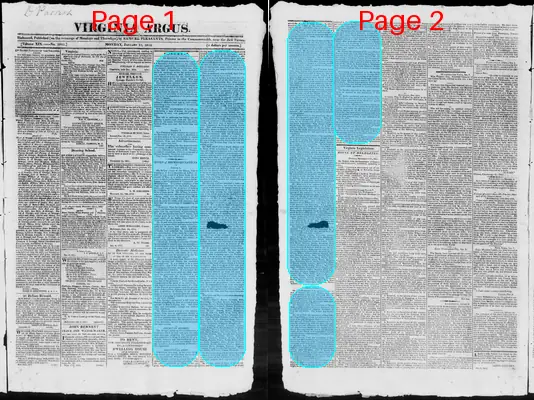
Virginia Argus
Richmond, Virginia
What is this article about?
U.S. Congressional proceedings on January 2-3: Senate handles reports from Navy and War Secretaries, bills on land claims, affidavits, munitions, and passes road bill. House discusses Indian goods, Beaumarchais claim, Fulton patent extension, American seamen protection, and debates/passes Senate bill to raise additional 25,000-man army force amid amendments and votes. January 3 includes petitions, reports, and further army bill debate.
Merged-components note: These components form a continuous report on U.S. Congressional proceedings from January 2-3, 1812, spanning pages 1 and 2.
Clippings
1 of 2
OCR Quality
Full Text
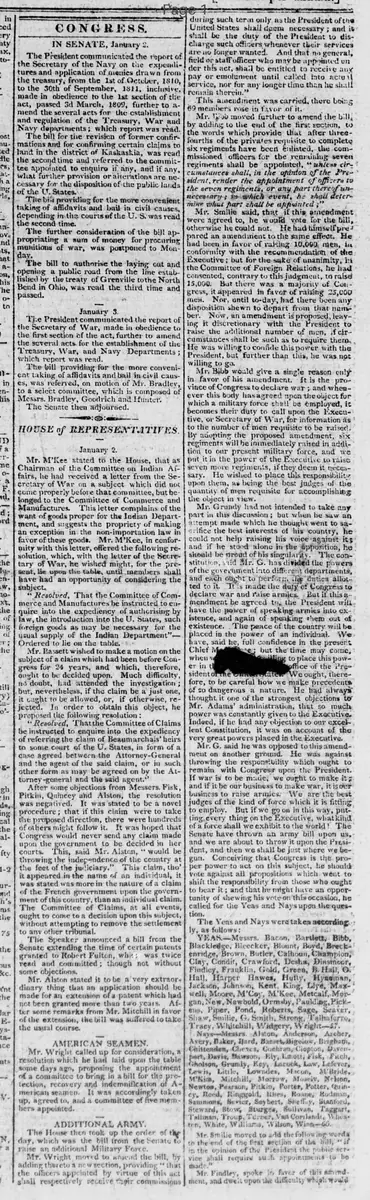
IN SENATE, January 2.
The President communicated the report of the Secretary of the Navy on the expenditures and application of moneys drawn from the treasury, from the 1st of October, 1810, to the 30th of September, 1811, inclusive, made in obedience to the 1st section of the act, passed 3d March, 1809, further to amend the several acts for the establishment and regulation of the Treasury, War and Navy departments; which report was read.
The bill for the revision of former confirmations and for confirming certain claims to land in the district of Kaskaskia, was read the second time and referred to the committee appointed to enquire if any, and if any, what further provision or alterations are necessary for the disposition of the public lands of the U. States.
The bill providing for the more convenient taking of affidavits and bail in civil causes, depending in the courts of the U. S. was read the second time.
The further consideration of the bill appropriating a sum of money for procuring munitions of war, was postponed to Monday.
The bill to authorise the laying out and opening a public road from the line established by the treaty of Greenville to the North Bend in Ohio, was read the third time and passed.
January 3.
The President communicated the report of the Secretary of War, made in obedience to the first section of the act, further to amend the several acts for the establishment of the Treasury, War, and Navy Departments; which report was read.
The bill providing for the more convenient taking of affidavits and bail in civil causes, was referred, on motion of Mr. Bradley, to a select committee, which is composed of Messrs. Bradley, Goodrich and Hunter.
The Senate then adjourned.
HOUSE of REPRESENTATIVES.
January 2.
Mr. M'Kee stated to the House, that as Chairman of the Committee on Indian Affairs, he had received a letter from the Secretary of War on a subject which did not come properly before that committee, but belonged to the Committee of Commerce and Manufactures. This letter complains of the want of goods proper for the Indian Department, and suggests the propriety of making an exception in the non-importation law in favor of these goods. Mr. M'Kee, in conformity with this letter, offered the following resolution, which, with the letter of the Secretary of War, he wished might, for the present, lie upon the table, until members shall have had an opportunity of considering the subject.
"Resolved, That the Committee of Commerce and Manufactures be instructed to enquire into the expediency of authorising by law, the introduction into the U. States, such foreign goods as may be necessary, for the usual supply of the Indian Department"--
Ordered to lie on the table.
Mr. Bassett wished to make a motion on the subject of a claim which had been before Congress for 24 years, and which, therefore, ought to be decided upon. Much difficulty, no doubt, had attended the investigation; but, nevertheless, if the claim be a just one, it ought to be allowed, or, if otherwise, rejected. In order to obtain this object, he proposed the following resolution:
"Resolved, That the Committee of Claims be instructed to enquire into the expediency of referring the claim of Beaumarchais' heirs to some Court of the U. States, in form of a case agreed between the Attorney-General and the agent of the said claim, or in such other form as may be agreed on by the Attorney-general and the said agent."
After some objections from Messers. Fisk, Pitkin, Quincy and Alston, the resolution was negatived. It was stated to be a novel procedure; that if this claim were to take the proposed direction, there were hundreds of others might follow it. It was hoped that Congress would never send any claim made upon the government to be decided in her courts. This, said Mr. Alston, "would be throwing the independence of the country at the feet of the judiciary." This claim, tho' it appeared in the name of an individual, it was stated was more in the nature of a claim of the French government upon the government of this country, than an individual claim. The Committee of Claims, at all events, ought to come to a decision upon this subject, without attempting to remove the settlement to any other tribunal.
The Speaker announced a bill from the Senate extending the time of certain patents granted to Robert Fulton, which was twice read and committed; though not without some objections.
Mr. Alston stated it to be a very extraordinary thing that an application should be made for an extension of a patent which had not been granted more than two years. After some remarks from Mr. Mitchill in favor of the extension, the bill was suffered to take the usual course.
AMERICAN SEAMEN.
Mr. Wright called up for consideration, a resolution which he had laid upon the table some days ago, proposing the appointment of a committee to bring in a bill for the protection, recovery and indemnification of American seamen. It was accordingly taken up, agreed to, and a committee of five members appointed.
ADDITIONAL ARMY.
The House then took up the order of the day, which was the bill from the Senate to raise an additional Military Force.
Mr. Wright moved to amend the bill, by adding thereto a new section, providing "that the officers appointed by virtue of this act shall respectively receive their commissions during such term only as the President of the United States shall deem necessary; and it shall be the duty of the President to discharge such officers whenever their services are no longer wanted. And that no general, field or staff officer who may be appointed under this act, shall be entitled to receive any pay or emolument until called into actual service, nor for any longer time than he shall remain therein."
This amendment was carried, there being 69 members rose in favor of it.
Mr. Cobb moved further to amend the bill, by adding to the end of the first section, to the words which provide that after three-fourths of the privates requisite to complete six regiments have been enlisted, the commissioned officers for the remaining seven regiments shall be appointed, "unless circumstances shall, in the opinion of the President, render the appointment of officers to the seven regiments, or any part thereof unnecessary; in which event, he shall determine what part shall be appointed;"
Mr. Smilie said, that if this amendment were agreed to, he would vote for the bill, otherwise he could not. He had himself prepared an amendment to the same effect. He had been in favor of raising 10,000 men, in conformity with the recommendation of the Executive; but for the sake of unanimity, in the Committee of Foreign Relations, he had consented, contrary to his judgment, to raise 15,000. But there was a majority of Congress, it appeared in favor of raising 25,000 men. Nor, until to-day, had there been any disposition shewn to depart from that number. Now, an amendment is proposed, leaving it discretionary with the President to raise the additional number of men, if circumstances shall be such as to require them. He was willing to confide this power with the President, but further than this, he was not willing to go.
Mr. Bibb would give a single reason only in favor of his amendment. It is the province of Congress to declare war; and whenever this body has agreed upon the object for which a military force shall be employed, it becomes their duty to call upon the Executive, or Secretary of War, for information as to the number of men requisite to be raised. By adopting the proposed amendment, six regiments will be immediately raised in addition to our present military force, and we put it in the power of the Executive to raise seven more regiments, if they deem it necessary. He wished to place this responsibility upon them, as being the best judges of the quantity of men requisite for accomplishing the object in view.
Mr. Grundy had not intended to take any part in this discussion; but when he saw an attempt made which he thought went to sacrifice the best interests of his country, he could not help raising his voice against it; and if he stood alone in the opposition, he should be proud of his singularity. The constitution, said Mr. G. has divided the powers of the government into different departments, and each ought to perform the duties allotted to it. It is made the duty of Congress to declare war and raise armies. But if this amendment be agreed to, the President will have the power of speaking armies into existence, and again of speaking them out of existence. The peace of the country will be placed in the power of an individual. We have, said he, full confidence in the present Chief Magistrate; but the time may come, when we will be unwilling to place this power in the office of the President or state. We ought, therefore, to be careful how we make precedents of so dangerous a nature. He had always thought it one of the strongest objections to Mr. Adams' administration, that so much power was constantly given to the Executive. Indeed, if he had any objection to our excellent Constitution, it was on account of the very great powers placed in the Executive.
Mr. G. said he was opposed to this amendment on another ground. He was against throwing the responsibility which ought to remain with Congress upon the President. If war is to be made, we ought to make it; and if it be our business to make war, it is our business to raise armies. We are the best judges of the kind of force which it is fitting to employ. But if we go on in this way, putting every thing on the Executive, what kind of a force shall we exhibit to the world! The Senate have thrown an army bill upon us, and we are about to throw it upon the President, and then we shall be just where we began. Conceiving that Congress is the proper power to act on this subject, he should vote against all propositions which went to shift the responsibility from those who ought to bear it; and that he might have an opportunity of shewing his vote on this occasion, he called for the Yeas and Nays upon the question.
The Yeas and Nays were taken accordingly, as follows:
YEAS.--Messrs. Bacon, Bartlett, Bibb, Blackledge, Bleecker, Blount, Boyd, Breckenridge, Brown, Butler, Calhoun, Champion, Clay, Condit, Crawford, Desha, Dinwiddie, Findley, Franklin, Gold, Green, B. Hall, O. Hall, Harper, Hawes, Hefty, Horsman, Jackson, Johnson, Kent, King, Lyle, Maxwell, Moore, M'Coy, M'Kee, Metcalf, Morgan, New, Newbold, Ormsby, Paulding, Pickens, Piper, Pond, Roberts, Sage, Seaver, Shaw, Smilie, G. Smith, Strong, Tallaferro, Tracy, Whitehill, Widgery, Wright--57.
NAYS--Messrs. Alston, Anderson, Archer, Avery, Baker, Bard, Bassett, Bigelow, Brigham, Chittenden, Cleves, Cochran, Clopton, Davenport, Davis, Dawson, Ely, Emott, Fisk, Fitch, Gholson, Grundy, Key, Lacock, Law, Lefever, Lewis, Little, Lowndes, Macon, M'Bride, M'Kim, Mitchill, Morrow, Moseley, Nelson, Newton, Pearson, Pitkin, Porter, Potter, Quincy, Reed, Ringgold, Rhea, Roane, Rodman, Sammons, Sever, Seybert, Sheffey, Stanford, Steward, Stow, Sturges, Sullivan, Taggart, Tallman, Troup, Turner, Van Cortlandt, Wheaton, White, Williams, Wilson, Winn--68.
Mr. Smilie moved to add the following words to the end of the first section of the bill. "if in the opinion of the President the public service shall require such appointments to be made."
Mr. Findley, spoke in favor of this amendment, and dwelt upon the difficulty which would
Mr. Alston said, he should vote against the amendment, not from any fear that the President would abuse the power proposed to be placed in him; but because he was against making any more amendments to the bill which were not material. He thought there were sufficient restrictions in the bill already. Some time will elapse before three-fourths of the men for the six regiments are enlisted. The whole subject will be before Congress during the session; and probably before the men for the six regiments are raised, Congress will have no difficulty in saying whether or not the remaining regiments shall be raised.
Mr. Troup observed, that if it were found, some time hence, that 25,000 men were unnecessary, Congress could at once say that only a certain number should be raised. It had, in his opinion, been correctly said, that if we do not want 25,000 men, we do not want one man. Can the gentleman from Pennsylvania doubt, that 5,000 men will be wanted for the defence of New-Orleans? And is it not stated by the Secretary at War that 12,000 men will be wanted for the fortifications on our seaboard, exclusive of the aid to be derived from the militia, which takes 17,000 out of the 25,000 men? And is there a man who has a knowledge of military affairs, who would be willing to set down before the Gibraltar of America, Quebec, with less than 20,000 men? In his mind, however, the capture of Halifax, would be more important than Quebec, as from thence may be expected the chief attacks upon our commerce: but Halifax could not be taken until Quebec was first secured. He could see no reason for adopting the amendment.
Mr. M'Kim said, it was peculiarly the province of Congress to raise armies. Why, then, throw the responsibility upon the President, who, by an honest error of opinion, might use the power improperly? Why should Congress shrink from this responsibility? It is for us, said he, to do the whole of the business, and upon us the whole responsibility ought to lie. For these reasons, he was opposed to the amendment.
Mr. Calhoun voted in favor of the amendment of the gentleman from Georgia, though he was in favor of raising the whole 25,000 men, because he wished to carry the present measure by as large a vote as possible. He believed nothing but the most energetic course would answer any purpose. The news of the steps already taken have no doubt passed over the Atlantic. The country against whom we are taking measures, may have taken her stand. Unanimity and decision in our councils alone can save the country. He believed the public sentiment was with Congress; but if gentlemen will not, in any instance, sacrifice their opinions, but pertinaciously insist upon amendment after amendment, to measures brought forward for our defence, we might be forced into war before we are prepared for it. We ought either to submit, or make an energetic defence. He perceived that the public sentiment began already to doubt whether Congress was really in earnest, from the tardiness of their movements. He should vote against the proposed amendment in order to prevent farther delay.
Mr. Bibb said, if he understood this bill, it did not contemplate to raise a number of men sufficient in case of war. The amendment introduced by the Speaker, provided only for the raising of six regiments in the first instance. The proposed amendment goes no farther, as it says the officers of the seven remaining regiments shall not be appointed except they shall be found necessary. And nothing but the adjustment of our differences with Great Britain could prevent this necessity. But a hope is still entertained by some that these difficulties may still be accommodated. He thought the House ought to agree to the proposition, which would do no possible injury. It was introduced in the spirit of compromise to meet the views of certain gentlemen, and he should vote for it.
The question was taken by Yeas and Nays and negatived 68 to 55. The yeas and nays were the same as on the last question, with two or three instances.
No other amendments being offered, the question 'Shall the bill be engrossed for a third reading?' was put and carried 90 to 35.
The yeas and nays were as follows:
Yeas.--Messrs. Alston, Anderson, Archer, Avery, Bacon, Bard, Bartlett, Bibb, Blackledge, Bleecker, Brown, Burwell, Butler, Calhoun, Cheves, Clay, Cochran, Clopton, Condit, Crawford, Davis, Dawson, Desha, Dinsmoor, Earl, Emott, Findley, Fisk, Franklin, Gholson, Gold, Green, Grundy, B. Hall, O. Hall, Harper, Hawes, Hyneman, Johnson, King, Lacock, Lefever, Little, Livingston, Lowndes, Lyle, Maxwell, Moore, McCoy, M'Kee, M'Kim, Metcalf, Mitchill, Morgan, Morrow, Nelson, New, Newton, Ormsby, Paulding, Pickens, Piper, Pond, Porter, Quincy, Reed, Ringgold, Rhea, Roane, Roberts, Sage, Sammons, Seaver, Sevier, Seybert, Shaw, G. Smith, Strong, Sturges, Sullivan, Tallman, Talliaferro, Tracy, Troup, Turner, Van Cortlandt, Williams, Widgery, Winn, Wright--90.
Nays.--Messrs. Baker, Bigelow, Boyd, Breckenridge, Brigham, Champion, Chittenden, Davenport, Ely, Fitch, Hufty, Jackson, Key, Law, Lewis, Macon, M'Bryde, Mosely, Newbold, Pearson, Pitkin, Potter, Randolph, Rodman, Sheffey, Smilie, Stanford, Stewart, Stow, Sturges, Taggart, Tallmadge, Wheaton, White, Wilson--35.
FRIDAY, January 3.
Mr. Lacock presented the petition of the widow of General Alexander Fowler, who came to this country in the year 1763, and who served in the French war, stating that he received from Virginia, warrants for 10,000 acres of land, but never derived any advantage from them. Relief is prayed for.--Referred.
Mr. Gholson, from the committee of Claims, made a report in favor of James Anderson, who prayed for payment of supplies furnished during the revolution. The report was committed.
Mr. Rhea, from the committee of Post-Office and Post-Roads, to whom was referred the petitions of several Religious Societies in the western parts of Pennsylvania, complaining of the practice of travelling with the mail, and opening it at the post-offices on the Sabbath, reported, that however desirable the regulations for which they pray may be, that at this particular crisis of our affairs, it is inexpedient to make any alterations in this respect. The report was concurred with.
Mr. Newton, from the committee of Commerce and Manufactures, reported a bill to authorise the Secretary of the Treasury, under the authority of the President of the United States, to purchase from Winslow Lewis, his patent right to a new method of lighting light-houses, and for other purposes. [Mr. N. stated, that by this new method, a light-house which now consumes 1400 gallons of oil, in a certain period, would be supplied by 400 only.] The bill was twice read and committed.
Mr. Bacon moved that the committee of the whole to whom was referred the report on the Petitions of the collectors of the several ports, might be discharged from the further consideration of it, that it might be re-committed to the committee of Ways and Means, in order to have some errors which had escaped the committee, corrected--Agreed.
Mr. Rhea said, that persons entitled to pensions had found great difficulty in complying with the requisitions of the law as it now stood. He wished to simplify the business, and for that purpose offered to the House a resolution, which, after some observations from different members, and receiving an amendment from Mr. Gholson, the chairman of the committee of Claims, was agreed to, and referred to that committee.
Mr. Porter, the chairman of the committee of Foreign Relations, said, that it having been discovered that there were some parts of the bill for raising a Volunteer Corps, which required correction, and which could be better done by the committee who reported it than in committee of the whole, he would move to discharge the committee of the whole from the further consideration of the bill, in order to re-commit it.
This motion was objected to by Mr. Smilie, (a member of the committee on Foreign Relations) who said that no meeting of the committee had been had, which he thought ought to have taken place before a motion of this kind was made. He had heard nothing of these corrections before, and did not understand the management which appeared to attend this business.
The Speaker objected to the term management, as applied to any committee of that House.
Mr. Smilie explained, and after some observations from other members, the motion to discharge the committee of the whole was agreed to, and the bill re-committed.
Mr. Jennings offered a resolution calling upon the President of the United States for information respecting the appointment of certain Indian Agents, &c. in the Indiana and Illinois Territories: but some objection being made to it, on the ground of a similar resolution having already been entered into, it was ordered to lie upon the table.
The order of the day being called for, the bill for raising an additional force was taken up, and read the third time, and the question being put 'Shall the bill pass?'
Mr. Sheffey rose, and spoke about three hours against the passage of the bill, and in favor of maintaining the country in a state of peace. His speech will appear in course.
After which, Mr. Rhea said he wished to deliver his sentiments on the passage of the bill. but as it was late, he moved an adjournment, which was carried.
What sub-type of article is it?
What keywords are associated?
What entities or persons were involved?
Domestic News Details
Event Date
January 2 3
Key Persons
Outcome
bill to raise additional military force of 25,000 passed house 90-35 after amendments and debates; other bills read, referred, or passed.
Event Details
Senate received and read reports from Secretary of Navy on expenditures (Oct 1810-Sep 1811) and Secretary of War; read second time bills on Kaskaskia land claims (referred to public lands committee), affidavits and bail in civil causes (second reading, later referred to select committee of Messrs. Bradley, Goodrich, Hunter on Jan 3), munitions appropriation (postponed), and passed third reading bill for public road from Greenville treaty line to North Bend, Ohio. House on Jan 2: Mr. M'Kee offered resolution (tabled) for committee to inquire on importing goods for Indian Department despite non-importation law, per Secretary of War letter; Mr. Bassett's resolution to refer Beaumarchais heirs' claim to court negatived after debate; Senate bill extending Robert Fulton patents committed after objections; resolution for committee on American seamen protection agreed, committee appointed; extensive debate on Senate bill to raise additional military force, with Mr. Wright's amendment on officer commissions and pay carried (69 yeas), Mr. Cobb's amendment on conditional officer appointments for seven regiments negatived 68-57, Mr. Smilie's similar amendment negatived 68-55, bill engrossed 90-35. On Jan 3: Petitions and reports handled including widow of General Alexander Fowler for land warrants (referred), James Anderson revolutionary supplies (committed), religious societies on Sabbath mail (report concurred inexpedient), bill for purchasing Winslow Lewis lighthouse lighting patent (committed), discharge/recommit report on port collectors' petitions (agreed), resolution to simplify pension law requisitions (agreed, referred), discharge/recommit volunteer corps bill (agreed after debate), Mr. Jennings' resolution on Indian agents (tabled); additional force bill read third time, Mr. Sheffey spoke against for three hours, Mr. Rhea moved adjournment.