Thank you for visiting SNEWPapers!
Sign up free
The New York Packet
New York, New York County, New York
What is this article about?
Correspondent 'COLUMBUS' submits to the New-York Packet printers a translated 1644 Dutch letter by Rev. Johannes Megapolensis, detailing the Mohawk Indians, land fertility, wildlife, and Cohoes Falls in New-Netherland (New York), offering more historical accounts if published.
Merged-components note: The components are sequential in reading order and spatially adjacent (y2 of first at 2677 aligns with y1 of second at 2676), with the second providing the translated Dutch account content introduced in the first as a letter to the editor; the literary label is adjusted to letter_to_editor for the overall submission format.
Clipping
OCR Quality
Full Text
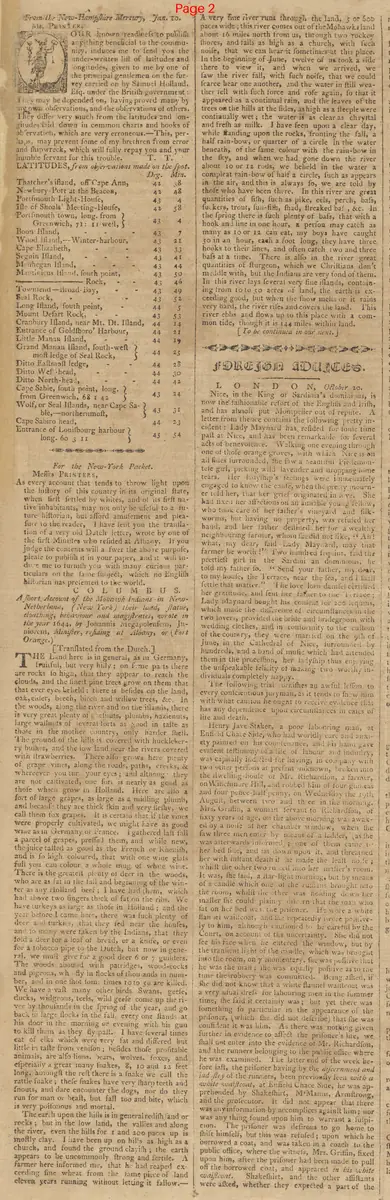
MESSRS. PRINTERS,
As every account that tends to throw light upon the history of this country in its original state, when first settled by whites, and of its first native inhabitants, may not only be useful to a future historian, but afford amusement and pleasure to the reader, I have sent you the translation of a very old Dutch letter, wrote by one of the first Ministers who resided at Albany. If you judge the contents will answer the above purpose, please to publish it in your paper, and it will induce me to furnish you with many curious particulars on the same subject, which no English historian has presented to the world.
COLUMBUS.
A short Account of the Mohawk Indians in New-Netherland, (New York) their land, state, cloathing, behaviour and magistrates, wrote in the year 1644, by Johannes Megapolensis, Junior, Minister, residing at Albany, or (Fort Orange.)
Translated from the Dutch.
THE Land here is in general, as in Germany, fruitful, but very hilly; on some parts there are rocks so high, that they appear to reach the clouds, and the largest pine trees grow on them that ever eyes beheld: there is besides on the land, oak, alder, beech, birch and willow trees, &c. In the woods, along the river and on the islands, there is very great plenty of chesnuts, plumbs, hazelnuts, large walnuts of several sorts as good in taste as those in the mother country, only harder shell. The ground of the hills is covered with huckleberry bushes, and the low land near the rivers covered with strawberries. There also grows here plenty of grape vines, along the roads, paths, creeks, &c. wherever you turn your eyes; and although they are not cultivated, one sort is nearly as good as those which grow in Holland. Here are also a sort of large grapes, as large as a middling plumb, and because they are thick skin and very fleshy, we call them fox grapes. It is certain that if the vines were properly cultivated, we might have as good wine as in Germany or France. I gathered last fall a parcel of grapes, pressed them, and while new, the juice tasted as good as the French or Rhenish, and is so high coloured, that with one wine glass full you can colour a whole mug of white wine. There is the greatest plenty of deer in the woods, who are as fat in the fall and beginning of the winter as any Holland beef; I have had them, which had above two fingers thick of fat on the ribs. We have turkeys as large as those in Holland; and the year before I came here, there was such plenty of deer and turkeys, that they fed near the houses, and so many were taken by the Indians, that they sold a deer for a loaf of bread, or a knife, or even for a tobacco pipe to the Dutch, but now in general, we must give for a good deer 6 or 7 guilders. The woods abound with partridges, wood-cocks and pigeons, which fly in flocks of thousands in number, and in one shot sometimes 10 to 15 are killed. We have a vast many other birds. Swans, geese, ducks, widgeons, teels, wild geese come up the river by thousands in the spring of the year, and go back in large flocks in the fall, every one stands at his door in the morning or evening with his gun to kill them as they fly past. I have several times eat of elks which were very fat and differed but little in taste from venison; besides those profitable animals, are also lions, bears, wolves, foxes, and especially a great many snakes, 8, 10 and 12 feet long, amongst the rest there is a snake we call the rattle snake; these snakes have very sharp teeth and mouths, and dare encounter the dogs, nor do they run from man or beast, but fall too and bite, which is very poisonous and mortal. The earth upon the hills is in general reddish and rocky; but in the low land, the vallies and along the river, even the hills for 1 and 200 paces up is mostly clay. I have been up on hills as high as a church, and found the ground clayish; the earth appears to be uncommonly strong and fertile. A farmer here informed me, that he had reaped exceeding fine wheat from the same piece of land eleven years running without letting it fallow.
A very fine river runs through the land, 50 or 60 paces wide; this river comes out of the Mohawks land about 16 miles north from us, through two rocky shores, and falls as high as a church, with such noise, that we can hear it sometimes at this place. In the beginning of June, twelve of us took a ride there to view it, and when we arrived, we saw the river fall, with such noise, that we could scarce hear one another, and the water in still weather fell with such force and rose again, so that it appeared as a continual rain, and the leaves of the trees on the hills at the sides, as high as a steeple were continually wet; the water is as clear as crystal and fresh as milk. I have seen upon a clear day, while standing upon the rocks, fronting the fall, a half rain-bow, or quarter of a circle in the water beneath, of the same colour with the rain-bow in the sky, and when we had gone down the river about 10 or 12 rods, we beheld in the water a compleat rain-bow of half a circle, such as appears in the air, and this is always so, we are told by those who have been there. In this river are great quantities of fish, such as pike, eels, perch, bass, suckers, trout, sun-fish, haddock, streaked bass, &c. In the spring there is such plenty of bass, that with a hook and line in one hour, a person may catch as many as 10 or 12 can eat, my boys have caught 50 in an hour, each a foot long, they have three hooks to their lines, and often catch two and three bass at a time. There is also in the river great quantities of sturgeon, which we Christians don't meddle with, but the Indians are very fond of them. In this river lays several very fine islands, containing from 10 to 50 acres of land, the earth is exceeding good, but when the snow melts or it rains very hard, the river rises and covers the land. This river ebbs and flows up to this place with a common tide, though it is 144 miles within land.
[To be continued in our next.]
What sub-type of article is it?
What themes does it cover?
What keywords are associated?
What entities or persons were involved?
Letter to Editor Details
Author
Columbus.
Recipient
Messrs. Printers,
Main Argument
submits a translated 1644 dutch account of the mohawk indians and new-netherland's natural features for publication to enlighten future historians and amuse readers, promising additional historical details if accepted.
Notable Details