Thank you for visiting SNEWPapers!
Sign up free
Editorial
June 12, 1870
New Orleans Republican
New Orleans, Orleans County, Louisiana
What is this article about?
Suggestions via Board of Health for New York City: improve tree pruning to prevent die-off, destroy caterpillar eggs, and introduce sparrows to eat insects, enhancing health, beauty, and attracting native birds. Submitted by J. R. Piquee, M.D.
Clipping
OCR Quality
95%
Excellent
Full Text
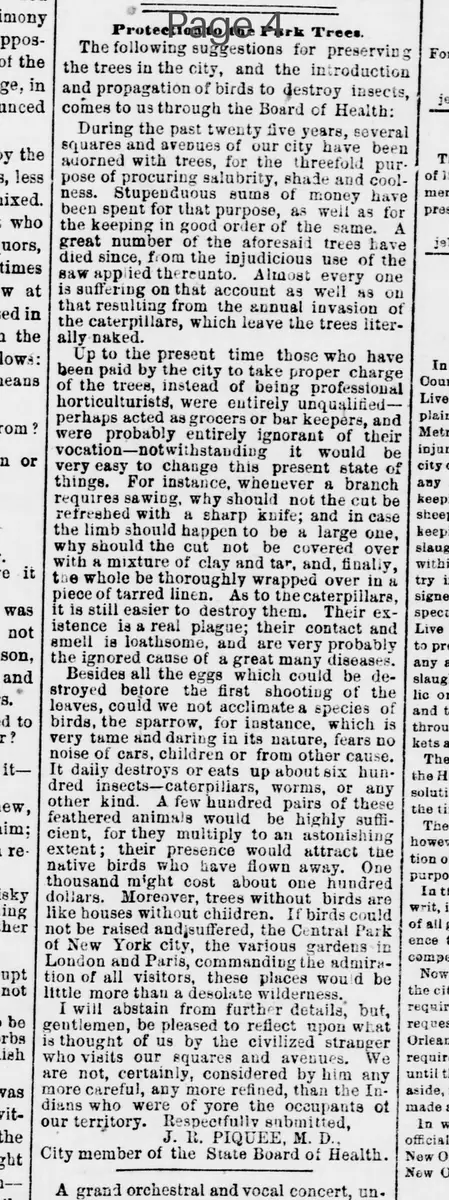
The following suggestions for preserving the trees in the city, and the introduction and propagation of birds to destroy insects, comes to us through the Board of Health:
During the past twenty-five years, several squares and avenues of our city have been adorned with trees, for the threefold purpose of procuring salubrity, shade and coolness. Stupendous sums of money have been spent for that purpose, as well as for the keeping in good order of the same. A great number of the aforesaid trees have died since, from the injudicious use of the saw applied thereunto. Almost every one is suffering on that account as well as on that resulting from the annual invasion of the caterpillars, which leave the trees literally naked.
Up to the present time those who have been paid by the city to take proper charge of the trees, instead of being professional horticulturists, were entirely unqualified—perhaps acted as grocers or bar keepers, and were probably entirely ignorant of their vocation—notwithstanding it would be very easy to change this present state of things. For instance, whenever a branch requires sawing, why should not the cut be refreshed with a sharp knife: and in case the limb should happen to be a large one, why should the cut not be covered over with a mixture of clay and tar, and, finally, the whole be thoroughly wrapped over in a piece of tarred linen. As to the caterpillars, it is still easier to destroy them. Their existence is a real plague; their contact and smell is loathsome, and are very probably the ignored cause of a great many diseases. Besides all the eggs which could be destroyed before the first shooting of the leaves, could we not acclimate a species of birds, the sparrow, for instance, which is very tame and daring in its nature, fears no noise of cars, children or from other cause. It daily destroys or eats up about six hundred insects—caterpillars, worms, or any other kind. A few hundred pairs of these feathered animals would be highly sufficient, for they multiply to an astonishing extent: their presence would attract the native birds who have flown away. One thousand might cost about one hundred dollars. Moreover, trees without birds are like houses without children. If birds could not be raised and suffered, the Central Park of New York city, the various gardens in London and Paris, commanding the admiration of all visitors, these places would be little more than a desolate wilderness.
I will abstain from further details, but, gentlemen, be pleased to reflect upon what is thought of us by the civilized stranger who visits our squares and avenues. We are not, certainly, considered by him any more careful, any more refined, than the Indians who were of yore the occupants of our territory.
Respectfully submitted,
J. R. PIQUEE, M. D.,
City member of the State Board of Health.
During the past twenty-five years, several squares and avenues of our city have been adorned with trees, for the threefold purpose of procuring salubrity, shade and coolness. Stupendous sums of money have been spent for that purpose, as well as for the keeping in good order of the same. A great number of the aforesaid trees have died since, from the injudicious use of the saw applied thereunto. Almost every one is suffering on that account as well as on that resulting from the annual invasion of the caterpillars, which leave the trees literally naked.
Up to the present time those who have been paid by the city to take proper charge of the trees, instead of being professional horticulturists, were entirely unqualified—perhaps acted as grocers or bar keepers, and were probably entirely ignorant of their vocation—notwithstanding it would be very easy to change this present state of things. For instance, whenever a branch requires sawing, why should not the cut be refreshed with a sharp knife: and in case the limb should happen to be a large one, why should the cut not be covered over with a mixture of clay and tar, and, finally, the whole be thoroughly wrapped over in a piece of tarred linen. As to the caterpillars, it is still easier to destroy them. Their existence is a real plague; their contact and smell is loathsome, and are very probably the ignored cause of a great many diseases. Besides all the eggs which could be destroyed before the first shooting of the leaves, could we not acclimate a species of birds, the sparrow, for instance, which is very tame and daring in its nature, fears no noise of cars, children or from other cause. It daily destroys or eats up about six hundred insects—caterpillars, worms, or any other kind. A few hundred pairs of these feathered animals would be highly sufficient, for they multiply to an astonishing extent: their presence would attract the native birds who have flown away. One thousand might cost about one hundred dollars. Moreover, trees without birds are like houses without children. If birds could not be raised and suffered, the Central Park of New York city, the various gardens in London and Paris, commanding the admiration of all visitors, these places would be little more than a desolate wilderness.
I will abstain from further details, but, gentlemen, be pleased to reflect upon what is thought of us by the civilized stranger who visits our squares and avenues. We are not, certainly, considered by him any more careful, any more refined, than the Indians who were of yore the occupants of our territory.
Respectfully submitted,
J. R. PIQUEE, M. D.,
City member of the State Board of Health.
What sub-type of article is it?
Infrastructure
Social Reform
Science Or Medicine
What keywords are associated?
Tree Preservation
Caterpillar Control
Sparrow Introduction
Urban Horticulture
Public Health
City Trees
What entities or persons were involved?
Board Of Health
J. R. Piquee, M. D.
Central Park Of New York City
Editorial Details
Primary Topic
Preserving City Trees And Introducing Birds To Control Insects
Stance / Tone
Advocacy For Improved Urban Tree Care And Environmental Measures
Key Figures
Board Of Health
J. R. Piquee, M. D.
Central Park Of New York City
Key Arguments
Trees In City Squares And Avenues Provide Salubrity, Shade, And Coolness But Many Have Died From Poor Pruning
Use Sharp Knife To Refresh Cuts And Cover Large Limb Cuts With Clay And Tar Mixture Wrapped In Tarred Linen
Caterpillars Devastate Trees And May Cause Diseases; Destroy Eggs Before Leaves Shoot
Acclimate Sparrows, Which Eat Up To 600 Insects Daily And Multiply Rapidly, To Control Pests
Cost Of 1000 Sparrows About 100 Dollars; Their Presence Attracts Native Birds
Trees Without Birds Are Like Houses Without Children; Enhances Beauty Of Urban Parks Like Central Park