Thank you for visiting SNEWPapers!
Sign up free
Story
March 28, 1862
Bellows Falls Times
Bellows Falls, Windham County, Vermont
What is this article about?
F. L. Uphan of Weathersfield shares his extensive experience in sheep husbandry, advocating for pure Spanish Merino sheep in Vermont's climate, detailing importation, breeding success, management practices, and profitability amid national events like the 1860 Texas rush.
Clipping
OCR Quality
95%
Excellent
Full Text
AGRICULTURAL.
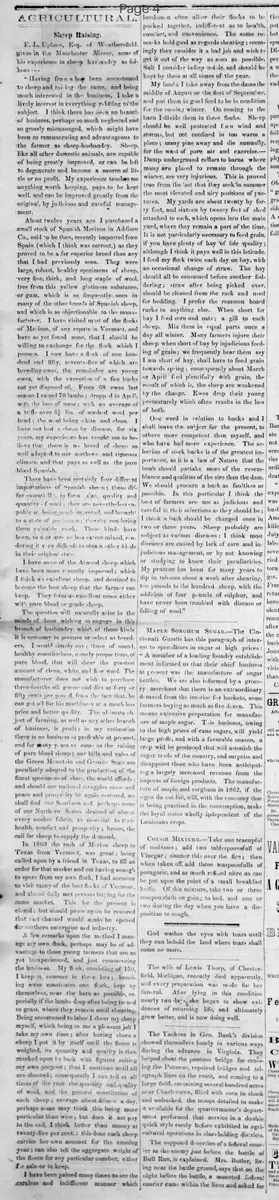
Sheep Raising.
F. L. Uphan, Esq. of Weathersfield, gives in the Manchester Mirror, some of his experience in sheep husbandry as follows:-
"Having from a boy been accustomed to sheep and raising the same, and being much interested in the business, I take a lively interest in everything relating to the subject. I think there has been no branch of business, perhaps so much neglected and so grossly mismanaged, which might have been so remunerating and advantageous to the farmer as sheep-husbandry. Sheep, like all other domestic animals, are capable of being greatly improved, or can be left to degenerate and become a source of little or no profit. My experience teaches me anything worth keeping, pays to be kept well, and can be improved greatly from the original, by judicious and careful management.
About twelve years ago I purchased a small stock of Spanish Merinos in Addison Co., said to be then, recently imported from Spain (which I think was correct.) as they proved to be a far superior breed than any that I had previously seen. They were large, robust, healthy specimens of sheep, very fine, thick, and long staple of wool, free from this yellow glutinous substance, or gum, which is so frequently seen in many of the other breeds of Spanish sheep, and which is so objectionable to the manufacturer. I have visited most of the flocks of Merinos, of any repute in Vermont, and have as yet found none, that I should be willing to exchange for the flock which I possess. I now have a flock of one hundred and fifty, seventy-five of which are breeding-ewes, the remainder are young ewes, with the exception of a few bucks, not yet disposed of. From 68 ewes last season I raised 70 lambs; dropped in April, with the loss of none; with an average of 8 fleeces, over 6 lbs. of washed wool per head: the wool being white and clean, I have not lost a sheep by disease, for six years, my experience has taught me to believe that there is no breed of sheep so well adapted to our northern and rigorous climate, and that pays so well as the pure blood Spanish.
There have been certainly four different importations of Spanish sheep: these differ essentially, in form, size, quality and quantity of wool: they are nevertheless capable of being much improved, and brought to a state of perfection; thereby rendering them valuable stock. These kinds have been, to a greater or less extent mixed, rendering it very difficult so obtain other kinds in their original state.
I have some of the Atwood sheep which have been more recently imported: which I think are excellent sheep, and destined to become the best sheep that the farmer can keep. They form an excellent cross, either with pure blood or grade sheep.
The question will naturally arise in the minds of those wishing to engage in this branch of husbandry, which of those kinds it is economy to procure or select as breeders. I would simply say; those of sound, healthy constitutions, comely proportions, of pure blood, that will shear the greatest amount of clean, white, and fine wool. The manufacturer does not wish to purchase three-fourths oil, grease and dirt at forty or fifty cents per pound, from the fact that, he can get oil for his machinery at a much less price and better quality. The ultimate object of farming, as well as any other branch of business, is profit; in my estimation there is no business so profitable at present, and for many years to come as the raising of pure blood sheep: our hills and vales of the Green Mountain and Granite State are peculiarly adapted to the production of the finest specimens of sheep the world affords: and should our national struggles cease and peace and prosperity be again restored, we shall find our Southern and perhaps some of our Northern States drained of almost every woolen fabric, so essential to their health, comfort and prosperity; hence, the call for sheep to supply the demand.
In 1860 the rush of Merino sheep to Texas from Vermont, was great; being called upon by a friend in Texas, to fill an order for that market and not having enough to spare from my own flock, I had occasion to visit many of the best flocks of Vermont, and almost daily met persons buying for the same market. This for the present is closed; but should peace again be restored that vast channel would again be opened for northern enterprise and industry.
A few remarks upon the method I manage my own flock, perhaps may be of advantage to those young farmers that are as yet inexperienced, and just commencing the business. My flock, consisting of 150, I keep in summer in three lots; breeding ewes constitutes one flock, kept by themselves, near the barn as possible, especially if the lambs drop after being turned to grass, where they remain until shearing. Being accustomed to labor I shear my sheep myself, which being to me a pleasant job I take my own time; after having shorn a sheep I put it by itself until the fleece is weighed, its quantity and quality is then marked upon its back with figures suiting my own purpose; thus I continue until all are sheared; consequently I can tell at all times of the year the quantity and quality of wool, and the general constitution of each sheep; average about fifteen a day, perhaps some may think this being more particular than wise; but does it not pay in the end, I think better than money at twenty-five per cent.: this done each sheep carries her own account for the ensuing year; can also tell the aggregate weight of the fleece for any particular number, either for sale or to keep.
I have been pained many times to see the careless and indifferent manner which herdsmen often allow their flocks to be packed together, indifferent as to health, comfort, and convenience. The same remarks hold good as regards shearing; seemingly they consider it a bad job and wish to get it out of the way as soon as possible Salt I consider indispensable, and should be kept by them at all times of the year. My lambs I take away from the dams the middle of August or the first of September, and put them in good feed to be in condition for the coming winter. On coming to the barn I divide them in three flocks. Sheep should be well protected from wind and storms, but not confined in too warm a place; many pine away and die annually, for the want of pure air and exercise. Damp underground cellars to barns where many are placed to remain through the winter, are very injurious. This is proved true from the fact that they seek in summer the most elevated and airy positions of pastures. My yards are about twenty by forty feet, and sixteen by twenty feet of shed attached to each, which opens into the main yard, where they remain a part of the time. It is not particularly necessary to feed grain, if you have plenty of hay of fair quality; although I think it pays well in this latitude. I feed my flock twice each day on hay, with an occasional change of straw. The hay should all be consumed before another foddering; straw after being picked over, should be cleaned from the rack and used for bedding. I prefer the common board racks to anything else. When short for hay I feed corn and oats; a gill to each sheep. Mix them in equal parts once a day all winter. Many farmers injure their sheep when short of hay by injudicious feeding of grain; we frequently hear them say I am short of hay, shall have to feed grain towards spring; consequently about March or April fed plentifully with grain, the result of which is, the sheep are weakened by the change. Ewes drop their young prematurely which often results in the loss of both.
One word in relation to bucks and I shall leave the subject for the present, to others more competent than myself, and who have had more experience. The selection of stock bucks is of the greatest importance, as it is a law of Nature that the lamb should partake more of the resemblance and qualities of the sire than the dam. We should procure a buck as faultless as possible. In this particular I think the best of farmers are not as judicious and careful in their selections as they should be: I think a buck should be changed once in two or three years. Sheep probably are subject to various diseases; I think most diseases are caused by lack of care and injudicious management, or by not knowing or studying to know their peculiarities. My practice has been for many years to dip in tobacco about a week after shearing, ten pounds to the hundred sheep, with the addition of four pounds of sulphur, and have never been troubled with disease or falling of wool."
Sheep Raising.
F. L. Uphan, Esq. of Weathersfield, gives in the Manchester Mirror, some of his experience in sheep husbandry as follows:-
"Having from a boy been accustomed to sheep and raising the same, and being much interested in the business, I take a lively interest in everything relating to the subject. I think there has been no branch of business, perhaps so much neglected and so grossly mismanaged, which might have been so remunerating and advantageous to the farmer as sheep-husbandry. Sheep, like all other domestic animals, are capable of being greatly improved, or can be left to degenerate and become a source of little or no profit. My experience teaches me anything worth keeping, pays to be kept well, and can be improved greatly from the original, by judicious and careful management.
About twelve years ago I purchased a small stock of Spanish Merinos in Addison Co., said to be then, recently imported from Spain (which I think was correct.) as they proved to be a far superior breed than any that I had previously seen. They were large, robust, healthy specimens of sheep, very fine, thick, and long staple of wool, free from this yellow glutinous substance, or gum, which is so frequently seen in many of the other breeds of Spanish sheep, and which is so objectionable to the manufacturer. I have visited most of the flocks of Merinos, of any repute in Vermont, and have as yet found none, that I should be willing to exchange for the flock which I possess. I now have a flock of one hundred and fifty, seventy-five of which are breeding-ewes, the remainder are young ewes, with the exception of a few bucks, not yet disposed of. From 68 ewes last season I raised 70 lambs; dropped in April, with the loss of none; with an average of 8 fleeces, over 6 lbs. of washed wool per head: the wool being white and clean, I have not lost a sheep by disease, for six years, my experience has taught me to believe that there is no breed of sheep so well adapted to our northern and rigorous climate, and that pays so well as the pure blood Spanish.
There have been certainly four different importations of Spanish sheep: these differ essentially, in form, size, quality and quantity of wool: they are nevertheless capable of being much improved, and brought to a state of perfection; thereby rendering them valuable stock. These kinds have been, to a greater or less extent mixed, rendering it very difficult so obtain other kinds in their original state.
I have some of the Atwood sheep which have been more recently imported: which I think are excellent sheep, and destined to become the best sheep that the farmer can keep. They form an excellent cross, either with pure blood or grade sheep.
The question will naturally arise in the minds of those wishing to engage in this branch of husbandry, which of those kinds it is economy to procure or select as breeders. I would simply say; those of sound, healthy constitutions, comely proportions, of pure blood, that will shear the greatest amount of clean, white, and fine wool. The manufacturer does not wish to purchase three-fourths oil, grease and dirt at forty or fifty cents per pound, from the fact that, he can get oil for his machinery at a much less price and better quality. The ultimate object of farming, as well as any other branch of business, is profit; in my estimation there is no business so profitable at present, and for many years to come as the raising of pure blood sheep: our hills and vales of the Green Mountain and Granite State are peculiarly adapted to the production of the finest specimens of sheep the world affords: and should our national struggles cease and peace and prosperity be again restored, we shall find our Southern and perhaps some of our Northern States drained of almost every woolen fabric, so essential to their health, comfort and prosperity; hence, the call for sheep to supply the demand.
In 1860 the rush of Merino sheep to Texas from Vermont, was great; being called upon by a friend in Texas, to fill an order for that market and not having enough to spare from my own flock, I had occasion to visit many of the best flocks of Vermont, and almost daily met persons buying for the same market. This for the present is closed; but should peace again be restored that vast channel would again be opened for northern enterprise and industry.
A few remarks upon the method I manage my own flock, perhaps may be of advantage to those young farmers that are as yet inexperienced, and just commencing the business. My flock, consisting of 150, I keep in summer in three lots; breeding ewes constitutes one flock, kept by themselves, near the barn as possible, especially if the lambs drop after being turned to grass, where they remain until shearing. Being accustomed to labor I shear my sheep myself, which being to me a pleasant job I take my own time; after having shorn a sheep I put it by itself until the fleece is weighed, its quantity and quality is then marked upon its back with figures suiting my own purpose; thus I continue until all are sheared; consequently I can tell at all times of the year the quantity and quality of wool, and the general constitution of each sheep; average about fifteen a day, perhaps some may think this being more particular than wise; but does it not pay in the end, I think better than money at twenty-five per cent.: this done each sheep carries her own account for the ensuing year; can also tell the aggregate weight of the fleece for any particular number, either for sale or to keep.
I have been pained many times to see the careless and indifferent manner which herdsmen often allow their flocks to be packed together, indifferent as to health, comfort, and convenience. The same remarks hold good as regards shearing; seemingly they consider it a bad job and wish to get it out of the way as soon as possible Salt I consider indispensable, and should be kept by them at all times of the year. My lambs I take away from the dams the middle of August or the first of September, and put them in good feed to be in condition for the coming winter. On coming to the barn I divide them in three flocks. Sheep should be well protected from wind and storms, but not confined in too warm a place; many pine away and die annually, for the want of pure air and exercise. Damp underground cellars to barns where many are placed to remain through the winter, are very injurious. This is proved true from the fact that they seek in summer the most elevated and airy positions of pastures. My yards are about twenty by forty feet, and sixteen by twenty feet of shed attached to each, which opens into the main yard, where they remain a part of the time. It is not particularly necessary to feed grain, if you have plenty of hay of fair quality; although I think it pays well in this latitude. I feed my flock twice each day on hay, with an occasional change of straw. The hay should all be consumed before another foddering; straw after being picked over, should be cleaned from the rack and used for bedding. I prefer the common board racks to anything else. When short for hay I feed corn and oats; a gill to each sheep. Mix them in equal parts once a day all winter. Many farmers injure their sheep when short of hay by injudicious feeding of grain; we frequently hear them say I am short of hay, shall have to feed grain towards spring; consequently about March or April fed plentifully with grain, the result of which is, the sheep are weakened by the change. Ewes drop their young prematurely which often results in the loss of both.
One word in relation to bucks and I shall leave the subject for the present, to others more competent than myself, and who have had more experience. The selection of stock bucks is of the greatest importance, as it is a law of Nature that the lamb should partake more of the resemblance and qualities of the sire than the dam. We should procure a buck as faultless as possible. In this particular I think the best of farmers are not as judicious and careful in their selections as they should be: I think a buck should be changed once in two or three years. Sheep probably are subject to various diseases; I think most diseases are caused by lack of care and injudicious management, or by not knowing or studying to know their peculiarities. My practice has been for many years to dip in tobacco about a week after shearing, ten pounds to the hundred sheep, with the addition of four pounds of sulphur, and have never been troubled with disease or falling of wool."
What sub-type of article is it?
Biography
Personal Triumph
What themes does it cover?
Moral Virtue
Triumph
What keywords are associated?
Sheep Husbandry
Spanish Merinos
Vermont Farming
Wool Production
Agricultural Management
Breeding Practices
What entities or persons were involved?
F. L. Uphan
Where did it happen?
Weathersfield, Vermont
Story Details
Key Persons
F. L. Uphan
Location
Weathersfield, Vermont
Event Date
About Twelve Years Ago; In 1860
Story Details
F. L. Uphan recounts purchasing Spanish Merino sheep twelve years prior, building a successful flock of 150 through careful management, achieving high wool yields and no losses, and shares detailed husbandry practices for profitability in Vermont.