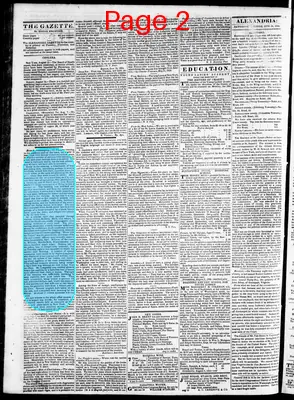
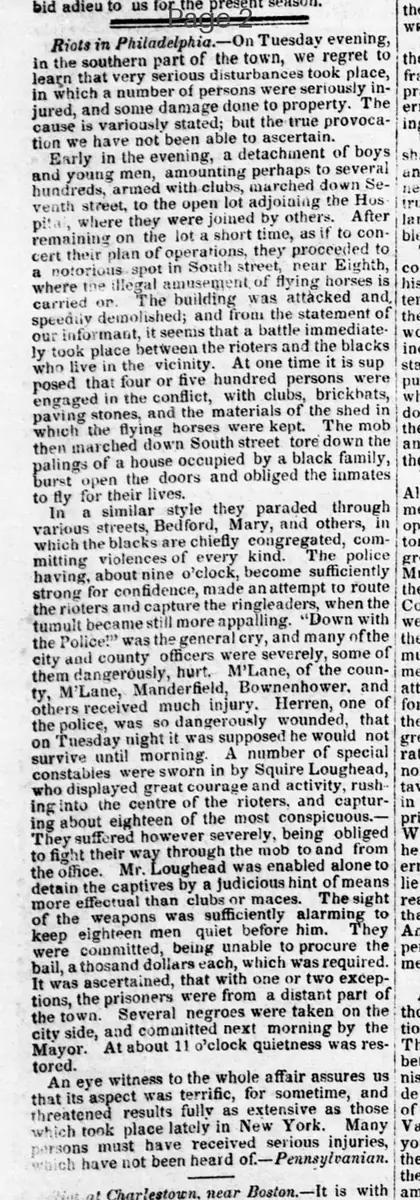
Riots in Philadelphia.—On Tuesday evening, in the southern part of the town, we regret to learn that very serious disturbances took place, in which a number of persons were seriously injured, and some damage done to property. The cause is variously stated; but the true provocation we have not been able to ascertain. Early in the evening, a detachment of boys and young men, amounting perhaps to several hundreds, armed with clubs, marched down Seventh street, to the open lot adjoining the Hospital, where they were joined by others. After remaining on the lot a short time, as if to concert their plan of operations, they proceeded to a notorious spot in South street, near Eighth, where the illegal amusement of flying horses is carried on. The building was attacked and speedily demolished; and from the statement of our informant, it seems that a battle immediately took place between the rioters and the blacks who live in the vicinity. At one time it is supposed that four or five hundred persons were engaged in the conflict, with clubs, brickbats, paving stones, and the materials of the shed in which the flying horses were kept. The mob then marched down South street to tear down the palings of a house occupied by a black family, burst open the doors and obliged the inmates to fly for their lives. In a similar style they paraded through various streets, Bedford, Mary, and others, in which the blacks are chiefly congregated, committing violences of every kind. The police having, about nine o'clock, become sufficiently strong for confidence, made an attempt to route the rioters and capture the ringleaders, when the tumult became still more appalling. "Down with the Police!" was the general cry, and many of the city and county officers were severely, some of them dangerously, hurt. M'Lane, of the county, M'Lane, Manderfield, Bownenhower, and others received much injury. Herren, one of the police, was so dangerously wounded, that on Tuesday night it was supposed he would not survive until morning. A number of special constables were sworn in by Squire Loughead, who displayed great courage and activity, rushing into the centre of the rioters, and capturing about eighteen of the most conspicuous.—They suffered however severely, being obliged to fight their way through the mob to and from the office. Mr. Loughead was enabled alone to detain the captives by a judicious hint of means more effectual than clubs or maces. The sight of the weapons was sufficiently alarming to keep eighteen men quiet before him. They were committed, being unable to procure the bail, a thousand dollars each, which was required. It was ascertained, that with one or two exceptions, the prisoners were from a distant part of the town. Several negroes were taken on the city side, and committed next morning by the Mayor. At about 11 o'clock quietness was restored. An eye witness to the whole affair assures us that its aspect was terrific, for sometime, and threatened results fully as extensive as those which took place lately in New York. Many persons must have received serious injuries which have not been heard of.—Pennsylvanian.