Thank you for visiting SNEWPapers!
Sign up free
The Potters Herald
East Liverpool, Columbiana County, Ohio
What is this article about?
The American Federation of Labor urges passage of the Wagner-Murray-Dingell Social Security Bill to meet war revenue needs via 6% employer and worker contributions, yielding $5.3 billion for war costs and inflation control while expanding social insurance benefits against emergencies, superior to sales or income taxes.
Clipping
OCR Quality
Full Text
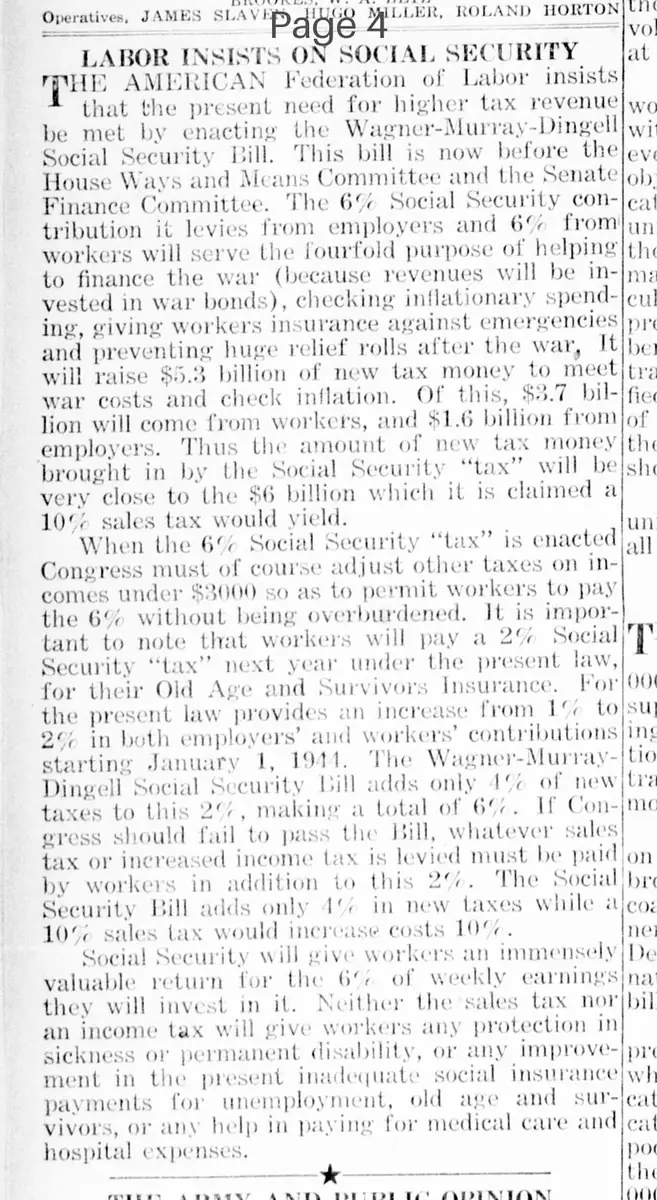
THE AMERICAN Federation of Labor insists that the present need for higher tax revenue be met by enacting the Wagner-Murray-Dingell Social Security Bill. This bill is now before the House Ways and Means Committee and the Senate Finance Committee. The 6% Social Security contribution it levies from employers and 6% from workers will serve the fourfold purpose of helping to finance the war (because revenues will be invested in war bonds), checking inflationary spending, giving workers insurance against emergencies and preventing huge relief rolls after the war. It will raise $5.3 billion of new tax money to meet war costs and check inflation. Of this, $3.7 billion will come from workers, and $1.6 billion from employers. Thus the amount of new tax money brought in by the Social Security "tax" will be very close to the $6 billion which it is claimed a 10% sales tax would yield.
When the 6% Social Security "tax" is enacted Congress must of course adjust other taxes on incomes under $3000 so as to permit workers to pay the 6% without being overburdened. It is important to note that workers will pay a 2% Social Security "tax" next year under the present law, for their Old Age and Survivors Insurance. For the present law provides an increase from 1% to 2% in both employers' and workers' contributions starting January 1, 1941. The Wagner-Murray-Dingell Social Security Bill adds only 4% of new taxes to this 2%, making a total of 6%. If Congress should fail to pass the Bill, whatever sales tax or increased income tax is levied must be paid by workers in addition to this 2%. The Social Security Bill adds only 4% in new taxes while a 10% sales tax would increase costs 10%.
Social Security will give workers an immensely valuable return for the 6% of weekly earnings they will invest in it. Neither the sales tax nor an income tax will give workers any protection in sickness or permanent disability, or any improvement in the present inadequate social insurance payments for unemployment, old age and survivors, or any help in paying for medical care and hospital expenses.
What sub-type of article is it?
What themes does it cover?
What keywords are associated?
What entities or persons were involved?
Where did it happen?
Story Details
Key Persons
Location
United States
Event Date
Starting January 1, 1941
Story Details
The American Federation of Labor advocates for the Wagner-Murray-Dingell Social Security Bill to raise $5.3 billion in new tax revenue through 6% contributions from employers and workers, funding the war, checking inflation, providing insurance against emergencies, and preventing post-war relief rolls, while arguing it offers better protection than sales or income taxes.