Thank you for visiting SNEWPapers!
Sign up free
Literary
May 29, 1792
The Patowmac Guardian, And Berkeley Advertiser
Martinsburg, Shepherdstown, Berkeley County, Jefferson County, West Virginia
What is this article about?
An 18th-century essay posits the existence of a creator from observations of nature's order, refutes Aristotle's eternal world and Epicurus's atomic chaos theory, and argues the innate idea of God in all humans as foundational to religion. Signed B., Martinsburg, May 1792.
Clipping
OCR Quality
98%
Excellent
Full Text
For the Potowmac Guardian, &c.
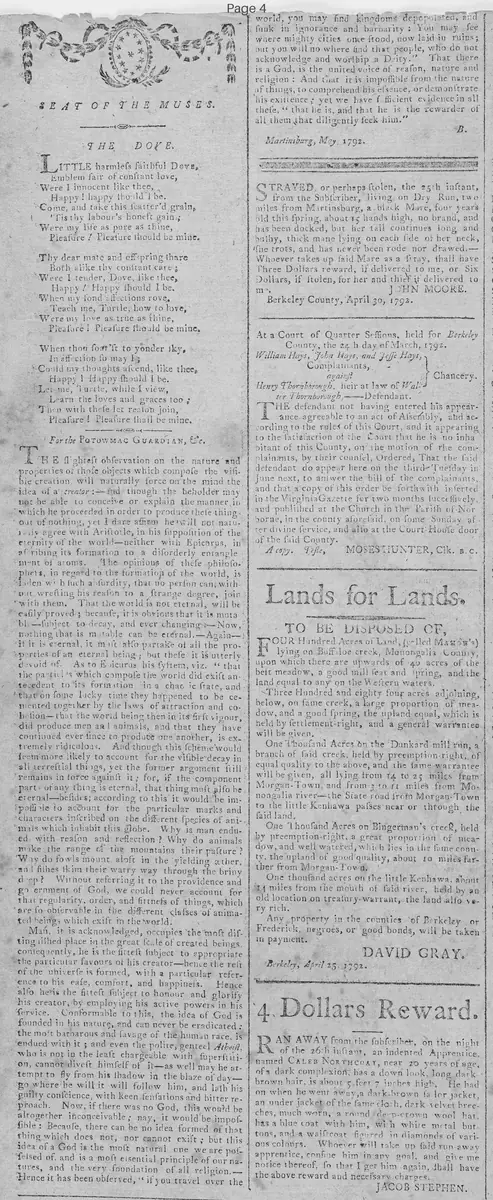
THE highest observation on the nature and properties of those objects which compose the visible creation, will naturally force on the mind the idea of a creator:--and though the beholder may not be able to conceive or explain the manner in which he proceeded in order to produce these things out of nothing, yet I dare affirm he will do natural justice to the supreme being, without agreeing with Aristotle, in his supposition of the eternity of the world--neither with Epicurus, in ascribing its formation to a disorderly entanglement of atoms. The opinions of these philosophers, in regard to the formation of the world, is laden with such absurdity, that no person can, without wresting his reason to a strange degree, join with them. That the world is not eternal, will be easily proved: because, it is obvious that it is mutable--subject to decay, and ever changing.--Now, nothing that is mutable can be eternal.--Again--if it is eternal, it must also partake of all the properties of an eternal being; but this it is utterly devoid of. As to Epicurus his system, viz. "that the particles which compose the world did exist antecedent to its formation in a chaotic state, and that on some lucky time they happened to be cemented together by the laws of attraction and cohesion--that the world being then in its first vigour, did produce men and animals, and that they have continued ever since to produce one another, is extremely ridiculous. And though this scheme would seem more likely to account for the visible decay in all terrestrial things, yet the former argument still remains in force against it; for, if the component parts of any thing is eternal, that thing must also be eternal--besides; according to this it would be impossible to account for the particular marks and characters inscribed on the different species of animals which inhabit this globe. Why is man endowed with reason and reflection? Why do animals make the range of the mountains their pasture? Why do fowls mount aloft in the yielding aether, and fishes skim their watery way through the briny deep? Without referring it to the providence and government of God, we could never account for that regularity, order, and fitness of things, which are so observable in the different classes of animated beings which exist in the world.
Man, it is acknowledged, occupies the most distinguished place in the great scale of created beings. consequently, he is the fittest subject to appropriate the particular favours of his creator--hence the rest of the universe is formed, with a particular reference to his ease, comfort, and happiness. Hence also he is the fittest subject to honour and glorify his creator, by employing his active powers in his service. Conformable to this, the idea of God is founded in his nature, and can never be eradicated: the most barbarous and savage of the human race, is endued with it: and even the polite, genteel Atheist who is not in the least chargeable with superstition, cannot divest himself of it--as well may he attempt to fly from his shadow in the blaze of day-- go where he will it will follow him, and lash his guilty conscience, with keen sensations and bitter reproach. Now, if there was no God, this would be altogether inconceivable; nay, it would be impossible: Because, there can be no idea formed of that thing which does not, nor cannot exist; but this idea of a God is the most natural one we are possessed of. and is a most essential principle of our natures. and the very foundation of all religion,-- Hence it has been observed, "if you travel over the world, you may find kingdoms depopulated, and sunk in ignorance and barbarity: You may see where mighty cities once stood, now laid in ruins; but you will no where find that people, who do not acknowledge and worship a Deity." That there is a God, is the united voice of reason, nature and religion: And that it is impossible from the nature of things, to comprehend his essence, or demonstrate his existence; yet we have sufficient evidence in all these, "that he is, and that he is the rewarder of all them that diligently seek him."
B.
Martinsburg, May, 1792.
THE highest observation on the nature and properties of those objects which compose the visible creation, will naturally force on the mind the idea of a creator:--and though the beholder may not be able to conceive or explain the manner in which he proceeded in order to produce these things out of nothing, yet I dare affirm he will do natural justice to the supreme being, without agreeing with Aristotle, in his supposition of the eternity of the world--neither with Epicurus, in ascribing its formation to a disorderly entanglement of atoms. The opinions of these philosophers, in regard to the formation of the world, is laden with such absurdity, that no person can, without wresting his reason to a strange degree, join with them. That the world is not eternal, will be easily proved: because, it is obvious that it is mutable--subject to decay, and ever changing.--Now, nothing that is mutable can be eternal.--Again--if it is eternal, it must also partake of all the properties of an eternal being; but this it is utterly devoid of. As to Epicurus his system, viz. "that the particles which compose the world did exist antecedent to its formation in a chaotic state, and that on some lucky time they happened to be cemented together by the laws of attraction and cohesion--that the world being then in its first vigour, did produce men and animals, and that they have continued ever since to produce one another, is extremely ridiculous. And though this scheme would seem more likely to account for the visible decay in all terrestrial things, yet the former argument still remains in force against it; for, if the component parts of any thing is eternal, that thing must also be eternal--besides; according to this it would be impossible to account for the particular marks and characters inscribed on the different species of animals which inhabit this globe. Why is man endowed with reason and reflection? Why do animals make the range of the mountains their pasture? Why do fowls mount aloft in the yielding aether, and fishes skim their watery way through the briny deep? Without referring it to the providence and government of God, we could never account for that regularity, order, and fitness of things, which are so observable in the different classes of animated beings which exist in the world.
Man, it is acknowledged, occupies the most distinguished place in the great scale of created beings. consequently, he is the fittest subject to appropriate the particular favours of his creator--hence the rest of the universe is formed, with a particular reference to his ease, comfort, and happiness. Hence also he is the fittest subject to honour and glorify his creator, by employing his active powers in his service. Conformable to this, the idea of God is founded in his nature, and can never be eradicated: the most barbarous and savage of the human race, is endued with it: and even the polite, genteel Atheist who is not in the least chargeable with superstition, cannot divest himself of it--as well may he attempt to fly from his shadow in the blaze of day-- go where he will it will follow him, and lash his guilty conscience, with keen sensations and bitter reproach. Now, if there was no God, this would be altogether inconceivable; nay, it would be impossible: Because, there can be no idea formed of that thing which does not, nor cannot exist; but this idea of a God is the most natural one we are possessed of. and is a most essential principle of our natures. and the very foundation of all religion,-- Hence it has been observed, "if you travel over the world, you may find kingdoms depopulated, and sunk in ignorance and barbarity: You may see where mighty cities once stood, now laid in ruins; but you will no where find that people, who do not acknowledge and worship a Deity." That there is a God, is the united voice of reason, nature and religion: And that it is impossible from the nature of things, to comprehend his essence, or demonstrate his existence; yet we have sufficient evidence in all these, "that he is, and that he is the rewarder of all them that diligently seek him."
B.
Martinsburg, May, 1792.
What sub-type of article is it?
Essay
What themes does it cover?
Religious
Moral Virtue
What keywords are associated?
Existence Of God
Creation
Providence
Aristotle
Epicurus
Reason
Nature
Atheism
What entities or persons were involved?
B.
Literary Details
Author
B.
Subject
Argument For The Existence Of God And Critique Of Aristotle And Epicurus
Form / Style
Philosophical Prose Argument
Key Lines
The Highest Observation On The Nature And Properties Of Those Objects Which Compose The Visible Creation, Will Naturally Force On The Mind The Idea Of A Creator
That There Is A God, Is The United Voice Of Reason, Nature And Religion
If You Travel Over The World, You May Find Kingdoms Depopulated, And Sunk In Ignorance And Barbarity: You May See Where Mighty Cities Once Stood, Now Laid In Ruins; But You Will No Where Find That People, Who Do Not Acknowledge And Worship A Deity.