Thank you for visiting SNEWPapers!
Sign up free
Editorial
April 1, 1866
Daily Union And American
Nashville, Davidson County, Tennessee
What is this article about?
Editorial from the New York Journal of Commerce defends Sabbath observance, criticizing the Philadelphia Press for promoting Sunday streetcar service and repealing Sunday laws, arguing it erodes moral foundations, national character, and fitness for self-government.
Clipping
OCR Quality
75%
Good
Full Text
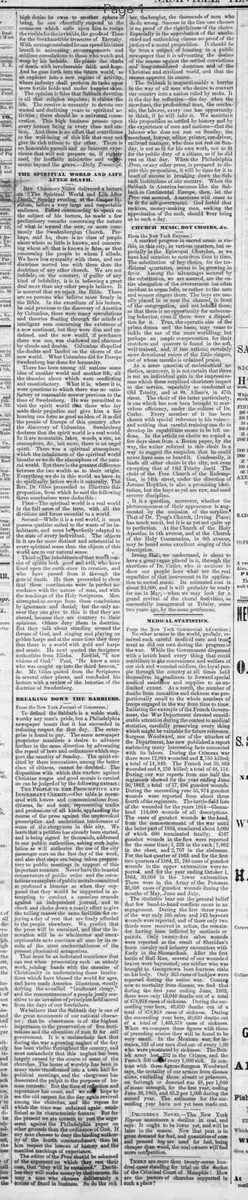
BREAKING DOWN THE BARRIERS.
From the New York Journal of Commerce.
To defend the Sabbath is a noble work, worthy any man's pride, but a Philadelphia newspaper boasts that it has succeeded in reducing respect for that day. The enterprise is found to pay. The same newspaper proprietor manifests a desire to advance further in the same direction by advocating the repeal of laws and ordinances which support the sanctity of Sunday. The spirit excited by these innovations, among the better class of citizens, cannot be doubted. The disposition with which this warfare against Christian usages and good morals is carried on can be judged of by the following extract:
The People vs. the Proscriptive And Intolerant Clergy.
Our table is covered with letters and communications from citizens, far and near, representing trades and professions of all kinds, applauding the course of the press against the unprovoked proscription and unchristian intolerance of some of the clergymen in this city. We learn that a petition has already been started and is being signed by thousands, addressed to our public authorities, asking such legislation as will authorize the use of the city passenger cars on the first day of the week, and also that steps are being taken preparatory to public meetings in support of this important measure. Never have the boasted conservators of public order and the ostentatious exemplars of public morals committed so profound a blunder as when they supposed that they would be supported in attempting to conduct a causeless crusade against an independent journal, and to check and choke down a manly effort to give the toiling masses the same facilities for enjoying a day of rest that are freely afforded to the people elsewhere. We predict that the press will be sustained, and that the innovation will be so wholesome and unexceptionable as to convince all men by its results of the utter uncharitableness of the present pharisaical antagonism.
That must be an iniquitous conscience that can rest when operating such an unholy work, joining hands with the enemies of Christianity in undermining those institutions which have blessed the world for ages and have made America illustrious. Stoutly defying the so-called "intolerant clergy," and the remonstrances of a people justly sensitive to an invasion of principles held sacred from the days of our forefathers. We believe that the Sabbath day is one of the great bulwarks of our national character; that its observance is of the highest importance to the preservation of free institutions and the education of men for self-government. It is a melancholy fact that during the war a growing neglect of the day has been visible throughout the country, and most melancholy that this neglect has been largely caused by the course of some of the churches. The house of worship has been in many cases transformed into a town hall for political meetings, and the clergyman has desecrated the pulpit to the purposes of human contests.
"But the time of reflection and repentance has come, and we hope to see the old respect for the day again revived among the churches, and the repose for which the day was ordained again established as its characteristic feature."
But for the present we are content to rest the argument against the Philadelphia paper on other grounds than the ordinance of God. If any man chooses to deny the binding authority of the fourth commandment; then let him respect the lessons of history and the manifest teachings of experience. The editor of the Press should be ashamed of the argument on which they rest their case, that "they will be sustained." Doubtless they will make money by their course. So does any man who chooses deliberately a course of fraud in business. So do the robber, the burglar, the thousands of men who do wrong. Success in the line one chooses is no proof of the rightfulness of the choice. Especially is the approbation of the uneducated and unthinking classes no proof of the justice of a moral proposition. It should be far from a subject of boasting in a public newspaper that it is advocating the desires of the masses against the settled convictions and long-considered doctrines of the Christian and civilized world, and that the masses approve its course. The Sabbath is unquestionably a barrier in the way of all men who desire to convert our country into a nation ruled by mobs. It is the day for reflection-the day when the merchant, the professional man, the mechanic, the laborer, every one has opportunity to think, if he will take it. We maintain this proposition as settled by history and by the experience of men and nations-that the laborer who does not rest on Sunday, the merchant, lawyer, editor, printer, car-driver, railroad manager, who does not rest on Sunday, is not as fit for his own work, not as fit for the public duty of a citizen, as if he did rest on that day. When the Philadelphia Press, or any other press, is prepared to dispute this proposition, it will be time for it to boast of success in breaking down the Sabbath institutions of our country. When the Sabbath in America becomes like the Sabbath in Continental Europe, then, let the Press rest assured, Americans will cease to be fit for self-government. God forbid that reckless, money-making men, seeking the approbation of the mob, should ever bring us to such a day.
From the New York Journal of Commerce.
To defend the Sabbath is a noble work, worthy any man's pride, but a Philadelphia newspaper boasts that it has succeeded in reducing respect for that day. The enterprise is found to pay. The same newspaper proprietor manifests a desire to advance further in the same direction by advocating the repeal of laws and ordinances which support the sanctity of Sunday. The spirit excited by these innovations, among the better class of citizens, cannot be doubted. The disposition with which this warfare against Christian usages and good morals is carried on can be judged of by the following extract:
The People vs. the Proscriptive And Intolerant Clergy.
Our table is covered with letters and communications from citizens, far and near, representing trades and professions of all kinds, applauding the course of the press against the unprovoked proscription and unchristian intolerance of some of the clergymen in this city. We learn that a petition has already been started and is being signed by thousands, addressed to our public authorities, asking such legislation as will authorize the use of the city passenger cars on the first day of the week, and also that steps are being taken preparatory to public meetings in support of this important measure. Never have the boasted conservators of public order and the ostentatious exemplars of public morals committed so profound a blunder as when they supposed that they would be supported in attempting to conduct a causeless crusade against an independent journal, and to check and choke down a manly effort to give the toiling masses the same facilities for enjoying a day of rest that are freely afforded to the people elsewhere. We predict that the press will be sustained, and that the innovation will be so wholesome and unexceptionable as to convince all men by its results of the utter uncharitableness of the present pharisaical antagonism.
That must be an iniquitous conscience that can rest when operating such an unholy work, joining hands with the enemies of Christianity in undermining those institutions which have blessed the world for ages and have made America illustrious. Stoutly defying the so-called "intolerant clergy," and the remonstrances of a people justly sensitive to an invasion of principles held sacred from the days of our forefathers. We believe that the Sabbath day is one of the great bulwarks of our national character; that its observance is of the highest importance to the preservation of free institutions and the education of men for self-government. It is a melancholy fact that during the war a growing neglect of the day has been visible throughout the country, and most melancholy that this neglect has been largely caused by the course of some of the churches. The house of worship has been in many cases transformed into a town hall for political meetings, and the clergyman has desecrated the pulpit to the purposes of human contests.
"But the time of reflection and repentance has come, and we hope to see the old respect for the day again revived among the churches, and the repose for which the day was ordained again established as its characteristic feature."
But for the present we are content to rest the argument against the Philadelphia paper on other grounds than the ordinance of God. If any man chooses to deny the binding authority of the fourth commandment; then let him respect the lessons of history and the manifest teachings of experience. The editor of the Press should be ashamed of the argument on which they rest their case, that "they will be sustained." Doubtless they will make money by their course. So does any man who chooses deliberately a course of fraud in business. So do the robber, the burglar, the thousands of men who do wrong. Success in the line one chooses is no proof of the rightfulness of the choice. Especially is the approbation of the uneducated and unthinking classes no proof of the justice of a moral proposition. It should be far from a subject of boasting in a public newspaper that it is advocating the desires of the masses against the settled convictions and long-considered doctrines of the Christian and civilized world, and that the masses approve its course. The Sabbath is unquestionably a barrier in the way of all men who desire to convert our country into a nation ruled by mobs. It is the day for reflection-the day when the merchant, the professional man, the mechanic, the laborer, every one has opportunity to think, if he will take it. We maintain this proposition as settled by history and by the experience of men and nations-that the laborer who does not rest on Sunday, the merchant, lawyer, editor, printer, car-driver, railroad manager, who does not rest on Sunday, is not as fit for his own work, not as fit for the public duty of a citizen, as if he did rest on that day. When the Philadelphia Press, or any other press, is prepared to dispute this proposition, it will be time for it to boast of success in breaking down the Sabbath institutions of our country. When the Sabbath in America becomes like the Sabbath in Continental Europe, then, let the Press rest assured, Americans will cease to be fit for self-government. God forbid that reckless, money-making men, seeking the approbation of the mob, should ever bring us to such a day.
What sub-type of article is it?
Moral Or Religious
What keywords are associated?
Sabbath Observance
Phila Press
Sunday Streetcars
Religious Intolerance
National Character
Self Government
Moral Decay
What entities or persons were involved?
Philadelphia Press
New York Journal Of Commerce
Clergymen
Public Authorities
Editorial Details
Primary Topic
Defense Of Sabbath Observance Against Philadelphia Press Innovations
Stance / Tone
Strongly Pro Sabbath, Critical Of Sabbath Breaking Press
Key Figures
Philadelphia Press
New York Journal Of Commerce
Clergymen
Public Authorities
Key Arguments
Defending The Sabbath Is Noble But Philadelphia Press Reduces Respect For It
Press Advocates Repealing Sunday Laws And Running Streetcars On Sunday
Public Petitions Support The Press Against Intolerant Clergy
Sabbath Is A Bulwark Of National Character And Self Government
War Era Church Politicization Caused Sabbath Neglect
Financial Success Does Not Prove Moral Rightness
Sabbath Rest Enhances Fitness For Work And Citizenship
Breaking Sabbath Leads To Mob Rule And Unfitness For Self Government