Thank you for visiting SNEWPapers!
Sign up free
Editorial
July 14, 1807
The Enquirer
Richmond, Henrico County, Virginia
What is this article about?
An anonymous editorial signed 'THE PEOPLE' criticizes Mr. Tazewell's unauthorized handling of a letter from British Capt. Douglas during a crisis involving British ships near Norfolk and Portsmouth. It accuses him of bypassing the people's committee, fraternizing with the enemy, and misrepresenting public sentiment to U.S. and state executives.
Clipping
OCR Quality
95%
Excellent
Full Text
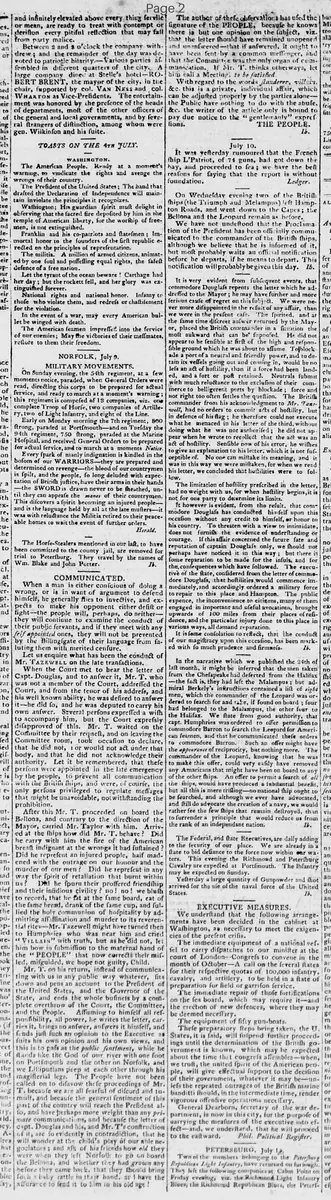
COMMUNICATED.
When a man is either conscious of doing a wrong, or is in want of argument to defend himself, he generally flies to invective, and expects to make his opponent either desist or fight—the people will, perhaps, do neither—they will continue to examine the conduct of their public servants, and if they meet with any self appointed ones, they will not be prevented by the Billingsgate of their language from saluting them with merited censure.
Let us enquire what has been the conduct of Mr. Tazewell on the late transactions.
When the Court met to hear the letter of Capt. Douglas, and to answer it, Mr. T. who was not a member of the Court, addressed the Court, and from the tenor of his address, and his well known ability, he was desired to answer it—he did so, and he was deputed to carry his own answer. Several persons expressed a wish to accompany him, but the Court expressly disapproved of this. Mr. T. waited on the Committee by their request, and on leaving the Committee room, took occasion to declare, that he did not, is or would not act under that body, and that he did not acknowledge their authority. Let it be remembered, that these persons were appointed in the late emergency by the people, to prevent all communication with the British ships, and were, of course, the only persons privileged to regulate messages that might be unavoidable, notwithstanding the prohibition.
After this Mr. T. proceeded on board the Bellona, and contrary to the direction of the Mayor, carried Mr. Taylor with him. Arrived at the ship's bow did Mr. T. behave? Did he carry with him the fire of the American breast indignant at the wrongs it had sustained? Did he represent an injured people, basimadened with the outrage on our honour and the murder of our men? Did he represent in any way the spirit of retaliation that burnt within us? Did he spurn their proffered friendship and their insidious civility? no! no! we blush to record, that he sat at the same board, eat of the same bread, drank of the same cup, and sullied the holy communion of hospitality by admitting assassination and murder to its reverential rites—Mr. Tazewell might have turned then to Humphries who was near him and cried "Villain" with truth, but as he did not, let him bow in submission to the maternal hand of the "PEOPLE" that now corrects their misguided, we hope but guilty, Child.
Mr. T. on his return, instead of communicating with us in any public way whatever, sits down and pens an account to the President of the United States, and the Governor of the State, and ends the whole business by a complete overthrow of the Court, the Committee, and the People. Assuming to himself all responsibility, all power, he writes the letter, carries it, brings no answer, answers it himself, and ends just such an opinion to the Executive as suit his own opinion and his own views, and this is to pass as the public Sentiment, while he stands like the God of our river with one foot on Portsmouth and the other on Norfolk, and we Lilliputians peep at each other through his magisterial legs. The People have not been called on to disavow these proceedings of Mr. T. because we are all fearful of discord and tumult, and because the general sentiment of this part of the country will reach the President also, and have perhaps more weight than any private communications, and because the letter of capt. Douglas and his, and Mr. T's construction if it, are so evidently in contradiction, that he will wonder at the child's play of our able negotiators; and ask of his friends how old they were when they left Norfolk to go on board the Bellona, and whether they had grown any before they came back, that they should bring such a baby rattle in their hand, as I have the assurance to send it to him in his old age!
The author of these observations has used the signature of the PEOPLE, because he knows there is but one opinion on the subject, viz. that the letter should have remained unopened and unanswered—that if answered, it ought to have been sent by a common messenger, and that the Committee was the only organ of communication. If Mr. T. thinks otherwise, let him call a Meeting; to be Satisfied
With regard to the words Slanderer, villain, &c. this is a private, individual affair, which can be adjusted properly by the parties alone—the Public have nothing to do with the abuse, &c. the writer of the article only is bound to pay due notice to the "gentlemanly" expressions.
THE PEOPLE.
When a man is either conscious of doing a wrong, or is in want of argument to defend himself, he generally flies to invective, and expects to make his opponent either desist or fight—the people will, perhaps, do neither—they will continue to examine the conduct of their public servants, and if they meet with any self appointed ones, they will not be prevented by the Billingsgate of their language from saluting them with merited censure.
Let us enquire what has been the conduct of Mr. Tazewell on the late transactions.
When the Court met to hear the letter of Capt. Douglas, and to answer it, Mr. T. who was not a member of the Court, addressed the Court, and from the tenor of his address, and his well known ability, he was desired to answer it—he did so, and he was deputed to carry his own answer. Several persons expressed a wish to accompany him, but the Court expressly disapproved of this. Mr. T. waited on the Committee by their request, and on leaving the Committee room, took occasion to declare, that he did not, is or would not act under that body, and that he did not acknowledge their authority. Let it be remembered, that these persons were appointed in the late emergency by the people, to prevent all communication with the British ships, and were, of course, the only persons privileged to regulate messages that might be unavoidable, notwithstanding the prohibition.
After this Mr. T. proceeded on board the Bellona, and contrary to the direction of the Mayor, carried Mr. Taylor with him. Arrived at the ship's bow did Mr. T. behave? Did he carry with him the fire of the American breast indignant at the wrongs it had sustained? Did he represent an injured people, basimadened with the outrage on our honour and the murder of our men? Did he represent in any way the spirit of retaliation that burnt within us? Did he spurn their proffered friendship and their insidious civility? no! no! we blush to record, that he sat at the same board, eat of the same bread, drank of the same cup, and sullied the holy communion of hospitality by admitting assassination and murder to its reverential rites—Mr. Tazewell might have turned then to Humphries who was near him and cried "Villain" with truth, but as he did not, let him bow in submission to the maternal hand of the "PEOPLE" that now corrects their misguided, we hope but guilty, Child.
Mr. T. on his return, instead of communicating with us in any public way whatever, sits down and pens an account to the President of the United States, and the Governor of the State, and ends the whole business by a complete overthrow of the Court, the Committee, and the People. Assuming to himself all responsibility, all power, he writes the letter, carries it, brings no answer, answers it himself, and ends just such an opinion to the Executive as suit his own opinion and his own views, and this is to pass as the public Sentiment, while he stands like the God of our river with one foot on Portsmouth and the other on Norfolk, and we Lilliputians peep at each other through his magisterial legs. The People have not been called on to disavow these proceedings of Mr. T. because we are all fearful of discord and tumult, and because the general sentiment of this part of the country will reach the President also, and have perhaps more weight than any private communications, and because the letter of capt. Douglas and his, and Mr. T's construction if it, are so evidently in contradiction, that he will wonder at the child's play of our able negotiators; and ask of his friends how old they were when they left Norfolk to go on board the Bellona, and whether they had grown any before they came back, that they should bring such a baby rattle in their hand, as I have the assurance to send it to him in his old age!
The author of these observations has used the signature of the PEOPLE, because he knows there is but one opinion on the subject, viz. that the letter should have remained unopened and unanswered—that if answered, it ought to have been sent by a common messenger, and that the Committee was the only organ of communication. If Mr. T. thinks otherwise, let him call a Meeting; to be Satisfied
With regard to the words Slanderer, villain, &c. this is a private, individual affair, which can be adjusted properly by the parties alone—the Public have nothing to do with the abuse, &c. the writer of the article only is bound to pay due notice to the "gentlemanly" expressions.
THE PEOPLE.
What sub-type of article is it?
War Or Peace
Partisan Politics
Foreign Affairs
What keywords are associated?
Mr Tazewell
Capt Douglas
British Ships
Norfolk Committee
Public Censure
War Outrage
Bellona
People's Authority
What entities or persons were involved?
Mr. Tazewell
Capt. Douglas
Committee
Court
Mayor
Mr. Taylor
Humphries
President Of The United States
Governor Of The State
People
British Ships
Bellona
Editorial Details
Primary Topic
Criticism Of Mr. Tazewell's Handling Of British Capt. Douglas's Letter
Stance / Tone
Strongly Critical Of Mr. Tazewell And Supportive Of The People's Committee
Key Figures
Mr. Tazewell
Capt. Douglas
Committee
Court
Mayor
Mr. Taylor
Humphries
President Of The United States
Governor Of The State
People
British Ships
Bellona
Key Arguments
Mr. Tazewell Acted Without Authority From The Court And Committee
He Declared He Did Not Acknowledge The Committee's Authority
Tazewell Fraternized With The British Captain Instead Of Showing Indignation
He Bypassed Public Communication And Reported Directly To Executives
His Actions Misrepresented The Public Sentiment
The Letter Should Have Been Ignored Or Handled By The Committee Via A Common Messenger