Thank you for visiting SNEWPapers!
Sign up free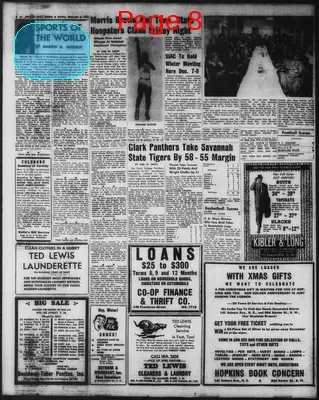
Story
December 5, 1954
Atlanta Daily World
Atlanta, Fulton County, Georgia
What is this article about?
The Orange Blossom Classic in Miami is the premier U.S. interracial football event, showcasing innovative Black coaching techniques, the famed Marching 100 band, and widespread local support, drawing large mixed crowds and fostering goodwill. (187 chars)
Clipping
OCR Quality
95%
Excellent
Full Text
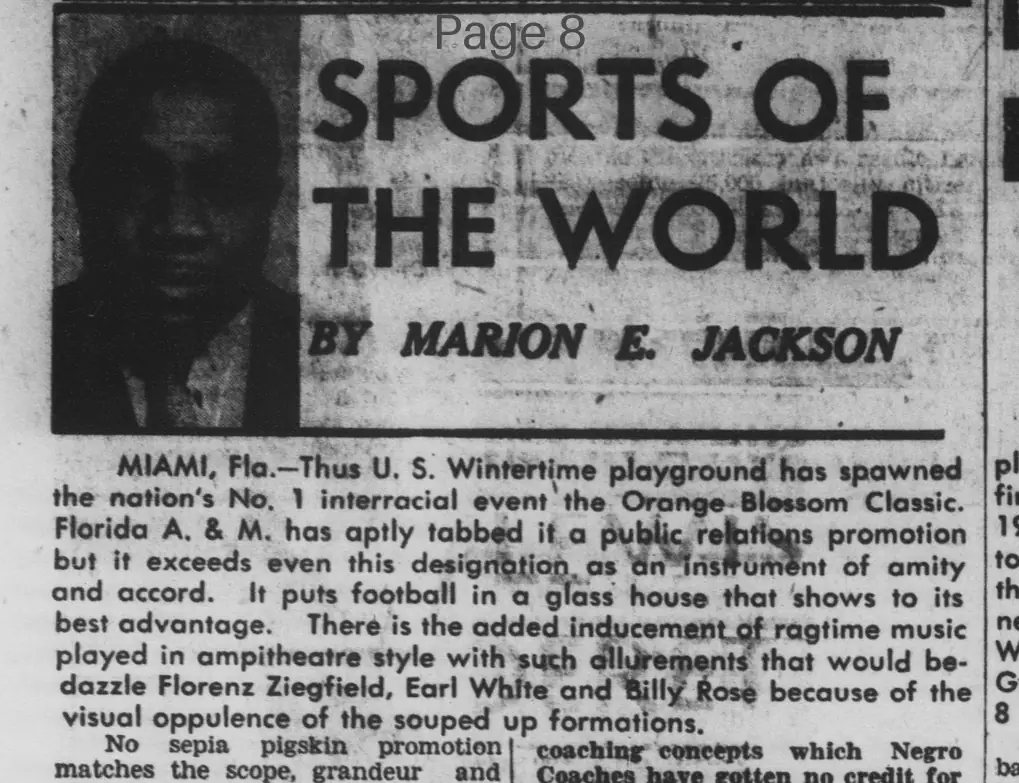
SPORTS OF THE WORLD
BY MARION E. JACKSON
MIAMI, Fla.—This U. S. wintertime playground has spawned the nation's No. 1 interracial event—the Orange Blossom Classic.
Florida A. & M. has aptly tabbed it a public relations promotion but it exceeds even this designation, as an instrument of amity and accord. It puts football in a glass house that shows to its best advantage. There is the added inducement of ragtime music played in amphitheatre style with such allurements that would bedazzle Florenz Ziegfeld, Earl White and Billy Rose because of the visual opulence of the souped up formations.
No sepia pigskin promotion matches the scope, grandeur and magnificence of this Orange Blossom Classic. It entices folks from throughout the country to Burdine (Orange Bowl) Stadium and rarely are they disappointed in the titanic fury of the contest or the razzle-dazzle gyrations of the band.
Likewise, football played here has revealed a strange treasure chest of coaching genius. In a sport where tricks of the trade make or break a coach the past masters of the craft have shown skills that have revolutionized techniques of the game.
Among those displaying their gifts for "crossing up" the opposition since the game shifted to Miami have been H. B. (Big Jeff) Jefferson (Hampton Institute), Sam Taylor (Virginia Union), William (Bill) Bell (North Carolina A&T), Gaston Lewis (Central State), Herman Riddick (North Carolina State). Sylvester (Sal) Hall (Virginia State College), W. J. Nicks, Sr. (Prairie View) and Vernon McCain (Maryland State).
Each has impressed Miami and national coaches with the imagination and daring of their attack and the precision and solidity of their defense.
There have been revolutionary coaching concepts which Negro coaches have gotten no credit for introducing which were first exploited in this classic. Many of the formations, spreads and line shifts which have popped up in the SEC, Big 10 and Southern Conference had their premiere in the Classic.
It is unfortunate that the publicity mills which hailed them when they were introduced elsewhere did not have the diligence to pursue the origination of these plays.
Not many of the major college coaches have had the frankness to confess, as did Robert Lee (Bobby) Dodd of Georgia Tech, that he had learned something from seeing the A&M-Virginia State game. Dodd admitted that he adopted several of Sylvester (Sal) Hall's spreads, polished them up to suit his attack, and put them into the Tech play archives.
The glass house aspect of the game has been reflected in the tremendous acclaim of the "Marching 100" directed by William Z. Foster. The band can rattle off eight to 17 formations during one show while clipping off steps at a cadence that varies from 80 to 320 steps per minute.
In an intellectual atmosphere where perfection is a rarity the nearest thing to perpetual motion infallibility is the celebrated "Marching 100" which has esprit de corps, dash, showmanship and color galore.
The workhorse team of Foster, Clarence Trice and Charles Cox works with such zeal and fervor that the band sheds as much energy in a thirty minute stint as the average football team in an eight game schedule.
Behind the coaching, football team and the band is the Miami citizenry. No Deep South metropolis anywhere greets a football game with the affection and cordiality as the newspapers, television, radio and public here.
There isn't an iota of difference in the reception that A&M gets here from that accorded the University of Miami, University of Florida, Florida State or anybody else from Maryland, Oklahoma, Alabama etc. The newspapers give the game banner headlines and full page pictorial layouts, radio and television interviews are accorded Jake Gaither and his staff as though he was Jim Tatum, Bud Wilkinson, Red Saunders, Red Drew, Don Faurot, or Red Drew.
The goodwill atmosphere has permeated the citizenry as a result. Last year some 26,000 majority citizens and 20,000 of the minority viewed the game - the largest interracial crowd to see a game in the United States.
Their tumult and shouting and
BY MARION E. JACKSON
MIAMI, Fla.—This U. S. wintertime playground has spawned the nation's No. 1 interracial event—the Orange Blossom Classic.
Florida A. & M. has aptly tabbed it a public relations promotion but it exceeds even this designation, as an instrument of amity and accord. It puts football in a glass house that shows to its best advantage. There is the added inducement of ragtime music played in amphitheatre style with such allurements that would bedazzle Florenz Ziegfeld, Earl White and Billy Rose because of the visual opulence of the souped up formations.
No sepia pigskin promotion matches the scope, grandeur and magnificence of this Orange Blossom Classic. It entices folks from throughout the country to Burdine (Orange Bowl) Stadium and rarely are they disappointed in the titanic fury of the contest or the razzle-dazzle gyrations of the band.
Likewise, football played here has revealed a strange treasure chest of coaching genius. In a sport where tricks of the trade make or break a coach the past masters of the craft have shown skills that have revolutionized techniques of the game.
Among those displaying their gifts for "crossing up" the opposition since the game shifted to Miami have been H. B. (Big Jeff) Jefferson (Hampton Institute), Sam Taylor (Virginia Union), William (Bill) Bell (North Carolina A&T), Gaston Lewis (Central State), Herman Riddick (North Carolina State). Sylvester (Sal) Hall (Virginia State College), W. J. Nicks, Sr. (Prairie View) and Vernon McCain (Maryland State).
Each has impressed Miami and national coaches with the imagination and daring of their attack and the precision and solidity of their defense.
There have been revolutionary coaching concepts which Negro coaches have gotten no credit for introducing which were first exploited in this classic. Many of the formations, spreads and line shifts which have popped up in the SEC, Big 10 and Southern Conference had their premiere in the Classic.
It is unfortunate that the publicity mills which hailed them when they were introduced elsewhere did not have the diligence to pursue the origination of these plays.
Not many of the major college coaches have had the frankness to confess, as did Robert Lee (Bobby) Dodd of Georgia Tech, that he had learned something from seeing the A&M-Virginia State game. Dodd admitted that he adopted several of Sylvester (Sal) Hall's spreads, polished them up to suit his attack, and put them into the Tech play archives.
The glass house aspect of the game has been reflected in the tremendous acclaim of the "Marching 100" directed by William Z. Foster. The band can rattle off eight to 17 formations during one show while clipping off steps at a cadence that varies from 80 to 320 steps per minute.
In an intellectual atmosphere where perfection is a rarity the nearest thing to perpetual motion infallibility is the celebrated "Marching 100" which has esprit de corps, dash, showmanship and color galore.
The workhorse team of Foster, Clarence Trice and Charles Cox works with such zeal and fervor that the band sheds as much energy in a thirty minute stint as the average football team in an eight game schedule.
Behind the coaching, football team and the band is the Miami citizenry. No Deep South metropolis anywhere greets a football game with the affection and cordiality as the newspapers, television, radio and public here.
There isn't an iota of difference in the reception that A&M gets here from that accorded the University of Miami, University of Florida, Florida State or anybody else from Maryland, Oklahoma, Alabama etc. The newspapers give the game banner headlines and full page pictorial layouts, radio and television interviews are accorded Jake Gaither and his staff as though he was Jim Tatum, Bud Wilkinson, Red Saunders, Red Drew, Don Faurot, or Red Drew.
The goodwill atmosphere has permeated the citizenry as a result. Last year some 26,000 majority citizens and 20,000 of the minority viewed the game - the largest interracial crowd to see a game in the United States.
Their tumult and shouting and
What sub-type of article is it?
Historical Event
Personal Triumph
What themes does it cover?
Triumph
Moral Virtue
Social Manners
What keywords are associated?
Orange Blossom Classic
Interracial Football
Coaching Genius
Marching 100
Miami Support
What entities or persons were involved?
Marion E. Jackson
H. B. (Big Jeff) Jefferson
Sam Taylor
William (Bill) Bell
Gaston Lewis
Herman Riddick
Sylvester (Sal) Hall
W. J. Nicks Sr.
Vernon Mccain
Robert Lee (Bobby) Dodd
William Z. Foster
Clarence Trice
Charles Cox
Jake Gaither
Where did it happen?
Miami, Fla., Burdine (Orange Bowl) Stadium
Story Details
Key Persons
Marion E. Jackson
H. B. (Big Jeff) Jefferson
Sam Taylor
William (Bill) Bell
Gaston Lewis
Herman Riddick
Sylvester (Sal) Hall
W. J. Nicks Sr.
Vernon Mccain
Robert Lee (Bobby) Dodd
William Z. Foster
Clarence Trice
Charles Cox
Jake Gaither
Location
Miami, Fla., Burdine (Orange Bowl) Stadium
Story Details
The Orange Blossom Classic is described as the nation's top interracial football event, promoting amity through exciting games, innovative coaching by Black coaches, and performances by the Marching 100 band, with strong support from Miami's citizenry leading to large interracial crowds.