Thank you for visiting SNEWPapers!
Sign up free
The National Intelligencer And Washington Advertiser
Washington, District Of Columbia
What is this article about?
An editorial defending Jefferson's Republican administration against Federalist claims of declining support, by comparing 1800 presidential election votes (73 Republican to 65 Federal) with projected 1802 votes under new census (129 Republican to 44 Federal), analyzing state-by-state strengths and attributing Republican gains to information diffusion, wise policies, and western population growth.
Merged-components note: Merged tables and text across pages 1 and 2, including the story continuation, as they form a single cohesive editorial analyzing the relative strength of Republican and Federal parties in the 1800 election and projected for 1802. The original 'story' label for the continuation is adjusted to 'editorial' to reflect the opinionated political analysis.
Clippings
1 of 2
OCR Quality
Full Text
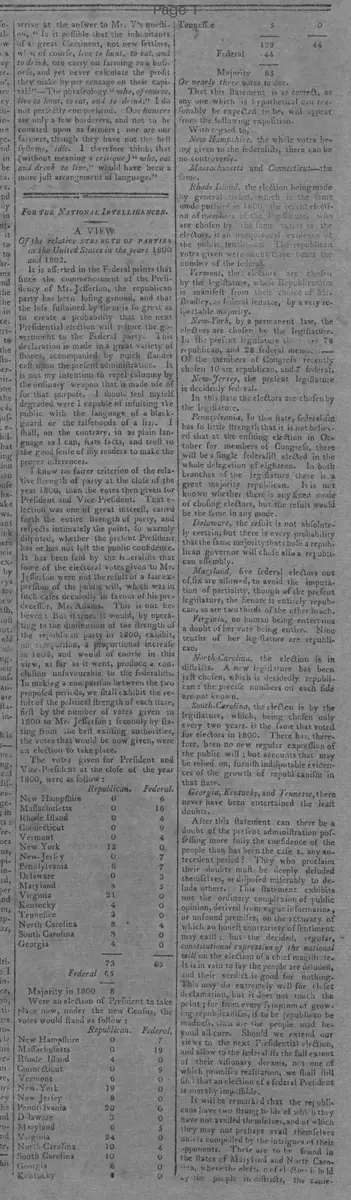
A VIEW
Of the relative STRENGTH OF PARTIES
in the United States in the years 1800
and 1802.
It is asserted in the Federal prints that since the commencement of the Presidency of Mr. Jefferson, the republican party has been losing ground, and that the loss sustained by them is so great as to create a probability that the next Presidential election will restore the government to the Federal party. This declaration is made in a great variety of shapes, accompanied by much slander cast upon the present administration. It is not my intention to repel calumny by the ordinary weapon that is made use of for that purpose. I should feel myself degraded were I capable of insulting the public with the language of a blackguard or the falsehoods of a liar. I shall, on the contrary, in as plain language as I can, state facts, and trust to the good sense of my readers to make the proper inferences.
I know no fairer criterion of the relative strength of party at the close of the year 1800, than the votes then given for President and Vice-President. That election was one of great interest, called forth the entire strength of party, and respects intimately the point, so warmly disputed, whether the present President has or has not lost the public confidence. It has been said by the federalists that some of the electoral votes given to Mr. Jefferson were not the result of a fair expression of the public will, which was in such cases decidedly in favour of his predecessor, Mr. Adams. This is not believed: But if true, it would, by operating to the diminution of the strength of the republican party in 1800, exhibit, on comparison, a proportional increase in 1802, and would of course in this view, as far as it went, produce a conclusion unfavourable to the federalists.
In making a comparison between the two proposed periods, we shall exhibit the result of the political strength of each state, first by the number of votes given in 1800 to Mr. Jefferson; secondly by stating from the best existing authorities, the votes that would be now given, were an election to take place.
The votes given for President and Vice-President at the close of the year 1800, were as follow:
[Majority in 1800: 8]
Were an election of President to take place now, under the new Census, the votes would stand as follow:
[Or nearly three votes to one.]
That this statement is as correct, as any one which is hypothetical can reasonably be expected to be, will appear from the following exposition.
With regard to, New Hampshire, the whole votes being given to the federalists, there can be no controversy.
Massachusetts and Connecticut the same.
Rhode Island, the election being made by general ticket, which is the same mode pursued in 1800 the recent election of members of the Legislature, who are chosen by the same voters as the electors, is an unequivocal evidence of the public sentiments. The republican votes given were about three times the number of the federal,
Vermont, the electors are chosen by the legislature, whose Republicanism is manifest from their choice of Mr. Bradley, as federal senator, by a very respectable majority.
New-York, by a permanent law, the electors are chosen by the legislature. In the present legislature there are 78 republican, and 28 federal members. Of the members of Congress recently chosen 10 are republican, and 7 federal.
New-Jersey, the present legislature is decidedly federal. In this state the electors are chosen by the legislature.
Pennsylvania, In this state, federalism has so little strength that it is not believed that at the ensuing election in October for members of Congress, there will be a single federalist elected in the whole delegation of eighteen. In both branches of the legislature there is a great majority republican. It is not known whether there is any fixed mode of choosing electors, but the result would be the same in any mode.
Delaware, the result is not absolutely certain, but there is every probability that the same majority that chose a republican governor will choose also a republican assembly.
Maryland, five federal electors out of ten are allowed, to avoid the imputation of partiality, though of the present legislature, the Senate is entirely republican, as are two thirds of the other branch.
Virginia, no human being entertains a doubt of her vote being entire. Nine tenths of her legislature are republican.
North-Carolina, the election is in districts. A new legislature has been just chosen, which is decidedly republican: the precise numbers on each side are not known.
South-Carolina, the election is by the legislature, which, being chosen only every two years, is the same that voted for electors in 1800. There has, therefore, been no new regular expression of the public will; but accounts that may be relied on, furnish indisputable evidences of the growth of republicanism in that state.
Georgia, Kentucky, and Tennessee, there never have been entertained the least doubts.
After this statement can there be a doubt of the present administration possessing more fully the confidence of the people than has been the case at any antecedent period? They who proclaim their doubts must be deeply deluded themselves, or disposed miserably to delude others. This statement exhibits not the ordinary complexion of public opinion, derived from vague information, or unsound premises, on the accuracy of which an honest contrariety of sentiment may exist; but the decided, regular, constitutional expression of the national will on the election of a chief magistrate. It is in vain to say the people are deluded, and their verdict is good for nothing- This may do extremely well for closet declamation, but it does not touch the point; for from every symptom of growing republicanism, if to be republican be madness, then are the people mad beyond all cure. Should we extend our views to the next Presidential election, and allow to the federalists the full extent of their visionary dreams, not one of which promises realization, we shall still find that an election of a federal President is morally impossible.
It will be remarked that the republicans have two strong holds of which they have not availed themselves, and of which they may not perhaps avail themselves unless compelled by the intrigues of their opponents. These are to be found in the states of Maryland and North Carolina, where the election of electors is held by the people in districts, the conle-
| Republican. | Federal. | |
| New Hampshire | 0 | 6 |
| Maffachuletts | 0 | 16 |
| Rhode Island | 0 | 4 |
| Connecticut | 0 | 9 |
| Vermont | 0 | 4 |
| New York | 12 | 0 |
| New-Jersey | 0 | 7 |
| Pennsylvania | 8 | 7 |
| Delaware | 0 | 3 |
| Maryland | 5 | 5 |
| Virginia | 21 | 0 |
| Kentucky | 4 | 0 |
| Tennessee | 3 | 0 |
| North Carolina | 8 | 4 |
| South Carolina | 3 | 0 |
| Georgia | 4 | 0 |
| 73 | 65 |
| Tenneflce | 5 | 0 |
| 129 | 44 | |
| Federal | 44 | |
| Republican | Federal | |
| New Hampshire | 0 | 7 |
| Maffachutets | 0 | 19 |
| Rhode Island | 4 | 0 |
| Connecticut | 0 | 9 |
| Vermont | 6 | 0 |
| New York | 19 | 0 |
| New Jersey | 8 | 0 |
| Pennsylvania | 20 | 0 |
| Daware | 3 | 0 |
| Maryland | 6 | 5 |
| Virginia | 24 | 0 |
| North Carolina | 10 | 4 |
| South Carolina | 10 | 0 |
| Georgia | 6 | 0 |
| Kentucky | 8 | 0 |
| Republican | Federal |
| New Hampshire | 7 |
| Maine | 19 |
| Rhode Island | 4 |
| Connecticut | 9 |
| Vermont | 6 |
| New York | 19 |
| New Jersey | 8 |
| Pennsylvania | 0 |
| Delaware | 3 |
| Maryland | 0 |
| Virginia | 0 |
| North Carolina | 0 |
| South Carolina | 10 |
| Georgia | 0 |
| Kentucky | 0 |
| Tennessee | 0 |
| 88 |
Commencement of which is a division of the votes.
The federalists have, in other states where they could, consolidated them whole strength, by dividing the chase to be made by the legislature, or, in a general ticket, by the people. They have thus given the result of an union's vote to states greatly divided, by suppressing the most respectable minorities. This they have done in New-Hampshire, Massachusetts, Connecticut, Vermont, New-Jersey, and Delaware. The republicans may do the same in Maryland and North Carolina. That they will have the power in the former there can be no doubt. The present Senate, every member of which is republican, continues beyond the next election, and there is scarcely a possibility that in either branch a majority of two thirds can in ten years sink into a minority, particularly, when we consider the amendment of the Constitution, which by extending the right of suffrage, will infuse new vigor into the republicans. And North Carolina, having been, without exception, republican, since the adoption of the constitution, no doubt can be entertained of the stability of her politics.
Let us then for a moment indulge our adversaries in their wildest dreams. Give them the full fruits of a wide spread detractor, and let us mark the result. Give them back again Rhode Island, Vermont, New-Jersey, and Delaware, allow them every vote in those states. If their intrigues subvert the political integrity of New-York. This is a prize worthy of the loftiest ambition. Be generous, and I give them. Proceed, and throw South-Carolina into the bargain. Let her too be bound a victim to intrigue. They have now got all they ever dream of. More they cannot possibly get. And what is the result? Disappointment and defeat. Still will the republicans carry their President. Behold this demonstrated.
Federal 85
Republican Majority, 3
Thus, it is evident: that no event short of miracle can prevent the republicans from obtaining a republican President at the ensuing election.
It may be interesting to enquire, by what means, this great change has been effected.
It has been occasioned by three leading causes, which though not absolutely distinct from each other, admit of distinct illustration.
1. The wide diffusion of political information.
2. The wise acts of the administration.
3. The rapid increase of our numbers, and especially, the increased population of our western country.
The two first causes are sufficiently well understood, as they are the standing topics of political discussion. But the last has been little noticed. To it, therefore, we shall confine our remarks.
The commencement of our revolution found public opinion greatly divided. The crisis called for decisive measures. measures of great energy, which soon produced a state of war. In this situation of the country the open expression of opinion was entirely suppressed on one side. The tories, who were a designated from their anti-republican sentiments, and attachment to Britain, were compelled to be silent or depart. Some went into exile, but more were silent and passive.
Our cause triumphed, liberty was established, and peace returned to reward our labours. With it also returned those disaffected to liberty, with their unexhausted resources. It is not in human nature to wage a long uninterrupted effort. War, of all human efforts, most exhausts the vigor of those engaged in it. Our war not only exhausted their vigor, but deprived them of their means of subsistence; and the whigs sunk into repose under the flattering belief of security.
The tories were generally men of wealth. Having carefully husbanded their resources, during the perilous period, they came forth, on the return of peace, with mighty influence. They were reinforced by a large body of men. no less formidable. Our trading towns became crammed with British merchants and agents; and all the commerce of the country instantaneously fell into the hands of these two descriptions of people.
A gigantic interest immediately sprang up, which in many parts of the Union carried all before it. Not confined to the acquisition of wealth, it entered our public councils, and in many places swayed them. A large portion of our citizens, who had supported the revolution, as it now appeared not so much from the love of republicanism, as from the pride of independence, or a spirit of adventure, augmented this powerful phalanx. and rendered it for a while irresistible.
The events that succeeded need not be told. They are fresh in our memories, and our country still bleeds from the wounds they inflicted on its peace.
To these events, a Spirit of resistance, calm, deliberate, energetic, gradually arose, which infused its efficacious influence through the whole extent of the Union. From the centre it passed to the body of the empire, where it acquired additional strength. Remote from scenes of mercenary traffic, it found among the independent yeomanry minds unprejudiced by foreign attachments, minds truly American, minds which, by the act part, had unfolded since the era of independence. The honest exercise of an independent and well informed judgment always leads to truth: and it has been the fortunate lot of our western brethren never to disregard or disobey it. The western states have always been republican.
At first they rose with little to attract admiration or inspire fear. But a few succeeding years have carried them to wealth and a vast population.
It is to those states that we owe so much of our political happiness. It is to their increasing strength that we shall be indebted for more security than we even now enjoy. The late census has given them their legitimate political weight. Had this weight been felt in the presidential election preceding the last, Mr. Adams had never been President, we should have had no alien or sedition laws, no political courts to put down, no immense standing armies to reduce, no extravagant loans to redeem.
I have been inadvertently drawn into a digression, but I trust not unprofitably to my readers. If unprofitably to them, certainly not uninteresting to myself. The subject, in my opinion, merits deep and frequent reflection. An enthusiast in the cause of republican liberty, binding all my hopes of happiness on its existence among us, I rejoice to find that it derives its great support from the planter, the farmers and the mechanic. of our interior country, whose devotion to it can only arise from an independent and disinterested conviction of its superiority to every other system that has been established. I rejoice to find that a virtuous administration, resting on this impregnable basis, may, such in the esteem of the largest and most honest portion of the community, pass with impunity the calumnies of diffidence and disappointment. I rejoice to see that each revolving year will increase this support, and render our liberty and happiness more and more secure.
(Other corroborating views will follow.)
What sub-type of article is it?
What keywords are associated?
What entities or persons were involved?
Editorial Details
Primary Topic
Relative Strength Of Republican And Federalist Parties In 1800 And 1802
Stance / Tone
Strongly Pro Republican, Defending Jefferson Against Federalist Slander
Key Figures
Key Arguments