Thank you for visiting SNEWPapers!
Sign up free
The Morning Star
Providence, Providence County, Rhode Island
What is this article about?
Bishop Thomas M. Clark delivered a discourse on 'Our Political Dangers' at Grace Church, discussing corruption in republican government, suffrage issues, political indifference, and the need for moral and religious principles in public affairs to avert perils.
Clipping
OCR Quality
Full Text
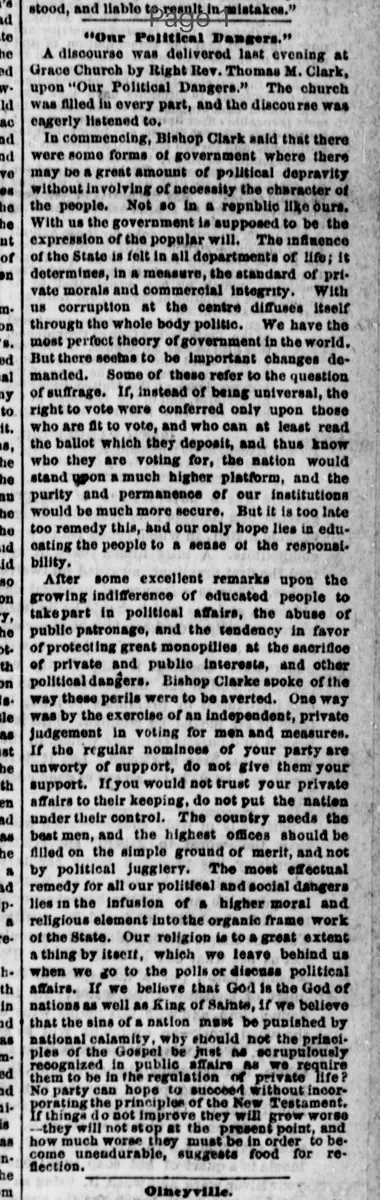
A discourse was delivered last evening at Grace Church by Right Rev. Thomas M. Clark, upon "Our Political Dangers." The church was filled in every part, and the discourse was eagerly listened to.
In commencing, Bishop Clark said that there were some forms of government where there may be a great amount of political depravity without involving of necessity the character of the people. Not so in a republic like ours. With us the government is supposed to be the expression of the popular will. The influence of the State is felt in all departments of life; it determines, in a measure, the standard of private morals and commercial integrity. With us corruption at the centre diffuses itself through the whole body politic. We have the most perfect theory of government in the world. But there seems to be important changes demanded. Some of these refer to the question of suffrage. If, instead of being universal, the right to vote were conferred only upon those who are fit to vote, and who can at least read the ballot which they deposit, and thus know who they are voting for, the nation would stand upon a much higher platform, and the purity and permanence of our institutions would be much more secure. But it is too late to remedy this, and our only hope lies in educating the people to a sense of the responsibility.
After some excellent remarks upon the growing indifference of educated people to take part in political affairs, the abuse of public patronage, and the tendency in favor of protecting great monopolies at the sacrifice of private and public interests, and other political dangers, Bishop Clark spoke of the way these perils were to be averted. One way was by the exercise of an independent, private judgement in voting for men and measures. If the regular nominees of your party are unworthy of support, do not give them your support. If you would not trust your private affairs to their keeping, do not put the nation under their control. The country needs the best men, and the highest offices should be filled on the simple ground of merit, and not by political jugglery. The most effectual remedy for all our political and social dangers lies in the infusion of a higher moral and religious element into the organic frame work of the State. Our religion is to a great extent a thing by itself, which we leave behind us when we go to the polls or discuss political affairs. If we believe that God is the God of nations as well as King of Saints, if we believe that the sins of a nation must be punished by national calamity, why should not the principles of the Gospel be just as scrupulously recognized in public affairs as we require them to be in the regulation of private life? No party can hope to succeed without incorporating the principles of the New Testament. If things do not improve they will grow worse -they will not stop at the present point, and how much worse they must be in order to become unendurable, suggests food for reflection.
What sub-type of article is it?
What themes does it cover?
What keywords are associated?
What entities or persons were involved?
Where did it happen?
Story Details
Key Persons
Location
Grace Church
Event Date
Last Evening
Story Details
Bishop Clark warns of political dangers in the republic, including corruption, universal suffrage issues, indifference to politics, patronage abuse, and monopolies. He advocates independent voting, merit-based appointments, and infusing moral and religious principles from the Gospel into public affairs to avert national calamity.