Thank you for visiting SNEWPapers!
Sign up free
The Morning News
Savannah, Chatham County, Georgia
What is this article about?
The American Federation of Labor's national convention opened on Dec. 9 in New York at Madison Square Garden, attended by labor leaders from the US, Canada, and Great Britain. Key topics include officer elections, headquarters relocation, and a push for an 8-hour workday on May 1, 1896. Reports were read, committees appointed, and addresses delivered by John Swinton and Rev. Father Ducey.
Clipping
OCR Quality
Full Text
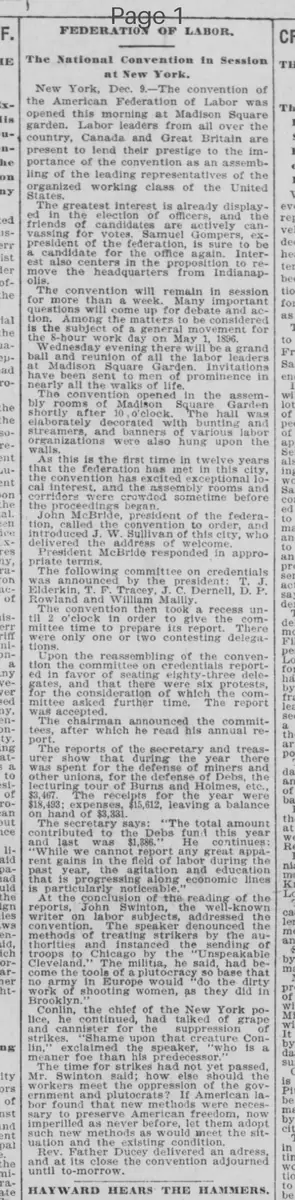
The National Convention in Session at New York.
New York, Dec. 9.—The convention of the American Federation of Labor was opened this morning at Madison Square garden. Labor leaders from all over the country, Canada and Great Britain are present to lend their prestige to the importance of the convention as an assembling of the leading representatives of the organized working class of the United States.
The greatest interest is already displayed in the election of officers, and the friends of candidates are actively canvassing for votes. Samuel Gompers, ex-president of the federation, is sure to be a candidate for the office again. Interest also centers in the proposition to remove the headquarters from Indianapolis.
The convention will remain in session for more than a week. Many important questions will come up for debate and action. Among the matters to be considered is the subject of a general movement for the 8-hour work day on May 1, 1896.
Wednesday evening there will be a grand ball and reunion of all the labor leaders at Madison Square Garden. Invitations have been sent to men of prominence in nearly all the walks of life.
The convention opened in the assembly rooms of Madison Square Garden shortly after 10 o'clock. The hall was elaborately decorated with bunting and streamers, and banners of various labor organizations were also hung upon the walls.
As this is the first time in twelve years that the federation has met in this city, the convention has excited exceptional local interest, and the assembly rooms and corridors were crowded sometime before the proceedings began.
John McBride, president of the federation, called the convention to order, and introduced J. W. Sullivan of this city, who delivered the address of welcome. President McBride responded in appropriate terms.
The following committee on credentials was announced by the president: T. J. Elderkin, T. F. Tracey, J. C. Dermell, D. P. Rowland and William Malloy.
The convention then took a recess until 2 o'clock in order to give the committee time to prepare its report. There were only one or two contesting delegations.
Upon the reassembling of the convention the committee on credentials reported in favor of seating eighty-three delegates, and that there were six protests, for the consideration of which the committee asked further time. The report was accepted.
The chairman announced the committees, after which he read his annual report.
The reports of the secretary and treasurer show that during the year there was spent for the defense of miners and other unions, for the defense of Debs, the lecturing tour of Burns and Holmes, etc., $3,467. The receipts for the year were $18,493; expenses, $15,612, leaving a balance on hand of $3,331.
The secretary says: "The total amount contributed to the Debs fund this year and last was $1,386." He continues:
"While we cannot report any great apparent gains in the field of labor during the past year, the agitation and education that is progressing along economic lines is particularly noticeable."
At the conclusion of the reading of the reports, John Swinton, the well-known writer on labor subjects, addressed the convention. The speaker denounced the methods of treating strikers by the authorities and instanced the sending of troops to Chicago by the unspeakable Cleveland. The militia, he said, had become the tools of a plutocracy so base that no army in Europe would do the dirty work of shooting women, as they did in Brooklyn.
Conlin, the chief of the New York police, he continued, had talked of grape and canister for the suppression of strikes. "Shame upon that creature Conlin," exclaimed the speaker, "who is a meaner foe than his predecessor."
The time for strikes had not yet passed, Mr. Swinton said; how else should the workers meet the oppression of the government and plutocrats? If American labor found that new methods were necessary to preserve American freedom, now imperilled as never before, let them adopt such new methods as would meet the situation and the existing condition.
Rev. Father Ducey delivered an address, and at its close the convention adjourned until to-morrow.
What sub-type of article is it?
What keywords are associated?
What entities or persons were involved?
Where did it happen?
Domestic News Details
Primary Location
New York
Event Date
Dec. 9
Key Persons
Outcome
convention opened with 83 delegates seated; six protests pending; financial reports showed $18,493 receipts, $15,612 expenses, $3,331 balance; adjourned until tomorrow; grand ball scheduled for wednesday evening.
Event Details
The American Federation of Labor convention opened at Madison Square Garden with labor leaders from the US, Canada, and Great Britain. President John McBride called it to order; J. W. Sullivan gave welcome address. Credentials committee seated 83 delegates. Annual reports read, including finances and Debs fund contributions. John Swinton addressed on labor oppression and strikes; Rev. Father Ducey spoke. Topics include officer elections, headquarters move, and 8-hour workday movement.