Thank you for visiting SNEWPapers!
Sign up free
Literary
September 23, 1911
The Wichita Searchlight
Wichita, Sedgwick County, Kansas
What is this article about?
Article advises builders to prioritize attractive interior features like fireplaces and built-in closets for increased property value, even if borrowing more, as they enhance selling or rental potential. Describes a $2,500 small house design with separated stair hall for privacy.
Clipping
OCR Quality
98%
Excellent
Full Text
Mr. William A. Radford will answer questions and give advice FREE OF COST on all subjects pertaining to the subject of building, for the readers of this paper. On account of his wide experience as Editor, Author and Manufacturer, he is, without doubt, the highest authority on all these subjects. Address all inquiries to William A. Radford, No. 178 West Jackson boulevard, Chicago, Ill., and only enclose two-cent stamp for reply.
Real estate dealers and speculative builders in the larger cities and suburban towns have long realized that every dollar spent in making more attractive the interior of the houses that they offer will come back ten-fold in the increased selling price that can be obtained or the larger rental that can be asked.
This is something which the home builder who has but a limited amount to invest, or the builder in the smaller towns, does not always realize. Indeed, it really pays better in the end to cut down the size of the house if it should become necessary to economize, rather than to omit any features which add to the selling value of the property.
One may say that he is building a house for himself, that he has no intention of selling, but expects to live in the house for the rest of his life and can do without the frills if only the house is big enough to accommodate the actual needs. What, therefore, is the necessity of considering selling or rental value?
Things that are put off until another time are very apt to be left undone. It would be far wiser to cut down in some of the hidden features that he may regard as essential, rather than to omit those which show upon the surface and which make the difference between a box-like barracks and a home. When you stop to figure the matter out, the two or three hundred dollars additional which a man will have to borrow in order to include those items which will make his home attractive will at most add eighteen to twenty dollars a year to the interest charges which he will have to pay, while they will add fully a thousand dollars to the price he can realize for the house, or five dollars a month—perhaps more—to the amount of rent he could get for it.
There is an old and very true proverb that "man proposes, but God disposes;" and though a man may be building a home, circumstances may in time arise that make the sale or renting of the house imperative, and every feature that adds to its selling or rental value will be doubly appreciated. Death may make it necessary to sell the house in order to settle the estate. Business reasons that cannot be foreseen often compel a man much against his inclinations to move to some distant part of the country; and I have found out by personal experience that there is nothing more unsatisfactory as an investment than real estate which is so far away that the owner cannot see for himself whether repairs asked for by the tenant are really needed or not, but must be compelled to depend upon the word of the real estate agent, whose interests seem often to be rather with the tenant than with the landlord. At such a time, the owner realizes that anything which by catching the eye and the fancy of the prospective purchaser makes a house sell more readily is something decidedly to his advantage.
Attractive wall papers, while adding much to the selling value of the house that is erected as a real estate speculation, especially when chosen with a good taste and artistic feeling that is now possible to command even with the low-cost papers—can be better left for the future than any other item which the home builder needs to consider. Wall paper must be renewed every few years at best, and the paper hangers are no more objectionable to have about the house than the scrub women that seem to be an inevitable part of the spring and fall house cleaning.
Gas or electric features are another item that can, if necessary, be postponed till some time in the future, provided the house is piped or wired for them, because there is no need for expensive or disturbing mechanical work in placing them in position; but it is the poorest kind of economy to omit the necessary piping or wiring—according to the custom in the locality—or both in those towns where both gas and electricity are installed.
The man who is compelled to borrow money in order to build his house usually endeavors to keep the sum that he borrows down to the lowest possible notch, and will cut down wherever he can in order to accomplish this object. But it is possible to carry this pruning too far. To the man unfamiliar with the cost of building, the things which appear to be most expensive are those items of interior finish and decoration which add the touch of elegance and refinement to the house. For the sake of saving from one to five hundred dollars—and often nearer the former figure than the latter—he will omit such items as fireplaces, mantels, built-in china closets, or attractive stair finish. He thinks, perhaps, that after the mortgage has been paid off he will add these features that he has omitted; but he forgets that it will cost very much more to add them later than to put them in at the time of building; to say nothing of the fact that those things which we put off until another time are very apt to be left undone.
But those features which are built into the house and which form an essential part of the construction or the finish should never be put off until a more convenient season, because the mechanical difficulty and the expense of adding them later will prevent them from ever being put in. The seat at the bottom of the stairs and which forms a part of the paneling should be built at the same time the stairs are, and made an essential feature of the design; and the same thing is true of the built-in china closet in the dining room.
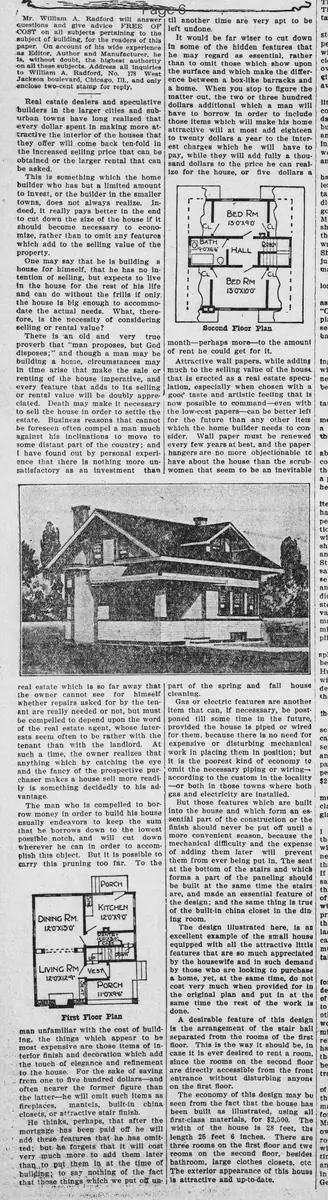
The design illustrated here, is an excellent example of the small house equipped with all the attractive little features that are so much appreciated by the housewife and in such demand by those who are looking to purchase a home, yet, at the same time, do not cost very much when provided for in the original plan and put in at the same time the rest of the work is done.
A desirable feature of this design is the arrangement of the stair hall separated from the rooms of the first floor. This is the way it should be, in case it is ever desired to rent a room, since the rooms on the second floor are directly accessible from the front entrance without disturbing anyone on the first floor.
The economy of this design may be seen from the fact that the house has been built as illustrated, using all first-class materials, for $2,500. The width of the house is 28 feet, the length 25 feet 6 inches. There are three rooms on the first floor and two rooms on the second floor, besides bathroom, large clothes closets, etc. The exterior appearance of this house is attractive and up-to-date.
First Floor Plan
Real estate dealers and speculative builders in the larger cities and suburban towns have long realized that every dollar spent in making more attractive the interior of the houses that they offer will come back ten-fold in the increased selling price that can be obtained or the larger rental that can be asked.
This is something which the home builder who has but a limited amount to invest, or the builder in the smaller towns, does not always realize. Indeed, it really pays better in the end to cut down the size of the house if it should become necessary to economize, rather than to omit any features which add to the selling value of the property.
One may say that he is building a house for himself, that he has no intention of selling, but expects to live in the house for the rest of his life and can do without the frills if only the house is big enough to accommodate the actual needs. What, therefore, is the necessity of considering selling or rental value?
Things that are put off until another time are very apt to be left undone. It would be far wiser to cut down in some of the hidden features that he may regard as essential, rather than to omit those which show upon the surface and which make the difference between a box-like barracks and a home. When you stop to figure the matter out, the two or three hundred dollars additional which a man will have to borrow in order to include those items which will make his home attractive will at most add eighteen to twenty dollars a year to the interest charges which he will have to pay, while they will add fully a thousand dollars to the price he can realize for the house, or five dollars a month—perhaps more—to the amount of rent he could get for it.
There is an old and very true proverb that "man proposes, but God disposes;" and though a man may be building a home, circumstances may in time arise that make the sale or renting of the house imperative, and every feature that adds to its selling or rental value will be doubly appreciated. Death may make it necessary to sell the house in order to settle the estate. Business reasons that cannot be foreseen often compel a man much against his inclinations to move to some distant part of the country; and I have found out by personal experience that there is nothing more unsatisfactory as an investment than real estate which is so far away that the owner cannot see for himself whether repairs asked for by the tenant are really needed or not, but must be compelled to depend upon the word of the real estate agent, whose interests seem often to be rather with the tenant than with the landlord. At such a time, the owner realizes that anything which by catching the eye and the fancy of the prospective purchaser makes a house sell more readily is something decidedly to his advantage.
Attractive wall papers, while adding much to the selling value of the house that is erected as a real estate speculation, especially when chosen with a good taste and artistic feeling that is now possible to command even with the low-cost papers—can be better left for the future than any other item which the home builder needs to consider. Wall paper must be renewed every few years at best, and the paper hangers are no more objectionable to have about the house than the scrub women that seem to be an inevitable part of the spring and fall house cleaning.
Gas or electric features are another item that can, if necessary, be postponed till some time in the future, provided the house is piped or wired for them, because there is no need for expensive or disturbing mechanical work in placing them in position; but it is the poorest kind of economy to omit the necessary piping or wiring—according to the custom in the locality—or both in those towns where both gas and electricity are installed.
The man who is compelled to borrow money in order to build his house usually endeavors to keep the sum that he borrows down to the lowest possible notch, and will cut down wherever he can in order to accomplish this object. But it is possible to carry this pruning too far. To the man unfamiliar with the cost of building, the things which appear to be most expensive are those items of interior finish and decoration which add the touch of elegance and refinement to the house. For the sake of saving from one to five hundred dollars—and often nearer the former figure than the latter—he will omit such items as fireplaces, mantels, built-in china closets, or attractive stair finish. He thinks, perhaps, that after the mortgage has been paid off he will add these features that he has omitted; but he forgets that it will cost very much more to add them later than to put them in at the time of building; to say nothing of the fact that those things which we put off until another time are very apt to be left undone.
But those features which are built into the house and which form an essential part of the construction or the finish should never be put off until a more convenient season, because the mechanical difficulty and the expense of adding them later will prevent them from ever being put in. The seat at the bottom of the stairs and which forms a part of the paneling should be built at the same time the stairs are, and made an essential feature of the design; and the same thing is true of the built-in china closet in the dining room.
The design illustrated here, is an excellent example of the small house equipped with all the attractive little features that are so much appreciated by the housewife and in such demand by those who are looking to purchase a home, yet, at the same time, do not cost very much when provided for in the original plan and put in at the same time the rest of the work is done.
A desirable feature of this design is the arrangement of the stair hall separated from the rooms of the first floor. This is the way it should be, in case it is ever desired to rent a room, since the rooms on the second floor are directly accessible from the front entrance without disturbing anyone on the first floor.
The economy of this design may be seen from the fact that the house has been built as illustrated, using all first-class materials, for $2,500. The width of the house is 28 feet, the length 25 feet 6 inches. There are three rooms on the first floor and two rooms on the second floor, besides bathroom, large clothes closets, etc. The exterior appearance of this house is attractive and up-to-date.
First Floor Plan
What sub-type of article is it?
Essay
What themes does it cover?
Commerce Trade
Moral Virtue
What keywords are associated?
Home Building
Interior Features
Real Estate Value
House Design
Economical Construction
What entities or persons were involved?
William A. Radford
Literary Details
Author
William A. Radford
Subject
Advice On Home Building And Interior Features For Value
Key Lines
Every Dollar Spent In Making More Attractive The Interior Of The Houses That They Offer Will Come Back Ten Fold In The Increased Selling Price
It Really Pays Better In The End To Cut Down The Size Of The House If It Should Become Necessary To Economize, Rather Than To Omit Any Features Which Add To The Selling Value Of The Property
Man Proposes, But God Disposes
The House Has Been Built As Illustrated, Using All First Class Materials, For $2,500