Thank you for visiting SNEWPapers!
Sign up free
Editorial
August 14, 1873
Saint Mary's Beacon
Leonardtown, Lexington Park, Saint Mary's County, Maryland
What is this article about?
Editorial critiques Farmer Smith's comparison of farmers to artisans, using 1860-1873 data to show both groups lost purchasing power for goods like alpaca, blankets, and boots due to protective tariffs, urging joint investigation.
Clipping
OCR Quality
95%
Excellent
Full Text
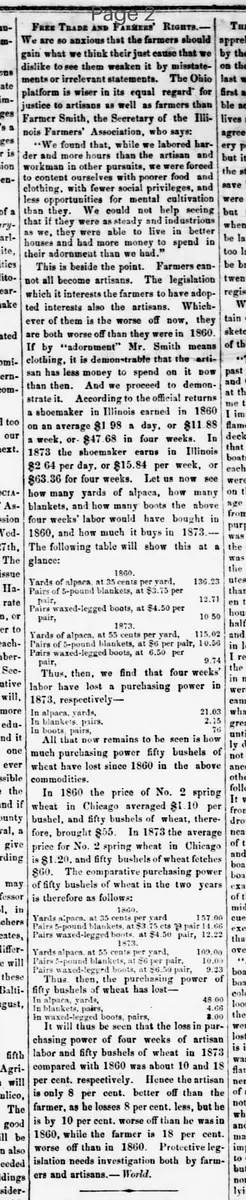
Free Trade and Farmers' Rights.—We are so anxious that the farmers should gain what we think their just cause that we dislike to see them weaken it by misstatements or irrelevant statements. The Ohio platform is wiser in its equal regard for justice to artisans as well as farmers than Farmer Smith, the Secretary of the Illinois Farmers' Association, who says: "We found that, while we labored harder and more hours than the artisan and workman in other pursuits, we were forced to content ourselves with poorer food and clothing, with fewer social privileges, and less opportunities for mental cultivation than they. We could not help seeing that if they were as steady and industrious as we, they were able to live in better houses and had more money to spend in their adornment than we had." This is beside the point. Farmers cannot all become artisans. The legislation which it interests the farmers to have adopted interests also the artisans. Whichever of them is the worse off now, they are both worse off than they were in 1860. If by "adornment" Mr. Smith means clothing, it is demonstrable that the artisan has less money to spend on it now than then. And we proceed to demonstrate it. According to the official returns a shoemaker in Illinois earned in 1860 on an average $1.98 a day, or $11.88 a week, or $47.68 in four weeks. In 1873 the shoemaker earns in Illinois $2.64 per day, or $15.84 per week, or $63.36 for four weeks. Let us now see how many yards of alpaca, how many blankets, and how many boots the above four weeks' labor would have bought in 1860, and how much it buys in 1873. The following table will show this at a glance:
1860.
Yards of alpaca, at 35 cents per yard, 136.23
Pairs of 5-pound blankets, at $3.75 per pair, 12.71
Pairs waxed-legged boots, at $4.50 per pair, 10.59
All that now remains to be seen is how much purchasing power fifty bushels of wheat have lost since 1860 in the above commodities. In 1860 the price of No. 2 spring wheat in Chicago averaged $1.10 per bushel, and fifty bushels of wheat, therefore, brought $55. In 1873 the average price for No. 2 spring wheat in Chicago is $1.20, and fifty bushels of wheat fetches $60. The comparative purchasing power of fifty bushels of wheat in the two years is therefore as follows:
1860.
Yards alpaca, at 35 cents per yard, 157.00
Pairs 5-pound blankets, at $3.75 cts per pair, 14.66
Pairs waxed-legged boots, at $4.50 pair, 12.22
1873.
Yards alpaca, at 55 cents per yard, 109.00
Pairs 5-pound blankets, at $6 per pair, 10.00
Pairs waxed-legged boots, at $6.50 pair, 9.23
Thus, then, the purchasing power of fifty bushels of wheat has lost—
In alpaca, yards, 48.00
In blankets, pairs, 4.66
In waxed-legged boots, pairs, 3.00
It will thus be seen that the loss in purchasing power of four weeks of artisan labor and fifty bushels of wheat in 1873 compared with 1860 was about 10 and 18 per cent. respectively. Hence the artisan is only 8 per cent. better off than the farmer, as he loses 8 per cent. less, but he is by 10 per cent. worse off than he was in 1860, while the farmer is 18 per cent. worse off than in 1860. Protective legislation needs investigation both by farmers and artisans.—World.
1860.
Yards of alpaca, at 35 cents per yard, 136.23
Pairs of 5-pound blankets, at $3.75 per pair, 12.71
Pairs waxed-legged boots, at $4.50 per pair, 10.59
All that now remains to be seen is how much purchasing power fifty bushels of wheat have lost since 1860 in the above commodities. In 1860 the price of No. 2 spring wheat in Chicago averaged $1.10 per bushel, and fifty bushels of wheat, therefore, brought $55. In 1873 the average price for No. 2 spring wheat in Chicago is $1.20, and fifty bushels of wheat fetches $60. The comparative purchasing power of fifty bushels of wheat in the two years is therefore as follows:
1860.
Yards alpaca, at 35 cents per yard, 157.00
Pairs 5-pound blankets, at $3.75 cts per pair, 14.66
Pairs waxed-legged boots, at $4.50 pair, 12.22
1873.
Yards alpaca, at 55 cents per yard, 109.00
Pairs 5-pound blankets, at $6 per pair, 10.00
Pairs waxed-legged boots, at $6.50 pair, 9.23
Thus, then, the purchasing power of fifty bushels of wheat has lost—
In alpaca, yards, 48.00
In blankets, pairs, 4.66
In waxed-legged boots, pairs, 3.00
It will thus be seen that the loss in purchasing power of four weeks of artisan labor and fifty bushels of wheat in 1873 compared with 1860 was about 10 and 18 per cent. respectively. Hence the artisan is only 8 per cent. better off than the farmer, as he loses 8 per cent. less, but he is by 10 per cent. worse off than he was in 1860, while the farmer is 18 per cent. worse off than in 1860. Protective legislation needs investigation both by farmers and artisans.—World.
What sub-type of article is it?
Economic Policy
Agriculture
Trade Or Commerce
What keywords are associated?
Free Trade
Farmers Rights
Protective Legislation
Purchasing Power
Artisans
Wheat Prices
Tariffs Impact
What entities or persons were involved?
Farmer Smith
Illinois Farmers' Association
Ohio Platform
Editorial Details
Primary Topic
Impact Of Protective Legislation On Farmers And Artisans' Purchasing Power Since 1860
Stance / Tone
Critical Of Protective Legislation And Farmers' Misstatements
Key Figures
Farmer Smith
Illinois Farmers' Association
Ohio Platform
Key Arguments
Farmers' Complaints Should Not Include Irrelevant Comparisons To Artisans
Both Farmers And Artisans Are Worse Off Than In 1860 Due To Lost Purchasing Power
Artisan Wages Increased But Prices Rose More, Losing 10% Purchasing Power
Farmers' Wheat Revenue Increased Slightly But Lost 18% Purchasing Power For Goods
Protective Legislation Harms Both Groups And Requires Investigation