Thank you for visiting SNEWPapers!
Sign up free
The Virginia Gazette
Richmond, Williamsburg, Richmond County, Virginia
What is this article about?
S. Henley, a clergyman, defends himself against accusations of suppressions, misrecitals, and unfaithful quotations in a dispute with 'The Real Associator' over authorship of Queries and personal attacks during a parish minister election. He refutes specific instances, exposes opponent's inconsistencies, and details Mr. Kidd's recantation of false claims of deism.
Merged-components note: Continuation of letter to the editor responding to 'REAL ASSOCIATOR' across pages.
Clippings
1 of 2
OCR Quality
Full Text
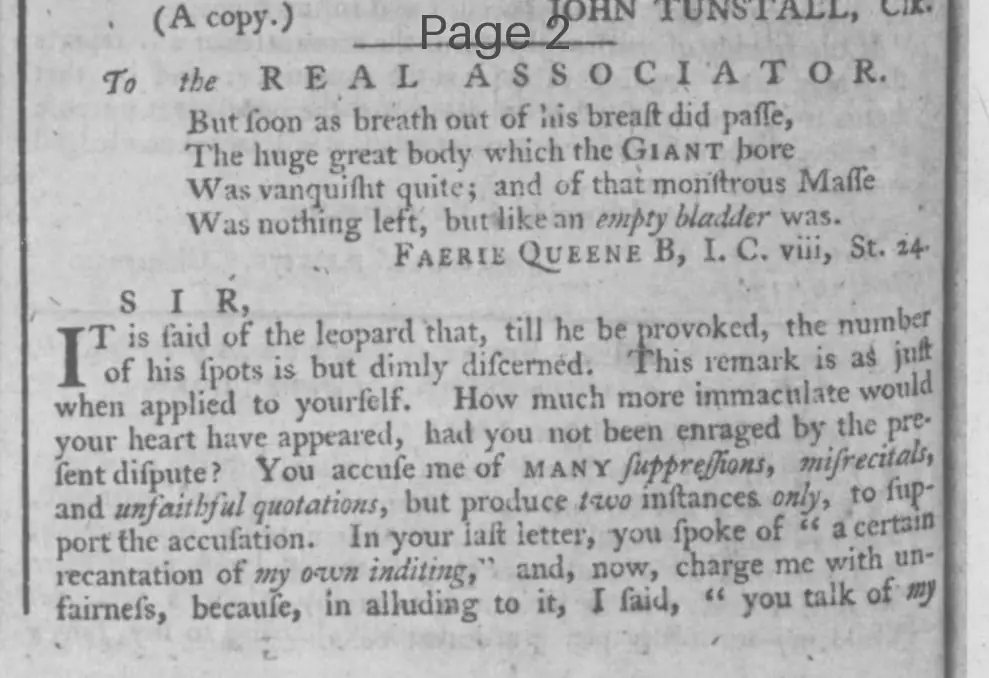
But soon as breath out of his breast did pass,
The huge great body which the Giant bore
Was vanquished quite; and of that monstrous mass
Was nothing left, but like an empty bladder was.
FAERIE QUEENE B. I. C. viii, St. 24
SIR,
It is said of the leopard that, till he be provoked, the number
of his spots is but dimly discerned. This remark is as just
when applied to yourself. How much more immaculate would
your heart have appeared, had you not been enraged by the pre-
sent dispute? You accuse me of many suppressions, misrecitals
and unfaithful quotations, but produce two instances only, to sup-
port the accusation. In your last letter, you spoke of a certain
recantation of my own inditing," and, now, charge me with un-
fairness, because, in alluding to it, I said, " you talk of my
recantation. "Why, surely Sir, if the recantation was of my own. But though it, now, should seem to be not mine, but Mr. Kidd's, yet you—by declaring you are possessed of proof " that yet"— of My owN dictating and written under the influence of fearing your meaning for calling it mine, How ridiculously ab-
surd at the same time charge me with misinterpre-
from the conspicuous manner in which the word RECANTATION was printed, and the stigma of infamy inseparable from it, when received in its worst signification ?- This it is to be a saint* ! to a clergyman you did not deign and hope it to be re-
unfaithful quotations" is thus expressed: " His strictures on Lord Your second instance of my " many suppressions misrecitals, and
Coke's maxim are exceedingly ingenious and prove that the words But let us inquire how this matter stands." You had said " I think my old acquaintance Lord proof." I, knowing this doctrine (which you insidiously had held forth for Lord Coke's) to be false and absurd, when admitted as
Coke used to tell me that a violent presumption amounts to a full universally true, produced the passage from Lord Coke; whence it appeared that you had false-quoted and misrecited him, unIversALLy true, by suppressing an ESSENTIAL part of his maxim, and observed had evidently expressed himself with great limitation, The word seldom was not, at all, used. It hath, rather, an unlucky appearance, as you boast of many instances of my suppressions, misrecitals and unfaithful quotations that you should produce only Two. And still more so, as the first of them rests upon a palpable prevarication, to say no worse; while the second, you could not have produced without a previ-
ous, though silent, confession that I had convicted you of the very crime, with respect to Lord Coke, which you labour, but in vain, to fix upon me. Yet, this is not all: For, the instance you bring to establish your charge is, absolutely, the creature of your own invention, and which, till it escaped through your lax-
atives pen, had a being only in your own choatick brains. The public, in general, will infer, that if my letter had afforded any more examples for your purpose, you would have certainly brought them: while some, who implicitly confide in your judgment, will be fully convinced that, were there more, yet you must have, un-
questionably, selected the best. Having thus discussed the whole of your reply to the arguments in my letter, I appeal to the public whether—as the points you undertook to prove were " that I was the author of the Queries, or, else, that they were approved of and published by me"—you have not virtually submitted to every plea that has been urged in confutation of your arguments, and, con-
sequently, confessed the inaccuracy and contradiction, misreason-
ing and misquotation, with all the other subsequent absurdities, into which you have been driven? And, if this be so, whether you will relinquish, or not, your original charge, is a matter of but little importance. An ingenuous acknowledgment of error is too severe a trial for a heart like yours. If self-complacency will still endeavour to throw a shade over your own convictions, and take refuge behind hatred to me, your own vanity, or the inattention of the public, I freely indulge you in all the satisfaction that may result from the fancied laurels you have won, and the consciousness of pertinaciously maintaining an idle suspicion in opposition to fact. But, were I disposed to press the matter still further upon you, I would produce a declaration, upon oath, by the author of the Queries, "that the WHOLE and ONLY concern I had with them entirely arose from his having accidentally desired me to leave them at the Printers." But, so thoroughly, however, were you convinced that I was both author and publisher of the libel, that, had DECENCY per-
mitted, I should long since have been personally applied to (and, perhaps in a gentleman-like manner) under both these capacities." Some persons might be glad to know from you, who are unques-
tionably the very pink of politeness, what could make ANY gentleman-like manner offensive to decency? However, as your intended mode of application was such as decency would not permit, and as, I, you think, " should hardly have approved," it was, no doubt, obliging in you to decline it. But is there not something here a little darkly expressed? You have taxed me with timidity. As the world goes, this charge might have been as properly brought against a woman. Were it not that I am a clergyman, I cannot forbear thinking, but that DISCRETION,--- which as Falstaff wisely observes, is the better part of VALOUR -- would have confined you within the limits of instinct. A black gown seems to inflate you, as much as a red one does a cock-
turkey; and it is to this I attribute your present strutting and swelling. Why should you so eagerly catch at opportunities to repeat to the world the mightiness of your courage, if you did not think the world a little shy in believing it ? Whether what the fat Knight says of Poins ---- that he had no more valour than a wild-duck—be true of you I will not determine; but in my own opinion you would have been no ill match for the magnani-
mous PISTOL; who would not swagger with a Barbary hen, if she turned back her feathers, in any show of resistance. Should I be wrong in this particular, the following hint will enable you to correct me:—There are some clergymen who do not always wear a gown. As to the charge of persecution: Did you think I expected you to confess it? Has it not even been the language of inquisitors, that the tortures they inflict are for God's sake; that the rack is an engine of mercy; that while they declare Heretics to be in a state of damnation, they commit them to the flames, out of a pure and holy love to their souls; and, that it is slander in the extreme to term this persecution? I cannot forbear noticing what artifice you have shown in con-
ducting this dispute. The Queries were the original ground on which we set out, but, like a fox, when hard pressed you have eluded the pursuit by wallowing in all the filth of abuse you could *You have mentioned Mr. Kidd's recantation; it is fit that affair should be known. When (previous to the election of a Minister in this parish) Mr. Kidd was employed to procure the names of subscribers to a paper in opposition to me, the arguments used by him to persuade the parishioners were " that I did not believe the articles of the Church; and that I was a Deist." A Magistrate of this city, with whom I was but lightly acquainted, shocked at so black a contrivance, informed me of it. I, immediately, went to Kidd and expostulated with him: At first, with much confusion, he denied the fact. However, as the Gentleman had authorised me in the fullest manner to use his evidence and name, I told him my author. He then began to equivocate, at last, confessed, named you as his authority for what he had said, and to avoid (what you, conscientious, Sir, have most pathetically denominated) " the terrors of the law," not only expressed a willingness to acknowledge the in-
justice of the calumny, but, more than once, thanked me for my lenity to him. In what words this acknowledgment was expressed the strength of my memory" will not now inform me. But, this, I affirm, that it was neither dictated, nor indited by me, and, that (whatever may have been written upon the subject to his em-
ployer, by this pious undertaker, correspondent and fellow-labourer in the Lord) if he declares that it was, I must say his assurance is equal to your own; for greater, I think, it cannot be. ---- After Mr. Kidd had undertaken the business I believe every person will allow that he acted with propriety. For, when he found that, from the goodness of my evidence a prosecution could be carried through with effect, and, perhaps, doubted whether the purse of his principal would expand, his wisest method was to secure himself with me, and, in his own way, relate the matter to him. Thus much for the original letter of Mr. Kidd written about the time;" Your share in keeping me out of the parish; and all the happy reflections which an exertion of pious and meritorious may excite! nat. Having at last however got upon your foot, I hope the chase will be soon at an end. S. HENLEY. If V'ocativo Caret be desirous of knowing who were the persons I ranked among the first of the age, what their testimonials were of my qualifications for the office I hold, and where they may be found, I refer him to the Register of the Bishop of London. FEBRUARY 20, 1775.
What sub-type of article is it?
What themes does it cover?
What keywords are associated?
What entities or persons were involved?
Letter to Editor Details
Author
S. Henley
Recipient
The Real Associator
Main Argument
the writer refutes accusations of suppressions, misrecitals, and unfaithful quotations by the opponent, particularly regarding a recantation and lord coke's maxim, while exposing the opponent's own inconsistencies and detailing mr. kidd's recantation of false deism charges during a parish election.
Notable Details