Thank you for visiting SNEWPapers!
Sign up free
Editorial
January 21, 1788
The New York Journal, And Daily Patriotic Register
New York, New York County, New York
What is this article about?
An anti-Federalist editorial critiques the U.S. Constitution as unstable and unsupported by divine will, mocking Dr. Benjamin Rush's claim of heavenly inspiration for the convention. It praises the minority opposition, including figures like Findley and Smilie, for resisting what it sees as a path to despotism.
Clipping
OCR Quality
95%
Excellent
Full Text
From the INDEPENDENT CHRONICLE.
[Printed in Boston.]
To the PUBLIC.
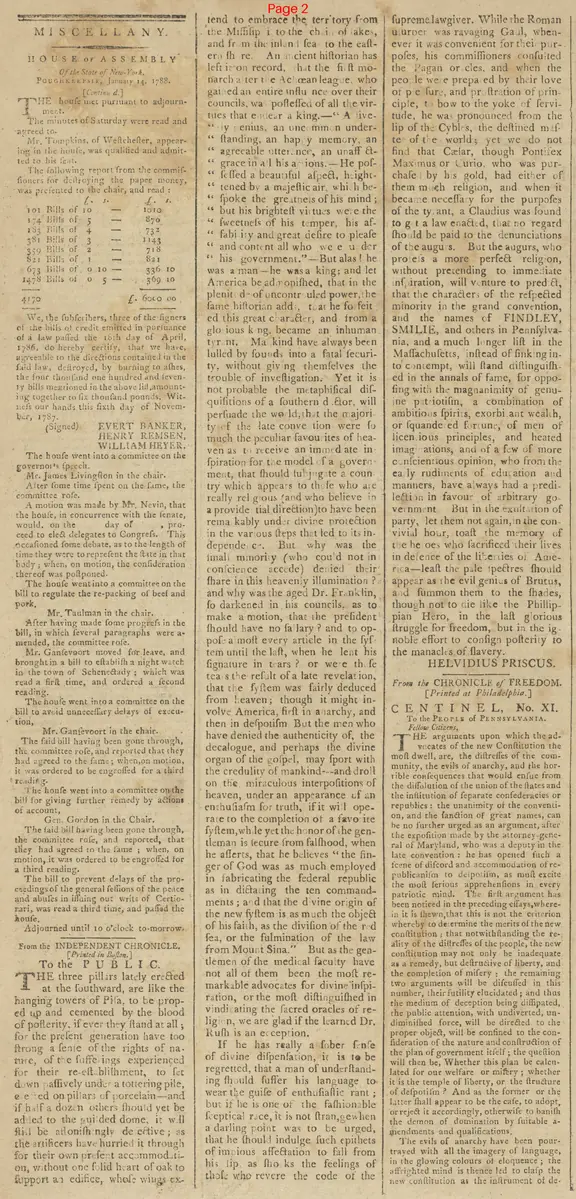
The three pillars lately erected at the southward, are like the hanging towers of Pisa, to be propped up and cemented by the blood of posterity, if ever they stand at all; for the present generation have too strong a sense of the rights of nature, of the sufferings experienced for their re-establishment, to set down passively under a tottering pile, erected on pillars of porcelain—and if half a dozen others should yet be added to the outsided dome, it will be astonishingly defective; as the artificers have hurried it through for their own present accommodation, without one solid heart of oak to support any edifice, whose wings extend to embrace the territory from the Mississippi to the St. Croix or Passamaquoddy, and from the inland sea to the eastern shore. An ancient historian has left it on record, that the first monarch after the Achaian league, who gained an entire influence over their councils, was possessed of all the virtues that denote a king.—"A lively genius, an uncommon understanding, a happy memory, an agreeable utterance, an unaffected grace in all his actions.—He possessed a beautiful aspect, heightened by a majestic air, which spoke the greatness of his mind; but his brightest virtues were the sweetness of his temper, his affability and great desire to please and content all who were under his government." But alas! he was a man—he was a king; and let America be admonished, that in the plenitude of uncontrouled power, the same historian adds, that he forfeited this great character, and from a glorious king, became an inhuman tyrant. Mankind have always been lulled by sounds into a fatal security, without giving themselves the trouble of investigation. Yet it is not probable the metaphysical disquisitions of a southern Doctor, will persuade the world, that the majority of the late convention were so much the peculiar favourites of heaven as to receive an immediate inspiration for the model of a government, that should subjugate a country which appears to those who are really religious (and who believe in a providential direction) to have been remarkably under divine protection in the various steps that led to its independence. But why was the small minority (who could not in conscience accede) denied their share in this heavenly illumination? and why was the aged Dr. Franklin so darkened in his councils, as to make a motion, that the president should have no salary? and to oppose almost every article in the system until the last, when he lent his signature in tears? or were the tears the result of a late revelation, that the system was fairly deduced from heaven; though it might involve America, first in anarchy, and then in despotism? But the men who have denied the authenticity of the decalogue, and perhaps the divine origin of the gospel, may part with the credulity of mankind—and droll on the miraculous interpositions of heaven, under an appearance of enthusiasm for truth, if it will operate to the completion of a favorite system, while yet the honor of the gentleman is secure from falsehood, when he asserts, that he believes "the finger of God was as much employed in fabricating the federal republic as in dictating the ten commandments; and that the divine origin of the new system is as much the object of his faith, as the division of the red sea, or the promulgation of the law from Mount Sinai." But as the gentlemen of the medical faculty have not all of them been the most remarkable advocates for divine inspiration, or the most distinguished in vindicating the sacred oracles of religion, we are glad if the learned Dr. Rush is an exception. If he has really a sober sense of divine dispensation, it is to be regretted, that a man of understanding should suffer his language to wear the guise of enthusiastic rant; but if he is one of the fashionable skeptical race, it is not strange when a darling point was to be urged, that he should indulge such epithets of impious affectation to fall from his lips, as shocks the feelings of those who revere the code of the supreme lawgiver. While the Roman usurper was ravaging Gaul, whenever it was convenient for their purposes, his commissioners consulted the Pagan oracles, and when the people were prepared by their love of pleasure, and prostitution of principle, to bow to the yoke of servitude, he was pronounced from the lips of the Sybils, the destined master of the world: yet we do not find that Caesar, though Pontifex Maximus or Curio, who was purchased by his gold, had either of them much religion, and when it became necessary for the purposes of the tyrant, a Claudius was found to get a law enacted, that no regard should be paid to the denunciations of the augurs. But the augurs, who profess a more perfect religion, without pretending to immediate inspiration, will venture to predict, that the characters of the respected minority in the grand convention, and the names of FINDLEY, SMILIE, and others in Pennsylvania, and a much longer list in the Massachusetts, instead of sinking into contempt, will stand distinguished in the annals of fame, for opposing with the magnanimity of genuine patriotism, a combination of ambitious spirits, exorbitant wealth, or squandered fortune, of men of licentious principles, and heated imaginations, and of a few of more conscientious opinion, who from the early rudiments of education and manners, have always had a predilection in favour of arbitrary government. But in the exultation of party, let them not again, in the convivial hour, toast the memory of the heroes who sacrificed their lives in defence of the liberties of America—lest the pale spectres should appear as the evil genius of Brutus, and summon them to the shades, though not to die like the Philippian Hero, in the last glorious struggle for freedom, but in the ignoble effort to consign posterity to the manacles of slavery.
HELVIDIUS PRISCUS.
[Printed in Boston.]
To the PUBLIC.
The three pillars lately erected at the southward, are like the hanging towers of Pisa, to be propped up and cemented by the blood of posterity, if ever they stand at all; for the present generation have too strong a sense of the rights of nature, of the sufferings experienced for their re-establishment, to set down passively under a tottering pile, erected on pillars of porcelain—and if half a dozen others should yet be added to the outsided dome, it will be astonishingly defective; as the artificers have hurried it through for their own present accommodation, without one solid heart of oak to support any edifice, whose wings extend to embrace the territory from the Mississippi to the St. Croix or Passamaquoddy, and from the inland sea to the eastern shore. An ancient historian has left it on record, that the first monarch after the Achaian league, who gained an entire influence over their councils, was possessed of all the virtues that denote a king.—"A lively genius, an uncommon understanding, a happy memory, an agreeable utterance, an unaffected grace in all his actions.—He possessed a beautiful aspect, heightened by a majestic air, which spoke the greatness of his mind; but his brightest virtues were the sweetness of his temper, his affability and great desire to please and content all who were under his government." But alas! he was a man—he was a king; and let America be admonished, that in the plenitude of uncontrouled power, the same historian adds, that he forfeited this great character, and from a glorious king, became an inhuman tyrant. Mankind have always been lulled by sounds into a fatal security, without giving themselves the trouble of investigation. Yet it is not probable the metaphysical disquisitions of a southern Doctor, will persuade the world, that the majority of the late convention were so much the peculiar favourites of heaven as to receive an immediate inspiration for the model of a government, that should subjugate a country which appears to those who are really religious (and who believe in a providential direction) to have been remarkably under divine protection in the various steps that led to its independence. But why was the small minority (who could not in conscience accede) denied their share in this heavenly illumination? and why was the aged Dr. Franklin so darkened in his councils, as to make a motion, that the president should have no salary? and to oppose almost every article in the system until the last, when he lent his signature in tears? or were the tears the result of a late revelation, that the system was fairly deduced from heaven; though it might involve America, first in anarchy, and then in despotism? But the men who have denied the authenticity of the decalogue, and perhaps the divine origin of the gospel, may part with the credulity of mankind—and droll on the miraculous interpositions of heaven, under an appearance of enthusiasm for truth, if it will operate to the completion of a favorite system, while yet the honor of the gentleman is secure from falsehood, when he asserts, that he believes "the finger of God was as much employed in fabricating the federal republic as in dictating the ten commandments; and that the divine origin of the new system is as much the object of his faith, as the division of the red sea, or the promulgation of the law from Mount Sinai." But as the gentlemen of the medical faculty have not all of them been the most remarkable advocates for divine inspiration, or the most distinguished in vindicating the sacred oracles of religion, we are glad if the learned Dr. Rush is an exception. If he has really a sober sense of divine dispensation, it is to be regretted, that a man of understanding should suffer his language to wear the guise of enthusiastic rant; but if he is one of the fashionable skeptical race, it is not strange when a darling point was to be urged, that he should indulge such epithets of impious affectation to fall from his lips, as shocks the feelings of those who revere the code of the supreme lawgiver. While the Roman usurper was ravaging Gaul, whenever it was convenient for their purposes, his commissioners consulted the Pagan oracles, and when the people were prepared by their love of pleasure, and prostitution of principle, to bow to the yoke of servitude, he was pronounced from the lips of the Sybils, the destined master of the world: yet we do not find that Caesar, though Pontifex Maximus or Curio, who was purchased by his gold, had either of them much religion, and when it became necessary for the purposes of the tyrant, a Claudius was found to get a law enacted, that no regard should be paid to the denunciations of the augurs. But the augurs, who profess a more perfect religion, without pretending to immediate inspiration, will venture to predict, that the characters of the respected minority in the grand convention, and the names of FINDLEY, SMILIE, and others in Pennsylvania, and a much longer list in the Massachusetts, instead of sinking into contempt, will stand distinguished in the annals of fame, for opposing with the magnanimity of genuine patriotism, a combination of ambitious spirits, exorbitant wealth, or squandered fortune, of men of licentious principles, and heated imaginations, and of a few of more conscientious opinion, who from the early rudiments of education and manners, have always had a predilection in favour of arbitrary government. But in the exultation of party, let them not again, in the convivial hour, toast the memory of the heroes who sacrificed their lives in defence of the liberties of America—lest the pale spectres should appear as the evil genius of Brutus, and summon them to the shades, though not to die like the Philippian Hero, in the last glorious struggle for freedom, but in the ignoble effort to consign posterity to the manacles of slavery.
HELVIDIUS PRISCUS.
What sub-type of article is it?
Constitutional
Partisan Politics
Moral Or Religious
What keywords are associated?
Federal Constitution
Anti Federalist
Divine Inspiration
Constitutional Convention
Dr. Rush
Minority Opposition
Despotism Warning
What entities or persons were involved?
Dr. Rush
Dr. Franklin
Findley
Smilie
Minority In The Convention
Pennsylvania
Massachusetts
Helvidius Priscus
Editorial Details
Primary Topic
Critique Of The Federal Constitution As Unstable And Divinely Unendorsed
Stance / Tone
Strongly Anti Federalist Warning Against Despotism
Key Figures
Dr. Rush
Dr. Franklin
Findley
Smilie
Minority In The Convention
Pennsylvania
Massachusetts
Helvidius Priscus
Key Arguments
The New Government Is Like Unstable Towers Requiring Blood To Support
Majority In Convention Lacked Divine Inspiration, Unlike Claims By Dr. Rush
Minority Opposed In Conscience, Including Franklin's Reluctance
Proponents Mock Religious Authenticity While Claiming Heavenly Origin
Historical Parallels To Tyrants Using Oracles To Justify Power
Minority Patriots Will Be Honored For Opposing Arbitrary Government
Warning Against Toasting Liberty While Supporting Potential Slavery