Thank you for visiting SNEWPapers!
Sign up free
Gazette Of The United States, & Philadelphia Daily Advertiser
Philadelphia, Philadelphia County, Pennsylvania
What is this article about?
U.S. House of Representatives proceedings on February 8-9: Debate in committee on expelling Vermont Rep. Matthew Lyon for assaulting Connecticut Rep. Roger Griswold and using indecent language. Speeches argue House powers, session status, and provocation. Amendment added for indecency passes 48-43. Routine reports, petitions, and a letter from Sen. Chipman denying Lyon's claims read.
Merged-components note: These components contain the continuation of the same congressional proceedings debate across sequential reading orders and pages; relabeled to domestic_news as it fits national non-story news.
Clippings
1 of 2
OCR Quality
Full Text
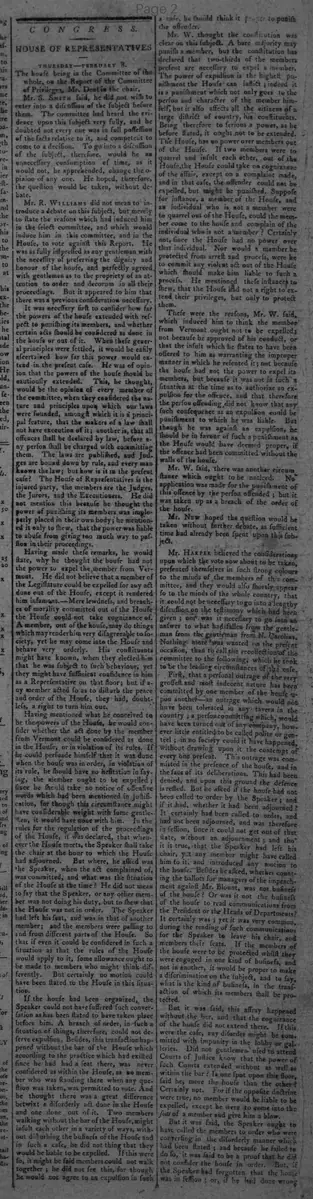
Thursday--February 8
The house being in the Committee of the whole, on the Report of the Committee of Privileges, Mr. Dent in the chair,
Mr. S. SMITH said, he did not wish to enter into a discussion of the subject before them. The committee had heard the evidence upon this subject very fully, and he doubted not every one was in full possession of the facts relative to it, and competent to come to a decision. To go into a discussion of the subject, therefore, would be an unnecessary consumption of time, as it would not, he apprehended, change the opinion of any one. He hoped, therefore, the question would be taken, without debate.
Mr. R. WILLIAMS did not mean to introduce a debate on this subject, but merely to state the reasons which had induced him in the select committee. and which would induce him in this committee, and in the House, to vote against this Report. He was as fully impressed as any gentleman with the necessity of preserving the dignity and honour of the house, and perfectly agreed with gentlemen as to the propriety of an attention to order and decorum in all their proceedings. But it appeared to him that there was a previous consideration necessary. It was necessary first to consider how far the powers of the house extended with respect to punishing its members, and whether certain acts should be considered as done in the house or out of it. When these general principles were settled, it would be easily ascertained how far this power would extend in the present case. He was of opinion that the powers of the house should be cautiously extended. This, he thought, would be the opinion of every member of the committee, when they considered the nature and principles upon which our laws were founded, amongst which it is a principal feature, that the makers of a law shall not have execution of it; another is, that all offences shall be declared by law, before any person shall be charged with committing them. The laws are published, and Judges are bound down by rule, and every man knows the law; but how is it in the present case? The House of Representatives is the injured party, the members are the Judges, the Jurors, and the Executioners. He did not mention this because he thought the power of punishing its members was improperly placed in their own body; he mentioned in only to show, that the power was liable to abuse from giving too much way to passion in their proceedings.
Having made these remarks, he would state, why he thought the house had not the power to expel the member from Vermont, He did not believe that a member of the Legislature could be expelled for any act done out of the House, except it rendered him infamous. Mere lewdness, and breaches of morality committed out of the House the House could not take cognizance of. A member, out of the house, may do things which may render him very disagreeable to society, yet he may come into the House and behave very orderly. His constituents might have known, when they elected him that he was subject to such behaviour, yet they might have sufficient confidence in him as a Representative on that floor; but if any member acted so as to disturb the peace and order of the House, they had, doubtless, a right to turn him out.
Having mentioned what he conceived to be the powers of the House, he would consider whether the act done by the member from Vermont could be considered as done in the House, or in violation of its rules. If he could persuade himself that it was done when the house was in order, in violation of its rule, he should have no hesitation in saying, the member ought to be expelled; since he should take no notice of offensive words which had been mentioned in justification, for though this circumstance might have considerable weight with some gentlemen, it would have none with him. In the rules for the regulation of the proceedings of the House, it was declared, that whenever the House meets, the Speaker shall take the chair at the hour to which the House had adjourned. But where, he asked was the Speaker, when the act complained of, was committed, and what was the situation of the House at the time? He did not mean to say that the Speaker, or any other member was not doing his duty, but to show that the House was not in order. The Speaker had left his seat, and was in that of another member; and the members were passing to and from different parts of the House. So that if even it could be considered in such a situation as that the rules of the House would apply to it, some allowance ought to be made to members who might think differently. But certainly no motion could have been stated to the House in this situation.
If the house had been organized, the Speaker could not have suffered such conversation as has been stated to have taken place before him. A breach of order, in such a situation of things, therefore, could not deserve expulsion. Besides, this transaction happened without the bar of the House which according to the practice which had existed since he had had a seat there, was never considered as within the House, as no member who was standing there when any question was taken, was permitted to vote. And he thought there was a great difference betwixt a disorderly act done in the House and one done out of it. Two members walking without the bar of the House, might insult each other in a variety of ways, without disturbing the business of the House and in such a case, he did not think that they would be liable to be expelled. If this were so, it might be said members could not walk together ; he did not see this, for though he would not agree to an expulsion in such a case, he should think it proper to punish the offender.
Mr. W. thought the constitution was clear on this subject. A bare majority may punish a member, but the constitution has declared that two-thirds of the members present are necessary to expel a member. The power of expulsion is the highest punishment the House can inflict ; indeed it is a punishment which not only goes to the person and character of the member himself, but it also affects all the citizens of a large district of country, his constituents. Being therefore so serious a power, as he before stated, it ought not to be extended. The House, has no power over members out of the House. If two members were to quarrel and insult each other, out of the House,the House could take no cognizance of the affair, except on a complaint made, and in that case, the offender could not be expelled, but might be punished. Suppose for instance, a member of the House, and an individual who is not a member were to quarrel out of the House, could the member come to the house and complain of the individual who is not a member ? Certainly not, since the House had no power over that individual. Nor would a member be protected from arrest and process, were he to commit any violent act out of the House which should make him liable to such a process. He mentioned these instances to show, that the House had not a right to extend their privileges, but only to protect them.
These were the reasons, Mr. W. said. which induced him to think the member from Vermont ought not to be expelled; not because he approved of his conduct, or that the insult which he states to have been offered to him as warranting the improper manner in which he resented it; not because the house had not the power to expel its members, but because it was not in such a situation at the time as to authorize an expulsion for the offence, and that therefore the person offending did not know that any such consequence as an expulsion could be punishment to which he was liable. But though he was against an expulsion, he should be in favour of such a punishment as the House would have deemed proper, if the offence had been committed without the walls of the house.
Mr. W. said, there was another circumstance which ought to be noticed. No application was made for the punishment of this offence by the person offended ; but it was taken up as a breach of the order of the house.
Mr. New hoped the question would be taken without farther debate, as sufficient time had already been spent upon this subject.
Mr. Harper believed the considerations upon which the vote now about to be taken, presented themselves in such strong colours to the minds of the members of this committee, and they would also shortly appear so to the minds of the whole country, that it should not be necessary to go into a lengthy discussion on the testimony which had been given ; nor was it necessary to go into an answer to what had fallen from the gentleman from the gentleman from N. Carolina. Nothing more was wanted on the present occasion, than to call the recollection of the committee to the following, which he took to be the leading circumstances of. he case.
First, that a personal outrage of the very greatest and most indecent nature has been committed by one member of the house upon another--an outrage which would not have been tolerated in any tavern in the country ; a person committing which, would have been turned out of any company, however little entitled to be called polite or genteel ; in no society could it have happened, without drawing upon it the contempt of every one present. This outrage was committed in the presence of the house, and in the face of its deliberations. This had been denied, and upon this ground the defence is rested. But he asked if the house had not been called to order by the Speaker; and if it had, whether it had been adjourned? It certainly had been called to order, and had not been adjourned, and was therefore in session, since it could not get out of that state, without an adjournment ; and tho' it is true, that the Speaker had left his chair, yet any member might have called him to it, and introduced any motion to the house. Besides he asked, whether counting the ballots for managers of the impeachment against Mr. Blount, was not business of the house? Or was it not the business of the house to read communications from the President or the Heads of Departments? It certainly was ; yet it was very common, during the reading of such communications for the Speaker to leave his chair, and members their seats. If the members of the house were to be protected whilst they were engaged in one kind of business, and not in another, it would be proper to make a discrimination on the subject, and to say, what is the kind of business, in the transaction of which its members shall be protected.
But it was said, this affray happened without the bar, and that the cognizance of the house did not extend there. If this were the case, any disorder might be committed with impunity in the lobby or galleries. Did not gentlemen used to attend Courts of Justice know that the power of such Courts extended without as well as within the bar ? Is one part upon this floor, said he, more the-house than the other? Certainly not. For if the opposite doctrine were true, no member would be liable to be expelled, except he were to come into the seat of a member and give him a blow.
But it was said, the Speaker ought to have called the members to order who were conversing in the disorderly manner which had been stated ; and because he failed to do so, it was said to be a proof that he did not consider the house in order. But, if the Speaker had forgotten that the house was in session ; or, if he had done wrong
in leaving his seat, (which he by no means thought) the circumstances did not put the house out of session; for, if one member were to knock another down, and the Speaker did not call to order, since the house once formed cannot be dissolved without a formal vote, the house would not be less in session than if the strictest order had been kept.
Mr. H. said, he should, like the gentleman from N. Carolina, omit noticing the provocation said to be given to the gentleman from Vermont. He believed that was out of the question; because, if the act complained of, had been in consequence of a blow received, he would have had both the gentlemen expelled; or if the gentleman from Connecticut had given way to his feelings and struck the member from Vermont to his feet, in return for the insult he had received, in that case, he should have been for involving both in one sentence.
For, if this rule was once departed from, and provocation was to be set up as an apology for outrage, every person would be left to judge in his own cause as to the sufficiency of provocation. The distinction between words and a personal attack, is a distinction well understood. No language could be sufficiently provoking to warrant a blow.
In well bred society, when a man receives an affront, does he knock down the person giving it? No; he represses his feelings, and takes another time and place to obtain justice. And unless the members of that house were to conduct themselves in this manner, they add prostrate the barriers which protected decency of conduct among them. He could not, therefore, believe that any possible provocation could either justify or mitigate the act of the gentleman from Vermont. Indeed, if the provocation was to be looked into, it would be found to be all on the other side.
From these considerations, he was so convinced of the propriety of agreeing to the resolution before the committee, that he was surprised how any person could doubt a moment on the subject. Indeed, if the circumstance had happened without, instead of within the walls of the house, he should have thought it right to have expelled the offender, as he held it to be one of those actions which rendered a man unworthy of a seat in that house.
A considerable cry for the question was made.
Mr. Nicholas said he was willing to have taken the question upon this subject, without debate; but it would be very improper, indeed, to suffer the observations which had been made to pass without notice. As it was too late in the day to enter upon a reply, he moved that the committee might rise.
The committee rose and had leave to sit again.
The house having resumed, Mr. Sitgreaves moved that the evidence which had been given to the committee, be printed.—Agreed.
Friday, February 9.
The Speaker laid before the house a communication from the secretary of the treasury inclosing a statement of the amount of drawbacks paid on dutiable articles for the year 1796, agreeably to a resolution of the house of the 2d of March 1792, which was ordered to be printed.
Mr. Thatcher reported a bill granting the right to the attorney general of the United States, of sending and receiving letters and packets, free of postage, which was committed for Monday.
Mr. Harper moved that the report of the committee of revisal and unfinished business, on the subject of clerks, printed copy of which he found laid upon his desk this morning, be referred to the committee of ways and means.—Agreed.
Mr. D. Foster, from the committee of claims, made an unfavourable report on the petition of Abraham Jones, who prayed for additional compensation during the war. Concurred in by the house.
Mr. Harper presented the petition of Timothy Winters, an old soldier, praying for a pension.—Referred to the committee of claims.
Mr. Livingston, from the committee of commerce and manufactures, made a report on the petition of sundry proprietors and workers of coal mines, in the state of Virginia, who prayed for a prohibition of the importation of coals, or an increase of duty, on the ground that their mines are sufficient for the consumption of the United States. The committee report, that as coal is every day becoming more an article of the first necessity, they do not think it would be right to comply with the prayer of the petition, especially as the duty paid on exportation in England is equal to the first cost of the coal, and a duty of five cents a bushel is already paid on its importation into this country.—Committed for Monday.
The same gentleman presented a petition from the coach and chair-makers of New-York, stating that notwithstanding the duty which had been laid on the importation of carriages, they are yet imported without duty, by the persons exporting them stating that they are second-hand: they pray, therefore, for a remedy of this grievance. Referred to the committee of commerce and manufactures.
Mr. Matthews presented the petition of Abraham Millen, in behalf of a claim due to his brother William. Referred to the committee of claims.
Mr. Harper said, he was under the necessity of performing a very disagreeable duty. It was a duty, however, which he found himself bound to perform, since no other member had thought proper to undertake it. It must be recollected, he said, by many members of that house, that the member from Vermont, whose very extraordinary conduct has been for some time the subject of discussion, yesterday, at the conclusion of his defence, made use of an expression so outrageous, so gross, and indecent, that no gentleman yet had been able to repeat it; and if this expression could have been buried in silence, he, for one, should have been in favour of its being so buried; but, unfortunately, this could not be the case, it had not only been heard by many of the members, but by many strangers; and he was authorized to say, it was about to appear in one of the public gazettes of this city.
As it could not, therefore, be kept from public view it was necessary to take such notice of it, as it deserved. Before he made it the subject of a resolution, he should move "that the chairman of the committee of the whole, who heard it, be requested to state precisely, in writing, the expression, and the time, place, and manner in which it was uttered." He did not wish to put the gentleman to the painful task of repeating it; he wished only that he should state it in writing.
Mr. Dent said it would not be in his power to state the precise expression, as he did not hear the first part of the sentence. It was true he heard the offensive term.
Mr. Harper hoped he would state the offensive term, and the time and manner of using it.
The question for requesting the chairman to put the offensive expression to writing, was carried 42 to 41.
Mr. Dent accordingly presented the offensive words to the chair; which, without being read, was referred to the committee of the whole to whom was referred the report of the committee of privileges. The question for this reference was carried by the casting vote of the Speaker, there being 43 votes for it, and 43 votes against it.
The house then again resolved itself into a committee of the whole on the report of the committee of privileges Mr. Dent in the chair, when a long debate ensued, which was opened by Mr. Shepard, in favour of the resolution.—
He was followed by Mr. Nicholas against it—
Messrs. Otis, Rutledge and Sitgreaves followed in favour of the resolution. The latter gentleman moved to add to the resolution, as an amendment, "and for the gross indecency of language made use of in his defence before the committee as the whole." This amendment was agreed to, after some debate 48 to 43.
The amendment being incorporated with the resolution, Mr. Gallatin spoke against agreeing to it as amended.
Mr. Morris (of Vermont) only rose to observe that the member from Vermont (Mr. Lyon) in the course of his defence of yesterday, stated that on a former occasion he was insulted by a senator from Vermont (Mr. Chipman) who gave his testimony before this committee, and that he had chastised that gentleman for it.
It is my duty to declare that this assertion is absolutely false—That I have had the honor of the senator's acquaintance for many years—that he is highly respected in his own country as a gentleman of learning, abilities and integrity—that he was an officer in the American army, saw actual service, and acquitted himself like a brave man.
There seemed to be a great desire, very loudly expressed, that the question should be taken before the committee rose; but Mr. Sewall and Mr. Rutledge, both appearing to have a desire to speak to the subject, and it being near four o'clock, the committee rose and had leave to sit again.
Just before the committee rose, the chairman informed the committee he had received a letter from Mr. Chipman, of the senate, in consequence of what had fallen from Mr. Lyon, in his defence of yesterday. The letter was requested to be read, and was as follows:
SIR,
I feel it my duty, in this public manner, to vindicate myself against an unwarranted attack on my character, by Mr. Lyon, yesterday, in the house of representatives—I learn that he there asserted that he had once chastised me publicly for an affront which I had given him.—This assertion of Mr. Lyon's is without foundation—It is false—
Nor can I conjecture to what circumstance Mr. Lyon could have alluded, unless it might be a ludicrous transaction, which took place at Westminster, in the state of Vermont, in the beginning of the year 1780, the circumstances of which I beg leave to relate, The legislature of Vermont were in session at that place—Mr. Lyon attended as a member—I attended on business The house of representatives, requested me; tho not a member, to examine and report my opinion concerning certain debts due from persons whose estates had been confiscated—I had made a report accordingly, at some part of which Mr. Lyon took offence. One morning Mr. Lyon called at Mr. Bradley's room, in which I was then doing business. No person was in the room but Mr. Bradley, Mr. Lyon and myself. Mr. Bradley and I at writing at opposite sides of a table. Mr. Lyon took a seat by the table at the side of Mr Bradley, and entered into conversation upon the subject of the report above mentioned He soon discovered himself to be somewhat irritated, and in a very rude and pointed manner declared that no man who had a spark of honesty could have reported as I had done. Attacked in this rude manner, I retorted, in a passion, that he was an ignorant Irish Puppy. Mr. Lyon rose in a violent passion, grasped at my hair, that was turned back with a comb, which he broke in the grasp—I was at that moment mending a pen—I instantly rose, intending to revenge the insult with the knife in my hand ; but Mr. Bradley had Mr. Lyon from behind, round the arms, and drew him back a little, upon which Mr, Lyon, bearing himself in Mr. Bradley's arms, threw his feet upon the table, to kick across. The awkward appearance of Mr. Lyon at this moment, and the grimaces of his countenance provoked me to laugh. I dropt the penknife, seized Mr. Lyon's feet, and, in this manner, with the help of Mr. Bradley. who still kept his hold carried him across the room and laid him on his back in a corner— Mr. Bradley and I returned to our seats, laughing very merrily at the scene. In the mean time Mr. Lvon rose from his corner, stood a short time in apparent agitation, and without uttering a word. At length, he turned upon his heel, with these expressions-" Damn it, I will not be mean" forced a laugh, and left the room. Nothing ever afterwards passed between Mr Lyon and myself upon this subject. I therefore repeat, that Mr. Lyon's assertion is wholly without foundation.
I ask pardon for the trouble I have given the house upon this business,
And am, with respect, &c.
NATHANIEL CHIPMAN
The Chairman of the Committee upon the report of the Committee of Privileges.
The house having resumed, Mr. Livingston asked obtained leave of absence for his colleague Mr. Van Cortlandt, for eight days.—The debate of to-day will be given on Monday.
Adj.
What sub-type of article is it?
What keywords are associated?
What entities or persons were involved?
Domestic News Details
Event Date
February 8 9
Key Persons
Outcome
debate ongoing; amendment adding 'gross indecency of language' to expulsion resolution passed 48-43; no final vote on expulsion; letter from sen. chipman read denying lyon's claims; routine petitions and reports handled.
Event Details
In the House Committee of the Whole, members debated the expulsion of Vermont Rep. Mr. Lyon for a personal outrage (spitting on Connecticut Rep.) committed during House session and for indecent language in his defense. Speakers argued over House powers to punish members, whether the act occurred in session, provocation, and constitutional limits requiring two-thirds vote for expulsion. Routine business on Feb. 9 included treasury report, bills on postage and clerks, unfavorable claim report, pension and trade petitions referred or committed. Debate continued with amendment passed; Mr. Morris defended Sen. Chipman; Chipman's letter detailed a 1780 altercation with Lyon.