Thank you for visiting SNEWPapers!
Sign up free
Literary
October 29, 1924
The Cody Enterprise
Cody, Park County, Wyoming
What is this article about?
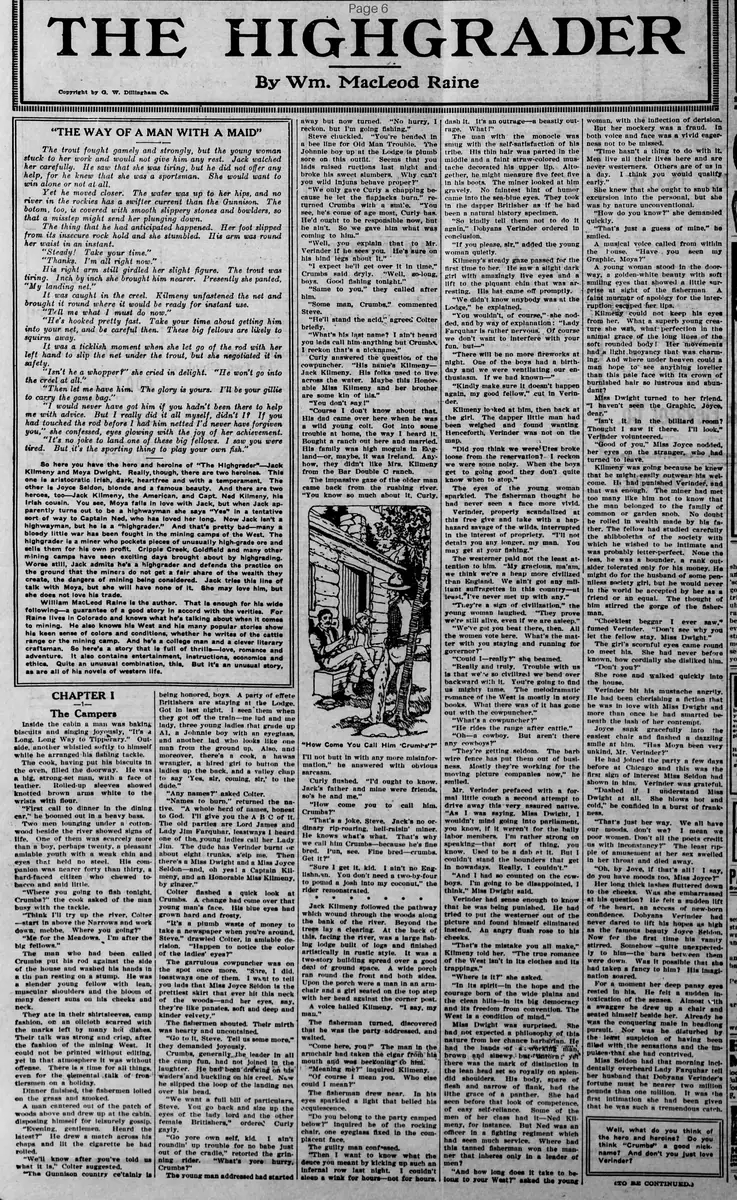
Excerpt from 'The Highgrader' by William MacLeod Raine, introducing characters Jack Kilmeny and Moya Dwight in a Western mining adventure romance. Includes a fishing scene and Chapter I depicting camp life, British visitors, and initial encounters.
Merged-components note: Image illustrates the serialized story.
Clipping
OCR Quality
75%
Good
Full Text
Copyright by G. W. Dillingham Co.
"THE WAY OF A MAN WITH A MAID"
The trout fought gamely and strongly, but the young woman stuck to her work and would not give him any rest. Jack watched her carefully. He saw that she was tiring, but he did not offer any help, for he knew that she was a sportsman. She would want to win alone or not at all.
Yet he moved closer. The water was up to her hips, and no river in the Rockies has a swifter current than the Gunnison. The bottom, too, is covered with smooth slippery stones and bowlders, so that a misstep might send her plunging down.
The thing that he had anticipated happened. Her foot slipped from its insecure rock hold and she stumbled. His arm was round her waist in an instant.
"Steady! Take your time."
"Thanks. I'm all right now."
His right arm still girdled her slight figure. The trout was tiring. Inch by inch she brought him nearer. Presently she panted,
"My landing net."
It was caught in the creel. Kilmeny unfastened the net and brought it round where it would be ready for instant use.
"Tell me what I must do now."
"He's hooked pretty fast. Take your time about getting him into your net, and be careful then. These big fellows are likely to squirm away."
It was a ticklish moment when she let go of the rod with her left hand to slip the net under the trout, but she negotiated it in safety.
"Isn't he a whopper?" she cried in delight. "He won't go into the creel at all."
"Then let me have him. The glory is yours. I'll be your gillie to carry the game bag."
"I would never have got him if you hadn't been there to help me with advice. But I really did it all myself, didn't I? If you had touched the rod before I had him netted I'd never have forgiven you," she confessed, eyes glowing with the joy of her achievement.
"It's no joke to land one of these big fellows. I saw you were tired. But it's the sporting thing to play your own fish."
So here you have the hero and heroine of "The Highgrader" Jack Kilmeny and Moya Dwight. Really, though, there are two heroines. This one is aristocratic Irish, dark, heartfree and with a temperament. The other is Joyce Seldon, blonde and a famous beauty. And there are two heroes, too Jack Kilmeny, the American. and Capt. Ned Kilmeny, his Irish cousin. You see, Moya falls in love with Jack, but when Jack apparently turns out to be a highwayman she says "Yes" in a tentative sort of way to Captain Ned, who has loved her long. Now Jack isn't a highwayman, but he is a "highgrader." And that's pretty bad many a bloody little war has been fought in the mining camps of the West. The highgrader is a miner who pockets pieces of unusually high-grade ore and sells them for his own profit. Cripple Creek, Goldfield and many other mining camps have seen exciting days brought about by highgrading.
Worse still, Jack admits he's a highgrader and defends the practice on the ground that the miners do not get a fair share of the wealth they create, the dangers of mining being considered. Jack tries this line of talk with Moya, but she will have none of it. She may love him, but she does not love his trade.
William MacLeod Raine is the author. That is enough for his wide following a guarantee of a good story in accord with the verities. For Raine lives in Colorado and knows what he's talking about when it comes to mining.
He also knows his West and his many popular stories show his keen sense of colors and conditions, whether he writes of the cattle range or the mining camp.
And he's a college man and a clever literary craftsman.
So here's a story that is full of thrills love, romance and adventure.
It also contains entertainment, instructions, economics and ethics.
Quite an unusual combination, this. But it's an unusual story, as are all of his novels of western life.
By Wm. MacLeod Raine
HIGHGRADER
CHAPTER I
The Campers
Inside the cabin a man was baking biscuits and singing joyously,
"It's a Long, Long Way to Tipperary."
Outside, another whistled softly to himself while he arranged his fishing tackle.
The cook, having put his biscuits in the oven, filled the doorway.
He was a big, strong-set man, with a face of leather.
Rolled-up sleeves showed knotted brown arms white to the wrists with flour.
"First call to dinner in the dining car," he boomed out in a heavy bass.
Two men lounging under a cottonwood beside the river showed signs of life. One of them was scarcely more than a boy, perhaps twenty, a pleasant amiable youth with a weak chin and eyes that held no steel.
His companion was nearer forty than thirty, a hard-faced citizen who chewed tobacco and said little.
"Where you going to fish tonight, Crumbs?" the cook asked of the man busy with the tackle.
"Think I'll try up the river, Colter - start in above the Narrows and work down, mebbe. Where you going?"
"Me for the Meadows. I'm after the big fellows."
The man who had been called Crumbs put his rod against the side of the house and washed his hands in a tin pan resting on a stump. He was a slender young fellow with lean, muscular shoulders and the bloom of many desert suns on his cheeks and neck.
They ate in their shirtsleeves, camp fashion, on an oilcloth scarred with the marks left by many hot dishes.
Their talk was strong and crisp, after the fashion of the mining West. It could not be printed without editing, yet in that atmosphere it was without offense. There is a time for all things, even for the elemental talk of frontiersmen on a holiday.
Dinner finished, the Ashermen lolled on the grass and smoked.
A man cantered out of the patch of woods above and drew up at the cabin, disposing himself for leisurely gossip.
"Evening, gentlemen. Heard the latest?" He drew a match across his chaps and lit the cigarette he had rolled.
"We'll know after you've told us what it is," Colter suggested.
"The Gunnison country certainly is being honored, boys. A party of effete Britishers are staying at the Lodge. Got in last night. I seen them when they got off the train - me lud and me lady, three young ladies that grade up A1, a Johnnie boy with an eyeglass, and another lad who looks like one man from the ground up. Also, and moreover, there's a cook, a hawss wrangler, a hired girl to button the ladies up the back, and a valley chap to say 'Yes, sir, coming, sir' to the dude."
"Any names?" asked Colter.
"Names to burn," returned the native. "A whole herd of names, honest to God. I'll give you the A B C of it. The old parties are Lord James and Lady Jim Farquhar, leastways I heard one of the young ladies call her Lady Jim. The dude has Verinder burnt or about eight trunks, s'elp me. Then there's a Miss Dwight and a Miss Joyce Seldon - and, oh yes! a Captain Kilmeny, and an Honorable Miss Kilmeny, by ginger."
Colter flashed a quick look at Crumbs.
A change had come over that young man's face.
His blue eyes had grown hard and frosty.
"It's a plumb waste of money to take a newspaper when you're around, Steve," drawled Colter, in amiable derision.
"Happen to notice the color of the ladies' eyes?"
The garrulous cowpuncher was on the spot once more.
"Sare, I did, leastways one of them. I want to tell you lads that Miss Joyce Seldon is the prettiest skirt that ever hit this neck of the woods - and her eyes, say, they're like pansies, soft and deep and kinder velvety."
The fishermen shouted. Their mirth was hearty and uncontained.
"Go to it, Steve. Tell us some more," they demanded joyously.
Crumbs, generally the leader in all the camp fun, had not joined in the laughter. He had been drawing on his waders and buckling on his creel. Now he slipped the loop of the landing net over his head.
"We want a full bill of particulars, Steve. You go back and size up the eyes of the lady lord and the other female Britishers," ordered Curly gayly.
"Go yore own self, kid. I ain't roundin' up trouble for no babe just out of the cradle," retorted the grinning rider.
"What's yore hurry, Crumbs?"
The young man addressed had started away but now turned. "No hurry, I reckon, but I'm going fishing."
Steve chuckled. "You're headin' in a bee line for Old Man Trouble. The Johnnie boy up at the Lodge is plumb sore on this outfit. Seems that you lads raised ructions last night and broke his sweet slumbers. Why can't you wild Injuns behave proper?"
"We only gave Curly a chapping because he let the flapjacks burn," returned Crumbs with a smile. "You see, he's come of age most, Curly has. He'd ought to be responsible now, but he ain't. So we gave him what was coming to him."
"Well, you explain that to Mr. Verinder if he sees you. He's sure on his hind legs about it."
"I expect he'll get over it in time," Crumbs said, dryly. "Well, so-long, boys. Good fishing tonight."
"Same to you," they called after him.
"Some man, Crumbs," commented Steve.
"He'll stand the acid," agreed Colter briefly.
"What's his last name? I ain't heard you lads call him anything but Crumbs. I reckon that's a nickname."
Curly answered the question of the cowpuncher. "His name's Kilmeny - Jack Kilmeny. His folks used to live across the water. Maybe this Honorable Miss Kilmeny and her brother are some kin of his."
"You don't say!"
"Course I don't know about that. His dad came over here when he was a wild young colt. Got into some trouble at home, the way I heard it. Bought a ranch out here and married. His family was high moguls in England - or, maybe, it was Ireland. Anyway, they didn't like Mrs. Kilmeny from the Bar Double C ranch."
The impassive gaze of the older man came back from the rushing river.
"You know so much about it, Curly. How come you call him 'Crumbs'?"
"I'll not butt in with any more misinformation," he answered with obvious sarcasm.
Curly flushed.
"I'd ought to know. Jack's father and mine were friends, so's he and me."
"How come you to call him, Crumbs?"
"That's a joke, Steve. Jack's no ordinary rip-roaring, hell-raisin' miner. He knows what's what. That's why we call him Crumbs - because he's fine bred.
Pun, see. Fine bred - crumbs. Get it?"
"Sure I get it, kid. I ain't no Englishman. You don't need a two-by-four to pound a josh into my coconut," the rider remonstrated.
Jack Kilmeny followed the pathway which wound through the woods along the bank of the river.
Beyond the trees lay a clearing. At the back of this, facing the river, was a large fishing lodge built of logs and finished artistically in rustic style. It was a two-story building spread over a good deal of ground space. A wide porch ran round the front and both sides.
Upon the porch were a man in an armchair and a girl seated on the top step with her head against the corner post.
A voice hailed Kilmeny. "I say, my man."
The Asherman turned, discovered that he was the party addressed, and waited.
"Come here, you!" The man in the armchair had taken the cigar from his mouth and was beckoning to him.
"Meaning me?" inquired Kilmeny.
"Of course I mean you. Who else could I mean?"
The fisherman drew near. In his eyes sparkled a light that belied his acquiescence.
"Do you belong to the party camped below?" inquired he of the rocking chair, one eyeglass fixed in the complacent face.
The guilty man confessed.
"Then I want to know what the deuce you meant by kicking up such an infernal row last night. I couldn't sleep a wink for hours - not for hours, dash it. It's an outrage - a beastly outrage. What!"
The man with the monocle was smug with the self-satisfaction of his tribe. His thin hair was parted in the middle and a faint straw-colored mustache decorated his upper lip. Altogether, he might measure five feet five in his boots. The miner looked at him gravely. No faintest hint of humor came into the sea-blue eyes. They took in the dapper Britisher as if he had been a natural history specimen.
"So kindly tell them not to do it again," Dobyans Verinder ordered in conclusion.
"If you please, sir," added the young woman quietly.
Kilmeny's steady gaze passed for the first time to her. He saw a slight dark girl with amazingly live eyes and a lift to the piquant chin that was arresting. His hat came off promptly.
"I didn't know anybody was at the Lodge," he explained.
"You wouldn't, of course," she nodded, and by way of explanation: "Lady Farquhar is rather nervous. Of course we don't want to interfere with your fun, but - "
"There will be no more fireworks at night. One of the boys had a birthday and we were ventilating our enthusiasm. If we had known - "
"Kindly make sure it doesn't happen again, my good fellow," cut in Verinder.
Kilmeny looked at him, then back at the girl. The dapper little man had been weighed and found wanting. Henceforth, Verinder was not on the map.
"Did you think we were Utes broke loose from the reservation? I reckon we were some noisy. When the boys get to going good they don't quite know when to stop."
The eyes of the young woman sparkled. The fisherman thought he had never seen a face more vivid.
Verinder, properly scandalized at this free give and take with a haphazard savage of the wilds, interrupted in the interest of propriety. "I'll not detain you any longer, my man. You may get at your fishing."
The westerner paid not the least attention to him. "My gracious, ma'am, we think we're a heap more civilized than England. We ain't got any militant suffragettes in this country - at least, I've never met up with any."
"They're a sign of civilization," the young woman laughed. "They prove we're still alive, even if we are asleep."
"We've got you beat there, then. All the women vote here. What's the matter with you staying and running for governor?"
"Could I - really?" she beamed.
"Really and truly. Trouble with us is that we're so civilized we bend over backward with it. You're going to find us mighty tame. The melodramatic romance of the West is mostly in story books. What there was of it has gone out with the cowpuncher."
"What's a cowpuncher?"
"He rides the range after cattle."
"Oh - a cowboy. But aren't there any cowboys?"
"They're getting seldom. The barbed wire fence has put them out of business. Mostly they're working for the moving picture companies now," he smiled.
Mr. Verinder prefaced with a formal little cough a second attempt to drive away this very assured native.
"As I was saying, Miss Dwight, I wouldn't mind going into parliament, you know, if it weren't for the bally labor members. I'm rather strong on speaking that sort of thing, you know. Used to be a dab at it. But I couldn't stand the bounders that get in nowadays. Really, I couldn't."
"And I had so counted on the cowboys. I'm going to be disappointed, I think," Miss Dwight said.
Verinder had sense enough to know that he was being punished. He had tried to put the westerner out of the picture and found himself eliminated instead. An angry flush rose to his cheeks.
"That's the mistake you all make," Kilmeny told her. "The true romance of the West isn't in its clothes and its trappings."
"Where is it?" she asked.
"In its spirit - in the hope and the courage born of the wide plains and the clean hills - in its big democracy and its freedom from convention. The West is a condition of mind."
Miss Dwight was surprised. She had not expected a philosophy of this nature from her chance barbarian. He had the hands of a working man, brown and sinewy, but there was the mark of distinction in the lean head set so royally on splendid shoulders. His body, spare of flesh and narrow of flank, had the grace of a panther. She had seen before that look of competence, of easy self-reliance. Some of the men of her class had it - Ned Kilmeny, for instance. But Ned was an officer in a fighting regiment which had seen much service. Where had this tanned fisherman won the manner that inheres only in a leader of men?
"And how long does it take to belong to your West?" asked the young woman, with the inflection of derision.
But her mockery was a fraud. In both voice and face was a vivid eagerness not to be missed.
"Time hasn't a thing to do with it. Men live all their lives here and are never westerners. Others are of us in a day. I - think you would qualify early."
She knew that she ought to snub his excursion into the personal, but she was by nature unconventional.
"How do you know?" she demanded quickly.
"That's just a guess of mine," he smiled.
A musical voice called from within the house.
"Have you seen my Graphic, Moya?"
A young woman stood in the doorway, a golden-white beauty with soft smiling eyes that showed a little surprise at sight of the fisherman. A faint murmur of apology for the interruption escaped her lips.
Kilmeny could not keep his eyes from her. What a superb young creature she was, what perfection in the animal grace of the long lines of the soft rounded body! Her movements had a light buoyancy that was charming. And where under heaven could a man hope to see anything lovelier than this pale face with its crown of burnished hair so lustrous and abundant?
Miss Dwight turned to her friend.
"I haven't seen the Graphic, Joyce dear."
"Isn't it in the billiard room? Thought I saw it there. I'll look," Verinder volunteered.
"Good of you." Miss Joyce nodded, her eyes on the stranger, who had turned to leave.
Kilmeny was going because he knew that he might easily outwear his welcome. He had punished Verinder, and that was enough. The miner had met too many like him not to know that the man belonged to the family of common or garden snob. No doubt he rolled in wealth made by his father. The fellow had studied carefully the shibboleths of the society with which he wished to be intimate and was probably letter-perfect. None the less, he was a bounder, a rank outsider tolerated only for his money. He might do for the husband of some penniless society girl, but he would never in the world be accepted by her as a friend or an equal. The thought of him stirred the gorge of the fisherman.
"Cheekiest beggar I ever saw," fumed Verinder. "Don't see why you let the fellow stay, Miss Dwight."
The girl's scornful eyes came round to meet his. She had never before known how cordially she disliked him.
"Don't you?"
She rose and walked quickly into the house.
Verinder bit his mustache angrily. He had been cherishing a fiction that he was in love with Miss Dwight and more than once he had smarted beneath the lash of her contempt.
Joyce sank gracefully into the easiest chair and flashed a dazzling smile at him. "Has Moya been very unkind, Mr. Verinder?"
He had joined the party a few days before at Chicago and this was the first sign of interest Miss Seldon had shown in him. Verinder was grateful.
"Dashed if I understand Miss Dwight at all. She blows hot and cold," he confided in a burst of frankness.
"That's just her way. We all have our moods, don't we? I mean we poor women. Don't all the poets credit us with inconstancy?" The least ripple of amusement at her sex swelled in her throat and died away.
"Oh, by Jove. If that's all! I say, do you have moods too, Miss Joyce?"
Her long thick lashes fluttered down to the cheeks. Was she embarrassed at his question? He felt a sudden lift of the heart, an access of new-born confidence. Dobyans Verinder had never dared to lift his hopes as high as the famous beauty Joyce Seldon. Now for the first time his vanity stirred. Somehow - quite unexpectedly to him - the bars between them were down. Was it possible that she had taken a fancy to him? His imagination soared.
For a moment her deep pansy eyes rested in his. He felt a sudden intoxication of the senses. Almost with a swagger he drew up a chair and seated himself beside her. Already he was the conquering male in headlong pursuit. Nor was he disturbed by the least suspicion of having been filled with the sensations and the impulses that she had contrived.
Miss Seldon had that morning incidentally overheard Lady Farquhar tell her husband that Dobyans Verinder's fortune must be nearer two million pounds than one million. It was the first intimation she had been given that he was such a tremendous catch.
Well, what do you think of the hero and heroine? Do you think "Crumbs" a good nickname? And don't you just love Verinder?
(TO BE CONTINUED.)
"THE WAY OF A MAN WITH A MAID"
The trout fought gamely and strongly, but the young woman stuck to her work and would not give him any rest. Jack watched her carefully. He saw that she was tiring, but he did not offer any help, for he knew that she was a sportsman. She would want to win alone or not at all.
Yet he moved closer. The water was up to her hips, and no river in the Rockies has a swifter current than the Gunnison. The bottom, too, is covered with smooth slippery stones and bowlders, so that a misstep might send her plunging down.
The thing that he had anticipated happened. Her foot slipped from its insecure rock hold and she stumbled. His arm was round her waist in an instant.
"Steady! Take your time."
"Thanks. I'm all right now."
His right arm still girdled her slight figure. The trout was tiring. Inch by inch she brought him nearer. Presently she panted,
"My landing net."
It was caught in the creel. Kilmeny unfastened the net and brought it round where it would be ready for instant use.
"Tell me what I must do now."
"He's hooked pretty fast. Take your time about getting him into your net, and be careful then. These big fellows are likely to squirm away."
It was a ticklish moment when she let go of the rod with her left hand to slip the net under the trout, but she negotiated it in safety.
"Isn't he a whopper?" she cried in delight. "He won't go into the creel at all."
"Then let me have him. The glory is yours. I'll be your gillie to carry the game bag."
"I would never have got him if you hadn't been there to help me with advice. But I really did it all myself, didn't I? If you had touched the rod before I had him netted I'd never have forgiven you," she confessed, eyes glowing with the joy of her achievement.
"It's no joke to land one of these big fellows. I saw you were tired. But it's the sporting thing to play your own fish."
So here you have the hero and heroine of "The Highgrader" Jack Kilmeny and Moya Dwight. Really, though, there are two heroines. This one is aristocratic Irish, dark, heartfree and with a temperament. The other is Joyce Seldon, blonde and a famous beauty. And there are two heroes, too Jack Kilmeny, the American. and Capt. Ned Kilmeny, his Irish cousin. You see, Moya falls in love with Jack, but when Jack apparently turns out to be a highwayman she says "Yes" in a tentative sort of way to Captain Ned, who has loved her long. Now Jack isn't a highwayman, but he is a "highgrader." And that's pretty bad many a bloody little war has been fought in the mining camps of the West. The highgrader is a miner who pockets pieces of unusually high-grade ore and sells them for his own profit. Cripple Creek, Goldfield and many other mining camps have seen exciting days brought about by highgrading.
Worse still, Jack admits he's a highgrader and defends the practice on the ground that the miners do not get a fair share of the wealth they create, the dangers of mining being considered. Jack tries this line of talk with Moya, but she will have none of it. She may love him, but she does not love his trade.
William MacLeod Raine is the author. That is enough for his wide following a guarantee of a good story in accord with the verities. For Raine lives in Colorado and knows what he's talking about when it comes to mining.
He also knows his West and his many popular stories show his keen sense of colors and conditions, whether he writes of the cattle range or the mining camp.
And he's a college man and a clever literary craftsman.
So here's a story that is full of thrills love, romance and adventure.
It also contains entertainment, instructions, economics and ethics.
Quite an unusual combination, this. But it's an unusual story, as are all of his novels of western life.
By Wm. MacLeod Raine
HIGHGRADER
CHAPTER I
The Campers
Inside the cabin a man was baking biscuits and singing joyously,
"It's a Long, Long Way to Tipperary."
Outside, another whistled softly to himself while he arranged his fishing tackle.
The cook, having put his biscuits in the oven, filled the doorway.
He was a big, strong-set man, with a face of leather.
Rolled-up sleeves showed knotted brown arms white to the wrists with flour.
"First call to dinner in the dining car," he boomed out in a heavy bass.
Two men lounging under a cottonwood beside the river showed signs of life. One of them was scarcely more than a boy, perhaps twenty, a pleasant amiable youth with a weak chin and eyes that held no steel.
His companion was nearer forty than thirty, a hard-faced citizen who chewed tobacco and said little.
"Where you going to fish tonight, Crumbs?" the cook asked of the man busy with the tackle.
"Think I'll try up the river, Colter - start in above the Narrows and work down, mebbe. Where you going?"
"Me for the Meadows. I'm after the big fellows."
The man who had been called Crumbs put his rod against the side of the house and washed his hands in a tin pan resting on a stump. He was a slender young fellow with lean, muscular shoulders and the bloom of many desert suns on his cheeks and neck.
They ate in their shirtsleeves, camp fashion, on an oilcloth scarred with the marks left by many hot dishes.
Their talk was strong and crisp, after the fashion of the mining West. It could not be printed without editing, yet in that atmosphere it was without offense. There is a time for all things, even for the elemental talk of frontiersmen on a holiday.
Dinner finished, the Ashermen lolled on the grass and smoked.
A man cantered out of the patch of woods above and drew up at the cabin, disposing himself for leisurely gossip.
"Evening, gentlemen. Heard the latest?" He drew a match across his chaps and lit the cigarette he had rolled.
"We'll know after you've told us what it is," Colter suggested.
"The Gunnison country certainly is being honored, boys. A party of effete Britishers are staying at the Lodge. Got in last night. I seen them when they got off the train - me lud and me lady, three young ladies that grade up A1, a Johnnie boy with an eyeglass, and another lad who looks like one man from the ground up. Also, and moreover, there's a cook, a hawss wrangler, a hired girl to button the ladies up the back, and a valley chap to say 'Yes, sir, coming, sir' to the dude."
"Any names?" asked Colter.
"Names to burn," returned the native. "A whole herd of names, honest to God. I'll give you the A B C of it. The old parties are Lord James and Lady Jim Farquhar, leastways I heard one of the young ladies call her Lady Jim. The dude has Verinder burnt or about eight trunks, s'elp me. Then there's a Miss Dwight and a Miss Joyce Seldon - and, oh yes! a Captain Kilmeny, and an Honorable Miss Kilmeny, by ginger."
Colter flashed a quick look at Crumbs.
A change had come over that young man's face.
His blue eyes had grown hard and frosty.
"It's a plumb waste of money to take a newspaper when you're around, Steve," drawled Colter, in amiable derision.
"Happen to notice the color of the ladies' eyes?"
The garrulous cowpuncher was on the spot once more.
"Sare, I did, leastways one of them. I want to tell you lads that Miss Joyce Seldon is the prettiest skirt that ever hit this neck of the woods - and her eyes, say, they're like pansies, soft and deep and kinder velvety."
The fishermen shouted. Their mirth was hearty and uncontained.
"Go to it, Steve. Tell us some more," they demanded joyously.
Crumbs, generally the leader in all the camp fun, had not joined in the laughter. He had been drawing on his waders and buckling on his creel. Now he slipped the loop of the landing net over his head.
"We want a full bill of particulars, Steve. You go back and size up the eyes of the lady lord and the other female Britishers," ordered Curly gayly.
"Go yore own self, kid. I ain't roundin' up trouble for no babe just out of the cradle," retorted the grinning rider.
"What's yore hurry, Crumbs?"
The young man addressed had started away but now turned. "No hurry, I reckon, but I'm going fishing."
Steve chuckled. "You're headin' in a bee line for Old Man Trouble. The Johnnie boy up at the Lodge is plumb sore on this outfit. Seems that you lads raised ructions last night and broke his sweet slumbers. Why can't you wild Injuns behave proper?"
"We only gave Curly a chapping because he let the flapjacks burn," returned Crumbs with a smile. "You see, he's come of age most, Curly has. He'd ought to be responsible now, but he ain't. So we gave him what was coming to him."
"Well, you explain that to Mr. Verinder if he sees you. He's sure on his hind legs about it."
"I expect he'll get over it in time," Crumbs said, dryly. "Well, so-long, boys. Good fishing tonight."
"Same to you," they called after him.
"Some man, Crumbs," commented Steve.
"He'll stand the acid," agreed Colter briefly.
"What's his last name? I ain't heard you lads call him anything but Crumbs. I reckon that's a nickname."
Curly answered the question of the cowpuncher. "His name's Kilmeny - Jack Kilmeny. His folks used to live across the water. Maybe this Honorable Miss Kilmeny and her brother are some kin of his."
"You don't say!"
"Course I don't know about that. His dad came over here when he was a wild young colt. Got into some trouble at home, the way I heard it. Bought a ranch out here and married. His family was high moguls in England - or, maybe, it was Ireland. Anyway, they didn't like Mrs. Kilmeny from the Bar Double C ranch."
The impassive gaze of the older man came back from the rushing river.
"You know so much about it, Curly. How come you call him 'Crumbs'?"
"I'll not butt in with any more misinformation," he answered with obvious sarcasm.
Curly flushed.
"I'd ought to know. Jack's father and mine were friends, so's he and me."
"How come you to call him, Crumbs?"
"That's a joke, Steve. Jack's no ordinary rip-roaring, hell-raisin' miner. He knows what's what. That's why we call him Crumbs - because he's fine bred.
Pun, see. Fine bred - crumbs. Get it?"
"Sure I get it, kid. I ain't no Englishman. You don't need a two-by-four to pound a josh into my coconut," the rider remonstrated.
Jack Kilmeny followed the pathway which wound through the woods along the bank of the river.
Beyond the trees lay a clearing. At the back of this, facing the river, was a large fishing lodge built of logs and finished artistically in rustic style. It was a two-story building spread over a good deal of ground space. A wide porch ran round the front and both sides.
Upon the porch were a man in an armchair and a girl seated on the top step with her head against the corner post.
A voice hailed Kilmeny. "I say, my man."
The Asherman turned, discovered that he was the party addressed, and waited.
"Come here, you!" The man in the armchair had taken the cigar from his mouth and was beckoning to him.
"Meaning me?" inquired Kilmeny.
"Of course I mean you. Who else could I mean?"
The fisherman drew near. In his eyes sparkled a light that belied his acquiescence.
"Do you belong to the party camped below?" inquired he of the rocking chair, one eyeglass fixed in the complacent face.
The guilty man confessed.
"Then I want to know what the deuce you meant by kicking up such an infernal row last night. I couldn't sleep a wink for hours - not for hours, dash it. It's an outrage - a beastly outrage. What!"
The man with the monocle was smug with the self-satisfaction of his tribe. His thin hair was parted in the middle and a faint straw-colored mustache decorated his upper lip. Altogether, he might measure five feet five in his boots. The miner looked at him gravely. No faintest hint of humor came into the sea-blue eyes. They took in the dapper Britisher as if he had been a natural history specimen.
"So kindly tell them not to do it again," Dobyans Verinder ordered in conclusion.
"If you please, sir," added the young woman quietly.
Kilmeny's steady gaze passed for the first time to her. He saw a slight dark girl with amazingly live eyes and a lift to the piquant chin that was arresting. His hat came off promptly.
"I didn't know anybody was at the Lodge," he explained.
"You wouldn't, of course," she nodded, and by way of explanation: "Lady Farquhar is rather nervous. Of course we don't want to interfere with your fun, but - "
"There will be no more fireworks at night. One of the boys had a birthday and we were ventilating our enthusiasm. If we had known - "
"Kindly make sure it doesn't happen again, my good fellow," cut in Verinder.
Kilmeny looked at him, then back at the girl. The dapper little man had been weighed and found wanting. Henceforth, Verinder was not on the map.
"Did you think we were Utes broke loose from the reservation? I reckon we were some noisy. When the boys get to going good they don't quite know when to stop."
The eyes of the young woman sparkled. The fisherman thought he had never seen a face more vivid.
Verinder, properly scandalized at this free give and take with a haphazard savage of the wilds, interrupted in the interest of propriety. "I'll not detain you any longer, my man. You may get at your fishing."
The westerner paid not the least attention to him. "My gracious, ma'am, we think we're a heap more civilized than England. We ain't got any militant suffragettes in this country - at least, I've never met up with any."
"They're a sign of civilization," the young woman laughed. "They prove we're still alive, even if we are asleep."
"We've got you beat there, then. All the women vote here. What's the matter with you staying and running for governor?"
"Could I - really?" she beamed.
"Really and truly. Trouble with us is that we're so civilized we bend over backward with it. You're going to find us mighty tame. The melodramatic romance of the West is mostly in story books. What there was of it has gone out with the cowpuncher."
"What's a cowpuncher?"
"He rides the range after cattle."
"Oh - a cowboy. But aren't there any cowboys?"
"They're getting seldom. The barbed wire fence has put them out of business. Mostly they're working for the moving picture companies now," he smiled.
Mr. Verinder prefaced with a formal little cough a second attempt to drive away this very assured native.
"As I was saying, Miss Dwight, I wouldn't mind going into parliament, you know, if it weren't for the bally labor members. I'm rather strong on speaking that sort of thing, you know. Used to be a dab at it. But I couldn't stand the bounders that get in nowadays. Really, I couldn't."
"And I had so counted on the cowboys. I'm going to be disappointed, I think," Miss Dwight said.
Verinder had sense enough to know that he was being punished. He had tried to put the westerner out of the picture and found himself eliminated instead. An angry flush rose to his cheeks.
"That's the mistake you all make," Kilmeny told her. "The true romance of the West isn't in its clothes and its trappings."
"Where is it?" she asked.
"In its spirit - in the hope and the courage born of the wide plains and the clean hills - in its big democracy and its freedom from convention. The West is a condition of mind."
Miss Dwight was surprised. She had not expected a philosophy of this nature from her chance barbarian. He had the hands of a working man, brown and sinewy, but there was the mark of distinction in the lean head set so royally on splendid shoulders. His body, spare of flesh and narrow of flank, had the grace of a panther. She had seen before that look of competence, of easy self-reliance. Some of the men of her class had it - Ned Kilmeny, for instance. But Ned was an officer in a fighting regiment which had seen much service. Where had this tanned fisherman won the manner that inheres only in a leader of men?
"And how long does it take to belong to your West?" asked the young woman, with the inflection of derision.
But her mockery was a fraud. In both voice and face was a vivid eagerness not to be missed.
"Time hasn't a thing to do with it. Men live all their lives here and are never westerners. Others are of us in a day. I - think you would qualify early."
She knew that she ought to snub his excursion into the personal, but she was by nature unconventional.
"How do you know?" she demanded quickly.
"That's just a guess of mine," he smiled.
A musical voice called from within the house.
"Have you seen my Graphic, Moya?"
A young woman stood in the doorway, a golden-white beauty with soft smiling eyes that showed a little surprise at sight of the fisherman. A faint murmur of apology for the interruption escaped her lips.
Kilmeny could not keep his eyes from her. What a superb young creature she was, what perfection in the animal grace of the long lines of the soft rounded body! Her movements had a light buoyancy that was charming. And where under heaven could a man hope to see anything lovelier than this pale face with its crown of burnished hair so lustrous and abundant?
Miss Dwight turned to her friend.
"I haven't seen the Graphic, Joyce dear."
"Isn't it in the billiard room? Thought I saw it there. I'll look," Verinder volunteered.
"Good of you." Miss Joyce nodded, her eyes on the stranger, who had turned to leave.
Kilmeny was going because he knew that he might easily outwear his welcome. He had punished Verinder, and that was enough. The miner had met too many like him not to know that the man belonged to the family of common or garden snob. No doubt he rolled in wealth made by his father. The fellow had studied carefully the shibboleths of the society with which he wished to be intimate and was probably letter-perfect. None the less, he was a bounder, a rank outsider tolerated only for his money. He might do for the husband of some penniless society girl, but he would never in the world be accepted by her as a friend or an equal. The thought of him stirred the gorge of the fisherman.
"Cheekiest beggar I ever saw," fumed Verinder. "Don't see why you let the fellow stay, Miss Dwight."
The girl's scornful eyes came round to meet his. She had never before known how cordially she disliked him.
"Don't you?"
She rose and walked quickly into the house.
Verinder bit his mustache angrily. He had been cherishing a fiction that he was in love with Miss Dwight and more than once he had smarted beneath the lash of her contempt.
Joyce sank gracefully into the easiest chair and flashed a dazzling smile at him. "Has Moya been very unkind, Mr. Verinder?"
He had joined the party a few days before at Chicago and this was the first sign of interest Miss Seldon had shown in him. Verinder was grateful.
"Dashed if I understand Miss Dwight at all. She blows hot and cold," he confided in a burst of frankness.
"That's just her way. We all have our moods, don't we? I mean we poor women. Don't all the poets credit us with inconstancy?" The least ripple of amusement at her sex swelled in her throat and died away.
"Oh, by Jove. If that's all! I say, do you have moods too, Miss Joyce?"
Her long thick lashes fluttered down to the cheeks. Was she embarrassed at his question? He felt a sudden lift of the heart, an access of new-born confidence. Dobyans Verinder had never dared to lift his hopes as high as the famous beauty Joyce Seldon. Now for the first time his vanity stirred. Somehow - quite unexpectedly to him - the bars between them were down. Was it possible that she had taken a fancy to him? His imagination soared.
For a moment her deep pansy eyes rested in his. He felt a sudden intoxication of the senses. Almost with a swagger he drew up a chair and seated himself beside her. Already he was the conquering male in headlong pursuit. Nor was he disturbed by the least suspicion of having been filled with the sensations and the impulses that she had contrived.
Miss Seldon had that morning incidentally overheard Lady Farquhar tell her husband that Dobyans Verinder's fortune must be nearer two million pounds than one million. It was the first intimation she had been given that he was such a tremendous catch.
Well, what do you think of the hero and heroine? Do you think "Crumbs" a good nickname? And don't you just love Verinder?
(TO BE CONTINUED.)
What sub-type of article is it?
Prose Fiction
What themes does it cover?
Love Romance
Commerce Trade
Moral Virtue
What keywords are associated?
Western Romance
Mining Adventure
Highgrader
Jack Kilmeny
Moya Dwight
Gunnison River
British Visitors
What entities or persons were involved?
By William Macleod Raine
Literary Details
Title
The Highgrader Chapter I: The Campers
Author
By William Macleod Raine
Key Lines
"The True Romance Of The West Isn't In Its Clothes And Its Trappings." "In Its Spirit In The Hope And The Courage Born Of The Wide Plains And The Clean Hills In Its Big Democracy And Its Freedom From Convention. The West Is A Condition Of Mind."
"It's A Long, Long Way To Tipperary."
"The Highgrader Is A Miner Who Pockets Pieces Of Unusually High Grade Ore And Sells Them For His Own Profit."