Thank you for visiting SNEWPapers!
Sign up free
Morning Star
Limerick, York County, Maine
What is this article about?
Account of the establishment and growth of Free Presbyterian churches in New York City from 1830 to 1835, emphasizing outreach to the poor, free seats, Sabbath schools, conversions, and principles like temperance and stewardship.
Clipping
OCR Quality
Full Text
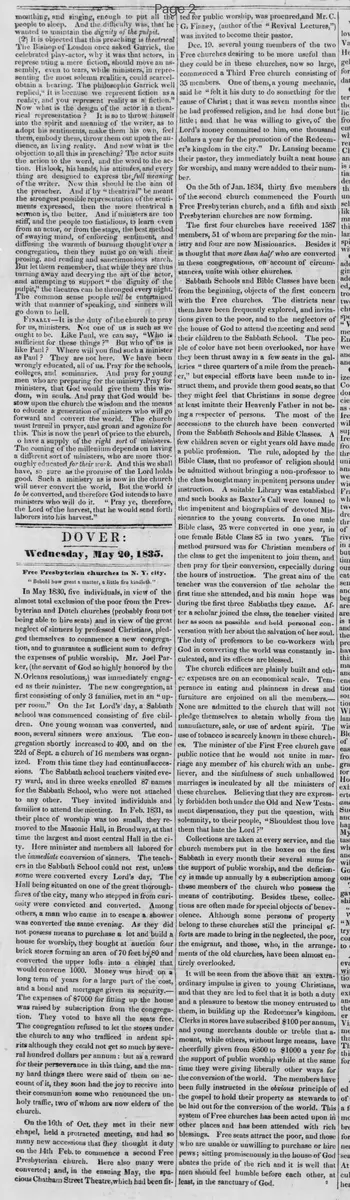
Wednesday, May 20, 1835.
Free Presbyterian churches in N. Y. city
"Behold how great a matter, a little fire kindleth."
In May 1830, five individuals, in view of the almost total exclusion of the poor from the Presbyterian and Dutch churches (probably from not being able to hire seats) and in view of the great neglect of sinners by professed Christians, pledged themselves to commence a new congregation, and to guarantee a sufficient sum to defray the expenses of public worship. Mr. Joel Parker, (the servant of God so highly honored by the N. Orleans resolutions,) was immediately engaged as their minister. The new congregation, at first consisting of only 3 families, met in an "upper room." On the 1st Lord's day, a Sabbath school was commenced consisting of five children. One young woman was converted, and soon, several sinners were anxious. The congregation shortly increased to 400, and on the 22d of Sept. a church of 16 members was organized. From this time they had continual accessions. The Sabbath school teachers visited every ward, and in three weeks enrolled 87 names for the Sabbath School, who were not attached to any other. They invited individuals and families to attend the meeting. In Feb. 1831, as their place of worship was too small, they removed to the Masonic Hall, in Broadway, at that time the largest and most central Hall in the city. Here minister and members all labored for the immediate conversion of sinners. The teachers in the Sabbath School could not rest, unless some were converted every Lord's day. The Hall being situated on one of the great thoroughfares of the city, many who stepped in from curiosity were convicted and converted. Among others, a man who came in to escape a shower was converted the same evening. As they did not possess means to purchase a lot and build a house for worship, they bought at auction four brick stores forming an area of 70 feet by 80 and converted the upper lofts into a chapel that would convene 1000. Money was hired on a long term of years for a large part of the cost, and a bond and mortgage given as security.—The expenses of $7000 for fitting up the house was raised by subscription from the congregation. They voted to have all the seats free. The congregation refused to let the stores under the church to any who trafficked in ardent spirits although they could not get so much by several hundred dollars per annum: but as a reward for their perseverance in this thing, and the many hard things there were said of them on account of it, they soon had the joy to receive into their communion some who renounced the unholy traffic, two of whom are now elders of the church.
On the 16th of Oct. they met in their new chapel, held a protracted meeting, and had so many new accessions that they thought it duty on the 14th Feb. to commence a second Free Presbyterian church. Here also many were converted; and, in the ensuing May, the spacious Chatham Street Theatre, which had been fitted for public worship, was procured, and Mr. C. G. Finney, (author of the "Revival Lectures," ) was invited to become their pastor.
Dec. 19. several young members of the two Free churches desiring to be more useful than they could be in these churches, now so large, commenced a Third Free church consisting of 35 members. One of them, a young mechanic, said he "felt it his duty to do something for the cause of Christ; that it was seven months since he had professed religion, and he had done but little; and that he was willing to give, of the Lord's money committed to him, one thousand dollars a year for the promotion of the Redeemer's kingdom in the city." Dr. Lansing became their pastor, they immediately built a neat house for worship, and many were added to their number.
On the 5th of Jan. 1834, thirty five members of the second church commenced the Fourth Free Presbyterian church, and a fifth and sixth Presbyterian churches are now forming.
The first four churches have received 1587 members, 51 of whom are preparing for the ministry and four are now Missionaries. Besides it is thought that more than half who are converted in these congregations, on account of circumstances, unite with other churches.
Sabbath Schools and Bible Classes have been from the beginning, objects of the first concern with the Free churches. The districts near them have been frequently explored, and invitations given to the poor, and to the neglectors of the house of God to attend the meeting and send their children to the Sabbath School. The people of color have not been overlooked, nor have they been thrust away in a few seats in the galleries three quarters of a mile from the preacher, but especial efforts have been made to instruct them, and provide them good seats, so that they might feel that Christians in some degree at least imitate their Heavenly Father in not being a respecter of persons. The most of the accessions to the church have been converted from the Sabbath Schools and Bible Classes. A few children seven or eight years old have made a public profession. The rule, adopted by the Bible Class, that no professor of religion should be admitted without bringing a non-professor to the class brought many impenitent persons under instruction. A suitable Library was established and such books as Baxter's Call were loaned to the impenitent and biographies of devoted Missionaries to the young converts. In one male Bible class, 25 were converted in one year, in one female Bible Class 85 in two years. The method pursued was for Christian members of the class to get the impenitent to join them, and then pray for their conversion, especially during the hours of instruction. The great aim of the teacher was the conversion of the scholar the first time she attended, and his main hope was during the first three Sabbaths they came. After a scholar joined the class, the teacher visited her as soon as possible and held personal conversation with her about the salvation of her soul. The duty of professors to be co-workers with God in converting the world was constantly inculcated, and its effects are blessed.
The church edifices are plainly built and other expenses are on an economical scale. Temperance in eating and plainness in dress and furniture are enjoined on all the members.—None are admitted to the church that will not pledge themselves to abstain wholly from the manufacture, sale, or use of ardent spirit. The use of tobacco is scarcely known in these churches. The minister of the First Free church gave public notice that he would not unite in marriage any member of his church with an unbeliever, and the sinfulness of such unhallowed marriages is inculcated by all the ministers of these churches. Believing that they are expressly forbidden both under the Old and New Testament dispensation, they put the question, with solemnity, to their people, "Shouldest thou love them that hate the Lord?"
Collections are taken at every service, and the church members put in the boxes on the first Sabbath in every month their several sums for the support of public worship, and the deficiency is made up annually by a subscription among those members of the church who possess the means of contributing. Besides these, collections are often made for special objects of benevolence. Although some persons of property belong to these churches still the principal efforts are made to bring in the neglected, the poor, the emigrant, and those, who, in the arrangements of the old churches, have been almost entirely overlooked.
It will be seen from the above that an extraordinary impulse is given to young Christians, and that they are led to feel that it is both a duty and a pleasure to bestow the money entrusted to them, in building up the Redeemer's kingdom. Clerks in stores have subscribed $100 per annum, and young merchants double or treble that amount, while others, without large means, have cheerfully given from $500 to $1000 a year for the support of public worship while at the same time they were giving liberally other ways for the conversion of the world. The members have been fully instructed in the obvious principle of the gospel to hold their property as stewards to be laid out for the conversion of the world. This system of Free churches has been acted upon in other places and has been attended with rich blessings. Free seats attract the poor, and those who are unable or unwilling to purchase or hire pews; sitting promiscuously in the house-of God abates the pride of the rich and it is well that men should feel humble before each other, at least, in the sanctuary of God.
What sub-type of article is it?
What keywords are associated?
What entities or persons were involved?
Where did it happen?
Domestic News Details
Primary Location
N. Y. City
Event Date
May 1830 To 1835
Key Persons
Outcome
the first four churches received 1587 members, with 51 preparing for ministry and 4 as missionaries; many conversions through sabbath schools and bible classes; outreach to poor, emigrants, and people of color.
Event Details
Five individuals started a Free Presbyterian congregation in May 1830 to include the poor excluded from other churches; grew rapidly with Rev. Joel Parker's ministry, free seats, Sabbath schools, and conversion efforts; expanded to six churches by 1835, emphasizing temperance, stewardship, and evangelism.