Thank you for visiting SNEWPapers!
Sign up free
Editorial
September 17, 1846
The Hillsborough Recorder
Hillsboro, Orange County, North Carolina
What is this article about?
This 1843 editorial from Hillsborough, NC, criticizes the Democratic legislature's 1842 gerrymandering of congressional districts, which subverts Whig majorities. It urges the new Whig-majority legislature to re-district for fairness, constitutionality, and to ensure proper representation in a potential contingent presidential election involving Calhoun.
Clipping
OCR Quality
95%
Excellent
Full Text
HILLSBOROUGH.
Thursday,
September 17.
Re-Districting the State,
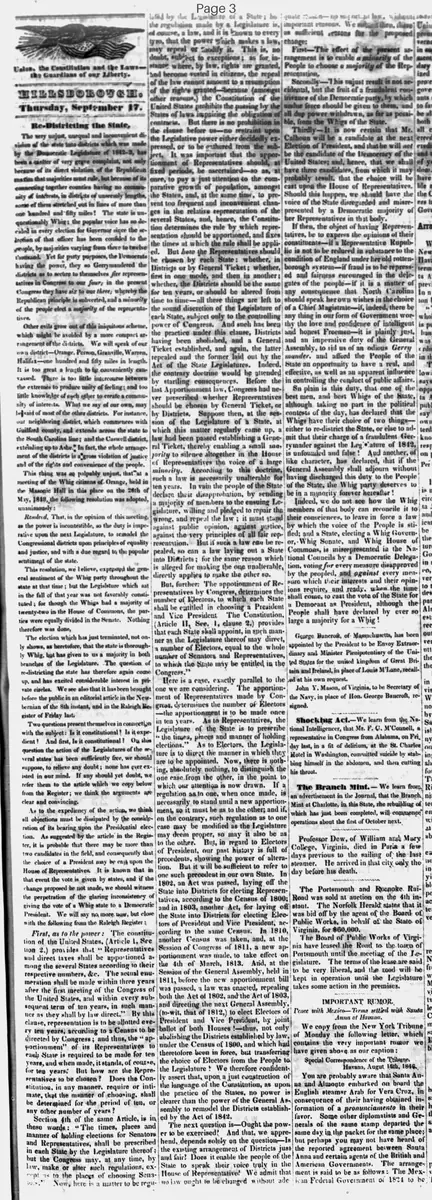
The very unjust, unequal and inconvenient division of the state into districts which was made by the Democratic Legislature of 1842-3, has been a matter of very grave complaint, not only because of its direct violation of the Republican maxim that majorities must rule, but because of its connecting together counties having no community of interests, in districts of unseemly lengths some of them stretched out in lines of more than one hundred and fifty miles! The state is unquestionably Whig: the popular voice has so decided in every election for Governor since the election of that officer has been confided to the people, by majorities varying from three to twelve thousand. Yet for party purposes, the Democrats having the power, they so Gerrymandered the districts as to secure to themselves five representatives in Congress to our four; in the present Congress they have six to our three; whereby the Republican principle is subverted, and a minority of the people elect a majority of the representatives.
Other evils grow out of this iniquitous scheme, which might be avoided by a more compact arrangement of the districts. We will speak of our own district—Orange, Person, Granville, Warren, Halifax—one hundred and fifty miles in length. It is too great a length to be conveniently canvassed. There is too little intercourse between the extremes to produce unity of feeling; and too little knowledge of each other to create a community of interests. What we say of our own, may be said of most of the other districts. For instance, our neighboring district, which commences with Guilford county, and extends across the state to the South Carolina line; and the Caswell district, extending up to Ashe. In fact, the whole arrangement of the districts is a gross violation of justice and of the rights and convenience of the people.
This thing was so palpably unjust, that at a meeting of the Whig citizens of Orange, held in the Masonic Hall in this place on the 26th of May, 1843, the following resolution was adopted, unanimously:
Resolved, That, in the opinion of this meeting, as the power is incontestable, so the duty is imperative upon the next Legislature, to remodel the Congressional districts upon principles of equality and justice, and with a due regard to the popular sentiment of the state.
This resolution, we believe, expressed the general sentiment of the Whig party throughout the state at that time; but the Legislature which sat in the fall of that year was not favorably constituted; for though the Whigs had a majority of twenty-two in the House of Commons, the parties were equally divided in the Senate. Nothing therefore was done.
The election which has just terminated, not only shows, as heretofore, that the state is thoroughly Whig, but has given to us a majority in both branches of the Legislature. The question of re-districting the state has therefore again come up, and has excited considerable interest in private circles. We see also that it has been brought before the public in an editorial article in the Newbernian of the 5th instant, and in the Raleigh Register of Friday last.
Two questions present themselves in connection with the subject: Is it constitutional? Is it expedient? And first, Is it constitutional? On this question the action of the Legislatures of the several states has been sufficiently frequent, we should suppose, to relieve any doubt; none has ever existed in our mind. If any should yet doubt, we refer them to the article which we copy below from the Register; we think the arguments are clear and convincing.
As to the expediency of the action, we think all objections must be dissipated by the consideration of its bearing upon the Presidential election. As suggested by the article in the Register, it is probable that there may be more than two candidates in the field, and consequently that the choice of a President may be cast upon the House of Representatives. It is known that in that event the vote is given by states, and if the change proposed be not made, we should witness the perpetration of the glaring inconsistency of giving the vote of a Whig state to a Democratic President. We will say no more now, but close with the following from the Raleigh Register:
First, as to the power: The constitution of the United States. (Article 1, Sec. 2.) provides that "Representatives and direct taxes shall be apportioned among the several States according to their respective numbers, &c. The actual enumeration shall be made within three years after the first meeting of the Congress of the United States, and within every subsequent term of ten years, in such manner as they shall by law direct." By this clause, representation is to be allotted every ten years, according to a Census to be directed by Congress; and thus, the "apportionment" of its Representatives to each State is required to be made every ten years, and when made, it stands, of course, for ten years? But how are the Representatives to be chosen? Does the Constitution, in any manner, require or intimate, that the manner of choosing, shall be determined for the period of ten, or any other number of years?
Section 4th of the same Article, is in these words: "The times, places and manner of holding elections for Senators and Representatives, shall be prescribed in each State by the Legislature thereof; but the Congress may, at any time, by law, make or alter such regulations, except as to the places of choosing Senators." Nowhere is a matter to be regulated by the Legislature of a State; how the regulation made by a legislature is, of course, a law, and it is known to every tyro, that the power which makes a law, may repeal or modify it. This is, no doubt, subject to exceptions; as for instance where, by law, rights are granted, and become vested in citizens, the repeal of the law cannot amount to a resumption of the rights granted—because (amongst other reasons) the Constitution of the United States prohibits the passing by the States of laws impairing the obligation of contracts. But there is no prohibition in the clause before us—no restraint upon the Legislative power either decidedly expressed, or to be gathered from the subject. It was important that the apportionment of Representatives should, at fixed periods, be ascertained—so as, at once, to pay a just attention to the comparative growth of population, amongst the States, and, at the same time, to prevent too frequent and inconvenient changes in the relative representation of the several States, and, hence, the Constitution determines the rule by which representation should be apportioned, and fixes the times at which the rule shall be applied. But how the Representatives should be chosen by each State: whether, in Districts or by General Ticket; whether, first in one mode, and then in another: whether, the Districts should be the same for ten years, or should be altered from time to time—all these things are left to the sound discretion of the Legislature of each State, subject only to the controlling power of Congress. And such has been the practice under this clause, Districts having been abolished, and a General Ticket established, and again, the latter repealed and the former laid out by the Act of the State Legislatures. Indeed, the contrary doctrine would be attended by startling consequences. Before the last Apportionment law, Congress had never prescribed whether Representatives should be chosen by General Ticket, or by Districts. Suppose then, at the session of the Legislature of a State, at which this matter regularly came up, a law had been passed establishing a General Ticket, thereby enabling a small majority to silence altogether in the House of Representatives the voice of a large minority. According to this doctrine, such a law is necessarily unalterable for ten years. In vain the people of the State declare their disapprobation, by sending a majority of members to the ensuing Legislature, willing and pledged to repair the wrong, and repeal the law; it must stand against public opinion, against justice, against the very principles of all fair representation. But if such a law can be repealed, so can a law laying out a State into Districts; for the same reason which is alleged for making the one unalterable, directly applies to make the other so.
But, further: The apportionment of Representatives by Congress, determines the number of Electors, to which each State shall be entitled in choosing a President and Vice President. The Constitution, (Article II, Sec. I, clause 2,) provides that each State shall appoint, in such manner as the Legislature thereof may direct, a number of Electors, equal to the whole number of Senators and Representatives, to which the State may be entitled in the Congress."
Here is a case, exactly parallel to the one we are considering. "The apportionment of Representatives made by Congress, determines the number of Electors —the apportionment is to be made once in ten years. As to Representatives, the Legislature of the State is to prescribe "the times, places and manner of holding elections." As to Electors, the Legislature is to direct the manner in which they are to be appointed. Now, there is nothing, absolutely nothing, to distinguish the one case from the other, in the point to which our attention is now drawn. If a regulation as to one, when once made, is necessarily to stand until a new apportionment, so it must be as to the other; and if, on the contrary, such regulation as to one case may be modified as the Legislature may deem proper, so may it also be as to the other. But, in regard to Electors of President, our past history is full of precedents, showing the power of alteration. But it will be sufficient to refer to one such precedent in our own State. In 1802, an Act was passed, laying off the State into Districts for electing Representatives, according to the Census of 1800; and in 1803, another Act, for laying off the State into Districts for electing Electors of President and Vice President, according to the same Census. In 1810, another census was taken, and, at the Session of Congress of 1811, a new apportionment was made, to take effect on the 4th of March, 1813. And, at the Session of the General Assembly, held in 1811, before the new apportionment bill was passed, a law was enacted, repealing both the Act of 1802, and the Act of 1803, and directing the next General Assembly, (to-wit, that of 1812,) to elect Electors of President and Vice President, by joint ballot of both Houses! thus, not only abolishing the Districts established by law, under the Census of 1800, and which had theretofore been in force, but transferring the choice of Electors from the People to the Legislature! We therefore confidently assert that, upon a just construction of the language of the Constitution, as upon the practice of the States, no power is clearer than the power of the General Assembly to remodel the Districts established by the Act of 1842.
The next question is—Ought the power to be exercised? And that, we apprehend, depends solely on the question—Is the existing arrangement of Districts just and fair? Does it enable the people of the State to speak their voice truly in the House of Representatives? We admit that no law ought to be changed without adequate reasons. We submit the following as sufficient reasons for the proposed change:
First—The effect of the present arrangement is to enable a minority of the People to choose a majority of the representation,
Secondly—This unjust result is not accidental, but the fruit of a fraudulent contrivance of the Democratic party, by which undue force should be given to them, and all due power withdrawn, as far as possible, from the Whigs of the State.
Thirdly—It is now certain that Mr. Calhoun will be a candidate at the next Election of President, and that he will be the candidate of the Democracy of the United States; and, hence, that we shall have three candidates, from which it may probably result that the choice will be cast upon the House of Representatives. Should this happen, we should have the voice of the State disregarded and misrepresented by a Democratic majority of her Representatives in that body.
If then, the object of having Representatives, be to express the opinions of their constituents—if a Representative Republic is not to be reduced in substance to the condition of England under her old rotten-borough system—if fraud is to be repressed and fairness encouraged in the delegates of the people—if it is a matter of any consequence that North Carolina should speak her own wishes in the choice of a Chief Magistrate—if, indeed, there be any thing in our form of Government worthy the love and confidence of intelligent and honest Freemen—it is plainly just, and an imperative duty of the General Assembly, to rid us of an odious Gerrymander, and afford the People of the State an opportunity to have a real, and effectual, as well as an apparent influence in controlling the conduct of public affairs.
So plain is this duty, that one of the best men, and best Whigs of the State, although taking no part in the political contests of the day, has declared that the Whigs have their choice of two things—either to re-district the State, or else to admit that their charge of a fraudulent Gerrymander against the Legislature of 1842, is unfounded and false! And another, of like character, has declared, that if the General Assembly shall adjourn without having discharged this duty to the People of the State, the Whig party deserves to be in a minority forever hereafter!
Indeed, we do not see how the Whig members of that body can reconcile it to their consciences, to leave in force a law by which the voice of the People is stifled; and a State, electing a Whig Governor,—Whig Senate, and Whig House of Commons, is misrepresented in the National Councils by a Democratic Delegation, voting for every measure disapproved by the people, and against every measure which their interests and their opinions require, and ready, when the time shall come, to cast the vote of the State for a Democrat as President, although the People shall have declared by ever so large a majority for a Whig!
Thursday,
September 17.
Re-Districting the State,
The very unjust, unequal and inconvenient division of the state into districts which was made by the Democratic Legislature of 1842-3, has been a matter of very grave complaint, not only because of its direct violation of the Republican maxim that majorities must rule, but because of its connecting together counties having no community of interests, in districts of unseemly lengths some of them stretched out in lines of more than one hundred and fifty miles! The state is unquestionably Whig: the popular voice has so decided in every election for Governor since the election of that officer has been confided to the people, by majorities varying from three to twelve thousand. Yet for party purposes, the Democrats having the power, they so Gerrymandered the districts as to secure to themselves five representatives in Congress to our four; in the present Congress they have six to our three; whereby the Republican principle is subverted, and a minority of the people elect a majority of the representatives.
Other evils grow out of this iniquitous scheme, which might be avoided by a more compact arrangement of the districts. We will speak of our own district—Orange, Person, Granville, Warren, Halifax—one hundred and fifty miles in length. It is too great a length to be conveniently canvassed. There is too little intercourse between the extremes to produce unity of feeling; and too little knowledge of each other to create a community of interests. What we say of our own, may be said of most of the other districts. For instance, our neighboring district, which commences with Guilford county, and extends across the state to the South Carolina line; and the Caswell district, extending up to Ashe. In fact, the whole arrangement of the districts is a gross violation of justice and of the rights and convenience of the people.
This thing was so palpably unjust, that at a meeting of the Whig citizens of Orange, held in the Masonic Hall in this place on the 26th of May, 1843, the following resolution was adopted, unanimously:
Resolved, That, in the opinion of this meeting, as the power is incontestable, so the duty is imperative upon the next Legislature, to remodel the Congressional districts upon principles of equality and justice, and with a due regard to the popular sentiment of the state.
This resolution, we believe, expressed the general sentiment of the Whig party throughout the state at that time; but the Legislature which sat in the fall of that year was not favorably constituted; for though the Whigs had a majority of twenty-two in the House of Commons, the parties were equally divided in the Senate. Nothing therefore was done.
The election which has just terminated, not only shows, as heretofore, that the state is thoroughly Whig, but has given to us a majority in both branches of the Legislature. The question of re-districting the state has therefore again come up, and has excited considerable interest in private circles. We see also that it has been brought before the public in an editorial article in the Newbernian of the 5th instant, and in the Raleigh Register of Friday last.
Two questions present themselves in connection with the subject: Is it constitutional? Is it expedient? And first, Is it constitutional? On this question the action of the Legislatures of the several states has been sufficiently frequent, we should suppose, to relieve any doubt; none has ever existed in our mind. If any should yet doubt, we refer them to the article which we copy below from the Register; we think the arguments are clear and convincing.
As to the expediency of the action, we think all objections must be dissipated by the consideration of its bearing upon the Presidential election. As suggested by the article in the Register, it is probable that there may be more than two candidates in the field, and consequently that the choice of a President may be cast upon the House of Representatives. It is known that in that event the vote is given by states, and if the change proposed be not made, we should witness the perpetration of the glaring inconsistency of giving the vote of a Whig state to a Democratic President. We will say no more now, but close with the following from the Raleigh Register:
First, as to the power: The constitution of the United States. (Article 1, Sec. 2.) provides that "Representatives and direct taxes shall be apportioned among the several States according to their respective numbers, &c. The actual enumeration shall be made within three years after the first meeting of the Congress of the United States, and within every subsequent term of ten years, in such manner as they shall by law direct." By this clause, representation is to be allotted every ten years, according to a Census to be directed by Congress; and thus, the "apportionment" of its Representatives to each State is required to be made every ten years, and when made, it stands, of course, for ten years? But how are the Representatives to be chosen? Does the Constitution, in any manner, require or intimate, that the manner of choosing, shall be determined for the period of ten, or any other number of years?
Section 4th of the same Article, is in these words: "The times, places and manner of holding elections for Senators and Representatives, shall be prescribed in each State by the Legislature thereof; but the Congress may, at any time, by law, make or alter such regulations, except as to the places of choosing Senators." Nowhere is a matter to be regulated by the Legislature of a State; how the regulation made by a legislature is, of course, a law, and it is known to every tyro, that the power which makes a law, may repeal or modify it. This is, no doubt, subject to exceptions; as for instance where, by law, rights are granted, and become vested in citizens, the repeal of the law cannot amount to a resumption of the rights granted—because (amongst other reasons) the Constitution of the United States prohibits the passing by the States of laws impairing the obligation of contracts. But there is no prohibition in the clause before us—no restraint upon the Legislative power either decidedly expressed, or to be gathered from the subject. It was important that the apportionment of Representatives should, at fixed periods, be ascertained—so as, at once, to pay a just attention to the comparative growth of population, amongst the States, and, at the same time, to prevent too frequent and inconvenient changes in the relative representation of the several States, and, hence, the Constitution determines the rule by which representation should be apportioned, and fixes the times at which the rule shall be applied. But how the Representatives should be chosen by each State: whether, in Districts or by General Ticket; whether, first in one mode, and then in another: whether, the Districts should be the same for ten years, or should be altered from time to time—all these things are left to the sound discretion of the Legislature of each State, subject only to the controlling power of Congress. And such has been the practice under this clause, Districts having been abolished, and a General Ticket established, and again, the latter repealed and the former laid out by the Act of the State Legislatures. Indeed, the contrary doctrine would be attended by startling consequences. Before the last Apportionment law, Congress had never prescribed whether Representatives should be chosen by General Ticket, or by Districts. Suppose then, at the session of the Legislature of a State, at which this matter regularly came up, a law had been passed establishing a General Ticket, thereby enabling a small majority to silence altogether in the House of Representatives the voice of a large minority. According to this doctrine, such a law is necessarily unalterable for ten years. In vain the people of the State declare their disapprobation, by sending a majority of members to the ensuing Legislature, willing and pledged to repair the wrong, and repeal the law; it must stand against public opinion, against justice, against the very principles of all fair representation. But if such a law can be repealed, so can a law laying out a State into Districts; for the same reason which is alleged for making the one unalterable, directly applies to make the other so.
But, further: The apportionment of Representatives by Congress, determines the number of Electors, to which each State shall be entitled in choosing a President and Vice President. The Constitution, (Article II, Sec. I, clause 2,) provides that each State shall appoint, in such manner as the Legislature thereof may direct, a number of Electors, equal to the whole number of Senators and Representatives, to which the State may be entitled in the Congress."
Here is a case, exactly parallel to the one we are considering. "The apportionment of Representatives made by Congress, determines the number of Electors —the apportionment is to be made once in ten years. As to Representatives, the Legislature of the State is to prescribe "the times, places and manner of holding elections." As to Electors, the Legislature is to direct the manner in which they are to be appointed. Now, there is nothing, absolutely nothing, to distinguish the one case from the other, in the point to which our attention is now drawn. If a regulation as to one, when once made, is necessarily to stand until a new apportionment, so it must be as to the other; and if, on the contrary, such regulation as to one case may be modified as the Legislature may deem proper, so may it also be as to the other. But, in regard to Electors of President, our past history is full of precedents, showing the power of alteration. But it will be sufficient to refer to one such precedent in our own State. In 1802, an Act was passed, laying off the State into Districts for electing Representatives, according to the Census of 1800; and in 1803, another Act, for laying off the State into Districts for electing Electors of President and Vice President, according to the same Census. In 1810, another census was taken, and, at the Session of Congress of 1811, a new apportionment was made, to take effect on the 4th of March, 1813. And, at the Session of the General Assembly, held in 1811, before the new apportionment bill was passed, a law was enacted, repealing both the Act of 1802, and the Act of 1803, and directing the next General Assembly, (to-wit, that of 1812,) to elect Electors of President and Vice President, by joint ballot of both Houses! thus, not only abolishing the Districts established by law, under the Census of 1800, and which had theretofore been in force, but transferring the choice of Electors from the People to the Legislature! We therefore confidently assert that, upon a just construction of the language of the Constitution, as upon the practice of the States, no power is clearer than the power of the General Assembly to remodel the Districts established by the Act of 1842.
The next question is—Ought the power to be exercised? And that, we apprehend, depends solely on the question—Is the existing arrangement of Districts just and fair? Does it enable the people of the State to speak their voice truly in the House of Representatives? We admit that no law ought to be changed without adequate reasons. We submit the following as sufficient reasons for the proposed change:
First—The effect of the present arrangement is to enable a minority of the People to choose a majority of the representation,
Secondly—This unjust result is not accidental, but the fruit of a fraudulent contrivance of the Democratic party, by which undue force should be given to them, and all due power withdrawn, as far as possible, from the Whigs of the State.
Thirdly—It is now certain that Mr. Calhoun will be a candidate at the next Election of President, and that he will be the candidate of the Democracy of the United States; and, hence, that we shall have three candidates, from which it may probably result that the choice will be cast upon the House of Representatives. Should this happen, we should have the voice of the State disregarded and misrepresented by a Democratic majority of her Representatives in that body.
If then, the object of having Representatives, be to express the opinions of their constituents—if a Representative Republic is not to be reduced in substance to the condition of England under her old rotten-borough system—if fraud is to be repressed and fairness encouraged in the delegates of the people—if it is a matter of any consequence that North Carolina should speak her own wishes in the choice of a Chief Magistrate—if, indeed, there be any thing in our form of Government worthy the love and confidence of intelligent and honest Freemen—it is plainly just, and an imperative duty of the General Assembly, to rid us of an odious Gerrymander, and afford the People of the State an opportunity to have a real, and effectual, as well as an apparent influence in controlling the conduct of public affairs.
So plain is this duty, that one of the best men, and best Whigs of the State, although taking no part in the political contests of the day, has declared that the Whigs have their choice of two things—either to re-district the State, or else to admit that their charge of a fraudulent Gerrymander against the Legislature of 1842, is unfounded and false! And another, of like character, has declared, that if the General Assembly shall adjourn without having discharged this duty to the People of the State, the Whig party deserves to be in a minority forever hereafter!
Indeed, we do not see how the Whig members of that body can reconcile it to their consciences, to leave in force a law by which the voice of the People is stifled; and a State, electing a Whig Governor,—Whig Senate, and Whig House of Commons, is misrepresented in the National Councils by a Democratic Delegation, voting for every measure disapproved by the people, and against every measure which their interests and their opinions require, and ready, when the time shall come, to cast the vote of the State for a Democrat as President, although the People shall have declared by ever so large a majority for a Whig!
What sub-type of article is it?
Partisan Politics
Constitutional
What keywords are associated?
Gerrymandering
Re Districting
Congressional Districts
Whig Majority
Democratic Fraud
Presidential Election
North Carolina Politics
What entities or persons were involved?
Democratic Legislature Of 1842 3
Whig Party
Raleigh Register
Mr. Calhoun
North Carolina General Assembly
Editorial Details
Primary Topic
Re Districting To Correct Gerrymandering
Stance / Tone
Strongly Pro Whig Advocacy For Re Districting Against Democratic Gerrymander
Key Figures
Democratic Legislature Of 1842 3
Whig Party
Raleigh Register
Mr. Calhoun
North Carolina General Assembly
Key Arguments
1842 3 Democratic Districts Violate Majority Rule By Connecting Unrelated Counties Into Long Districts
Gerrymandering Gives Democrats Majority Representation Despite Whig State Majorities
Re Districting Is Constitutional Per U.S. Constitution And State Precedents
Expedient To Prevent Whig State's Vote Going To Democratic President In House
Current Districts Hinder Canvassing And Unity Of Interests
Whig Legislature Must Act To Uphold Republican Principles And Avoid Fraud