Thank you for visiting SNEWPapers!
Sign up free
Editorial
June 27, 1955
Trainman News
Indianapolis, Marion County, Indiana
What is this article about?
Editorial urges railroad management to heed public relations officers' advice from their convention, emphasizing their role in shaping salable policies to counter competition from trucks and promote services like piggybacking for industry prosperity.
Clipping
OCR Quality
100%
Excellent
Full Text
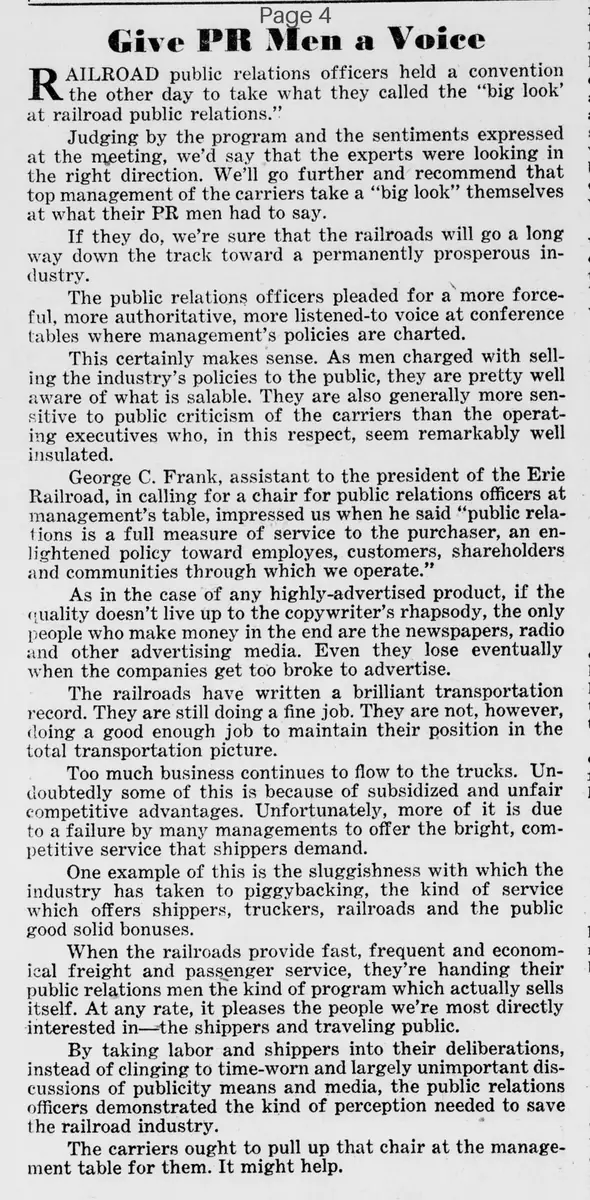
Give PR Men a Voice
RAILROAD public relations officers held a convention
the other day to take what they called the "big look"
at railroad public relations.
Judging by the program and the sentiments expressed
at the meeting, we'd say that the experts were looking in
the right direction. We'll go further and recommend that
top management of the carriers take a "big look" themselves
at what their PR men had to say.
If they do, we're sure that the railroads will go a long
way down the track toward a permanently prosperous in-
dustry.
The public relations officers pleaded for a more force-
ful, more authoritative, more listened-to voice at conference
tables where management's policies are charted.
This certainly makes sense. As men charged with sell-
ing the industry's policies to the public, they are pretty well
aware of what is salable. They are also generally more sen-
sitive to public criticism of the carriers than the operat-
ing executives who, in this respect, seem remarkably well
insulated.
George C. Frank, assistant to the president of the Erie
Railroad, in calling for a chair for public relations officers at
management's table, impressed us when he said "public rela-
tions is a full measure of service to the purchaser, an en-
lightened policy toward employes, customers, shareholders
and communities through which we operate."
As in the case of any highly-advertised product, if the
quality doesn't live up to the copywriter's rhapsody, the only
people who make money in the end are the newspapers, radio
and other advertising media. Even they lose eventually
when the companies get too broke to advertise.
The railroads have written a brilliant transportation
record. They are still doing a fine job. They are not, however,
doing a good enough job to maintain their position in the
total transportation picture.
Too much business continues to flow to the trucks. Un-
doubtedly some of this is because of subsidized and unfair
competitive advantages. Unfortunately, more of it is due
to a failure by many managements to offer the bright, com-
petitive service that shippers demand.
One example of this is the sluggishness with which the
industry has taken to piggybacking, the kind of service
which offers shippers, truckers, railroads and the public
good solid bonuses.
When the railroads provide fast, frequent and econom-
ical freight and passenger service, they're handing their
public relations men the kind of program which actually sells
itself. At any rate, it pleases the people we're most directly
interested in- the shippers and traveling public.
By taking labor and shippers into their deliberations,
instead of clinging to time-worn and largely unimportant dis-
cussions of publicity means and media, the public relations
officers demonstrated the kind of perception needed to save
the railroad industry.
The carriers ought to pull up that chair at the manage-
ment table for them. It might help.
RAILROAD public relations officers held a convention
the other day to take what they called the "big look"
at railroad public relations.
Judging by the program and the sentiments expressed
at the meeting, we'd say that the experts were looking in
the right direction. We'll go further and recommend that
top management of the carriers take a "big look" themselves
at what their PR men had to say.
If they do, we're sure that the railroads will go a long
way down the track toward a permanently prosperous in-
dustry.
The public relations officers pleaded for a more force-
ful, more authoritative, more listened-to voice at conference
tables where management's policies are charted.
This certainly makes sense. As men charged with sell-
ing the industry's policies to the public, they are pretty well
aware of what is salable. They are also generally more sen-
sitive to public criticism of the carriers than the operat-
ing executives who, in this respect, seem remarkably well
insulated.
George C. Frank, assistant to the president of the Erie
Railroad, in calling for a chair for public relations officers at
management's table, impressed us when he said "public rela-
tions is a full measure of service to the purchaser, an en-
lightened policy toward employes, customers, shareholders
and communities through which we operate."
As in the case of any highly-advertised product, if the
quality doesn't live up to the copywriter's rhapsody, the only
people who make money in the end are the newspapers, radio
and other advertising media. Even they lose eventually
when the companies get too broke to advertise.
The railroads have written a brilliant transportation
record. They are still doing a fine job. They are not, however,
doing a good enough job to maintain their position in the
total transportation picture.
Too much business continues to flow to the trucks. Un-
doubtedly some of this is because of subsidized and unfair
competitive advantages. Unfortunately, more of it is due
to a failure by many managements to offer the bright, com-
petitive service that shippers demand.
One example of this is the sluggishness with which the
industry has taken to piggybacking, the kind of service
which offers shippers, truckers, railroads and the public
good solid bonuses.
When the railroads provide fast, frequent and econom-
ical freight and passenger service, they're handing their
public relations men the kind of program which actually sells
itself. At any rate, it pleases the people we're most directly
interested in- the shippers and traveling public.
By taking labor and shippers into their deliberations,
instead of clinging to time-worn and largely unimportant dis-
cussions of publicity means and media, the public relations
officers demonstrated the kind of perception needed to save
the railroad industry.
The carriers ought to pull up that chair at the manage-
ment table for them. It might help.
What sub-type of article is it?
Infrastructure
Economic Policy
Trade Or Commerce
What keywords are associated?
Railroad Pr
Management Policies
Industry Competition
Piggybacking Service
Public Criticism
Transportation Business
What entities or persons were involved?
Railroad Public Relations Officers
George C. Frank
Erie Railroad
Editorial Details
Primary Topic
Empowering Public Relations Officers In Railroad Management
Stance / Tone
Advocacy For Integrating Pr Into Policy Making
Key Figures
Railroad Public Relations Officers
George C. Frank
Erie Railroad
Key Arguments
Pr Officers Need Authoritative Voice In Management Conferences
Railroads Losing Business To Trucks Due To Poor Service And Competition
Adopt Piggybacking And Competitive Services To Boost Industry
Pr Involves Service To Employees, Customers, Shareholders, And Communities
Management Often Insulated From Public Criticism