Thank you for visiting SNEWPapers!
Sign up free
Virginia Argus
Richmond, Virginia
What is this article about?
Editorial reports unconfirmed news of a naval engagement in the Mediterranean between a U.S. frigate (Constitution or Constellation) and a British 74-gun ship over impressed seamen. It expresses patriotic skepticism but believes British aggression signals war, urging self-reliance, militia defense, and no large navy or army.
Merged-components note: Merged as a single editorial piece on British outrages and military policy; the second component's opinionated advice on navy and army fits as continuation, relabeling the first from domestic_news to editorial.
Clipping
OCR Quality
Full Text
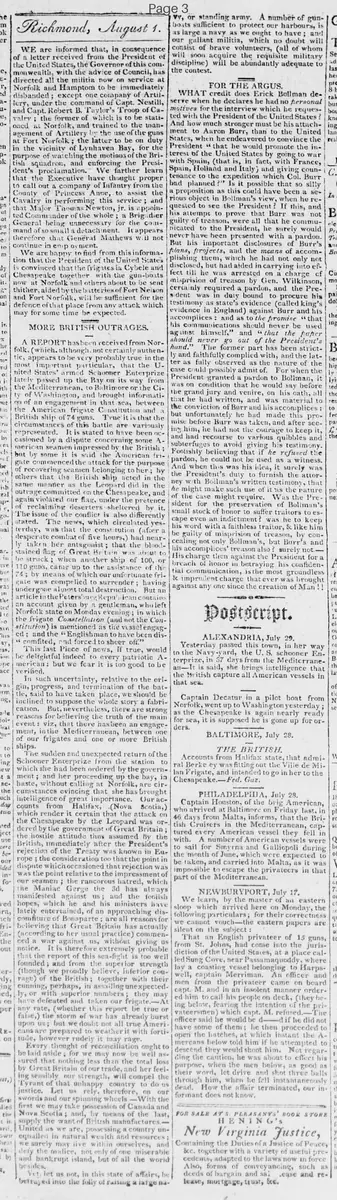
A REPORT has been received from Norfolk, (which, although, not certainly authentic, appears to be very probably true in the most important particular, that the United States' armed Schooner Enterprize lately passed up the Bay on its way from the Mediterranean, to Baltimore or the City of Washington, and brought information of an engagement in that sea, between the American frigate Constitution and a British ship of 74 guns. True it is that the circumstances of this battle are variously represented. It is stated to have been occasioned by a dispute concerning some American seamen impressed by the British ; but by some it is said the American frigate commenced the attack for the purpose of recovering seamen belonging to her; by others that the British ship acted in the same manner as the Leopard did in the outrage committed on the Chesapeake, and again violated our flag, under the pretence of reclaiming deserters sheltered by it.
The issue of the conflict is also differently stated. The news, which circulated yesterday, was that the Constitution (after a desperate combat of five hours,) had nearly taken her antagonist: that the blood-stained flag of Great Britain was about to be struck; when another ship of 100, or 110 guns, came up to the assistance of the 74 ; by means of which our unfortunate frigate was compelled to surrender; having undergone almost total destruction. But an article in the Petersburg Republican contains an account given by a gentleman, who left Norfolk state on Monday evening; in which the frigate Constellation (and not the Constitution) is mentioned as the vessel engaged: and the "Englishman to have been discomfited, and forced to sheer off."
This last piece of news, if true, would be delightful indeed to every patriotic American: but we fear it is too good to be verified.
In such uncertainty, relative to the origin, progress, and termination of the battle, said to have taken place, we should be inclined to suppose the whole story a fabrication. But, nevertheless, there are strong reasons for believing the truth of the main event : viz, that there has been an engagement, in the Mediterranean, between one of our frigates and one or more British ships.
The sudden and unexpected return of the Schooner Enterprize from the station to which she had been ordered by the government; and her proceeding up the bay, in haste, without calling at Norfolk, are circumstances evincing that she has brought intelligence of great importance. Our accounts from Halifax, -(Nova Scotia,) which render it certain that the attack on the Chesapeake by the Leopard was ordered by the government of Great Britain; the hostile attitude thus assumed by the British, immediately after the President's rejection of the Treaty was known in Europe ; the consideration too that the point in dispute which occasioned that rejection was the point relative to the impressment of our seamen ; the rancorous hatred, which the Maniac George the 3d has always manifested against us; and the foolish hopes, which he and his ministers have lately entertained, of an approaching discomfiture of Bonaparte : are all reasons for believing that Great Britain has actually (according to her usual practice) commenced a war against us, without giving us notice. It is therefore extremely probable that the report of this sea-fight is too well founded; and from the superior strength (though we proudly believe, inferior courage) of the British; together with their cunning, perhaps, in assailing unexpectedly, or with superior numbers; they may have defeated and taken our frigate.-At any rate, (whether this report be true or false,) the storm of war has already burst upon us: but we doubt not all true Americans are prepared to weather it with fortitude, however rudely it may rage.
Every thought of reconciliation ought to be laid aside : for we may now be well assured that nothing less than the total loss by Great Britain of our trade, and her feeling sensibly our strength, will compel the 'Tyrant of that unhappy country to do us justice. Let us rely. therefore, on our swords and our spinning wheels-With the first we may take possession of Canada and Nova Scotia; and, by means of the last, supply the want of British manufactures.- United as we are, possessing a country unequalled in natural wealth and resources: we surely may live within ourselves, and defy the malice, not only of one miserable and bankrupt island, but of all the world besides.
Yet, let us not, in this state of affairs, be betrayed into the folly of raising a large naVy, or standing army. A number of gun-boats sufficient to protect our harbours, is as large a navy as we ought to have; and our gallant militia, which no doubt will consist of brave volunteers, (all of whom will soon acquire the requisite military discipline) will be abundantly adequate to the contest.
What sub-type of article is it?
What keywords are associated?
What entities or persons were involved?
Editorial Details
Primary Topic
Reported Naval Engagement With British Ship And Call For War Preparation
Stance / Tone
Patriotic Anti British Exhortation Urging Self Reliance And Limited Military Buildup
Key Figures
Key Arguments