Thank you for visiting SNEWPapers!
Sign up free
Letter to Editor
January 27, 1938
The Poplar Standard
Poplar, Roosevelt County, Montana
What is this article about?
A.D. Paulson, after traveling through the Great American Desert, praises the Poplar, Montana area's potential compared to arid regions, urging locals to stay, develop irrigation from Fort Peck Dam and other projects, and avoid migration during the Dust Bowl era.
Clipping
OCR Quality
98%
Excellent
Full Text
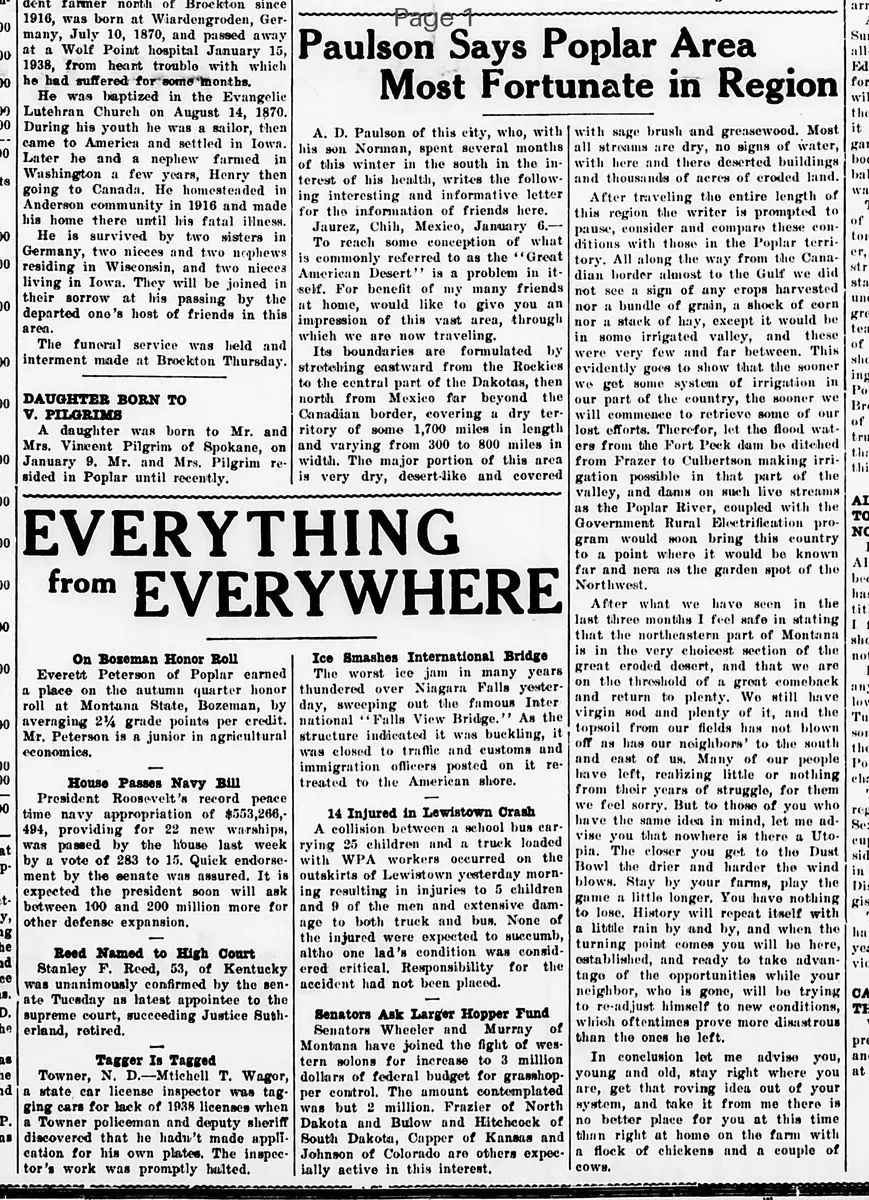
Paulson Says Poplar Area Most Fortunate in Region
A. D. Paulson of this city, who, with his son Norman, spent several months of this winter in the south in the interest of his health, writes the following interesting and informative letter for the information of friends here.
Juarez, Chih, Mexico, January 6.
To reach some conception of what is commonly referred to as the 'Great American Desert' is a problem in itself. For benefit of my many friends at home, would like to give you an impression of this vast area, through which we are now traveling.
Its boundaries are formulated by stretching eastward from the Rockies to the central part of the Dakotas, then north from Mexico far beyond the Canadian border, covering a dry territory of some 1,700 miles in length and varying from 300 to 800 miles in width. The major portion of this area is very dry, desert-like and covered with sage brush and greasewood. Most all streams are dry, no signs of water, with here and there deserted buildings and thousands of acres of eroded land.
After traveling the entire length of this region the writer is prompted to pause, consider and compare these conditions with those in the Poplar territory. All along the way from the Canadian border almost to the Gulf we did not see a sign of any crops harvested nor a bundle of grain, a shock of corn nor a stack of hay, except it would be in some irrigated valley, and these were very few and far between. This evidently goes to show that the sooner we get some system of irrigation in our part of the country, the sooner we will commence to retrieve some of our lost efforts. Therefore, let the flood waters from the Fort Peck dam be ditched from Frazer to Culbertson making irrigation possible in that part of the valley, and dams on such live streams as the Poplar River, coupled with the Government Rural Electrification program would soon bring this country to a point where it would be known far and near as the garden spot of the Northwest.
After what we have seen in the last three months I feel safe in stating that the northeastern part of Montana is in the very choicest section of the great eroded desert, and that we are on the threshold of a great comeback and return to plenty. We still have virgin sod and plenty of it, and the topsoil from our fields has not blown off as has our neighbors' to the south and east of us. Many of our people have left, realizing little or nothing from their years of struggle, for them we feel sorry. But to those of you who have the same idea in mind, let me advise you that nowhere is there a Utopia. The closer you get to the Dust Bowl the drier and harder the wind blows. Stay by your farms, play the game a little longer. You have nothing to lose. History will repeat itself with a little rain by and by, and when the turning point comes you will be here, established, and ready to take advantage of the opportunities while your neighbor, who is gone, will be trying to re-adjust himself to new conditions, which oftentimes prove more disastrous than the ones he left.
In conclusion let me advise you, young and old, stay right where you are, get that roving idea out of your system, and take it from me there is no better place for you at this time than right at home on the farm with a flock of chickens and a couple of cows.
A. D. Paulson of this city, who, with his son Norman, spent several months of this winter in the south in the interest of his health, writes the following interesting and informative letter for the information of friends here.
Juarez, Chih, Mexico, January 6.
To reach some conception of what is commonly referred to as the 'Great American Desert' is a problem in itself. For benefit of my many friends at home, would like to give you an impression of this vast area, through which we are now traveling.
Its boundaries are formulated by stretching eastward from the Rockies to the central part of the Dakotas, then north from Mexico far beyond the Canadian border, covering a dry territory of some 1,700 miles in length and varying from 300 to 800 miles in width. The major portion of this area is very dry, desert-like and covered with sage brush and greasewood. Most all streams are dry, no signs of water, with here and there deserted buildings and thousands of acres of eroded land.
After traveling the entire length of this region the writer is prompted to pause, consider and compare these conditions with those in the Poplar territory. All along the way from the Canadian border almost to the Gulf we did not see a sign of any crops harvested nor a bundle of grain, a shock of corn nor a stack of hay, except it would be in some irrigated valley, and these were very few and far between. This evidently goes to show that the sooner we get some system of irrigation in our part of the country, the sooner we will commence to retrieve some of our lost efforts. Therefore, let the flood waters from the Fort Peck dam be ditched from Frazer to Culbertson making irrigation possible in that part of the valley, and dams on such live streams as the Poplar River, coupled with the Government Rural Electrification program would soon bring this country to a point where it would be known far and near as the garden spot of the Northwest.
After what we have seen in the last three months I feel safe in stating that the northeastern part of Montana is in the very choicest section of the great eroded desert, and that we are on the threshold of a great comeback and return to plenty. We still have virgin sod and plenty of it, and the topsoil from our fields has not blown off as has our neighbors' to the south and east of us. Many of our people have left, realizing little or nothing from their years of struggle, for them we feel sorry. But to those of you who have the same idea in mind, let me advise you that nowhere is there a Utopia. The closer you get to the Dust Bowl the drier and harder the wind blows. Stay by your farms, play the game a little longer. You have nothing to lose. History will repeat itself with a little rain by and by, and when the turning point comes you will be here, established, and ready to take advantage of the opportunities while your neighbor, who is gone, will be trying to re-adjust himself to new conditions, which oftentimes prove more disastrous than the ones he left.
In conclusion let me advise you, young and old, stay right where you are, get that roving idea out of your system, and take it from me there is no better place for you at this time than right at home on the farm with a flock of chickens and a couple of cows.
What sub-type of article is it?
Informative
Persuasive
Reflective
What themes does it cover?
Agriculture
Infrastructure
Social Issues
What keywords are associated?
Great American Desert
Poplar Montana
Irrigation
Fort Peck Dam
Dust Bowl
Rural Electrification
Farm Persistence
What entities or persons were involved?
A. D. Paulson
Letter to Editor Details
Author
A. D. Paulson
Main Argument
the poplar territory in northeastern montana is the most fortunate part of the great american desert due to its remaining fertile soil and potential for irrigation; residents should stay on their farms and support development projects like the fort peck dam to ensure future prosperity rather than migrating.
Notable Details
Description Of Great American Desert Boundaries And Conditions
Comparison To Irrigated Valleys
Advocacy For Irrigation From Fort Peck Dam And Dams On Poplar River
Reference To Government Rural Electrification Program
Encouragement To Stay During Dust Bowl Hardships