Thank you for visiting SNEWPapers!
Sign up free
Daily Richmond Whig
Richmond, Virginia
What is this article about?
Account of pirate Edward Teach, known as Black Beard, who operated off North Carolina in 1717. He surrendered under pardon but returned to piracy, capturing a French ship with alleged official complicity. Pursued and killed by Lt. Maynard; associates tried, implicating Secretary Knight and Governor Eden.
Clipping
OCR Quality
Full Text
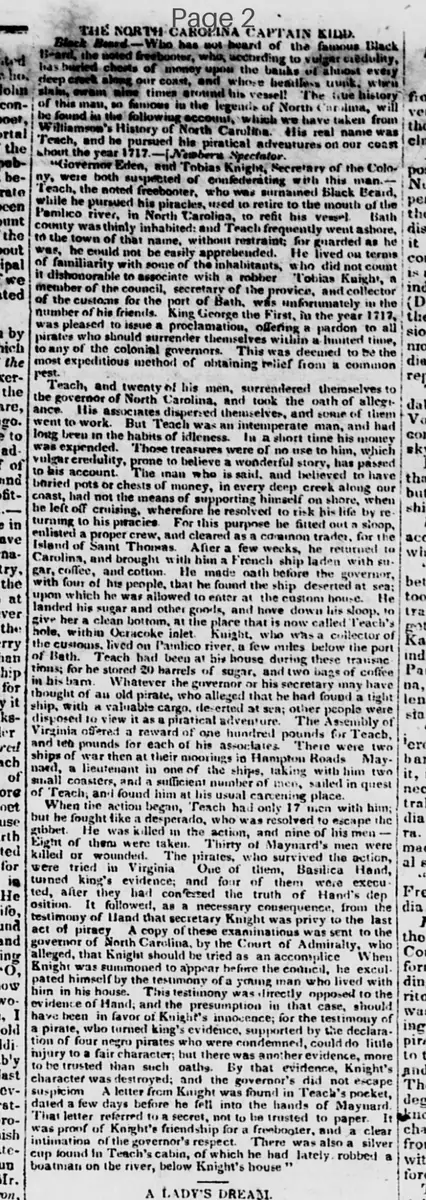
Broad—Who has not heard of the famous Black Beard, the noted freebooter, who, according to vulgar credulity, has buried chests of money upon the banks of almost every deep creek along our coast, and whose headless trunk, when sink, swam nine times round his vessel! The true history of this man, so famous in the legends of North Carolina, will be found in the following account, which we have taken from Williamson's History of North Carolina. His real name was Teach, and he pursued his piratical adventures on our coast about the year 1717.—[Newbern Spectator.]
Governor Eden and Tobias Knight, Secretary of the Colony, were both suspected of Confederating with this man.*
Teach, the noted freebooter, who was surnamed Black Beard, while he pursued his piracies, used to retire to the mouth of the Pamlico river, in North Carolina, to refit his vessel. Bath county was thinly inhabited: and Teach frequently went ashore, to the town of that name, without restraint; or guarded as he was, he could not be easily apprehended. He lived on terms of familiarity with some of the inhabitants, who did not count it dishonorable to associate with a robber Tobias Knight, a member of the council, secretary of the province, and collector of the customs for the port of Bath, was unfortunately in the number of his friends. King George the First, in the year 1717, was pleased to issue a proclamation, offering a pardon to all pirates who should surrender themselves within a limited time, to any of the colonial governors. This was deemed to be the most expeditious method of obtaining relief from a common pest.
Teach, and twenty of his men, surrendered themselves to the governor of North Carolina, and took the oath of allegiance. His associates dispersed themselves, and some of them went to work. But Teach was an intemperate man, and had long been in the habits of idleness. In a short time his money was expended. Those treasures were of no use to him, which vulgar credulity, prone to believe a wonderful story, has passed to his account. The man who is said, and believed to have buried pots or chests of money, in every deep creek along our coast, had not the means of supporting himself on shore, when he left off cruising, wherefore he resolved to risk his life by returning to his piracies.
For this purpose he fitted out a sloop enlisted a proper crew, and cleared as a common trader, for the Island of Saint Thomas. After a few weeks, he returned to Carolina, and brought with him a French ship laden with sugar, coffee, and cotton. He made oath before the governor, with four of his people, that he found the ship deserted at sea: upon which he was allowed to enter at the custom house. He landed his sugar and other goods, and hove down his sloop, to give her a clean bottom, at the place that is now called Teach's hole, within Ocracoke inlet. Knight, who was a collector of the customs, lived on Pamlico river, a few miles below the port of Bath. Teach had been at his house during these transactions; for he stored 60 barrels of sugar, and two bags of coffee in his barn.
Whatever the governor or his secretary may have thought of an old pirate, who alleged that he had found a tight ship, with a valuable cargo, deserted at sea; other people were disposed to view it as a piratical adventure. The Assembly of Virginia offered a reward of one hundred pounds for Teach, and ten pounds for each of his associates. There were two ships of war then at their moorings in Hampton Roads Maynaard, a lieutenant in one of the ships, taking with him two small coasters, and a sufficient number of men, sailed in quest of Teach; and found him at his usual careening place.
When the action began, Teach had only 17 men with him; but he fought like a desperado, who was resolved to escape the gibbet. He was killed in the action, and nine of his men— Eight of them were taken. Thirty of Maynard's men were killed or wounded. The pirates, who survived the action, were tried in Virginia One of them, Basilica Hand, turned king's evidence; and four of them were executed, after they had confirmed the truth of Hand's deposition. It followed, as a necessary consequence, from the testimony of Hand that secretary Knight was privy to the last act of piracy A copy of these examinations was sent to the governor of North Carolina, by the Court of Admiralty, who alleged, that Knight should be tried as an accomplice When Knight was summoned to appear before the council, he exculpated himself by the testimony of a young man who lived with him in his house. This testimony was directly opposed to the evidence of Hand; and the presumption in that case, should have been in favor of Knight's innocence; for the testimony of a pirate, who turned king's evidence, supported by the declaration of four negro pirates who were condemned, could do little injury to a fair character; but there was another evidence, more to be trusted than such oaths. By that evidence, Knight's character was destroyed; and the governor's did not escape suspicion A letter from Knight was found in Teach's pocket, dated a few days before he fell into the hands of Maynard. That letter referred to a secret, not to be trusted to paper. It was proof of Knight's friendship for a freebooter, and a clear intimation of the governor's respect. There was also a silver cup found in Teach's cabin, of which he had lately robbed boatman on the river, below Knight's house
What sub-type of article is it?
What themes does it cover?
What keywords are associated?
What entities or persons were involved?
Where did it happen?
Story Details
Key Persons
Location
North Carolina Coast, Pamlico River, Bath, Ocracoke Inlet
Event Date
About The Year 1717
Story Details
Edward Teach, aka Black Beard, surrendered to pardon in 1717 but resumed piracy, capturing a French ship with possible aid from officials Knight and Eden. Pursued by Lt. Maynard, Teach was killed in battle; survivors' testimony implicated Knight, supported by incriminating letter and items found.