Thank you for visiting SNEWPapers!
Sign up free
Daily Kennebec Journal
Augusta, Kennebec County, Maine
What is this article about?
On July 2, 1881, President James A. Garfield was shot twice by Charles Guiteau at the Baltimore and Potomac Railroad station in Washington, D.C., while preparing to board a train. The nation reacted with shock, horror, and prayers for his recovery amid fluctuating medical bulletins and speculation on the assassin's motives.
Merged-components note: These components form a single continuous narrative story on the attempted assassination of President Garfield, spanning multiple sections with sequential reading order.
Clippings
1 of 2
OCR Quality
Full Text
Augusta, Monday Morning, July 4.
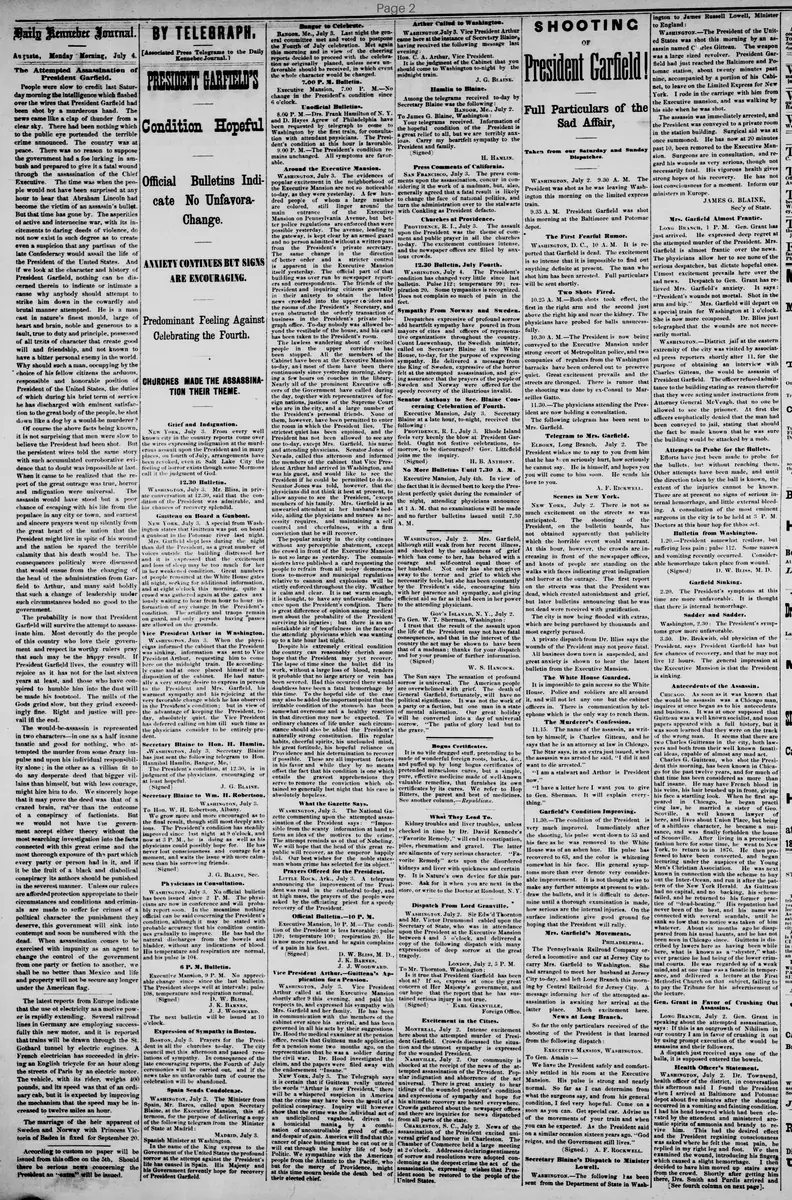
The Attempted Assassination of President Garfield.
People were slow to credit last Saturday morning the intelligence which flashed over the wires that President Garfield had been shot by a murderous hand. The news came like a clap of thunder from a clear sky. There had been nothing which to the public eye portended the terrible crime announced. The country was at peace. There was no reason to suppose the government had a foe lurking in ambush and prepared to give it a fatal wound through the assassination of the Chief Executive. The time was when the people would not have been surprised at any hour to hear that Abraham Lincoln had become the victim of an assassin's bullet. But that time has gone by. The asperities of active and internecine war, with its incitements to daring deeds of violence, do not now exist in such degree as to create even a suspicion that any partisan of the late Confederacy would assail the life of the President of the United States. And if we look at the character and history of President Garfield, nothing can be discerned therein to indicate or intimate a cause why anybody should attempt to strike him down in the cowardly and brutal manner attempted. He is a man cast in nature's finest mould, large of heart and brain, noble and generous to a fault, true to duty and principle, possessed of all traits of character that create good will and friendship, and not known to have a bitter personal enemy in the world. Why should such a man, occupying by the choice of his fellow citizens the arduous, responsible and honorable position of President of the United States, the duties of which during his brief term of service he has discharged with eminent satisfaction to the great body of the people, be shot down like a dog by a would-be murderer? Of course the above facts being known, it is not surprising that men were slow to believe the President had been shot. But the persistent wires told the same story with such accumulated corroborative evidence that to doubt was impossible at last. When it came to be realized that the report of the great outrage was true, horror and indignation were universal.
The assassin would have stood but a poor chance of escaping with his life from the populace in any city or town, and earnest and sincere prayers went up silently from the great heart of the nation that the President might live in spite of his wound and the nation be spared the terrible calamity that his death would be. The consequences politically were discussed that would ensue from the changing of the head of the administration from Garfield to Arthur, and many said boldly that such a change of leadership under such circumstances boded no good to the government.
The probability is now that President Garfield will survive the attempt to assassinate him. Most devoutly do the people of this country who love their government and respect its worthy rulers pray that such may be the happy result. If President Garfield lives, the country will rejoice as it has not for the last sixteen years at least, and those who have conspired to humble him into the dust will be made his footstool. The mills of the Gods grind slow, but they grind exceedingly fine. Right and justice will prevail in the end.
The would-be-assassin is represented in two characters-in one as a half insane fanatic and good for nothing, who attempted the murder from some crazy impulse and upon his individual responsibility alone; in the other as a villain fit to do any desperate deed that bigger villains than himself, but with less courage, might hire him to do. We sincerely hope that it may prove the deed was that of a crazed brain, rather than the outcome of a conspiracy of factionists. But we would not have the government accept either theory without the most searching investigation into the facts connected with this great crime and the most thorough exposure of the part which every party or person had in it, and if it be the fruit of a black and diabolical conspiracy its authors should be punished in the severest manner. Unless our rulers are afforded protection appropriate to their circumstances and conditions and criminals are made to suffer for crimes of a political character the punishment they deserve, this government will sink into contempt and soon be numbered with the dead. When assassination comes to be exercised with impunity as an agent to change the control of the government from one party or faction to another, we shall be no better than Mexico and life and property will not be secure any longer under the American flag.
The latest reports from Europe indicate that the use of electricity as a motive power is rapidly extending. Several railroad lines in Germany are employing successfully this new motor, and it is reported that trains will be drawn through the St. Gotthard tunnel by electric engines. A French electrician has succeeded in driving an English tricycle for an hour along the streets of Paris by an electric motor. The vehicle, with its rider, weighs 400 pounds, and its speed was that of an ordinary cab, but it is expected by improving the mechanism that the speed may be increased to twelve miles an hour.
The marriage of the heir apparent to Sweden and Norway with Princess Victoria of Baden is fixed for September 20.
According to custom no paper will be issued from this office on the 5th. Should there be serious news concerning the President an "extra" will be issued.
BY TELEGRAPH:
Associated Press Telegrams to the Daily Kennebec Journal.
PRESIDENT GARFIELD'S
Condition Hopeful
Official Bulletins Indicate No Unfavorable
Change.
ANXIETY CONTINUES BUT SIGNS
ARE ENCOURAGING.
Predominant Feeling Against
Celebrating the Fourth.
CHURCHES MADE THE ASSASSINATION
THEIR THEME.
Grief and Indignation.
New York, July 3. From every well known city in the country reports come over the wires expressing indignation at the murderous assault upon the President and in many places, on fourth of July, arrangements have been revoked, even in Salt Lake City the feeling of horror exists though some Mormons call it the judgment of God.
12.30 Bulletin.
Washington, July 3. Mr. Bliss, in private conversation at 12.30, said that the condition of the President was admirable, and his chances of recovery splendid.
Guiteau on Board a Gunboat.
New York, July 3. A special from Washington states that Guiteau was put on board a gunboat in the Potomac river last night. Mrs. Garfield slept less during the night than did the President, as a great number of voices outside the building distressed her and it is expressed that the excitement and loss of sleep may be too much for her in her weakened condition. Great numbers of people remained at the White House gates all night, seeking for additional information, and at eight o'clock this morning, quite a crowd was gathered again at the gates anxiously waiting to hear from hour to hour information of any change in the President's condition. The artillery and troops remain on guard, and only persons having passes are allowed on the grounds.
Vice President Arthur in Washington.
Washington, July 3. When the physicians informed the cabinet that the President was sinking, information was sent to Vice President Arthur, requesting him to come here on the midnight train. He accordingly came and at once placed himself at the disposition of the cabinet. He had naturally a very strong desire to express in person to the President and Mrs. Garfield, his warmest sympathy and his rejoicing at the very favorable change which he has observed in the President's condition; but in view of the advantage of keeping the President, to-day, absolutely quiet, the Vice President has deferred calling on him till such time as the physicians consider to be entirely prudent.
Secretary Blaine to Hon. H. Hamlin.
Washington, July 3. Secretary Blaine has just sent the following telegram to Hon. Hannibal Hamlin, Bangor, Me.:
The President's condition, at 12.30, is in judgment of the physicians, encouraging or at least hopeful.
(Signed)
J. G. BLAINE.
Secretary Blaine to Wm. H. Robertson,
Washington, July 3.
To Hon. W. H. Robertson, Albany.
We grow more and more encouraged as to the final result, though still most deeply anxious. The President's condition has steadily improved since last night at 9 o'clock, and now at 3 P. M., he is doing as well as his physicians could possibly hope for. He has never lost consciousness and courage for a moment, and waits the issue with more calmness than his sorrowing friends.
(Signed)
J. G. BLAINE, Sec.
Physicians in Consultation.
Washington, July 3. No official bulletin has been issued since 2 P. M. The physicians are now in conference and will probably report soon. In the meantime nothing official can be said concerning the President's condition, although it may be stated with probable accuracy that his condition continues gradually to improve. He has had the natural discharges from the bowels and bladder, without any indications of blood. His temperature and respiration are normal, and his pulse is 104.
6 P. M. Bulletin.
Executive Mansion, 9 P. M. No appreciable change since the last bulletin. The President sleeps well at intervals; pulse 108, temperature and respiration normal.
(Signed)
D. W. BLISS,
J. K. BARNES.
J. J. WOODWARD.
The next bulletin will be issued at 10 o'clock.
Expression of Sympathy in Boston.
Boston, July 3. Prayers for the President in all the churches to-day. The city council met this afternoon and passed resolutions of sympathy. In consequence of the late encouraging reports, the Fourth of July ceremonies will be carried out, and if the news take an unfavorable turn of course the celebration will be abandoned.
Spain Sends Condolence.
Washington, July 3. The Minister from Spain, Mr. Barca, called upon Secretary Blaine, at the Executive Mansion, this afternoon, for the purpose of delivering a copy of the following telegram from the Minister of State at Madrid:
MADRID, July 3.
Spanish Minister at Washington.
In the name of the King express to the Government of the United States the profound sorrow at the attempt against the President's life has caused in Spain. His Majesty and his Government fervently hope for recovery of President Garfield.
Bangor, Me., July 3. Last night the general committee met and voted to postpone the Fourth of July celebration. Met again this morning and in view of the cheering reports decided to proceed with the celebration as originally planned, unless news unfavorable should be received, in which event the whole character would be changed.
7.00 P. M. Bulletin.
Executive Mansion, 7.00 P. M.-No change in the President's condition since 6 o'clock.
Unofficial Bulletins.
8.00 P. M.-Drs. Frank Hamilton of N. Y. and D. Hayes Agnew of Philadelphia have been requested by telegraph to come to Washington by the first train, for consultation with attending physicians. The President's condition at this hour is favorable.
9.00 P. M.-The President's condition remains unchanged. All symptoms are favorable.
Around the Executive Mansion.
Washington, July 3. The evidences of popular excitement in the neighborhood of the Executive Mansion are not so noticeable to-day, as they were yesterday. A few hundred people of whom a large number are colored, still linger around the main entrance of the Executive Mansion on Pennsylvania Avenue, but better police regulations are enforced than were possible yesterday. The avenue, leading to the gateway, is kept clear by an armed guard and no person admitted without a written pass from the President's private secretary. The same change in the direction of better order and a stricter control is apparent in the Executive Mansion itself yesterday. The official part of that building was over run by newspaper reporters and correspondents. The friends of the President and inquiring citizens generally in their anxiety to obtain the latest news crowded into the upper corridors and the rooms of the President's Secretary, and even obstructed the orderly transaction of business in the President's private telegraph office. To-day nobody was allowed beyond the vestibule of the house, and his card has been taken to the President's room. The lawless wandering about of excited people in the upper corridors has been stopped. All the members of the Cabinet have been at the Executive Mansion to-day, and most of them have been there continuously since yesterday morning, sleeping a few hours on couches in the library. Nearly all of the prominent Executive officers of the Government have called during the day, together with representatives of foreign nations, justices of the Supreme Court who are in the city, and a large number of the President's personal friends. None of them, however, have been permitted to enter the room in which the President lies. The strictest quiet has been enjoined, and the President has not been allowed to see any one to-day, except Mrs. Garfield, his nurse and attending physicians. Senator Jones of Nevada, called this afternoon and informed the members of the cabinet that Vice President Arthur had arrived in Washington, and was his guest, and would like to see the President if he could be permitted to do so. Senator Jones was told, however, that the physicians did not think it best at present, to allow anyone to see the President, except members of his family. Mrs. Garfield is an unwearied attendant at her husband's bedside, aiding the physicians and nurses as necessity requires, and maintaining a self control and cheerfulness, with a firm conviction that he will recover.
The popular anxiety in the city continues without any perceptible abatement, except the crowd in front of the Executive Mansion is not so large as yesterday. The commissioners have published a card requesting the people to refrain from all noisy demonstrations to-morrow and municipal regulations relative to cannon and explosions will be strictly enforced throughout the city. Weather is calm and clear. It is not warm enough, it is thought, to have any unfavorable influence upon the President's condition. There is great difference of opinion among medical men about the probability of the President surviving his injuries; but there is an unmistakable air of hopefulness in the faces of the attending physicians which was wanting up to a late hour last night.
Despite his extremely critical condition the country can reasonably cherish some hope that the President may yet recover. The lapse of time since the bullet did its work, without a large loss of blood, renders it probable that no large artery or vein has been severed. Had this occurred there would doubtless have been a fatal hemorrhage by this time. To the hopeful side of the case may also be added the important point that the irritable condition of the stomach has been somewhat overcome and a healthy reaction in that direction may now be expected. To ordinary chances of life under such circumstances should also be added the President's naturally strong constitution. His regular habits, cheerful spirits, his unclouded mind, his great fortitude, his hopeful reliance on Providence and his determination to recover if possible. These are all important factors in his favor and while they by no means offset the fact that his condition is one which entails the gravest apprehensions they serve to remove the conviction which obtained so generally last night that his case is absolutely hopeless.
What the Gazette Says.
Washington, July 3. The National Gazette commenting upon the attempted assassination of the President says: "Impossible from the scanty information at hand to form an idea of the motives to the crime. The attempt reminds us of that of Nobeling. We will hope that the head of this great republic will recover, as the emperor happily did. Our best wishes for the noble statesman whom crime has selected for its object."
Prayers Offered for the President.
Little Rock, Ark., July 3. A telegram announcing the improvement of the President was read in the cathedral to-day, and at high mass, the prayers of the people were asked by the officiating priest for a speedy recovery of the President.
Official Bulletin.-10 P. M.
Executive Mansion. 10 P. M.--The condition of the President is less favorable; pulse 120; temperature 100; respiration 20. He is now more restless and he again complains of a pain in his feet.
(Signed)
D. W. BLISS, M. D.
J. K. Barnes,
J. J. WOODWARD.
Vice President Arthur.-Guiteau's Application for a Pension.
Washington, July 3.
Vice President Arthur called at the Executive Mansion shortly after 9 this evening, and paid his respects to, and expressed his sympathy with Mrs. Garfield and her family. He has been in communication with the members of the cabinet ever since his arrival, and has been governed in all his acts by their suggestions. Dr. Hood the medical examiner at the pension office, recalls that Guiteau made application for a pension some two months ago, on the representation that he was a soldier during the civil war. Dr. Hood investigated the claim, and the papers were filed away with the endorsement "Insane."
New York, July 3. The Telegraph says it is certain that if Guiteau really uttered the words "Arthur is now President," there will be a whispered suspicion in America that the crime may have been the result of a political conspiracy. Inquiry will however show that the crime was the individual act of an undisciplined vagabond, driven to a homicidal mania by a combination of uncontrollable greed of office and despair of gain. America will find that this cancer of place hunting must be cut out or it will eat through the healthy life of body politic. We sympathize with the American people from the Atlantic to the Pacific, who but for the mercy of Providence, might at this time mourn beside the death bed of their elected chief.
Arthur Called to Washington.
Washington, July 3. Vice President Arthur came here at the instance of Secretary Blaine, having received the following message last evening:
Hon. C. A. Arthur, Vice President.
It is the judgment of the Cabinet that you should come to Washington to-night by the midnight train.
J. G. Blaine.
Hamlin to Blaine.
Among the telegrams received to-day by Secretary Blaine was the following:
Bangor, Me., July 2.
To James G. Blaine, Washington:
Your telegrams received. Information of the hopeful condition of the President is a great relief to all, but we are terribly anxious. Carry my heartfelt sympathy to the President and family.
(Signed)
H. HAMLIN.
Press Comments of California.
San Francisco, July 3. The press comments upon the assassination, concur in considering it the work of a madman, but, also, generally agreed that a fatal result is likely to change the face of national politics, and turn the administration over to the stalwarts with Conkling as President de facto.
Churches at Providence.
Providence, R. I., July 3. The assault upon the President was the theme of comment and public prayer in all the churches to-day. The excitement continues intense, and the newspaper offices are filled by anxious crowds.
12.30 Bulletin, July Fourth.
Washington, July 4. The President's condition has changed very little since last bulletin. Pulse 120; temperature 99; respiration 20. Some tympanites is recognized. Does not complain so much of pain in the feet.
Sympathy From Norway and Sweden.
Dispatches expressive of profound sorrow and heartfelt sympathy have poured in from mayors of cities and officers of representative organizations throughout the country. Count Lewenhaupt, the Swedish minister, called on Secretary Blaine at the White House, to-day, for the purpose of expressing sympathy. He delivered a message from the King of Sweden, expressive of the horror felt at the attempted assassination, and giving assurance that the prayers of the people of Sweden and Norway were offered for the speedy recovery of the illustrious invalid.
Senator Anthony to Sec. Blaine Concerning Celebration of Fourth.
Executive Mansion, July 3. Secretary Blaine at a late hour, to-night, received the following:
Providence, R. I., July 3. Rhode Island feels very keenly the blow at President Garfield. Ought not festive celebrations, to-morrow, to be discouraged? Gov. Littlefield joins me the inquiry.
(Signed)
H. B. ANTHONY.
No More Bulletins Until 7.30 A. M.
Executive Mansion. July 4th. In view of the fact that it is deemed best to keep the President perfectly quiet during the remainder of the night, attending physicians announce at 1 A. M. that no examinations will be made and no further bulletins issued until 7.30 A. M.
WASHINGTON, July 2.
Mrs. Garfield, although still weak from her recent illness, and shocked by the suddenness of grief which has come to her, has behaved with a courage and self-control equal those of her husband. Not only has she not given away to the terror and grief to which she necessarily feels, but she has been constantly by the President's side, encouraging him with her presence and sympathy, and giving efficient aid so far as it had been in her power to the attending physicians.
Gov's Island, N. Y., July 2.
To Gen. W. T. Sherman, Washington:
I trust that the result of the assault upon the life of the President may not have fatal consequences, and that in the interest of the country the act may be shown to have been that of a madman; thanks for your dispatch and for your promise of further information.
(Signed)
W. S. Hancock.
The Sun says The sensation of profound sorrow is universal. The American people are overwhelmed with grief. The death of General Garfield, fortunately, will have no political significance. It was not the work of a party or a faction, but one man in a state of mental alienation. Our great holiday will be converted into a day of universal sorrow.
"The paths of glory lead but to the grave."
Bogus Certificates.
It is no vile drugged stuff., pretending to be made of wonderful foreign roots, barks, &c.., and puffed up by long bogus certificates of pretended miraculous cures, but a simple, pure, effective medicine made of well-known valuable remedies, that furnishes its own certificates by its cures. We refer to Hop Bitters, the purest and best of medicines. See another column.-Republican.
What They Lead To.
Kidney troubles and liver troubles, unless checked in time by Dr. David Kennedy's "Favorite Remedy," will end in constipation, piles, rheumatism and gravel. The latter are ailments of very serious character. "Favorite Remedy" acts upon the disordered kidneys and liver with quickness and certainty. It is Nature's own device for this purpose. Ask for it when you are next in the store, or write to the Doctor at Rondout, N. Y.
Dispatch From Lord Granville.
Washington, July 2. Sir Edw'd Thornton and Mr. Victor Drummond called upon the Secretary of State, who was in attendance upon the President at the Executive Mansion between 4 and 5 o'clock, and delivered a copy of the following dispatch with many expressions of deep sorrow at the great tragedy.
London, July 2, 5 P. M.
To Mr. Thornton. Washington;
Is it true that President Garfield has been shot at? If so, express at once the great concern of Her Majesty's government, and our hope that the report that he has sustained serious injury is not true.
(Signed)
Earl Granville,
Foreign Office.
Excitement in the Cities.
Montreal, July 2. Intense excitement here about the attempted murder of President Garfield. Crowds discussed the situation and the utmost sympathy is expressed for the wounded President.
Nashville, July 2. Our community is shocked at the receipt of the news of the attempted assassination of the President. Popular indignation and abhorrence of the act universal. There is great anxiety to hear tidings of the wounded president's condition and expressions of sympathy and hope for his ultimate recovery are heard everywhere. Crowds gathered about the newspaper offices and there are inquiries for news dispatched from all parts of the state.
Charleston, S. C., July 2. News of the assassination of the President excited universal grief and horror in Charleston. The Chamber of Commerce held a large meeting at 2 o'clock. Addresses declaring sentiments of sorrow and resolutions were adopted condemning as the deepest crime the act of the assassination, expressing wishes that President soon be restored to the people of the United States.
SHOOTING
OF
President Garfield!
Full Particulars of the
Sad Affair,
Taken from our Saturday and Sunday
Dispatches.
WASHINGTON, July 2. 9.30 A. M. The President was shot as he was leaving Washington this morning on the limited express train.
9.35 A. M. President Garfield was shot this morning at the Baltimore and Potomac depot.
The First Fearful Rumor.
WASHINGTON, D. C., 10 A. M. It is reported that Garfield is dead. The excitement is so intense that it is impossible to find out anything definite at present. The man who shot him has been arrested. Full particulars will be sent shortly.
Two Shots Fired,
10.25 A. M.-Both shots took effect, the first in the right arm and the second just above the right hip and near the kidney. The physicians have probed for balls unsuccessfully.
10.30 A. M.-The President is now being conveyed to the Executive Mansion under strong escort of Metropolitan police, and two companies of regulars from the Washington barracks have been ordered out to preserve quiet. Great excitement prevails and the streets are thronged. There is rumor that the shooting was done by ex-Consul to Marseilles Gatto.
11.30.-The physicians attending the President are now holding a consultation.
The following telegram has been sent to Mrs. Garfield.
Telegram to Mrs. Garfield.
ELBERON, Long Branch, July 2.
The President wishes me to say to you from him that he has been seriously hurt, how seriously he cannot say. He is himself, and hopes you will come to him soon. He sends his love to you.
A. F. Rockwell.
Scenes in New York.
New York,
July 2. There is not as much excitement on the streets as was anticipated. The shooting of the President, on the bulletin boards, has not obtained apparently that publicity which the horrible event would warrant. At this hour, however, the crowds are increasing in front of the newspaper offices, and knots of people are standing on the walks with faces indicating great indignation and horror at the outrage. The first report on the streets was that the President was dead, which created astonishment and grief, but later bulletins announcing that he was not dead were received with gratification. The city is now being flooded with extras, which are being purchased by thousands and most eagerly perused. A private dispatch from Dr. Bliss says the wounds of the President may not prove fatal. All business down town is suspended, and great anxiety is shown to hear the latest bulletin from the Executive Mansion.
The White House Guarded.
It is impossible to gain access to the White House. Police and soldiers are all around it, and will not let any one but the cabinet officers in. There is communication by telephone which is the only way to reach them.
The Murderer's Confession.
11.15. The name of the assassin, as written by himself, is Charles Guiteau, and he says that he is an attorney at law in Chicago. The Star says, in an extra just issued, when the assassin was arrested he said, "I did it and want to die arrested."
"I am a stalwart and Arthur is President now."
"I have a letter here I want you to give to Gen. Sherman. It will explain everything."
Garfield's Condition Improving
11.30.-The condition of the President is very much improved. Immediately after the shooting, his pulse went down to 53 and his face as he was removed to the White House was of an ashen hue. His pulse has recovered to 63, and the color is whitening somewhat in his face. His general symptoms more than ever denote very considerable improvement. It is not thought wise to make any further attempts at present to withdraw the bullets, and it is difficult to determine until a thorough examination is made, how serious are the internal injuries. On the surface indications give good ground for hoping that the President will rally.
Mrs. Garfield's Movements.
PHILADELPHIA.
The Pennsylvania Railroad Company ordered a locomotive and car at Jersey City to carry Mrs. Garfield to Washington. She had arranged to meet her husband at Jersey City to-day, and left Long Branch this morning by Central Railroad for Jersey City. A message informing her of the attempted assassination is awaiting her arrival at the latter place.
Much excitement here.
News at Long Branch.
So far the only particulars received of the shooting of the President is that learned from the following dispatch:
Executive Mansion, Washington.
To Gen. Swaim:-
We have the President safely and comfortably settled in his room at the Executive Mansion. His pulse is strong and nearly normal. So far as I can determine from what the surgeons say, and from his general condition, I feel very hopeful. Come on as soon as you can. Get special car. Advise us of the movements of your train and when you can be expected. As the President said on a similar occasion sixteen years ago. God reigns. and the Government still lives."
(Signed.) A. F. ROCKWELL.
Secretary Blaine's Dispatch to Minister Lowell.
Washington.-The following has been sent from the Department of State in Washington to James Russell Lowell, Minister to England:
Washington.--The President of the United States was shot this morning by an assassin named Charles Guiteau. The weapon was a large sized revolver. President Garfield had just reached the Baltimore and Potomac station, about twenty minutes past nine, accompanied by a portion of his Cabinet, to leave on the Limited Express for New York. I rode in the carriage with him from the Executive mansion, and was walking by his side when he was shot. The assassin was immediately arrested, and the President was conveyed to a private room in the station building. Surgical aid was at once summoned. He has now at 20 minutes past 10, been removed to the Executive Mansion. Surgeons are in consultation, and regard his wounds as very serious, though not necessarily fatal. His vigorous health gives strong hopes of his recovery. He has not lost consciousness for a moment. Inform our ministers in Europe.
JAMES G. BLAINE,
Sec'y of State.
Mrs. Garfield Almost Frantic.
Long Branch. 1 P. M. Gen. Grant has just arrived. He expressed deep regret at the attempted murder of the President. Mrs. Garfield is almost frantic over the news. The physicians allow her to see none of the serious despatches, but dictate hopeful ones. Utmost excitement prevails here over the sad news. Despatch to Gen. Grant has relieved Mrs. Garfield's anxiety. It says: "President's wounds not mortal. Shot in the arm and hip." Mrs. Garfield will depart on a special train for Washington at 1 o'clock. She is now more composed. Dr. Bliss just telegraphed that the wounds are not necessarily mortal.
Washington.-District jail at the eastern extremity of the city was visited by associated press reporters shortly after 11, for the purpose of obtaining an interview with Charles Guiteau, the would be assassin of President Garfield. The officer refused admittance to the building stating as reason therefor that they were acting under instructions from Attorney General McVeagh, that no one be allowed to see the prisoner. At first the officers emphatically denied that the man had been conveyed to jail, stating that should the fact be made known that he was sure the building would be attacked by a mob.
Attempts to Probe for the Bullets,
Efforts have just been made to probe for the bullets, but without reaching them. Other attempts have been made, and until the direction taken by the ball is known, the extent of the injuries cannot be known. There are at present no signs of serious internal hemorrhage, and little external bleeding. A consultation of the most eminent surgeons in the city is to be held at 3 P. M. Doctors at this hour hope for the best.
Bulletin from Washington.
1.20.--President somewhat restless, but suffering less pain; pulse 112. Some nausea and vomiting recently occurred. Considerable hemorrhage taken place from wound.
(Signed)
D. W. BLISS, M. D.
Garfield Sinking.
2.20. The President's symptoms at this time are more unfavorable. It is thought that there is internal hemorrhage.
Sadder and Sadder.
Washington, 2.30: The President's symptoms grow more unfavorable.
3.30. Dr. Reykwith, old physician of the President, says President Garfield has but few chances of recovery, and that he may not live 12 hours. The general impression at the Executive Mansion is that the President is sinking.
Antecedents of the Assassin.
Chicago. As soon as it was known that the would be assassin was a Chicago man, inquires at once began as to his antecedents and business. It was at once supposed that Guiteau was a well known socialist, and noon papers appeared with a full history, but it was soon learned that they were on the track of the wrong man. It seems that there are two Charles Guiteaus in the city, both lawyers and both from their well known fanatical ideas, capable of almost any mad act. Charles G. Guiteau, who shot the President this morning, has been known in Chicago for the past twelve years, and for much of that time has been considered as more than half insane. He may have French blood in his veins, his hair brushed up in front, giving his face a startling look. When he first appeared in Chicago, he began practicing law, he married a sister of Geo. Scoville, a well known lawyer here, and lives about Union Place, but being of a shiftless character, he became a nuisance, and was finally forbidden the house of Scoville. After living in a precarious fashion here for some time, he went to New York, to return to in 1876. He then professed to have been converted, and began lecturing under the auspices of the Young Men's Christian Association. He was next known in connection with the scheme to buy out the Inter-Ocean, and run it after the pattern of the New York Herald. As Guiteau had no capital, and no backing, his scheme failed, and he returned to his former practice of "dead-beating." His reputation had never been of the best, and his name was connected with several scandals, until he sank so low that no notice was taken of him whatever. About six months ago he disappeared from his usual haunts, and he has not been seen in Chicago since. Guiteau is described by lawyers here as having been while here, what is known as a "shyster," whatever practice he had being of the lower criminal courts. He was regarded as of a weak mind, and at one time was a fanatic in temperance, and delivered a lecture at the First Methodist Church on that subject, failing to pay the Tribune for his advertisement of the lecture.
Gen. Grant in Favor of Crushing Out Assassins.
Long Branch, July 2. Gen. Grant in speaking about the attempted assassination, says: If this is an outgrowth of Nihilism in our country I am in favor of crushing it out by using prompt execution of the would be assassins and their followers.
A dispatch just received says one of the balls, it is supposed entered the bowels.
Health Officer's Statement.
Washington, July 2. Dr. Townsend, health officer of the district, in conversation this afternoon said I found the President when I arrived at Baltimore and Potomac depot about five minutes after the shooting occurred in a vomiting and fainting condition. I had his head lowered which had been elevated by the attendant and ministered aromatic spirits of ammonia and brandy to revive him. This had the desired effect and the President regaining consciousness was asked where he felt the most pain, he replied in my right leg and foot. We then examined the wound, introducing his finger which caused a slight hemorrhage. I then decided to have him moved up stairs away from the crowd. Shortly after getting him there, Drs. Smith and Purvis arrived and upon consultation with them it was decided to remove him to the White House. Dr. Smith and myself accompanied the President in the ambulance to the White House, when another examination was made and stimulants again administered. An ineffectual attempt was made to trace the course of the wound, and at 12:20, the President suffering much pain, a hypodermic injection of morphine was administered. Dr. Townsend left the President shortly afterward somewhat revived. The Doctor said at two o'clock that he could not give an intelligent opinion as yet, but pronounced the wound dangerous, but not necessarily fatal.
Departments Suspended Business.
Washington, July 2. At the departments, business is almost suspended. All the cabinet officers have been during the entire day at the White House, as also many Navy and other officers.
Another Theory of the Murder.
Chas. Guiteau, the assassin, is a Canadian Frenchman. Has been here since February with recommendations from Ill., for Consulship to Marseilles. He has acted strangely at his boarding house he claimed acquaintanceship with General Logan, who ignored him, and he has not paid his board. There is a theory which has many adherents, that the attempted assassination was not the work of a lunatic, but is the result of a plot much deeper and darker than has been suspected. In support of this theory, that Guiteau arranged before-hand with a hackman to be in readiness to drive him swiftly in the direction of the Congressional cemetery, as soon as he made his appearance in returning from the depot. In the mean time he had a bundle of papers in the hands of a boy with a view, it is maintained, to create a belief in his insanity, in the event of his capture. Guiteau said on his way to the jail, that the President's assassination was premeditated, and he went to Long Branch, for the purpose of shooting him there and was deterred by the enfeebled and saddened condition of Mrs. Garfield, which appealed so strongly to his sense of humanity, that he came back without carrying out his intentions. Those by whom Guiteau has been examined since the shooting, say that he shows no signs of insanity, and it is understood that the letter which has already been telegraphed addressed to the White House, is only a document in the collection which supports the theory of insanity. It is reported that Guiteau had an accomplice whose description is in the hands of the police, and further developments are anxiously looked for.
At 10.20.
The President's symptoms continue to grow more favorable, and to afford more ground for hope.
A Crazy Spirit of Faction
New York, July 2. The Tribune heads its leader, "Factions latest crime," and says that President Garfield yesterday, was more popular than when he was elected. There is absolutely nothing to account for this horrible deed except a crazy spirit of faction. Every true American will rejoice if it appears that the murderer was insane. It does not appear that he had ever been thought a lunatic, until the deadly shots were fired. The assassin was not ignorant that he was trying to kill one President to make another. The spirit of faction which fired the shots of yesterday, gave in that act the most complete evidence of its real character. Must we not realize in the light of the dreadful calamity at Washington, that those who bred and nursed this malignant grasping and desperate spirit are aiming a blow at the life of the republic.
Improvement in President Continues.
Executive Mansion, 1.55.—The following bulletin is just issued 1 A. M. Improvement in the President's condition which began early in the evening, has steadily continued up to this hour. His temperature and respiration are now normal, and his pulse has fallen to 120. Attending physicians regard all the symptoms as favorable, and a more hopeful feeling prevails.
Account of an Eye Witness.
S. Comacho, Minister to this Country from Venezuela, who resides at West 4th street, was present in the depot at Washington, to-day, when President Garfield was shot by Chas. Guiteau. Mr. Comacho arrived in this city at 4 o'clock this afternoon, from Washington. He gave the following account of the attempted assassination:
"I was in Washington, to-day, looking after the interests of Venezuela, and I had made arrangements to visit New York, this morning in company with four lady friends, members of my family. I was to meet them at the Baltimore & Potomac depot at 9:50 A. M. A few moments after nine o'clock, I alighted from my carriage and entered the station. After purchasing a ticket I walked leisurely about the depot, when presently I saw a carriage drive up and two gentlemen alight therefrom. I took little notice of them at first. In a minute I observed the two men were President Garfield and Secretary Blaine. The President and Secretary Blaine stood beside the carriage and conversed together for some minutes, when they walked into the depot. As they entered the depot the President and Secretary, both bowed to me. I had just raised my hat, and was about turning around for the appearance of my lady friends, when I heard the report of a pistol. Quickly I wheeled around, and before me I beheld the staggering form of the President of the United States. I also saw the would-be assassin within a few feet of the President. He had a revolver in his right hand. His knees were slightly bent and he took two or three hasty steps toward the President and fired again. The first ball took effect in the President's right side, and the second one struck him in the back. When the second shot was fired, the President fell to the earth, and the would-be assassin seeing the President fall, turned and attempted to escape by the B street entrance, and hurried toward that door, and when the villain saw that I intended to head him off, he turned and ran to the opposite, where he was caught by a number of employees in the depot.
When the President was shot, and when he fell to the ground, he spoke not a word, nor did his would-be murderer. It was quickly noised about the depot that the President had been shot, the doors of the depot were immediately closed in order to prevent the crowd from rushing in. When Secretary Blaine heard the report of the revolver, he sprang toward the door, but when he realized that the President had been shot, he immediately ran to his assistance. The man who shot the President had a determined look upon his face, and did not resemble a crazy man. He was calm and resolute, and did not run away until he saw the President fall.
Special Bulletin—Latest.
Executive Mansion, July 3.—4 A. M.—The President has just awakened, greatly refreshed, and has not vomited since 1 A. M., having taken milk and lime water on each occasion, frequently asking for it. Pulse 120, fuller and of decidedly more character; temperature, 98; respiration 18. The patient is decidedly more cheerful, and has amused himself and watchers by telling a laughable incident of his early life.
D. W. Bliss.
What sub-type of article is it?
What themes does it cover?
What keywords are associated?
What entities or persons were involved?
Where did it happen?
Story Details
Key Persons
Location
Washington, D.C.
Event Date
July 2, 1881
Story Details
Charles Guiteau shoots President Garfield twice at the Baltimore and Potomac depot as he prepares to board a train; Garfield is wounded in the arm and back, transported to the Executive Mansion; medical bulletins report fluctuating condition with hopes for recovery; national outrage, prayers, and calls for investigation into possible conspiracy; Guiteau arrested and described as insane or politically motivated.