Thank you for visiting SNEWPapers!
Sign up free
Canton Weekly Register
Canton, Fulton County, Illinois
What is this article about?
In a ruling by the Illinois Supreme Court, J. Edward Thomas sued the First National Bank of Belleville to recover on a $1,335 certificate of deposit indorsed to him for a gambling transaction with E. J. Arnold & Company. The court denied enforcement, stating Illinois courts will not aid in collecting gambling debts, regardless of assignment to a third party or legality elsewhere.
Clipping
OCR Quality
Full Text
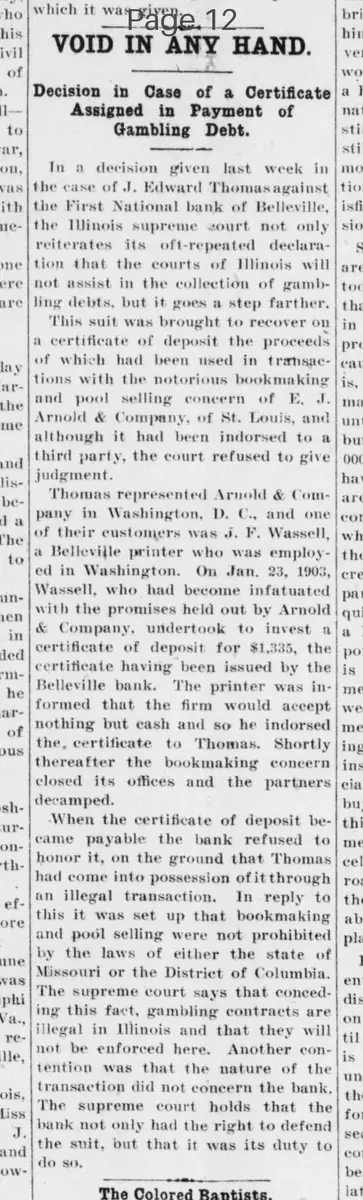
Decision in Case of a Certificate Assigned in Payment of Gambling Debt.
In a decision given last week in the case of J. Edward Thomas against the First National bank of Belleville, the Illinois supreme court not only reiterates its oft-repeated declaration that the courts of Illinois will not assist in the collection of gambling debts, but it goes a step farther.
This suit was brought to recover on a certificate of deposit the proceeds of which had been used in transactions with the notorious bookmaking and pool selling concern of E. J. Arnold & Company, of St. Louis, and although it had been indorsed to a third party, the court refused to give judgment.
Thomas represented Arnold & Company in Washington, D. C., and one of their customers was J. F. Wassell, a Belleville printer who was employed in Washington. On Jan. 23, 1903, Wassell, who had become infatuated with the promises held out by Arnold & Company, undertook to invest a certificate of deposit for $1,335, the certificate having been issued by the Belleville bank. The printer was informed that the firm would accept nothing but cash and so he indorsed the certificate to Thomas. Shortly thereafter the bookmaking concern closed its offices and the partners decamped.
When the certificate of deposit became payable the bank refused to honor it, on the ground that Thomas had come into possession of it through an illegal transaction. In reply to this it was set up that bookmaking and pool selling were not prohibited by the laws of either the state of Missouri or the District of Columbia.
The supreme court says that conceding this fact, gambling contracts are illegal in Illinois and that they will not be enforced here. Another contention was that the nature of the transaction did not concern the bank. The supreme court holds that the bank not only had the right to defend the suit, but that it was its duty to do so.
What sub-type of article is it?
What themes does it cover?
What keywords are associated?
What entities or persons were involved?
Where did it happen?
Story Details
Key Persons
Location
Belleville, Illinois; St. Louis, Missouri; Washington, D. C.
Event Date
Jan. 23, 1903
Story Details
Illinois Supreme Court refuses to enforce a certificate of deposit indorsed for payment of gambling debts to a bookmaking firm, even when assigned to a third party, holding that courts will not assist in collecting such illegal contracts.