Thank you for visiting SNEWPapers!
Sign up free
The Daily Telegram
Clarksburg, Harrison County, West Virginia
What is this article about?
British Premier Lloyd-George, in his first House of Commons speech on Dec. 19, insists Germany must provide reparation for peace, criticizes Central powers' proposals, announces Allies' forthcoming unified reply demanding guarantees against Prussian militarism, and updates on war fronts including Roumania and Greece.
Clipping
OCR Quality
Full Text
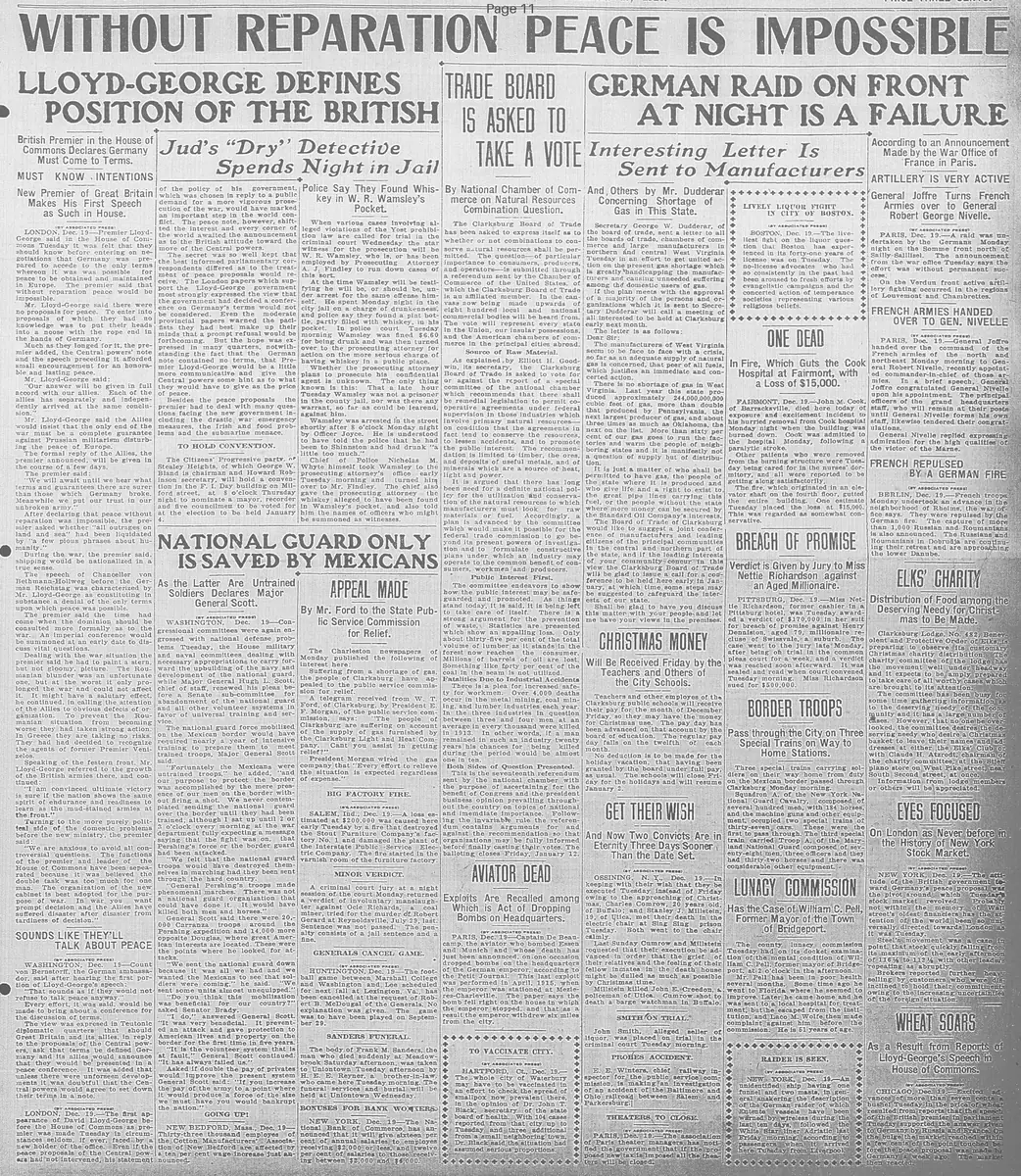
PEACE
IS
IMPOSSIBLE
LLOYD-GEORGE
DEFINES
POSITION OF
THE
BRITISH
British Premier in the House of Commons Declares Germany Must Come to Terms.
MUST KNOW INTENTIONS
New Premier of Great Britain Makes His First Speech as Such in House.
(BY ASSOCIATED PRESS)
LONDON, Dec. 19—Premier Lloyd-George said in the House of Commons Tuesday it was felt that they should know before entering on negotiations that Germany was prepared to accede to the only terms whereon it was possible for peace to be obtained and maintained in Europe.
The premier said that without reparation peace would be impossible.
Mr. Lloyd-George said there were no proposals for peace. To enter into proposals of which they had no knowledge was to put their heads into a noose with the rope end in the hands of Germany.
Much as they longed for it, the premier added, the Central powers' note and the speech preceding it afforded small encouragement for an honorable and lasting peace.
Mr. Lloyd-George said:
"Our answer will be given in full accord with our allies.
Each of the allies has separately and independently arrived at the same conclusion."
Mr. Lloyd-George said the Allies would insist that the only end of the war must be a complete guarantee against Prussian militarism disturbing the peace of Europe.
The formal reply of the Allies, the premier announced, will be given in the course of a few days.
The premier said:
"We will await until we hear what terms and guarantees there are surer than those which Germany broke.
Meanwhile we put our trust in our unbroken army."
After declaring that peace without reparation was impossible, the premier asked whether "all outrages on land and sea" had been liquidated by "a few pious phrases about humanity."
During the war, the premier said, shipping would be nationalized in a true sense.
The speech of Chancellor von Bethmann-Hollweg before the German Reichstag was characterized by Mr. Lloyd-George as constituting in substance a denial of the only terms upon which peace was possible.
The premier said the time had come when the dominion should be consulted more formally as to the war. An imperial conference would be summoned at an early date to discuss vital questions.
Dealing with the war situation the premier said he had to paint a stern, but not gloomy, picture. The Roumanian blunder was an unfortunate one, but at the worst it only prolonged the war and could not affect it. It might have a salutary effect, he continued, in calling the attention of the Allies to obvious defects of organization.
To prevent the Roumanian situation from becoming worse they had taken strong action.
In Greece they are taking no risks.
They had decided to recognize the agents of former Premier Venizelos.
Speaking of the western front, Mr. Lloyd-George referred to the growth of the British armies there, and continued:
"I am convinced ultimate victory is sure if the nation shows the same spirit of endurance and readiness to learn as the mud-stained armies at the front."
Turning to the more purely political side of the domestic problems before the new ministry, the premier said:
"We are anxious to avoid all controversial questions. The functions of the premier and leader of the House of Commons have been separated because it was believed the double task was too much for one man. The organization of the new cabinet is best adopted for the purpose of war.
In war you want prompt decision and the Allies have suffered disaster after disaster from tardiness of decision."
SOUNDS LIKE THEY'LL TALK ABOUT PEACE
(BY ASSOCIATED PRESS)
WASHINGTON, Dec. 19—Count von Bernstorff, the German ambassador, said after hearing the first portion of Lloyd-George's speech:
"That sounds as if they would not refuse to talk peace anyway."
Every effort, it was said, would be made to bring about a conference for the discussion of terms.
The view was expressed in Teutonic diplomatic quarters that should Great Britain and its allies, in reply to the proposals of the Central powers, ask that terms be defined, Germany and its allies would announce that they would be presented in a peace conference. It was added that unless there were unforeseen developments it was doubtful that the Central powers would agree to set down their terms in a note.
(BY ASSOCIATED PRESS)
LONDON, Dec. 19. The first appearance of David Lloyd-George before the House of Commons as premier was made Tuesday in circumstances seldom, if ever, faced by a new holder of the office. Even if the peace proposals of the Central powers had not intervened, his statement of the policy of his government, which was chosen in reply to a public demand for a more vigorous prosecution of the war, would have marked an important step in the world conflict. The peace note, however, shifted the interest and every corner of the world awaited the announcement as to the British attitude toward the move of the Central powers.
The secret was so well kept that the best informed parliamentary correspondents differed as to the treatment peace proposals would receive. The London papers which support the Lloyd-George government most strongly expressed the view that the government had decided a conference on Germany's terms would not be considered.
Even the moderate provincial papers warned the pacifists they had best make up their minds that a prompt refusal would be forthcoming.
But the hope was expressed in many quarters, notwithstanding the fact that the German note contained no terms, that Premier Lloyd-George would be a little more communicative and give the Central powers some hint as to what they would have to give as the price of peace.
Besides the peace proposals the premier had to deal with many questions facing the new government including the drastic war emergency measures, the Irish and food problems and the submarine menace.
TO HOLD CONVENTION.
The Citizens' Progressive party of Stealey Heights, of which George W. Bland is chairman and Howard Robinson secretary, will hold a convention in the F. I. Day building on Milford street, at 8 o'clock Thursday night to nominate a mayor, recorder and five councilmen to be voted for at the election to be held January.
What sub-type of article is it?
What keywords are associated?
What entities or persons were involved?
Where did it happen?
Foreign News Details
Primary Location
London
Event Date
Dec. 19
Key Persons
Outcome
allies to insist on reparation and guarantees against prussian militarism; formal reply in a few days; recognition of venizelos' agents in greece; ultimate victory assured with endurance.
Event Details
Premier Lloyd-George in House of Commons declares peace impossible without reparation from Germany, criticizes Central powers' note, insists on knowing terms before negotiations, announces Allies' unified response, discusses war situation including Roumania and Greece, and outlines new government's focus on war prosecution.