Thank you for visiting SNEWPapers!
Sign up free
Editorial
June 12, 1801
The National Intelligencer And Washington Advertiser
Washington, District Of Columbia
What is this article about?
An editorial defending President Jefferson's removals and appointments of revenue officers, marshals, and attorneys, arguing they restore political tolerance, counter judicial bias under the Sedition Law, and align with republican principles and constitutional intent, contrasting with Adams' actions.
Clipping
OCR Quality
98%
Excellent
Full Text
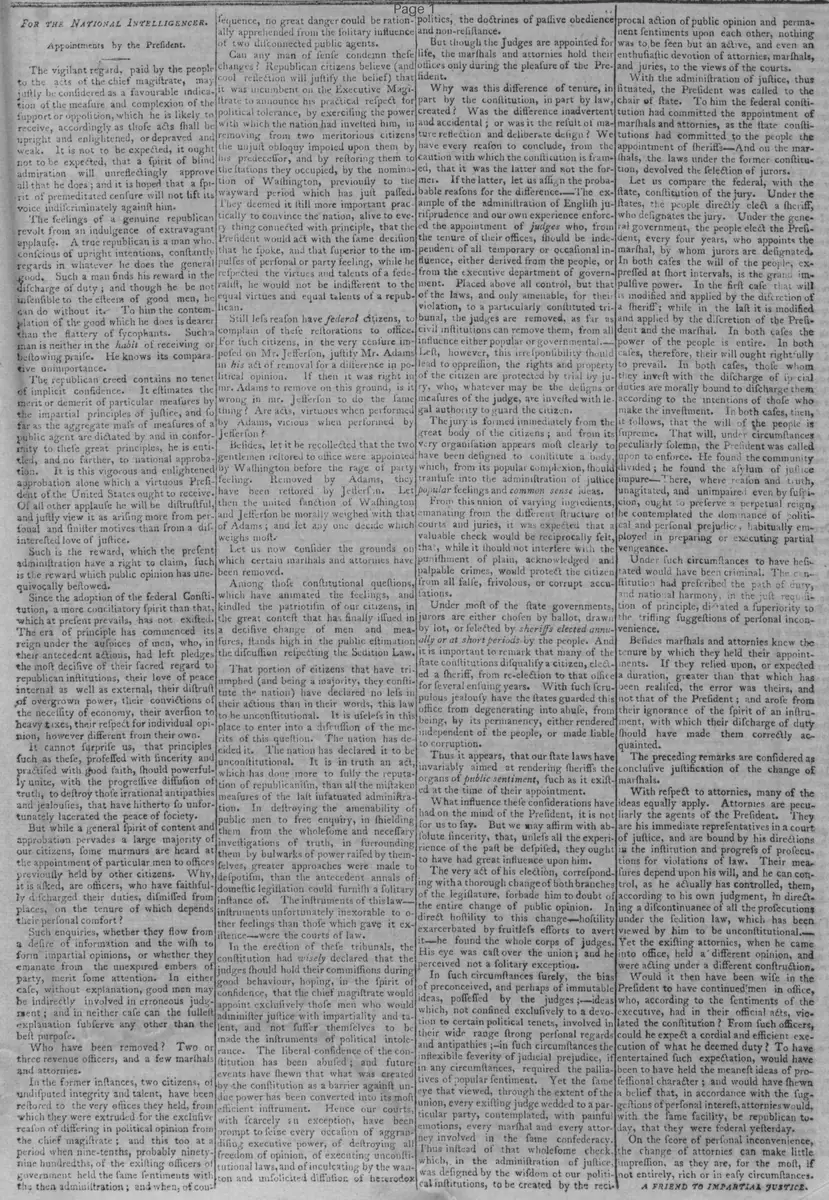
FOR THE NATIONAL INTELLIGENCER.
Appointments by the President.
The vigilant regard, paid by the people to the acts of the chief magistrate, may justly be considered as a favourable indication of the measure and complexion of the support or opposition, which he is likely to receive, accordingly as those acts shall be upright and enlightened, or depraved and weak. It is not to be expected, it ought not to be expected, that a spirit of blind admiration will unreflectingly approve all that he does; and it is hoped that a spirit of premeditated censure will not lift its voice indiscriminately against him.
The feelings of a genuine republican revolt from an indulgence of extravagant applause. A true republican is a man who, conscious of upright intentions, constantly regards in whatever he does the general good. Such a man finds his reward in the discharge of duty; and though he be not insensible to the esteem of good men, he can do without it. To him the contemplation of the good which he does is dearer than the flattery of sycophants. Such a man is neither in the habit of receiving or bestowing praise. He knows its comparative unimportance.
The republican creed contains no tenet of implicit confidence. It estimates the merit or demerit of particular measures by the impartial principles of justice, and so far as the aggregate mass of measures of a public agent are dictated by and in conformity to these great principles, he is entitled, and no farther, to national approbation. It is this vigorous and enlightened approbation alone which a virtuous President of the United States ought to receive. Of all other applause he will be distrustful, and justly view it as arising more from personal and sinister motives than from a disinterested love of justice.
Such is the reward, which the present administration have a right to claim, such is the reward which public opinion has unequivocally bestowed. Since the adoption of the federal Constitution, a more conciliatory spirit than that, which at present prevails, has not existed. The era of principle has commenced its reign under the auspices of men, who, in their antecedent actions, had left pledges the most decisive of their sacred regard to republican institutions, their love of peace internal as well as external, their distrust of overgrown power, their convictions of the necessity of economy, their aversion to heavy taxes, their respect for individual opinion, however different from their own.
It cannot surprise us, that principles such as these, professed with sincerity and practiced with good faith, should powerfully unite, with the progressive diffusion of truth, to destroy those irrational antipathies and jealousies, that have hitherto so unfortunately lacerated the peace of society. But while a general spirit of content and approbation pervades a large majority of our citizens, some murmurs are heard at the appointment of particular men to offices previously held by other citizens. Why, it is asked, are officers, who have faithfully discharged their duties, dismissed from places, on the tenure of which depends their personal comfort?
Such enquiries, whether they flow from a desire of information and the wish to form impartial opinions, or whether they emanate from the unexpired embers of party, merit some attention. In either case, without explanation, good men may be indirectly involved in erroneous judgment; and in neither case can the fullest explanation subserve any other than the best purpose.
Who have been removed? Two or three revenue officers, and a few marshals and attorneys.
In the former instances, two citizens, of undisputed integrity and talent, have been restored to the very offices they held, from which they were extruded for the exclusive reason of differing in political opinion from the chief magistrate; and this too at a period when nine-tenths, probably ninety-nine hundredths, of the existing officers of government held the same sentiments with the then administration: and when, of consequence, no great danger could be rationally apprehended from the solitary influence of two disconnected public agents.
Can any man of sense condemn these changes? Republican citizens believe (and cool reflection will justify the belief) that it was incumbent on the Executive Magistrate to announce his practical respect for political tolerance, by exercising the power with which the nation had invested him, in removing from two meritorious citizens the unjust obloquy imposed upon them by his predecessor, and by restoring them to the stations they occupied, by the nomination of Washington, previously to the wayward period which has just passed.
They deemed it still more important practically to convince the nation, alive to everything connected with principle, that the President would act with the same decision that he spoke, and that superior to the impulses of personal or party feeling, while he respected the virtues and talents of a federalist, he would not be indifferent to the equal virtues and equal talents of a republican.
Still less reason have federal citizens, to complain of these restorations to office. For such citizens, in the very censure imposed on Mr. Jefferson, justify Mr. Adams in his acts of removal for a difference in political opinion. If then it was right in Mr. Adams to remove on this ground, is it wrong in Mr. Jefferson to do the same thing? Are acts, virtuous when performed by Adams, vicious when performed by Jefferson?
Besides, let it be recollected that the two gentlemen restored to office were appointed by Washington before the rage of party feeling. Removed by Adams, they have been restored by Jefferson. Let then the united sanction of Washington and Jefferson be morally weighed with that of Adams; and let any one decide which weighs most.
Let us now consider the grounds on which certain marshals and attorneys have been removed.
Among those constitutional questions, which have animated the feelings, and kindled the patriotism of our citizens, in the great contest that has finally issued in a decisive change of men and measures, stands high in the public estimation the discussion respecting the Sedition Law. That portion of citizens that have triumphed (and being a majority, they constitute the nation) have declared no less in their actions than in their words, this law to be unconstitutional. It is useless in this place to enter into a discussion of the merits of this question. The nation has decided it. The nation has declared it to be unconstitutional. It is in truth an act, which has done more to sully the reputation of republicanism, than all the mistaken measures of the last infatuated administration. In destroying the amenability of public men to free enquiry, in shielding them from the wholesome and necessary investigations of truth, in surrounding them by bulwarks of power raised by themselves, greater approaches were made to despotism, than the antecedent annals of domestic legislation could furnish a solitary instance of. The instruments of this law—instruments unfortunately inexorable to other feelings than those which gave it existence—were the courts of law.
In the erection of these tribunals, the constitution had wisely declared that the judges should hold their commissions during good behaviour, hoping, in the spirit of confidence, that the chief magistrate would appoint exclusively those men who would administer justice with impartiality and talent, and not suffer themselves to be made the instruments of political intolerance. The liberal confidence of the constitution has been abused; and future events have shown that what was created by the constitution as a barrier against undue power has been converted into its most efficient instrument. Hence our courts, with scarcely an exception, have been prompt to seize every occasion of aggrandizing executive power, of destroying all freedom of opinion, of executing unconstitutional laws, and of inculcating by the wanton and unsolicited diffusion of heterodox politics, the doctrines of passive obedience and non-resistance.
But though the Judges are appointed for life, the marshals and attorneys hold their offices only during the pleasure of the President.
Why was this difference of tenure, in part by the constitution, in part by law, created? Was the difference inadvertent and accidental; or was it the result of mature reflection and deliberate design? We have every reason to conclude, from the caution with which the constitution is framed, that it was the latter and not the former. If the latter, let us assign the probable reasons for the difference. The example of the administration of English jurisprudence and our own experience enforced the appointment of judges who, from the tenure of their offices, should be independent of all temporary or occasional influence, either derived from the people, or from the executive department of government. Placed above all control, but that of the laws, and only amenable, for their violation, to a particularly constituted tribunal, the judges are removed, as far as civil institutions can remove them, from all influence either popular or governmental.
Let, however, this irresponsibility should lead to oppression, the rights and property of the citizen are protected by trial by jury, who, whatever may be the designs or measures of the judge, are invested with legal authority to guard the citizen.
The jury is formed immediately from the great body of the citizens; and from its very organization appears most clearly to have been designed to constitute a body, which, from its popular complexion, should transfuse into the administration of justice popular feelings and common sense ideas. From this union of varying ingredients, emanating from the different structure of courts and juries, it was expected that a valuable check would be reciprocally felt, that, while it should not interfere with the punishment of plain, acknowledged and palpable crimes, would protect the citizen from all false, frivolous, or corrupt accusations.
Under most of the state governments, jurors are either chosen by ballot, drawn by lot, or selected by sheriffs elected annually or at short periods by the people. And it is important to remark that many of the state constitutions disqualify a citizen, elected a sheriff, from re-election to that office for several ensuing years. With such scrupulous jealousy have the states guarded this office from degenerating into abuse, from being, by its permanency, either rendered independent of the people, or made liable to corruption.
Thus it appears, that our state laws have invariably aimed at rendering sheriffs the organs of public sentiment, such as it existed at the time of their appointment.
What influence these considerations have had on the mind of the President, it is not for us to say. But we may affirm with absolute sincerity, that, unless all the experience of the past be despised, they ought to have had great influence upon him. The very act of his election, corresponding with a thorough change of both branches of the legislature, forbade him to doubt of the entire change of public opinion. In direct hostility to this change—hostility exacerbated by fruitless efforts to avert it—he found the whole corps of judges. His eye was cast over the union; and he perceived not a solitary exception. In such circumstances surely, the bias of preconceived, and perhaps of immutable ideas, possessed by the judges;—ideas which, not confined exclusively to a devotion to certain political tenets, involved in their wide range strong personal regards and antipathies;—in such circumstances the inflexible severity of judicial prejudice, if in any circumstances, required the palliatives of popular sentiment. Yet the same eye that viewed, through the extent of the union, every existing judge wedded to a particular party, contemplated, with painful emotions, every marshal and every attorney involved in the same confederacy.
Thus instead of that wholesome check, which, in the administration of justice, was designed by the wisdom of our political institutions, to be created by the reciprocal action of public opinion and permanent sentiments upon each other, nothing was to be seen but an active, and even an enthusiastic devotion of attorneys, marshals, and juries, to the views of the courts.
With the administration of justice, thus situated, the President was called to the chair of state. To him the federal constitution had committed the appointment of marshals and attorneys, as the state constitutions had committed to the people the appointment of sheriffs—And on the marshals, the laws under the former constitution, devolved the election of jurors.
Let us compare the federal, with the state, constitution of the jury. Under the states, the people directly elect a sheriff, who designates the jury. Under the general government, the people elect the President, every four years, who appoints the marshal, by whom jurors are designated. In both cases the will of the people, expressed at short intervals, is the grand impulsive power. In the first case that will is modified and applied by the discretion of a sheriff; while in the last it is modified and applied by the discretion of the President and the marshal. In both cases the power of the people is entire. In both cases, therefore, their will ought rightfully to prevail. In both cases, those whom they invest with the discharge of special duties are morally bound to discharge them according to the intentions of those who make the investment. In both cases, then, it follows, that the will of the people is supreme. That will, under circumstances peculiarly solemn, the President was called upon to enforce. He found the community divided; he found the asylum of justice impure—There, where reason and truth, unagitated, and unimpaired even by suspicion, ought to preserve a perpetual reign, he contemplated the dominance of political and personal prejudice, habitually employed in preparing or executing partial vengeance.
Under such circumstances to have hesitated would have been criminal. The constitution had prescribed the path of duty, and national harmony, in the just requisition of principle, dictated a superiority to the trifling suggestions of personal inconvenience.
Besides marshals and attorneys knew the tenure by which they held their appointments. If they relied upon, or expected a duration, greater than that which has been realized, the error was theirs, and not that of the President; and arose from their ignorance of the spirit of an instrument, with which their discharge of duty should have made them correctly acquainted.
The preceding remarks are considered as conclusive justification of the change of marshals.
With respect to attorneys, many of the ideas equally apply. Attorneys are peculiarly the agents of the President. They are his immediate representatives in a court of justice, and are bound by his directions in the institution and progress of prosecutions for violations of law. Their measures depend upon his will, and he can control, as he actually has controlled, them, according to his own judgment, in directing a discontinuance of all the prosecutions under the sedition law, which has been viewed by him to be unconstitutional. Yet the existing attorneys, when he came into office, held a different opinion, and were acting under a different construction.
Would it then have been wise in the President to have continued men in office, who, according to the sentiments of the executive, had in their official acts, violated the constitution? From such officers, could he expect a cordial and efficient execution of what he deemed duty? To have entertained such expectation, would have been to have held the meanest ideas of professional character; and would have shown a belief that, in accordance with the suggestions of personal interest, attorneys would, with the same facility, be republican today, that they were federal yesterday.
On the score of personal inconvenience, the change of attorneys can make little impression, as they are, for the most, if not entirely, rich or in easy circumstances.
A FRIEND TO IMPARTIAL JUSTICE.
Appointments by the President.
The vigilant regard, paid by the people to the acts of the chief magistrate, may justly be considered as a favourable indication of the measure and complexion of the support or opposition, which he is likely to receive, accordingly as those acts shall be upright and enlightened, or depraved and weak. It is not to be expected, it ought not to be expected, that a spirit of blind admiration will unreflectingly approve all that he does; and it is hoped that a spirit of premeditated censure will not lift its voice indiscriminately against him.
The feelings of a genuine republican revolt from an indulgence of extravagant applause. A true republican is a man who, conscious of upright intentions, constantly regards in whatever he does the general good. Such a man finds his reward in the discharge of duty; and though he be not insensible to the esteem of good men, he can do without it. To him the contemplation of the good which he does is dearer than the flattery of sycophants. Such a man is neither in the habit of receiving or bestowing praise. He knows its comparative unimportance.
The republican creed contains no tenet of implicit confidence. It estimates the merit or demerit of particular measures by the impartial principles of justice, and so far as the aggregate mass of measures of a public agent are dictated by and in conformity to these great principles, he is entitled, and no farther, to national approbation. It is this vigorous and enlightened approbation alone which a virtuous President of the United States ought to receive. Of all other applause he will be distrustful, and justly view it as arising more from personal and sinister motives than from a disinterested love of justice.
Such is the reward, which the present administration have a right to claim, such is the reward which public opinion has unequivocally bestowed. Since the adoption of the federal Constitution, a more conciliatory spirit than that, which at present prevails, has not existed. The era of principle has commenced its reign under the auspices of men, who, in their antecedent actions, had left pledges the most decisive of their sacred regard to republican institutions, their love of peace internal as well as external, their distrust of overgrown power, their convictions of the necessity of economy, their aversion to heavy taxes, their respect for individual opinion, however different from their own.
It cannot surprise us, that principles such as these, professed with sincerity and practiced with good faith, should powerfully unite, with the progressive diffusion of truth, to destroy those irrational antipathies and jealousies, that have hitherto so unfortunately lacerated the peace of society. But while a general spirit of content and approbation pervades a large majority of our citizens, some murmurs are heard at the appointment of particular men to offices previously held by other citizens. Why, it is asked, are officers, who have faithfully discharged their duties, dismissed from places, on the tenure of which depends their personal comfort?
Such enquiries, whether they flow from a desire of information and the wish to form impartial opinions, or whether they emanate from the unexpired embers of party, merit some attention. In either case, without explanation, good men may be indirectly involved in erroneous judgment; and in neither case can the fullest explanation subserve any other than the best purpose.
Who have been removed? Two or three revenue officers, and a few marshals and attorneys.
In the former instances, two citizens, of undisputed integrity and talent, have been restored to the very offices they held, from which they were extruded for the exclusive reason of differing in political opinion from the chief magistrate; and this too at a period when nine-tenths, probably ninety-nine hundredths, of the existing officers of government held the same sentiments with the then administration: and when, of consequence, no great danger could be rationally apprehended from the solitary influence of two disconnected public agents.
Can any man of sense condemn these changes? Republican citizens believe (and cool reflection will justify the belief) that it was incumbent on the Executive Magistrate to announce his practical respect for political tolerance, by exercising the power with which the nation had invested him, in removing from two meritorious citizens the unjust obloquy imposed upon them by his predecessor, and by restoring them to the stations they occupied, by the nomination of Washington, previously to the wayward period which has just passed.
They deemed it still more important practically to convince the nation, alive to everything connected with principle, that the President would act with the same decision that he spoke, and that superior to the impulses of personal or party feeling, while he respected the virtues and talents of a federalist, he would not be indifferent to the equal virtues and equal talents of a republican.
Still less reason have federal citizens, to complain of these restorations to office. For such citizens, in the very censure imposed on Mr. Jefferson, justify Mr. Adams in his acts of removal for a difference in political opinion. If then it was right in Mr. Adams to remove on this ground, is it wrong in Mr. Jefferson to do the same thing? Are acts, virtuous when performed by Adams, vicious when performed by Jefferson?
Besides, let it be recollected that the two gentlemen restored to office were appointed by Washington before the rage of party feeling. Removed by Adams, they have been restored by Jefferson. Let then the united sanction of Washington and Jefferson be morally weighed with that of Adams; and let any one decide which weighs most.
Let us now consider the grounds on which certain marshals and attorneys have been removed.
Among those constitutional questions, which have animated the feelings, and kindled the patriotism of our citizens, in the great contest that has finally issued in a decisive change of men and measures, stands high in the public estimation the discussion respecting the Sedition Law. That portion of citizens that have triumphed (and being a majority, they constitute the nation) have declared no less in their actions than in their words, this law to be unconstitutional. It is useless in this place to enter into a discussion of the merits of this question. The nation has decided it. The nation has declared it to be unconstitutional. It is in truth an act, which has done more to sully the reputation of republicanism, than all the mistaken measures of the last infatuated administration. In destroying the amenability of public men to free enquiry, in shielding them from the wholesome and necessary investigations of truth, in surrounding them by bulwarks of power raised by themselves, greater approaches were made to despotism, than the antecedent annals of domestic legislation could furnish a solitary instance of. The instruments of this law—instruments unfortunately inexorable to other feelings than those which gave it existence—were the courts of law.
In the erection of these tribunals, the constitution had wisely declared that the judges should hold their commissions during good behaviour, hoping, in the spirit of confidence, that the chief magistrate would appoint exclusively those men who would administer justice with impartiality and talent, and not suffer themselves to be made the instruments of political intolerance. The liberal confidence of the constitution has been abused; and future events have shown that what was created by the constitution as a barrier against undue power has been converted into its most efficient instrument. Hence our courts, with scarcely an exception, have been prompt to seize every occasion of aggrandizing executive power, of destroying all freedom of opinion, of executing unconstitutional laws, and of inculcating by the wanton and unsolicited diffusion of heterodox politics, the doctrines of passive obedience and non-resistance.
But though the Judges are appointed for life, the marshals and attorneys hold their offices only during the pleasure of the President.
Why was this difference of tenure, in part by the constitution, in part by law, created? Was the difference inadvertent and accidental; or was it the result of mature reflection and deliberate design? We have every reason to conclude, from the caution with which the constitution is framed, that it was the latter and not the former. If the latter, let us assign the probable reasons for the difference. The example of the administration of English jurisprudence and our own experience enforced the appointment of judges who, from the tenure of their offices, should be independent of all temporary or occasional influence, either derived from the people, or from the executive department of government. Placed above all control, but that of the laws, and only amenable, for their violation, to a particularly constituted tribunal, the judges are removed, as far as civil institutions can remove them, from all influence either popular or governmental.
Let, however, this irresponsibility should lead to oppression, the rights and property of the citizen are protected by trial by jury, who, whatever may be the designs or measures of the judge, are invested with legal authority to guard the citizen.
The jury is formed immediately from the great body of the citizens; and from its very organization appears most clearly to have been designed to constitute a body, which, from its popular complexion, should transfuse into the administration of justice popular feelings and common sense ideas. From this union of varying ingredients, emanating from the different structure of courts and juries, it was expected that a valuable check would be reciprocally felt, that, while it should not interfere with the punishment of plain, acknowledged and palpable crimes, would protect the citizen from all false, frivolous, or corrupt accusations.
Under most of the state governments, jurors are either chosen by ballot, drawn by lot, or selected by sheriffs elected annually or at short periods by the people. And it is important to remark that many of the state constitutions disqualify a citizen, elected a sheriff, from re-election to that office for several ensuing years. With such scrupulous jealousy have the states guarded this office from degenerating into abuse, from being, by its permanency, either rendered independent of the people, or made liable to corruption.
Thus it appears, that our state laws have invariably aimed at rendering sheriffs the organs of public sentiment, such as it existed at the time of their appointment.
What influence these considerations have had on the mind of the President, it is not for us to say. But we may affirm with absolute sincerity, that, unless all the experience of the past be despised, they ought to have had great influence upon him. The very act of his election, corresponding with a thorough change of both branches of the legislature, forbade him to doubt of the entire change of public opinion. In direct hostility to this change—hostility exacerbated by fruitless efforts to avert it—he found the whole corps of judges. His eye was cast over the union; and he perceived not a solitary exception. In such circumstances surely, the bias of preconceived, and perhaps of immutable ideas, possessed by the judges;—ideas which, not confined exclusively to a devotion to certain political tenets, involved in their wide range strong personal regards and antipathies;—in such circumstances the inflexible severity of judicial prejudice, if in any circumstances, required the palliatives of popular sentiment. Yet the same eye that viewed, through the extent of the union, every existing judge wedded to a particular party, contemplated, with painful emotions, every marshal and every attorney involved in the same confederacy.
Thus instead of that wholesome check, which, in the administration of justice, was designed by the wisdom of our political institutions, to be created by the reciprocal action of public opinion and permanent sentiments upon each other, nothing was to be seen but an active, and even an enthusiastic devotion of attorneys, marshals, and juries, to the views of the courts.
With the administration of justice, thus situated, the President was called to the chair of state. To him the federal constitution had committed the appointment of marshals and attorneys, as the state constitutions had committed to the people the appointment of sheriffs—And on the marshals, the laws under the former constitution, devolved the election of jurors.
Let us compare the federal, with the state, constitution of the jury. Under the states, the people directly elect a sheriff, who designates the jury. Under the general government, the people elect the President, every four years, who appoints the marshal, by whom jurors are designated. In both cases the will of the people, expressed at short intervals, is the grand impulsive power. In the first case that will is modified and applied by the discretion of a sheriff; while in the last it is modified and applied by the discretion of the President and the marshal. In both cases the power of the people is entire. In both cases, therefore, their will ought rightfully to prevail. In both cases, those whom they invest with the discharge of special duties are morally bound to discharge them according to the intentions of those who make the investment. In both cases, then, it follows, that the will of the people is supreme. That will, under circumstances peculiarly solemn, the President was called upon to enforce. He found the community divided; he found the asylum of justice impure—There, where reason and truth, unagitated, and unimpaired even by suspicion, ought to preserve a perpetual reign, he contemplated the dominance of political and personal prejudice, habitually employed in preparing or executing partial vengeance.
Under such circumstances to have hesitated would have been criminal. The constitution had prescribed the path of duty, and national harmony, in the just requisition of principle, dictated a superiority to the trifling suggestions of personal inconvenience.
Besides marshals and attorneys knew the tenure by which they held their appointments. If they relied upon, or expected a duration, greater than that which has been realized, the error was theirs, and not that of the President; and arose from their ignorance of the spirit of an instrument, with which their discharge of duty should have made them correctly acquainted.
The preceding remarks are considered as conclusive justification of the change of marshals.
With respect to attorneys, many of the ideas equally apply. Attorneys are peculiarly the agents of the President. They are his immediate representatives in a court of justice, and are bound by his directions in the institution and progress of prosecutions for violations of law. Their measures depend upon his will, and he can control, as he actually has controlled, them, according to his own judgment, in directing a discontinuance of all the prosecutions under the sedition law, which has been viewed by him to be unconstitutional. Yet the existing attorneys, when he came into office, held a different opinion, and were acting under a different construction.
Would it then have been wise in the President to have continued men in office, who, according to the sentiments of the executive, had in their official acts, violated the constitution? From such officers, could he expect a cordial and efficient execution of what he deemed duty? To have entertained such expectation, would have been to have held the meanest ideas of professional character; and would have shown a belief that, in accordance with the suggestions of personal interest, attorneys would, with the same facility, be republican today, that they were federal yesterday.
On the score of personal inconvenience, the change of attorneys can make little impression, as they are, for the most, if not entirely, rich or in easy circumstances.
A FRIEND TO IMPARTIAL JUSTICE.
What sub-type of article is it?
Constitutional
Partisan Politics
Legal Reform
What keywords are associated?
Presidential Appointments
Political Removals
Sedition Law
Republican Principles
Judicial Bias
Political Tolerance
Constitutional Tenure
Federalist Republicans
What entities or persons were involved?
President Jefferson
Mr. Adams
Washington
Federalists
Republicans
Marshals
Attorneys
Judges
Editorial Details
Primary Topic
Defense Of Jefferson's Presidential Appointments And Removals
Stance / Tone
Strongly Supportive Of Republican Principles And Jefferson's Actions
Key Figures
President Jefferson
Mr. Adams
Washington
Federalists
Republicans
Marshals
Attorneys
Judges
Key Arguments
Restorations Of Revenue Officers Demonstrate Political Tolerance And Reverse Unjust Removals By Adams.
Removals Of Marshals And Attorneys Counter Judicial Bias And Enforce Public Will In Jury Selection.
Sedition Law Is Unconstitutional And Enabled Despotism Through Biased Courts.
Judges' Life Tenure Contrasts With Removable Marshals And Attorneys To Incorporate Popular Sentiment.
Attorneys Must Align With President's Constitutional Views, Especially On Discontinuing Sedition Prosecutions.
Changes Align With Republican Creed Of Impartial Justice Over Party Loyalty.
Public Opinion Supports The Administration's Principled Measures.
Federalists Cannot Consistently Criticize Jefferson's Removals After Justifying Adams'.
Constitution Intends Checks Via Jury And Elected Officials To Prevent Oppression.
Personal Inconvenience Does Not Outweigh Duty To National Harmony And Principle.