Thank you for visiting SNEWPapers!
Sign up free
The New Hampshire Gazette
Portsmouth, Rockingham County, New Hampshire
What is this article about?
Proceedings in the U.S. House of Representatives from March 4-6, 1794, including passage of a constitutional amendment limiting federal judicial power over state suits, approval of loan and military bills, discussions on fortifications for key ports, and actions on slave trade prohibition and other petitions.
Merged-components note: Direct textual continuation of congressional proceedings across pages 1 and 2.
Clippings
1 of 2
OCR Quality
Full Text
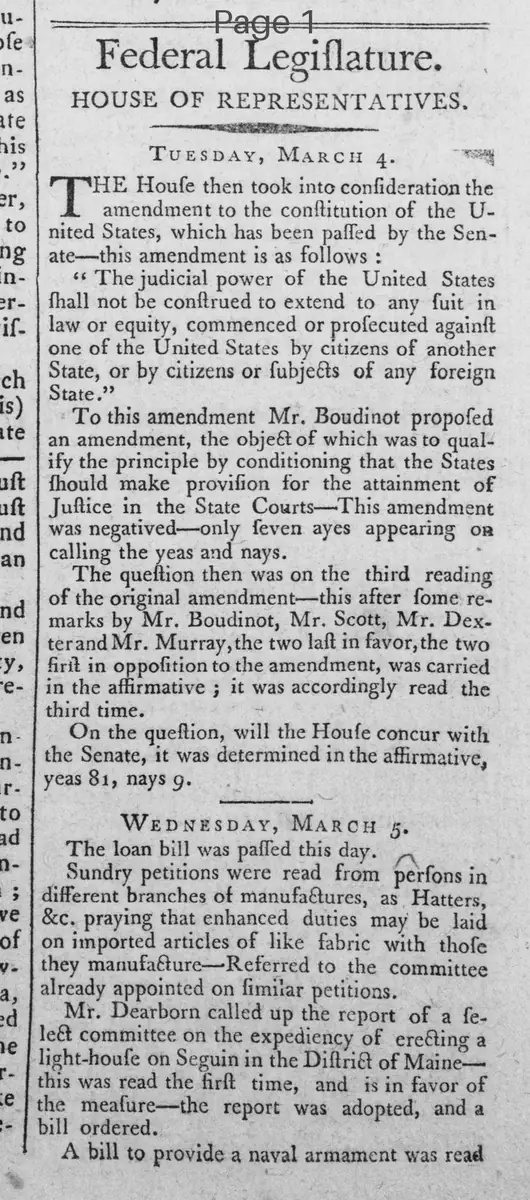
HOUSE OF REPRESENTATIVES.
TUESDAY, MARCH 4.
The House then took into consideration the amendment to the constitution of the United States, which has been passed by the Senate—this amendment is as follows:
"The judicial power of the United States shall not be construed to extend to any suit in law or equity, commenced or prosecuted against one of the United States by citizens of another State, or by citizens or subjects of any foreign State."
To this amendment Mr. Boudinot proposed an amendment, the object of which was to qualify the principle by conditioning that the States should make provision for the attainment of Justice in the State Courts—This amendment was negatived—only seven ayes appearing on calling the yeas and nays.
The question then was on the third reading of the original amendment—this after some remarks by Mr. Boudinot, Mr. Scott, Mr. Dexter and Mr. Murray, the two last in favor, the two first in opposition to the amendment, was carried in the affirmative; it was accordingly read the third time.
On the question, will the House concur with the Senate, it was determined in the affirmative, yeas 81, nays 9.
Wednesday, March 5.
The loan bill was passed this day.
Sundry petitions were read from persons in different branches of manufactures, as Hatters, &c. praying that enhanced duties may be laid on imported articles of like fabric with those they manufacture—Referred to the committee already appointed on similar petitions.
Mr. Dearborn called up the report of a select committee on the expediency of erecting a light-house on Seguin in the District of Maine—this was read the first time, and is in favor of the measure—the report was adopted, and a bill ordered.
A bill to provide a naval armament was read in committee of the whole house to-morrow.
In committee of the whole on the report relative to placing the ports and harbors of the United States in a posture of defence—Mr. Boudinot in the chair. The report was read—it states that the following ports and harbors ought to be put in a state of defence, to wit: Portland in Maine; Portsmouth in New-Hampshire; Cape-Ann, Salem, Marblehead, Boston, in Massachusetts; Newport, Rhode-Island; New-London, (Connecticut,) New-York; Philadelphia; Baltimore; Norfolk; Wilmington, North-Carolina; Ocracoke Inlet, Charleston, South-Carolina; Savannah, Georgia. The fortifications to be of a nature to defend the several ports and harbors against surprize by naval armaments; that the several places to be fortified, be garrisoned by troops in the pay of the United States.
From the estimates it appears, that the sums necessary to erect the fortifications amount to
Dolls. Cts.
76,053 25
That 200 cannon will be necessary, which with their carriages, &c. amount to
96,645 0
Dolls.
172,698 25
The annual expences of the troops necessary to garrison the several fortifications including pay, subsistence, &c.
90,349 25.
The committee state, that in their opinion the security of the United States, renders it necessary to provide the cannon, whether the fortifications should be erected or not—The report goes on to state the expence which would probably be incurred at the several places mentioned—the aggregate of which is as above stated.
Mr. Fitzsimons who was on the select committee, observed that it must appear to the committee of the whole, that the report was substantially a recommendatory business—the carrying of which into execution, must eventually depend on various circumstances—all that Congress can do, he added, was to vote a sum of money—and leave the execution of the plan to the discretion of the President of the United States, to be completed in such manner as he may find expedient—the committee went through the report—some alterations were made by increasing the number of places to be fortified, and diminishing the number of cannon in others—so that the aggregate of the expence remains the same.
Mr. Fitzsimons then moved sundry resolutions for carrying the report into effect—these were severally put, and agreed to.
The committee then rose and the Chairman reported the amendments and resolutions to the House.
The committee on that part of the President's message relating to arms and military stores—brought in a report, which states the several additions and augmentations necessary—Two additional arsenals—a national armoury—5000 stands of arms—gun-powder, &c. are specified—this report was twice read and referred to the committee of the whole.
THURSDAY, March 6.
Several petitions were read and referred.
Mr. Trumbull reported a bill making appropriations for the support of the military establishment of the United States for the year 1794—which was read twice, and committed for to-morrow.
A petition was presented by Mr. Watts from Stephen Paranque, Capt. of a French Indiaman now lying in the port of New-York, praying for reasons stated, a longer time than is allowed by the letter of the law, for the payment of the duties on goods to be landed from said ship, giving the customary bonds—this petition was referred to a select committee.
Mr. W. Smith reported a bill making provisions in case of disability of a district Judge, this was read twice and committed for to-morrow.
In committee of the whole, on the bill to prohibit the carrying on the slave trade from the ports of the United States—Mr. Boudinot in the chair.—The two first sections of the bill were agreed to with an alteration moved by Mr. Trumbull, which was to give the district court as well as the circuit courts, cognizance of the offence.
The third section which relates to the penalty, &c. it was moved should be struck out. The motion was negatived. It was then moved to insert the word foreign before "ship or vessel"—which was agreed to.
The committee proceeded through the bill, which was reported to the House, with sundry amendments:—They were agreed to by the House. and the bill ordered to be engrossed for a third reading.
In committee of the whole, on the bill to provide for destroyed certificates of a certain description, Mr. Bourne in the chair. The bill being read. a motion was made that the committee should rise and report the same : this was done. It was then voted that it be read the third time.
Mr. Watts of the committee on the petition of Stephen Paranque, Capt. of the French Indiaman, brought in a report which is in favor of the petitioner. The report was accepted by the House and a bill ordered to be brought in pursuant thereto.
A bill to provide for the expence attending the intercourse between the United States and foreign nations, was taken up in committee of the whole, Mr. Bourne in the chair. This bill being read Mr. W. Smith moved to add a section to continue in force for an act already extant on this subject. This amendment was agreed to. The bill was then reported to the House,and with the amendment laid on the table till to-morrow.
What sub-type of article is it?
What keywords are associated?
What entities or persons were involved?
Domestic News Details
Event Date
March 4 6, 1794
Key Persons
Outcome
constitutional amendment passed (yeas 81, nays 9); loan bill passed; fortifications report approved with resolutions; slave trade prohibition bill advanced with amendments; military appropriations bill reported; various petitions referred or acted upon.
Event Details
The House considered and passed a Senate amendment to the U.S. Constitution limiting federal judicial power in suits against states. On March 5, the loan bill passed, manufacturing petitions were referred, a lighthouse bill for Seguin, Maine was ordered, and a report on fortifying key U.S. ports was debated and resolutions adopted. A naval armament bill was scheduled. A report on military stores was referred. On March 6, military appropriations for 1794 were reported, a French captain's petition for duty extension was favorably reported, a district judge disability bill was reported, the slave trade prohibition bill was amended and ordered engrossed, a destroyed certificates bill advanced, and a foreign intercourse expenses bill was amended and tabled.