Thank you for visiting SNEWPapers!
Sign up free
Story
October 1, 1933
The Arkansas Farmer
Little Rock, Pulaski County, Arkansas
What is this article about?
Practical guide to controlling grain weevils and moths in cowpeas, small grains, and sorghum seed using carbon disulphide, including application method and safety precautions about its flammability.
Clipping
OCR Quality
98%
Excellent
Full Text
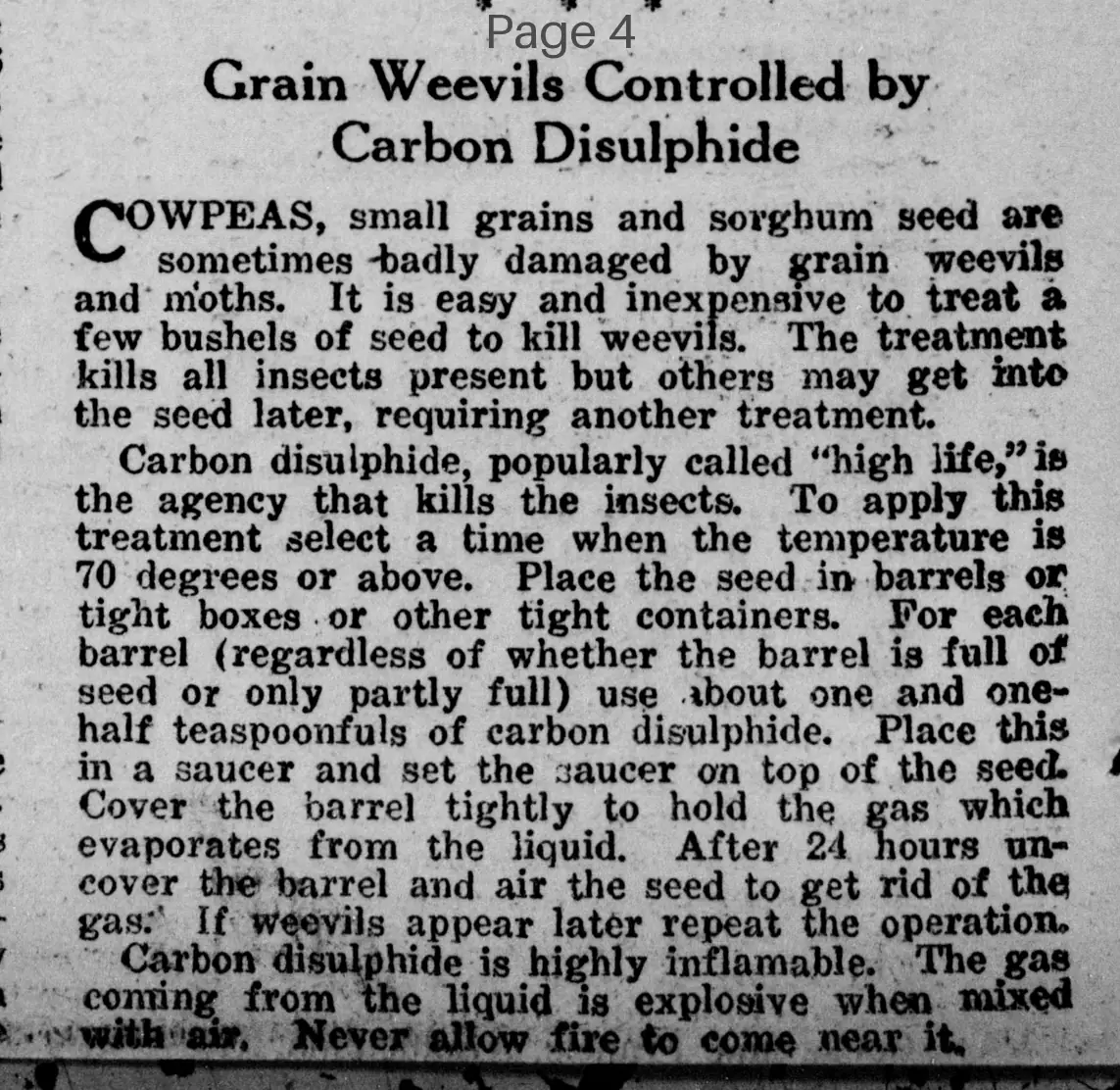
Grain Weevils Controlled by Carbon Disulphide
COWPEAS, small grains and sorghum seed are sometimes badly damaged by grain weevils and moths. It is easy and inexpensive to treat a few bushels of seed to kill weevils. The treatment kills all insects present but others may get into the seed later, requiring another treatment.
Carbon disulphide, popularly called "high life," is the agency that kills the insects. To apply this treatment select a time when the temperature is 70 degrees or above. Place the seed in barrels or tight boxes or other tight containers. For each barrel (regardless of whether the barrel is full of seed or only partly full) use about one and one-half teaspoonfuls of carbon disulphide. Place this in a saucer and set the saucer on top of the seed. Cover the barrel tightly to hold the gas which evaporates from the liquid. After 24 hours uncover the barrel and air the seed to get rid of the gas. If weevils appear later repeat the operation.
Carbon disulphide is highly inflammable. The gas coming from the liquid is explosive when mixed with air. Never allow fire to come near it.
COWPEAS, small grains and sorghum seed are sometimes badly damaged by grain weevils and moths. It is easy and inexpensive to treat a few bushels of seed to kill weevils. The treatment kills all insects present but others may get into the seed later, requiring another treatment.
Carbon disulphide, popularly called "high life," is the agency that kills the insects. To apply this treatment select a time when the temperature is 70 degrees or above. Place the seed in barrels or tight boxes or other tight containers. For each barrel (regardless of whether the barrel is full of seed or only partly full) use about one and one-half teaspoonfuls of carbon disulphide. Place this in a saucer and set the saucer on top of the seed. Cover the barrel tightly to hold the gas which evaporates from the liquid. After 24 hours uncover the barrel and air the seed to get rid of the gas. If weevils appear later repeat the operation.
Carbon disulphide is highly inflammable. The gas coming from the liquid is explosive when mixed with air. Never allow fire to come near it.
What sub-type of article is it?
Agricultural Guide
Pest Control Method
What keywords are associated?
Grain Weevils
Carbon Disulphide
Seed Treatment
Pest Control
Agriculture
Fumigation
Story Details
Story Details
Carbon disulphide is used to kill weevils and moths in seed by placing it in a saucer on top of seed in tight containers at 70 degrees or above, covering for 24 hours, then airing out; repeat if needed; highly inflammable and explosive.