Thank you for visiting SNEWPapers!
Sign up free
Glasgow Weekly Times
Glasgow, Howard County, Missouri
What is this article about?
U.S. Senate debates Henry Clay's resolutions to resolve slavery disputes by admitting California without restrictions, establishing territories without slavery limits, adjusting Texas boundaries, and other measures for union harmony. Additional House and Senate proceedings on land bills and revenue on Jan. 29-30.
Clipping
OCR Quality
Full Text
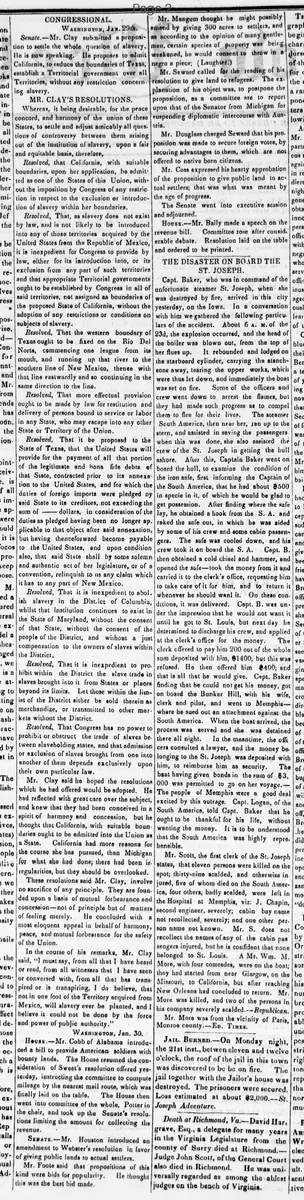
Washington, Jan. 29th
Senate.—Mr. Clay submitted a proposition to settle the whole question of slavery. He is now speaking. He proposes to admit California, to reduce the boundaries of Texas, establish a Territorial government over all Territories, without any restriction concerning slavery.
MR. CLAY'S RESOLUTIONS.
Whereas, it being desirable, for the peace, concord, and harmony of the union of these States, to settle and adjust amicably all questions of controversy between them arising out of the institution of slavery, upon a fair and equitable basis, therefore,
Resolved, that California, with suitable boundaries, upon her application, be admitted as one of the States of this Union, without the imposition by Congress of any restriction in respect to the exclusion or introduction of slavery within her boundaries.
Resolved, That, as slavery does not exist by law, and is not likely to be introduced into any of those territories acquired by the United States from the Republic of Mexico, it is inexpedient for Congress to provide by law, either for its introduction into, or its exclusion from any part of such territories; and that appropriate Territorial governments ought to be established by Congress in all of said territories, not assigned as boundaries of the proposed State of California, without the adoption of any restrictions or conditions on the subjects of slavery.
Resolved, That the western boundary of Texas ought to be fixed on the Rio Del Norte, commencing one league from its mouth, and running up that river to the southern line of New Mexico, thence with that line eastwardly and so continuing in the same direction to the line.
Resolved. That more effectual provision ought to be made by law for restitution and delivery of persons bound to service or labor in any State, who may escape into any other State or Territory of the Union.
Resolved, That it be proposed to the State of Texas, that the United States will provide for the payment of all that portion of the legitimate and bona fide debts of that State, contracted prior to its annexation to the United States, and for which the duties of foreign imports were pledged by said State to its creditors, not exceeding the sum of [amount redacted] dollars, in consideration of the duties as pledged having been no longer applicable to that object after said annexation, but having thenceforward become payable to the United States, and upon condition also, that said State shall by some solemn and authentic act of her legislature, or of a convention, relinquish to us any claim which it has to any part of New Mexico.
Resolved, That it is inexpedient to abolish slavery in the District of Columbia, whilst that institution continues to exist in the State of Maryland, without the consent of that State, without the consent of the people of the District, and without a just compensation to the owners of slaves within the District.
Resolved, That it is inexpedient to prohibit within the District the slave trade in slaves brought into it from States or places beyond its limits. Let those within the limits of the District either be sold therein as merchandise, or transmitted to other markets without the District.
Resolved, That Congress has no power to prohibit or obstruct the trade of slaves between slaveholding states, and that admission or exclusion of slaves brought from one into another of them depends exclusively upon their own particular law.
Mr. Clay said he hoped the resolutions which he had offered would be adopted. He had reflected with great care over the subject, and knew that they had been conceived in a spirit of harmony and concession, but he thought that California, with suitable boundaries ought to be admitted into the Union as a State. California had more reasons for the course she has pursued, than Michigan for what she had done; there had been irregularities, but they should be overlooked. These resolutions said Mr. Clay, involve no sacrifice of any principle. They are founded upon a basis of mutual forbearance and concession—not of principle but of matters of feeling merely.
He concluded with a most eloquent appeal in behalf of harmony, peace, and mutual forbearance for the safety of the Union.
In the course of his remarks, Mr. Clay said, "I must say, from all that I have heard or read, from all witnesses that I have seen or conversed with, from all that has transpired or is transpiring, I do believe, that not in one foot of the Territory acquired from Mexico, will slavery ever be planted, and I believe it could not be done by the force and power of public authority."
Washington, Jan. 30.
House.—Mr. Cobb of Alabama introduced a bill to provide American soldiers with bounty lands. The House resumed the consideration of Sweet's resolution offered yesterday, instructing the committee to compute mileage by the nearest mail route, which was finally laid on the table.
The House then went into committee of the whole, Potter in the chair, and took up the Senate's resolutions limiting the amount for collecting the revenue.
Senate.—Mr. Houston introduced an amendment to Webster's resolution in favor of giving public lands to actual settlers.
Mr. Foote said that propositions of this kind were bids for popularity.
He thought this was the best bid made.
Mr. Mangum thought he might possibly amend by giving 300 acres to settlers, and as according to the opinion of many gentlemen, certain species of property was being weakened, he would consent to throw in a negro a piece; (Laughter.)
Mr. Seward called for the reading of his resolution to give land to refugees. The explanation of his object was, to postpone the proposition, as a committee are to report upon that of the Senator from Michigan for suspending diplomatic intercourse with Austria.
Mr. Douglass charged Seward that his proposition was made to secure foreign votes, by securing advantages to them, which are not offered to native born citizens.
Mr. Cass expressed his hearty approbation of the proposition to give public land to actual settlers; that was what was meant by the age of progress.
The Senate went into executive session and adjourned.
House.—Mr. Baily made a speech on the revenue bill. Committee rose after considerable debate. Resolution laid on the table and ordered to be printed.
What sub-type of article is it?
What keywords are associated?
What entities or persons were involved?
Where did it happen?
Domestic News Details
Primary Location
Washington
Event Date
Jan. 29th Jan. 30th
Key Persons
Outcome
resolutions proposed and debated; no final votes reported; various bills introduced and tabled.
Event Details
In the Senate, Mr. Clay submits and speaks on resolutions to settle slavery questions by admitting California without slavery restrictions, establishing territories without slavery limits, fixing Texas boundaries, improving fugitive slave provisions, assuming Texas debts in exchange for New Mexico claims, and maintaining slavery in D.C. and interstate trade. He appeals for harmony. On Jan. 30, House considers soldier bounty lands, mileage resolution, and revenue limits. Senate debates land for settlers with amendments and refugee proposals amid partisan remarks.