Thank you for visiting SNEWPapers!
Sign up free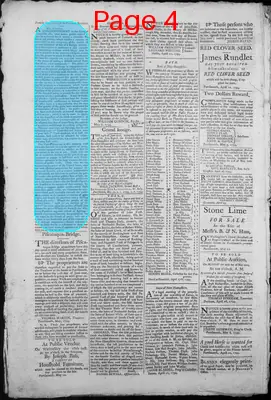
Editorial
May 20, 1794
The New Hampshire Gazette
Portsmouth, Rockingham County, New Hampshire
What is this article about?
An editorial defends public credit as essential for national security and prosperity, arguing it opposes war rather than causing it. It criticizes war advocates for undermining credit and urges negotiation with Britain to avoid debt increase and ensure equal footing if war ensues.
Clipping
OCR Quality
95%
Excellent
Full Text
From the GAZETTE of the UNITED STATES:
Mr. Fenno,
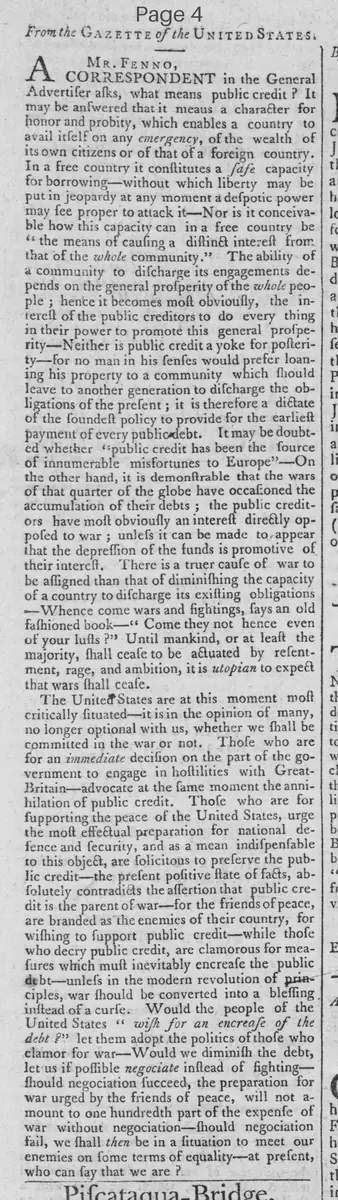
A CORRESPONDENT in the General Advertiser asks, what means public credit? It may be answered that it means a character for honor and probity, which enables a country to avail itself on any emergency, of the wealth of its own citizens or of that of a foreign country. In a free country it constitutes a safe capacity for borrowing—without which liberty may be put in jeopardy at any moment a despotic power may see proper to attack it—Nor is it conceivable how this capacity can in a free country be "the means of calling a distinct interest from that of the whole community." The ability of a community to discharge its engagements depends on the general prosperity of the whole people; hence it becomes most obviously, the interest of the public creditors to do every thing in their power to promote this general prosperity—Neither is public credit a yoke for property—for no man in his senses would prefer loaning his property to a community which should leave to another generation to discharge the obligations of the present: it is therefore a dictate of the soundest policy to provide for the earliest payment of every public debt. It may be doubted whether "public credit has been the source of innumerable misfortunes to Europe"-On the other hand, it is demonstrable that the wars of that quarter of the globe have occasioned the accumulation of their debts; the public creditors have most obviously an interest directly opposed to war; unless it can be made to appear that the depression of the funds is promotive of their interest. There is a truer cause of war to be assigned than that of diminishing the capacity of a country to discharge its existing obligations --Whence come wars and fightings, says an old fashioned book" Come they not hence even of your lusts?" Until mankind, or at least the majority, shall cease to be actuated by resentment, rage, and ambition, it is utopian to expect that wars shall cease.
The United States are at this moment most critically situated—it is in the opinion of many, no longer optional with us, whether we shall be committed in the war or not. Those who are for an immediate decision on the part of the government to engage in hostilities with Great-Britain—advocate at the same moment the annihilation of public credit. Those who are for supporting the peace of the United States, urge the most effectual preparation for national defence and security, and as a mean indispensable to this object, are solicitous to preserve the public credit-the present positive state of facts, absolutely contradicts the assertion that public credit is the parent of warfor the friends of peace, are branded as the enemies of their country, for wishing to support public credit--while those who decry public credit, are clamorous for measures which must inevitably increase the public debt--unless in the modern revolution of principles, war should be converted into a blessing instead of a curse. Would the people of the United States "wish for an increase of the debt?" let them adopt the politics of those who clamor for war-Would we diminish the debt, let us if possible negotiate instead of fighting- should negotiation succeed, the preparation for war urged by the friends of peace, will not amount to one hundredth part of the expense of war without negotiation-should negotiation fail, we shall then be in a situation to meet our enemies on some terms of equality---at present, who can say that we are?.
Mr. Fenno,
A CORRESPONDENT in the General Advertiser asks, what means public credit? It may be answered that it means a character for honor and probity, which enables a country to avail itself on any emergency, of the wealth of its own citizens or of that of a foreign country. In a free country it constitutes a safe capacity for borrowing—without which liberty may be put in jeopardy at any moment a despotic power may see proper to attack it—Nor is it conceivable how this capacity can in a free country be "the means of calling a distinct interest from that of the whole community." The ability of a community to discharge its engagements depends on the general prosperity of the whole people; hence it becomes most obviously, the interest of the public creditors to do every thing in their power to promote this general prosperity—Neither is public credit a yoke for property—for no man in his senses would prefer loaning his property to a community which should leave to another generation to discharge the obligations of the present: it is therefore a dictate of the soundest policy to provide for the earliest payment of every public debt. It may be doubted whether "public credit has been the source of innumerable misfortunes to Europe"-On the other hand, it is demonstrable that the wars of that quarter of the globe have occasioned the accumulation of their debts; the public creditors have most obviously an interest directly opposed to war; unless it can be made to appear that the depression of the funds is promotive of their interest. There is a truer cause of war to be assigned than that of diminishing the capacity of a country to discharge its existing obligations --Whence come wars and fightings, says an old fashioned book" Come they not hence even of your lusts?" Until mankind, or at least the majority, shall cease to be actuated by resentment, rage, and ambition, it is utopian to expect that wars shall cease.
The United States are at this moment most critically situated—it is in the opinion of many, no longer optional with us, whether we shall be committed in the war or not. Those who are for an immediate decision on the part of the government to engage in hostilities with Great-Britain—advocate at the same moment the annihilation of public credit. Those who are for supporting the peace of the United States, urge the most effectual preparation for national defence and security, and as a mean indispensable to this object, are solicitous to preserve the public credit-the present positive state of facts, absolutely contradicts the assertion that public credit is the parent of warfor the friends of peace, are branded as the enemies of their country, for wishing to support public credit--while those who decry public credit, are clamorous for measures which must inevitably increase the public debt--unless in the modern revolution of principles, war should be converted into a blessing instead of a curse. Would the people of the United States "wish for an increase of the debt?" let them adopt the politics of those who clamor for war-Would we diminish the debt, let us if possible negotiate instead of fighting- should negotiation succeed, the preparation for war urged by the friends of peace, will not amount to one hundredth part of the expense of war without negotiation-should negotiation fail, we shall then be in a situation to meet our enemies on some terms of equality---at present, who can say that we are?.
What sub-type of article is it?
Economic Policy
War Or Peace
What keywords are associated?
Public Credit
National Debt
War With Britain
Peace Negotiation
Economic Prosperity
Defense Preparation
What entities or persons were involved?
United States
Great Britain
Public Creditors
Editorial Details
Primary Topic
Defense Of Public Credit And Advocacy For Peace Over War
Stance / Tone
Supportive Of Public Credit Preservation And Negotiation For Peace
Key Figures
United States
Great Britain
Public Creditors
Key Arguments
Public Credit Enables Borrowing In Emergencies And Supports Liberty
Public Creditors Promote General Prosperity To Ensure Debt Repayment
Public Credit Is Not A Cause Of War But Wars Cause Debt Accumulation
Advocates For War Seek To Annihilate Public Credit While Peace Supporters Preserve It
Negotiation Is Preferable To War To Avoid Increasing Debt
Preparation For Defense Without War Is Less Expensive Than Actual Hostilities