Thank you for visiting SNEWPapers!
Sign up free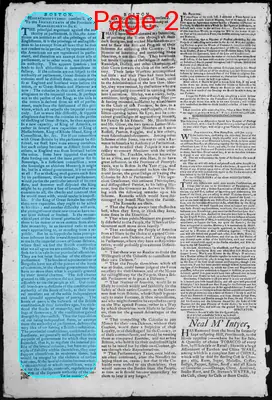
Literary
March 31, 1775
The New Hampshire Gazette And Historical Chronicle
Portsmouth, Greenland, Rockingham County, New Hampshire
What is this article about?
This continuation of 'Massachusettensis' argues against the claim that Americans, unrepresented in Parliament, are exempt from its authority. It posits that such exemption would make colonies distinct states, severing ties to the British crown and constitution, leading to instability without imperial checks.
Clipping
OCR Quality
95%
Excellent
Full Text
BOSTON.
MASSACHUSETTENSIS continu'd.
To the Inhabitants of the Province of
MASSACHUSETTS-BAY.
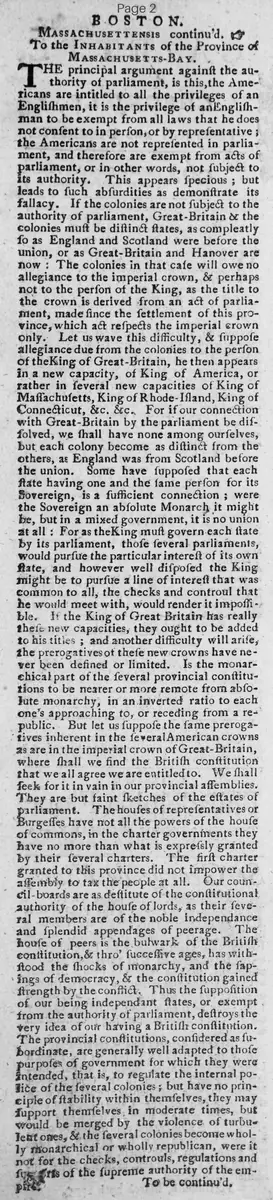
THE principal argument against the authority of parliament, is this, the Americans are entitled to all the privileges of an Englishman, it is the privilege of an Englishman to be exempt from all laws that he does not consent to in person, or by representative; the Americans are not represented in parliament, and therefore are exempt from acts of parliament, or in other words, not subject to its authority. This appears specious; but leads to such absurdities as demonstrate its fallacy. If the colonies are not subject to the authority of parliament, Great-Britain & the colonies must be distinct states, as compleatly so as England and Scotland were before the union. or as Great-Britain and Hanover are now: The colonies in that case will owe no allegiance to the imperial crown, & perhaps not to the person of the King. as the title to the crown is derived from an act of parliament, made since the settlement of this province. which act respects the imperial crown only. Let us wave this difficulty, & suppose allegiance due from the colonies to the person of the King of Great-Britain, he then appears in a new capacity, of King of America, or rather in several new capacities of King of Massachusetts, King of Rhode-Island, King of Connecticut. &c. &c. For if our connection with Great-Britain by the parliament be dissolved, we shall have none among ourselves, but each colony become as distinct from the others, as England was from Scotland before the union. Some have supposed that each State having one and the same person for its Sovereign, is a sufficient connection ; were the Sovereign an absolute Monarch it might be, but in a mixed government, it is no union at all : For as the King must govern each state by its parliament, those several parliaments. would pursue the particular interest of its own State. and however well disposed the King might be to pursue a line of interest that was common to all, the checks and controul that he would meet with, would render it impossible. If the King of Great Britain has really these new capacities, they ought to be added to his titles ; and another difficulty will arise, the prerogatives of these new crowns have never been defined or limited. Is the monarchical part of the several provincial constitutions to be nearer or more remote from absolute monarchy, in an inverted ratio to each one's approaching to, or receding from a republic. But let us suppose the same prerogatives inherent in the several American crowns as are in the imperial crown of Great-Britain, where shall we find the British constitution that we all agree we are entitled to. We shall seek for it in vain in our provincial assemblies. They are but faint sketches of the estates of parliament. The houses of representatives or Burgesses have not all the powers of the house of commons, in the charter governments they have no more than what is expressly granted by their several charters. The first charter granted to this province did not impower the assembly to tax the people at all. Our council-boards are as destitute of the constitutional authority of the house of lords., as their several members are of the noble independance and splendid appendages of peerage. The house of peers is the bulwark of the British constitution,& thro' successive ages, has withstood the shocks of monarchy, and the aspirations of democracy, & the constitution gained strength by the conflict. Thus the supposition of our being independant states, or exempt from the authority of parliament, destroys the very idea of our having a British constitution. The provincial constitutions, considered as subordinate, are generally well adapted to those purposes of government for which they were intended, that is, to regulate the internal police of the several colonies ; but have no principle of stability within themselves, they may support themselves, in moderate times, but would be merged by the violence of turbulent ones. & the several colonies become wholly monarchical or wholly republican, were it not for the checks, controuls, regulations and supports of the supreme authority of the empire.
To be continu'd.
MASSACHUSETTENSIS continu'd.
To the Inhabitants of the Province of
MASSACHUSETTS-BAY.
THE principal argument against the authority of parliament, is this, the Americans are entitled to all the privileges of an Englishman, it is the privilege of an Englishman to be exempt from all laws that he does not consent to in person, or by representative; the Americans are not represented in parliament, and therefore are exempt from acts of parliament, or in other words, not subject to its authority. This appears specious; but leads to such absurdities as demonstrate its fallacy. If the colonies are not subject to the authority of parliament, Great-Britain & the colonies must be distinct states, as compleatly so as England and Scotland were before the union. or as Great-Britain and Hanover are now: The colonies in that case will owe no allegiance to the imperial crown, & perhaps not to the person of the King. as the title to the crown is derived from an act of parliament, made since the settlement of this province. which act respects the imperial crown only. Let us wave this difficulty, & suppose allegiance due from the colonies to the person of the King of Great-Britain, he then appears in a new capacity, of King of America, or rather in several new capacities of King of Massachusetts, King of Rhode-Island, King of Connecticut. &c. &c. For if our connection with Great-Britain by the parliament be dissolved, we shall have none among ourselves, but each colony become as distinct from the others, as England was from Scotland before the union. Some have supposed that each State having one and the same person for its Sovereign, is a sufficient connection ; were the Sovereign an absolute Monarch it might be, but in a mixed government, it is no union at all : For as the King must govern each state by its parliament, those several parliaments. would pursue the particular interest of its own State. and however well disposed the King might be to pursue a line of interest that was common to all, the checks and controul that he would meet with, would render it impossible. If the King of Great Britain has really these new capacities, they ought to be added to his titles ; and another difficulty will arise, the prerogatives of these new crowns have never been defined or limited. Is the monarchical part of the several provincial constitutions to be nearer or more remote from absolute monarchy, in an inverted ratio to each one's approaching to, or receding from a republic. But let us suppose the same prerogatives inherent in the several American crowns as are in the imperial crown of Great-Britain, where shall we find the British constitution that we all agree we are entitled to. We shall seek for it in vain in our provincial assemblies. They are but faint sketches of the estates of parliament. The houses of representatives or Burgesses have not all the powers of the house of commons, in the charter governments they have no more than what is expressly granted by their several charters. The first charter granted to this province did not impower the assembly to tax the people at all. Our council-boards are as destitute of the constitutional authority of the house of lords., as their several members are of the noble independance and splendid appendages of peerage. The house of peers is the bulwark of the British constitution,& thro' successive ages, has withstood the shocks of monarchy, and the aspirations of democracy, & the constitution gained strength by the conflict. Thus the supposition of our being independant states, or exempt from the authority of parliament, destroys the very idea of our having a British constitution. The provincial constitutions, considered as subordinate, are generally well adapted to those purposes of government for which they were intended, that is, to regulate the internal police of the several colonies ; but have no principle of stability within themselves, they may support themselves, in moderate times, but would be merged by the violence of turbulent ones. & the several colonies become wholly monarchical or wholly republican, were it not for the checks, controuls, regulations and supports of the supreme authority of the empire.
To be continu'd.
What sub-type of article is it?
Essay
Satire
What themes does it cover?
Political
Liberty Freedom
Taxation Oppression
What keywords are associated?
Parliament Authority
American Privileges
British Constitution
Colonial Allegiance
Imperial Crown
Literary Details
Title
Massachusettensis Continu'd.
Subject
Argument Against Exemption From Parliamentary Authority
Form / Style
Political Prose Essay
Key Lines
The Principal Argument Against The Authority Of Parliament, Is This, The Americans Are Entitled To All The Privileges Of An Englishman, It Is The Privilege Of An Englishman To Be Exempt From All Laws That He Does Not Consent To In Person, Or By Representative;
Thus The Supposition Of Our Being Independant States, Or Exempt From The Authority Of Parliament, Destroys The Very Idea Of Our Having A British Constitution.