Thank you for visiting SNEWPapers!
Sign up free
The National Intelligencer And Washington Advertiser
Washington, District Of Columbia
What is this article about?
Opinion piece compares US grievances against Britain in 1794 (impressment, blockades, trade restrictions) to present, criticizes Federalist Jay Treaty policy, advocates pre-negotiation commercial restrictions under current administration for better redress.
Clipping
OCR Quality
Full Text
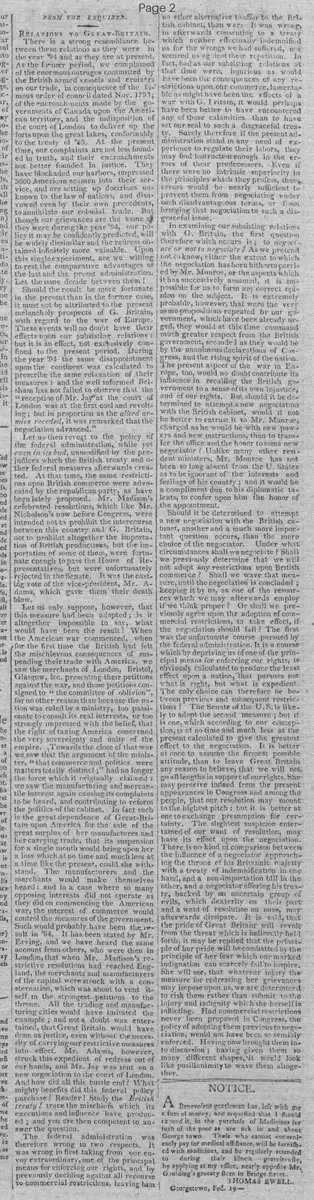
There is a strong resemblance between these relations as they were in the year '94 and as they are at present. At the former period, we complained of the enormous outrages committed by the British armed vessels and cruizers on our trade, in consequence of the famous order of council dated Nov. 1793; of the encroachments made by the governments of Canada upon the American territory, and the indisposition of the court of London to deliver up the forts upon the great lakes, conformably to the treaty of '83. At the present time, our complaints are not less founded in truth, and their encroachments not better founded in justice. They have blockaded our harbors, impressed 5000 American seamen into their service, and are setting up doctrines unknown to the law of nations, and disavowed even by their own precedents, to annihilate our colonial trade. But though our grievances are the same as they were during the year '94, our policy it may be confidently, predicted, will be widely dissimilar and the redress obtained infinitely more valuable. Upon this single experiment, are we willing to rest the comparative advantages of the last and the present administration. Let the issue decide between them!
Should the result be more fortunate in the present than in the former case, it must not be attributed to the present melancholy prospects of G. Britain, with regard to the war of Europe. These events will no doubt have their effects upon our subsisting relations: but it is an effect, not exclusively confined to the present period. During the year '94 the same disappointment upon the continent was calculated to prescribe the same relaxation of their measures: and the well informed Belsham has not failed to observe that "the reception of Mr. Jay at the court of London was at the first cool and revolting; but in proportion as the allied armies receded, it was remarked that the negociation advanced."
Let us then revert to the policy of the federal administration, while yet even in its bud, unmodified by the prejudices which the British treaty and other federal measures afterwards created. At that time, the same restrictions upon British commerce were advocated by the republican party, as have been lately proposed. Mr. Madison's celebrated resolutions. which like Mr. Nicholson's now before Congress, were intended not to prohibit the intercourse between this country and G. Britain. not to prohibit altogether the importation of British productions, but the importation of some of them, were fortunate enough to pass the House of Representatives, but were unfortunately rejected in the Senate. It was the casting vote of the vice-president, Mr. Adams, which gave them their death blow.
Let us only suppose, however, that this measure had been adopted; is it altogether impossible to say, what would have been the result? When the American war commenced, when for the first time the British had felt the mischievous consequences of suspending their trade with America, we saw the merchants of London, Bristol, Glasgow, &c. presenting their petitions against the war. and those petitions consigned to "the committee of oblivion" for no other reason than because the nation was ruled by a ministry. too passionate to consult its real interests, or too strongly impressed with the belief, that the right of taxing America concerned the very sovereignty and unity of the empire. Towards the close of that war we saw that the argument of the minister, "that commerce and politics were matters totally distinct;" had no longer the force which it originally claimed: we saw the manufacturing and mercantile interest again causing its complaints to be heard, and contributing to reform the politics of the cabinet. In fact such is the great dependence of Great-Britain upon America for the sale of the great surplus of her manufactures and her carrying trade, that its suspension for a single month would bring upon her a loss which at no time and much less at a time like the present, could she withstand. The manufacturers and the merchants would make themselves heard: and in a case where so many opposing interests did not operate as they did on commencing the American war, the interest of commerce would control the measures of the government.
Such would probably have been the result in '94. It has been stated by Mr. Erving, and we have heard the same account from others, who were then in London, that when Mr. Madison's restrictive resolutions had reached England, the merchants and manufacturers of the capital were struck with a consternation, which was about to vent itself in the strongest petitions to the throne. All the trading and manufacturing cities would have imitated the example; and no doubt was entertained, that Great Britain would have done us justice, even without the necessity of carrying our restrictive measures into effect. Mr. Adams, however, struck this expedient of redress out of our hands, and Mr. Jay was sent on a new negociation to the court of London.
And how did all this bustle end? What mighty benefits did this federal policy purchase? Reader! Study the British treaty! trace the mischiefs which its executions and influence have produced; and you are then competent to answer the question.
The federal administration was therefore wrong in two respects. It was wrong in first taking from our envoy extraordinary, one of the principal means for enforcing our rights, and by previously deciding against all recourse to commercial restrictions, leaving him no other alternative to offer to the British cabinet, than war: It was wrong in afterwards consenting to a treaty which neither effectually indemnified us for the wrongs we had suffered, nor secured us against their repetition. In fact, bad as our subsisting relations at that time were, injurious as would have been the consequences of any restrictions upon our commerce, lamentable as might have been the effects of a war with G. Britain, it would perhaps have been better to have encountered any of those calamities than to have set our seal to such a disgraceful treaty. Surely therefore if the present administration stand in any need of experience to regulate their labors, they may find instruction enough in the errors of their predecessors. Even if there were no intrinsic superiority in the principles which they profess, those errors would be nearly sufficient to prevent them from negociating under such disadvantageous terms, or from bringing that negociation to such a disgraceful issue.
In examining our subsisting relations with G. Britain, the first question therefore which occurs is; to negociate or not to negociate? As we pretend not to know, either the extent to which the negociation has been hitherto carried by Mr. Munroe, or the aspects which it has successively assumed, it is impossible for us to form any correct opinion on the subject. It is extremely probable, however, that were the very same propositions repeated by our government, which have been already urged, they would at this time command much greater respect from the British government, seconded as they would be by the unanimous declarations of Congress, and the rising spirit of the nation. The present aspect of the war in Europe, too, would no doubt contribute its influence in recalling the British government to a sense of its own injustice, and of our rights. But should it be determined to attempt a new negociation with the British cabinet, would it not be better to entrust it to Mr. Munroe, charged as he would be with new powers and new instructions, than to transfer the office and the honor to some new negociator? Unlike many other resident ministers, Mr. Monroe has not been so long absent from the U. States as to be ignorant of the interests and feelings of his country; and it would be a compliment due to his diplomatic talents, to confer upon him the honor of the appointment.
Should it be determined to attempt a new negociation with the British cabinet, another and a much more important question occurs, than the mere choice of the negociator. Under what circumstances shall we negociate? Shall we previously determine that we will not adopt any restrictions upon British commerce? Shall we wave that measure, until the negociation is concluded: keeping it by us, as one of the resources which we may afterwards employ if we think proper? Or shall we previously agree upon the adoption of commercial restrictions, to take effect, if the negociation should fail? The first was the unfortunate course pursued by the federal administration. It is a course which by depriving us of one of the principal means for enforcing our rights. is obviously calculated to produce the least effect upon a nation, that pursues not what is right, but what is expedient.
The only choice can therefore be between previous and subsequent restrictions? The Senate of the U.S. is likely to adopt the second measure; but it is one, which according to our conception, is at no time and much less at the present calculated to give the greatest effect to the negociation. It is better at once to assume the firmest possible attitude, than to leave Great Britain any reason to believe, that we will not go all lengths in support of our rights. She may perceive indeed from the present appearances in Congress and among the people, that our resolution may mount to the highest pitch: but it is better at one to exchange presumption for certainty. The slightest suspicion entertained of our want of resolution, may have its effect upon the negociation. There is no kind of comparison between the influence of a negociator approaching the throne of his Britannic majesty with a treaty of indemnification in one hand, and a non-importation bill in the other, and a negociator offering his treaty, backed by an uncertain group of evils, which dexterity on their part and a want of resolution on ours, may afterwards dissipate. It is said, that the pride of Great Britain will revolt from the threat which is indirectly held forth, it may be replied that the principle of her pride will be combatted by the principle of her fear which our marked indignation can scarcely fail to inspire. She will see, that whatever injury the measure for redressing her grievances may impose upon us, we are determined to risk them rather than submit to the injury and indignity which she herself is inflicting. Had commercial restrictions never been proposed in Congress, the policy of adopting them previous to negociation, would not have been so sensibly enforced. Having now brought them into discussion; having given them so many different shapes, it would look like pusillanimity to wave them altogether.
What sub-type of article is it?
What keywords are associated?
What entities or persons were involved?
Where did it happen?
Foreign News Details
Primary Location
Great Britain
Event Date
Year '94 And Present
Key Persons
Outcome
criticism of british treaty as disgraceful; prediction that commercial restrictions would force british concessions without war or poor treaty.
Event Details
Discusses similarities in US-British trade grievances from 1794 to now, including blockades and impressment of 5000 seamen; contrasts Federalist policy of negotiation without restrictions leading to Jay Treaty with advocated Republican approach of prior commercial restrictions to strengthen current negotiations by Mr. Munroe.