Thank you for visiting SNEWPapers!
Sign up free
Elizabeth Town Gazette
Elizabeth, Union County, New Jersey
What is this article about?
London report on the August 17 trial of Queen Caroline before the House of Lords for alleged misconduct, detailing her arrival amid cheers, Brougham's lengthy defense against the bill of pains and penalties accusing ministers of hypocrisy, and the adjournment. Minor notes on Lord Byron's arrival with dispatches and restored tranquility in Italy.
Clipping
OCR Quality
Full Text
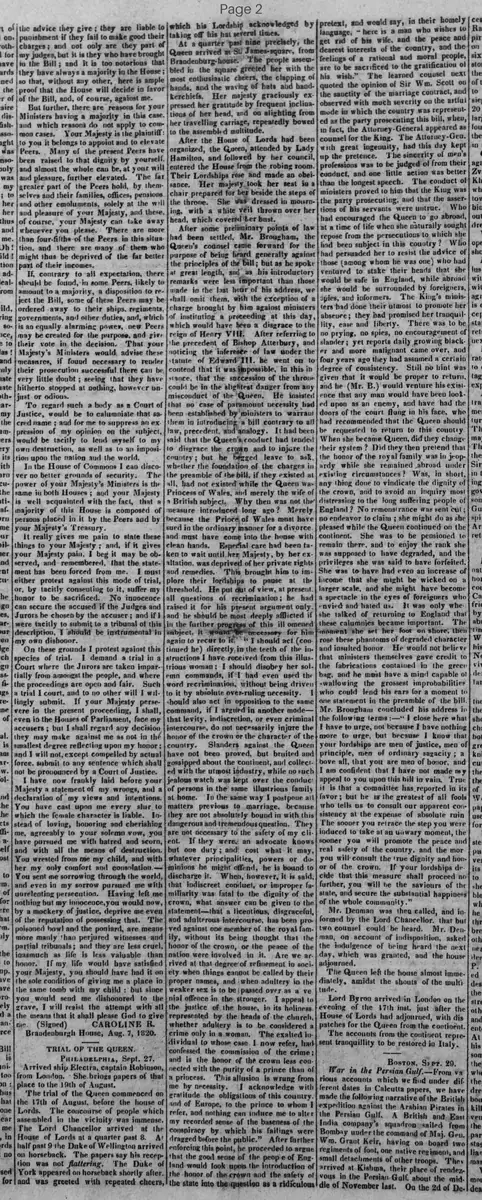
PHILADELPHIA, Sept. 27.
Arrived ship Electra, captain Robinson, from London. She brings papers of that place to the 18th of August.
The trial of the Queen commenced on the 17th of August, before the house of Lords. The concourse of people which assembled in the vicinity was immense.
The Lord Chancellor arrived at the House of Lords at a quarter past 8. At half past 9 the Duke of Wellington arrived on horseback. The papers say his reception was not flattering. The Duke of York appeared on horseback shortly after, and was greeted with repeated cheers, which his Lordship acknowledged by taking off his hat several times.
At a quarter past nine precisely, the Queen arrived at St. James's-square, from Brandenburg-house. The people assembled in the square greeted her with the most enthusiastic cheers, the clapping of hands, and the waving of hats and handkerchiefs. Her majesty graciously expressed her gratitude by frequent inclinations of her head, and on alighting from her travelling carriage, repeatedly bowed to the assembled multitude.
After the House of Lords had been organized, the Queen, attended by Lady Hamilton, and followed by her council, entered the House from the robing room. Their Lordships rose and made an obeisance. Her majesty took her seat in a chair prepared for her beside the steps of the throne. She was dressed in mourning, with a white veil thrown over her head, which covered her bust.
After some preliminary points of law had been settled, Mr. Brougham, the Queen's counsel came forward for the purpose of being heard generally against the principles of the bill; but as he spoke at great length, and as his introductory remarks were less important than those made in the last hour of his address, we shall omit them, with the exception of a charge brought by him against ministers of instituting a proceeding at this day, which would have been a disgrace to the reign of Henry VIII. After referring to the precedent of Bishop Atterbury, and noticing the inference of law under the statute of Edward III. he went on to contend that it was impossible, in this instance, that the succession of the thrones could be in the slightest danger from any misconduct of the Queen. He insisted that no case of paramount necessity had been established by ministers to warrant them in introducing a bill contrary to all law, precedent, and analogy. It had been said that the Queen's conduct had tended to disgrace the crown and to injure the country; but he begged leave to ask, whether the foundation of the charges in the preamble of the bill, if they existed at all, had not existed while the Queen was Princess of Wales, and merely the wife of a British subject. Why then was not the measure introduced long ago? Merely because the Prince of Wales must have sued in the ordinary manner for a divorce, and must have come into the house with clean hands. Especial care had been taken to wait until her Majesty, by her exaltation, was deprived of her private rights and remedies. This brought him to implore their lordships to pause at the threshold. He put out of view, at present, all questions of recrimination; he had raised it for his present argument only, and he should be most deeply afflicted if in the further progress of this ill omened subject, it would be necessary for him again to recur to it. "I should act (continued he) directly, in the teeth of the instructions I have received from this illustrious woman; I should disobey her solemn commands, if I had even used the word recrimination, without being driven to it by absolute over-ruling necessity. I should also act in opposition to the same command, if I argued in another mode—that levity, indiscretion, or even criminal intercourse, do not necessarily injure the honor of the crown or the character of the country. Slanders against the Queen have not been proved, but bruited and gossiped about the continent, and collected with the utmost industry, while no such jealous watch was kept over the conduct of persons in the same illustrious family at home. In the same way I postpone all matters previous to marriage, because they are not absolutely bound in with this dangerous and tremendous question. They are not necessary to the safety of my client. If they were, an advocate knows but one duty; and cost what it may, whatever principalities, powers or dominions he might offend, he is bound to discharge it. When, however, it is said, that indiscreet conduct, or improper familiarity was fatal to the dignity of the crown, what answer can be given to the statement—that a licentious, disgraceful, and adulterous intercourse, has been proved against one member of the royal family, without its being thought that the honor of the crown, or the peace of the nation were involved in it. Are we arrived at that degree of refinement in society when things cannot be called by their proper names, and when adultery in the weaker sex is to be passed over as a venial offence in the stronger. I appeal to the justice of the house, in its holiness, represented by the heads of the church, whether adultery is to be considered a crime only in a woman. The exalted individual to whose case I now refer, had confessed the commission of the crime; and is the honor of the crown less connected with the purity of a prince than of a princess. This allusion is wrung from me by necessity. I acknowledge with gratitude the obligations of this country, and of Europe, to the prince to whom I refer, and nothing can induce me to alter my recorded sense of the baseness of the conspiracy by which his failings were dragged before the public." After further enforcing this point, he proceeded to argue that the good sense of the people of England would look upon the introduction of the honor of the crown and the safety of the state into the question as a ridiculous pretext, and would say, in their homely language, "here is a man who wishes to get rid of his wife, and the peace and dearest interests of the country, and the feelings of a rational and moral people, are to be sacrificed to the gratification of his wish." The learned counsel next quoted the opinion of Sir Wm. Scott on the sanctity of the marriage contract, and observed with much severity on the artful mode in which the country was represented as the party prosecuting this bill, when, in fact, the Attorney-General appeared as counsel for the King. The Attorney-Gen. with great ingenuity, had this day kept up the pretence. The sincerity of men's professions was to be judged of from their conduct, and one little action was better than the longest speech. The conduct of ministers proved to him that the King was the party prosecuting, and that the assertions of his servants were untrue. Who had encouraged the Queen to go abroad, at a time of life when she naturally sought repose from the persecutions to which she had been subject in this country? Who had persuaded her to resist the advice of those (among whom he was one) who had ventured to stake their heads that she would be safe in England, while abroad she would be surrounded by foreigners, spies, and informers. The King's ministers had done their utmost to promote her absence; they had promised her tranquillity, ease and liberty. There was to be no prying, no spies, no encouragement of slander; yet reports daily growing blacker and more malignant came over, and four years ago they had assumed a certain degree of consistency. Still no hint was given that it would be proper to return, and he (Mr. B.) would venture his existence that any man would have been looked upon as an enemy, and have had the doors of the court flung in his face, who had recommended that the Queen should be requested to return to this country. When she became Queen, did they change their system? Did they then pretend that the honor of the royal family was in jeopardy while she remained abroad under existing circumstances? Was, in short, any thing done to vindicate the dignity of the crown, and to avoid an inquiry most distressing to the long suffering people of England? No remonstrance was sent out; no endeavor to claim; she might do as she pleased while the Queen continued on the continent. She was to be pensioned to remain there, and to enjoy the rank she was supposed to have degraded, and the privileges she was said to have forfeited. She was to have had even an increase of income that she might be wicked on a larger scale, and she might have become a spectacle in the eyes of foreigners who envied and hated us. It was only when she talked of returning to England that these calumnies became important. The moment she set her foot on shore, then rose these phantoms of degraded character and insulted honor. He would not believe that ministers themselves gave credit to the fabrications contained in the green bag, and he must have a mind capable of swallowing the grossest improbabilities who could lend his ears for a moment to one statement in the preamble of the bill.
Mr. Brougham concluded his address in the following terms:—”I close here what I have to urge, not because I have nothing more to urge, but because I know that your lordships are men of justice, men of principle, men of ordinary sagacity; above all, that you are men of honor, and I am confident that I have not made my appeal to you upon this bill in vain. True it is that a committee has reported in its favor; but he is the greatest of all fools who tells us to consult our apparent consistency at the expense of absolute ruin. The sooner you retrace the step you were induced to take at an unwary moment, the sooner you will promote the peace and real safety of the country, and the more you will consult the true dignity and honor of the crown. If your lordships decide that this measure shall proceed no further, you will be the saviours of the state, and secure the substantial happiness of the whole community."
Mr. Denman was then called, and informed by the Lord Chancellor, that but two counsel could be heard. Mr. Denman, on account of indisposition, asked the indulgence of being heard the next day, which was granted, and the house adjourned.
The Queen left the house almost immediately, amidst the shouts of the multitude.
Lord Byron arrived in London on the evening of the 17th inst. just after the House of Lords had adjourned, with dispatches for the Queen from the continent.
The accounts from the continent represent tranquillity to be restored in Italy.
What sub-type of article is it?
What keywords are associated?
What entities or persons were involved?
Where did it happen?
Foreign News Details
Primary Location
London
Event Date
17th Of August
Key Persons
Outcome
trial commenced and adjourned after brougham's address; denman to speak next day due to indisposition.
Event Details
The trial of the Queen began on August 17 before the House of Lords amid large crowds. The Queen arrived to enthusiastic cheers, dressed in mourning. After preliminaries, Mr. Brougham delivered a lengthy speech defending the Queen, charging ministers with hypocrisy, referencing past royal scandals, and arguing against the bill's necessity and legality. He implored the Lords to halt proceedings. Mr. Denman was deferred due to illness. The Queen departed amid shouts. Lord Byron arrived with continental dispatches for the Queen. Reports indicate restored tranquility in Italy.