Thank you for visiting SNEWPapers!
Sign up free
Editorial
October 29, 1894
The Herald
Los Angeles, Los Angeles County, California
What is this article about?
Editorial criticizes Republican candidates Estee and McLachlan for inconsistent anti-railroad positions and ties to Southern Pacific company, doubting their sincerity amid California elections and issues like San Pedro harbor.
Clipping
OCR Quality
95%
Excellent
Full Text
CONSISTENCY.
THOU ART A JEWEL.
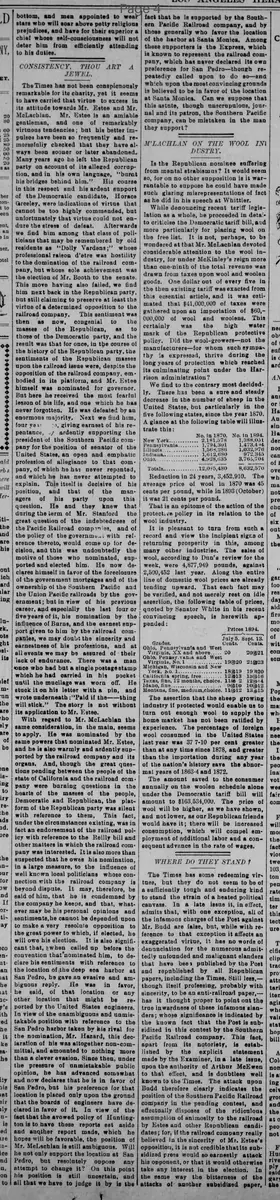
The Times has not been conspicuously remarkable for its charity, yet it seems to have carried that virtue to excess in its attitude towards Mr. Estee and Mr. McLachlan. Mr. Estee is an amiable gentleman, and one of remarkably virtuous tendencies; but his better impulses have been so frequently and remorsefully checked that they have always been sooner or later abandoned. Many years ago he left the Republican party on account of its alleged corruption, and in his own language, "burnt his bridges behind him." His course in this respect and his ardent support of the Democratic candidate, Horace Greeley, were indications of virtue that cannot be too highly commended, but unfortunately that virtue could not endure the stress of defeat. Afterward we find him among that class of politicians that may be remembered by old residents as "Dolly Vardens;" whose professional raison d'etre was hostility to the domination of the railroad company, but whose sole achievement was the election of Mr. Booth to the senate. This move having also failed, we find him next back in the Republican party but still claiming to preserve at least the virtue of determined opposition to the railroad company. This sentiment was then, as now, congenial to the masses of the Republican as well as to those of the Democratic party, and the result was that for once, in the course of the history of the Republican party, the sentiments of the Republican masses upon the railroad issue were, despite the opposition of the railroad company, embodied in its platform, and Mr. Estee himself was nominated for governor. But here he received the most fearful lesson of his life, and one which he has never forgotten. He was defeated by an enormous majority. Next we find him, four years ago, giving earnest of his repentance, and ardently supporting the president of the Southern Pacific company for the position of senator of the United States, an open and emphatic profession of allegiance to that company, of which he has never repented, and which he has never attempted to explain. This, itself, is decisive of his position, and that of the managers of his party upon this question. He and they knew that during the term of Mr. Stanford the great question of the indebtedness of the Pacific Railroad companies, and of the policy of the government with reference thereto, would come up for decision, and this was undoubtedly the motive of those who nominated, supported and elected him. He now declares himself in favor of the foreclosure of the government mortgages and of the ownership of the Southern Pacific and the Union Pacific railroads by the government; but in view of his previous career, and especially the last four or five years of it, his nomination by the influence of Stanford, and the earnest support given to him by the railroad companies, we may doubt the sincerity and earnestness of his professions, and at all events we may be assured of their lack of endurance. There was a man once who had but a single postage stamp which he had carried in his pocket until the mucilage was worn off. He stuck it on his letter with a pin, and wrote underneath: "Paid if the——thing will stick." The story is not without its application to Mr. Estee.
With regard to Mr. McLachlan the same consideration, in the main, seems to apply. He was nominated by the same powers that nominated Mr. Estee, and he is also warmly and ardently supported by the railroad company and its organs. And, though the great questions pending between the people of the state of California and the railroad company were burning questions in the hearts of the masses of the people, Democratic and Republican, the platform of the Republican party was silent with reference to them. This fact, under the circumstances existing, was in fact an endorsement of the railroad policy with reference to the Reilly bill and other matters in which the railroad company was interested. It is also more than suspected that he owes his nomination, in a large measure, to the influence of well known local politicians whose connection with the railroad company is beyond dispute. It may, therefore, be said of him, that he is condemned by the company he keeps, and that, whatever may be his personal opinions and sentiments, he cannot be depended upon to make a very resolute opposition to the great power to which, if elected, he will owe his election. It is also significant that, when called up before the convention that nominated him, to declare his sentiments with reference to the location of the deep sea harbor at San Pedro, he gave an evasive and ambiguous reply. He was in favor, he said, of that location or any other location that might be reported by the United States engineers. In view of the unambiguous and unmistakable position with reference to the San Pedro harbor taken by his rival for the nomination, Mr. Hazard, this declaration of his was altogether non-committal, and amounted to nothing more than a clever evasion. Since then, under the pressure of unmistakable public opinion, he has advanced somewhat and now declares that he is in favor of San Pedro, but his preference for that location is placed only upon the ground that the boards of engineers have declared in favor of it. In view of the fact that the avowed policy of Huntington is to have these reports set aside and another report made, which he hopes will be favorable, the position of Mr. McLachlan is still ambiguous. Will he not only support the location at San Pedro, but resolutely oppose any attempt to change it? On this point his position is still uncertain, and all that we have to judge it by in the fact that he is supported by the Southern Pacific Railroad company, and by those generally who favor the location of the harbor at Santa Monica. Among these supporters is the Express, which is known to represent the railroad company, which has never declared its own preference for San Pedro—though repeatedly called upon to do so—and which upon the most convincing grounds is believed to be in favor of the location at Santa Monica. Can we suppose that this astute, though unscrupulous, journal and its patron, the Southern Pacific company, can be mistaken in the man they support?
THOU ART A JEWEL.
The Times has not been conspicuously remarkable for its charity, yet it seems to have carried that virtue to excess in its attitude towards Mr. Estee and Mr. McLachlan. Mr. Estee is an amiable gentleman, and one of remarkably virtuous tendencies; but his better impulses have been so frequently and remorsefully checked that they have always been sooner or later abandoned. Many years ago he left the Republican party on account of its alleged corruption, and in his own language, "burnt his bridges behind him." His course in this respect and his ardent support of the Democratic candidate, Horace Greeley, were indications of virtue that cannot be too highly commended, but unfortunately that virtue could not endure the stress of defeat. Afterward we find him among that class of politicians that may be remembered by old residents as "Dolly Vardens;" whose professional raison d'etre was hostility to the domination of the railroad company, but whose sole achievement was the election of Mr. Booth to the senate. This move having also failed, we find him next back in the Republican party but still claiming to preserve at least the virtue of determined opposition to the railroad company. This sentiment was then, as now, congenial to the masses of the Republican as well as to those of the Democratic party, and the result was that for once, in the course of the history of the Republican party, the sentiments of the Republican masses upon the railroad issue were, despite the opposition of the railroad company, embodied in its platform, and Mr. Estee himself was nominated for governor. But here he received the most fearful lesson of his life, and one which he has never forgotten. He was defeated by an enormous majority. Next we find him, four years ago, giving earnest of his repentance, and ardently supporting the president of the Southern Pacific company for the position of senator of the United States, an open and emphatic profession of allegiance to that company, of which he has never repented, and which he has never attempted to explain. This, itself, is decisive of his position, and that of the managers of his party upon this question. He and they knew that during the term of Mr. Stanford the great question of the indebtedness of the Pacific Railroad companies, and of the policy of the government with reference thereto, would come up for decision, and this was undoubtedly the motive of those who nominated, supported and elected him. He now declares himself in favor of the foreclosure of the government mortgages and of the ownership of the Southern Pacific and the Union Pacific railroads by the government; but in view of his previous career, and especially the last four or five years of it, his nomination by the influence of Stanford, and the earnest support given to him by the railroad companies, we may doubt the sincerity and earnestness of his professions, and at all events we may be assured of their lack of endurance. There was a man once who had but a single postage stamp which he had carried in his pocket until the mucilage was worn off. He stuck it on his letter with a pin, and wrote underneath: "Paid if the——thing will stick." The story is not without its application to Mr. Estee.
With regard to Mr. McLachlan the same consideration, in the main, seems to apply. He was nominated by the same powers that nominated Mr. Estee, and he is also warmly and ardently supported by the railroad company and its organs. And, though the great questions pending between the people of the state of California and the railroad company were burning questions in the hearts of the masses of the people, Democratic and Republican, the platform of the Republican party was silent with reference to them. This fact, under the circumstances existing, was in fact an endorsement of the railroad policy with reference to the Reilly bill and other matters in which the railroad company was interested. It is also more than suspected that he owes his nomination, in a large measure, to the influence of well known local politicians whose connection with the railroad company is beyond dispute. It may, therefore, be said of him, that he is condemned by the company he keeps, and that, whatever may be his personal opinions and sentiments, he cannot be depended upon to make a very resolute opposition to the great power to which, if elected, he will owe his election. It is also significant that, when called up before the convention that nominated him, to declare his sentiments with reference to the location of the deep sea harbor at San Pedro, he gave an evasive and ambiguous reply. He was in favor, he said, of that location or any other location that might be reported by the United States engineers. In view of the unambiguous and unmistakable position with reference to the San Pedro harbor taken by his rival for the nomination, Mr. Hazard, this declaration of his was altogether non-committal, and amounted to nothing more than a clever evasion. Since then, under the pressure of unmistakable public opinion, he has advanced somewhat and now declares that he is in favor of San Pedro, but his preference for that location is placed only upon the ground that the boards of engineers have declared in favor of it. In view of the fact that the avowed policy of Huntington is to have these reports set aside and another report made, which he hopes will be favorable, the position of Mr. McLachlan is still ambiguous. Will he not only support the location at San Pedro, but resolutely oppose any attempt to change it? On this point his position is still uncertain, and all that we have to judge it by in the fact that he is supported by the Southern Pacific Railroad company, and by those generally who favor the location of the harbor at Santa Monica. Among these supporters is the Express, which is known to represent the railroad company, which has never declared its own preference for San Pedro—though repeatedly called upon to do so—and which upon the most convincing grounds is believed to be in favor of the location at Santa Monica. Can we suppose that this astute, though unscrupulous, journal and its patron, the Southern Pacific company, can be mistaken in the man they support?
What sub-type of article is it?
Partisan Politics
Infrastructure
What keywords are associated?
Political Inconsistency
Railroad Influence
California Elections
Southern Pacific
San Pedro Harbor
Candidate Critique
What entities or persons were involved?
Mr. Estee
Mr. Mclachlan
Southern Pacific Company
Mr. Stanford
Horace Greeley
Mr. Booth
Mr. Hazard
Huntington
Reilly Bill
Editorial Details
Primary Topic
Critique Of Political Candidates' Inconsistency And Railroad Ties
Stance / Tone
Critical And Skeptical Of Sincerity
Key Figures
Mr. Estee
Mr. Mclachlan
Southern Pacific Company
Mr. Stanford
Horace Greeley
Mr. Booth
Mr. Hazard
Huntington
Reilly Bill
Key Arguments
Estee's History Of Switching Parties And Abandoning Anti Railroad Stances
Estee's Support For Stanford Despite Prior Opposition
Mclachlan's Nomination Influenced By Railroad Interests
Republican Platform Silent On Key Railroad Issues
Mclachlan's Evasive Stance On San Pedro Harbor
Support From Railroad Organs Indicates Unreliability