Thank you for visiting SNEWPapers!
Sign up free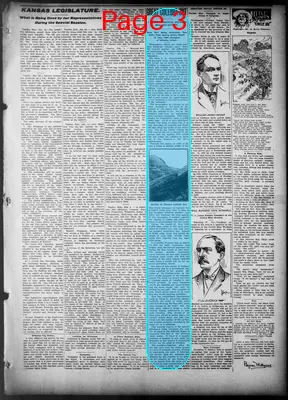
Story
February 12, 1908
Barbour County Index
Medicine Lodge, Barber County, Kansas
What is this article about?
Engineering triumphs at Culebra Cut in Panama Canal construction: excavation surged from 31,000 cubic yards in July 1904 to 800,000+ monthly by 1907, battling landslides, rains, and jungle malaria via railroads and sanitation.
Clipping

OCR Quality
98%
Excellent
Full Text
GREAT CULEBRA CUT IS SCENE OF BATTLE BETWEEN MAN AND NATURE.
More Dirt Being Excavated Now Daily Than During Entire Month of July, 1904 -Conquest of Isthmian Jungle.
Washington. -There are those who have wondered whether, apart from the tropical weather, the difficulties of overcoming the engineering obstacles of Culebra cut were not overestimated.
But when it is remembered that this nine-mile strip, varying from 250 feet to the top of Gold Hill, west of Culebra, is composed of rock, slime, gravel and tropical dirt; when it is borne in mind that the existing prism of this canal is subject to frequent landslides, and when it is considered that this region is washed by a torrential rainfall which exceeds 12 feet yearly, some realization of the difficulties presented will be possible.
It is one thing to blast and shovel a million cubic yards out of Culebra, but it is another problem so to place the excavation that it will be out of the way for all time or so to place it that it will protect the canal channel on the lowlands of the eastern portion of the waterway.
The investigator at Culebra, as on other portions of the ditch, is impressed at the outset with the fact that the railroad is the key to the situation both from an engineering and a sanitary standpoint. This canal cannot be constructed upon a trunk sewer plan. All of us have intelligent friends who seem to think that it is only necessary to excavate and throw the dirt along the banks of the waterway. But as the tourist obtains his first view of the cut at Empire he observes that the rapidity with which the dirt trains are enabled to move out is the measure of the day's achievement.
Through this region, in order to assure a prism of definite width, it has been found necessary to increase the proposed width from time to time as one landslide followed another; and while that increases the total amount of the excavation it renders possible the placing of tracks one above another to accommodate the dirt trains.
During the month of July, 1904, 31,000 cubic yards of dirt were excavated at Culebra cut; one year later the monthly excavation was upward of 80,000 cubic yards, and during the month of July, 1906, 157,000 cubic yards were removed from the nine-mile strips.
It is worthy of notice that on March 14, 1907, the daily excavation was greater than the amount shoveled out during the first month of July cited. The present monthly excavation varies between six and eight hundred thousand cubic yards, and with the passing of the rainy season 1,000,000 cubic yards a month will be the assured excavation record.
But back of this record of monthly excavation and as a preliminary condition essential to the present efficiency of the Culebra army is the story of the conquest of the Isthmian jungle. The canal cut proper has been a constant source of trouble to the health division.
In many instances outlets for drainage are impracticable and the water supply can only be ditched in one pool. The progress of each steam shovel leaves in its train new and varied drainage problems.
This has necessitated constructing pools by filling in, deepening ditches, confining the water by rough stone walls and ditching the large side pools, thus turning all the water into the main ditch, where it forms a swift running stream unfavorable to mosquito breeding. Drip barrels of oil have been placed at points where the current slowed down, and this, combined with the rapidity of the current, has reduced mosquito breeding in the canal cut to a minimum.
The malarial reports of the district physicians being tabulated, the number of cases in the different camps is compared with that of the previous three weeks. If there is a decided increase of malaria at any camp the inspector of that district is telephoned to look for the point of infection.
The mosquito inspector takes the list and goes over the whole ground in order of greatest increase, locating or confirming the point of infection, and reports upon the measures best adapted for the removal of the same. All the laborers of the district who can be spared from the daily routine work are at once concentrated at that point to make a swift and effective end to the mosquito breeding places.
More Dirt Being Excavated Now Daily Than During Entire Month of July, 1904 -Conquest of Isthmian Jungle.
Washington. -There are those who have wondered whether, apart from the tropical weather, the difficulties of overcoming the engineering obstacles of Culebra cut were not overestimated.
But when it is remembered that this nine-mile strip, varying from 250 feet to the top of Gold Hill, west of Culebra, is composed of rock, slime, gravel and tropical dirt; when it is borne in mind that the existing prism of this canal is subject to frequent landslides, and when it is considered that this region is washed by a torrential rainfall which exceeds 12 feet yearly, some realization of the difficulties presented will be possible.
It is one thing to blast and shovel a million cubic yards out of Culebra, but it is another problem so to place the excavation that it will be out of the way for all time or so to place it that it will protect the canal channel on the lowlands of the eastern portion of the waterway.
The investigator at Culebra, as on other portions of the ditch, is impressed at the outset with the fact that the railroad is the key to the situation both from an engineering and a sanitary standpoint. This canal cannot be constructed upon a trunk sewer plan. All of us have intelligent friends who seem to think that it is only necessary to excavate and throw the dirt along the banks of the waterway. But as the tourist obtains his first view of the cut at Empire he observes that the rapidity with which the dirt trains are enabled to move out is the measure of the day's achievement.
Through this region, in order to assure a prism of definite width, it has been found necessary to increase the proposed width from time to time as one landslide followed another; and while that increases the total amount of the excavation it renders possible the placing of tracks one above another to accommodate the dirt trains.
During the month of July, 1904, 31,000 cubic yards of dirt were excavated at Culebra cut; one year later the monthly excavation was upward of 80,000 cubic yards, and during the month of July, 1906, 157,000 cubic yards were removed from the nine-mile strips.
It is worthy of notice that on March 14, 1907, the daily excavation was greater than the amount shoveled out during the first month of July cited. The present monthly excavation varies between six and eight hundred thousand cubic yards, and with the passing of the rainy season 1,000,000 cubic yards a month will be the assured excavation record.
But back of this record of monthly excavation and as a preliminary condition essential to the present efficiency of the Culebra army is the story of the conquest of the Isthmian jungle. The canal cut proper has been a constant source of trouble to the health division.
In many instances outlets for drainage are impracticable and the water supply can only be ditched in one pool. The progress of each steam shovel leaves in its train new and varied drainage problems.
This has necessitated constructing pools by filling in, deepening ditches, confining the water by rough stone walls and ditching the large side pools, thus turning all the water into the main ditch, where it forms a swift running stream unfavorable to mosquito breeding. Drip barrels of oil have been placed at points where the current slowed down, and this, combined with the rapidity of the current, has reduced mosquito breeding in the canal cut to a minimum.
The malarial reports of the district physicians being tabulated, the number of cases in the different camps is compared with that of the previous three weeks. If there is a decided increase of malaria at any camp the inspector of that district is telephoned to look for the point of infection.
The mosquito inspector takes the list and goes over the whole ground in order of greatest increase, locating or confirming the point of infection, and reports upon the measures best adapted for the removal of the same. All the laborers of the district who can be spared from the daily routine work are at once concentrated at that point to make a swift and effective end to the mosquito breeding places.
What sub-type of article is it?
Historical Event
Extraordinary Event
Personal Triumph
What themes does it cover?
Triumph
Exploration
Survival
What keywords are associated?
Culebra Cut
Panama Canal
Excavation Progress
Istthmian Jungle
Malaria Control
Landslides
Dirt Trains
Where did it happen?
Culebra Cut, Isthmus Of Panama
Story Details
Location
Culebra Cut, Isthmus Of Panama
Event Date
1904 1907
Story Details
Progress in excavating the Culebra Cut shows dramatic increase from 31,000 cubic yards in July 1904 to over 800,000 monthly by 1907, overcoming landslides, torrential rains, and jungle health issues through railroad efficiency, widened prisms, and mosquito control measures.