Thank you for visiting SNEWPapers!
Sign up free
Editorial
October 12, 1843
The Madisonian
Washington, District Of Columbia
What is this article about?
Editorial from the Boston Daily Times strongly supports President John Tyler's renomination by the Democratic Party, highlighting his veto of the National Bank as a key service akin to Andrew Jackson's, crediting it with saving the party and earning public acclaim.
Clipping
OCR Quality
95%
Excellent
Full Text
From the Boston Daily Times.
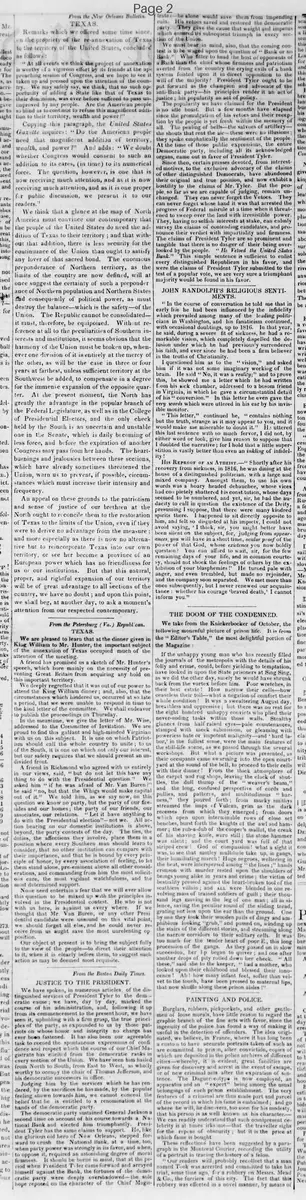
JUSTICE TO THE PRESIDENT.
We have spoken, in numerous articles, of the distinguished services of President Tyler to the democratic cause; we have, day by day, marked the course of his administration, and, following it up from its commencement to the present hour, we have seen it, upholding with a firm grasp, the true principles of the party, as expounded to us by those patriots on whose honor and integrity no charge has ever been fastened. It has also been our agreeable task to record the spontaneous expressions of confidence and respect which the course of our Chief Magistrate has elicited from the democratic ranks in every section of the Union. We have seen him hailed from North to South, from East to West, as wholly worthy to occupy the chair of Thomas Jefferson, and his democratic successors in office.
Judging him by the services which he has rendered, by the sacrifices he has made, by the popular feeling shown towards him, we cannot conceal the belief that he is entitled to a renomination at the hands of the democratic party.
The democratic party sustained General Jackson a second time on account of his course towards a National Bank and elected him triumphantly. President Tyler has the same claims to support. He, like the glorious old hero of New Orleans, stepped forward to crush the National Bank, at a time, too, when party power was strongly in its favor, and when, to oppose it, required an astonishing degree of moral firmness. It should be borne in mind, that at the period when President Tyler came forward and arrayed himself against the Bank, the fortunes of the democratic party were deeply overshadowed—the sole hope reposed on the character of the Chief Magistrate;—he alone would save them from impending ruin. His vetoes saved and restored the democratic party. They gave the cause that weight and impetus which ensured its subsequent triumph in every section of the Union.
We must bear in mind, also, that the coming contest is to be waged upon the question of "Bank or no Bank." Who fitter to head the host of opponents of a Bank than the chief whose firmness and patriotism averted from the country the crying evils of a bank system foisted upon it in direct opposition to the will of the majority? President Tyler ought to be put forward as the champion and advocate of the anti-Bank party—his principles render it an act of justice; his popularity an act of policy.
The popularity we have claimed for the President is no idle boast. But a few months have elapsed since the promulgation of his vetoes and their reception by the people is yet fresh within the memory of all. The pealing of bells—the salvoes of artillery—the shouts that rent the air—these were no illusions; they spoke emphatically the sentiment of the people. At the time of those public expressions, the entire Democratic party, including all its acknowledged organs, came out in favor of President Tyler.
Since then, certain presses devoted, from interested motives, to the exclusive advocacy of the claims of other distinguished Democrats, have abandoned their original and true position, and now exhibit a hostility to the claims of Mr. Tyler. But the people, so far as we are capable of judging, remain unchanged. They can never forget the Vetoes. They can never forget whose hand it was that arrested the progress of Federal misrule at a time when it threatened to sweep over the land with irresistible power. They, having no selfish interests at stake, can calmly survey the claims of contending candidates, and pronounce their verdict with impartiality and firmness.
The claims of President Tyler are so prominent and tangible that there is no danger of their being overlooked by the people. "He Vetoed the United States Bank." This simple sentence is sufficient to enlist every distinguished Republican in his favor, and were the claims of President Tyler submitted to the test of a popular vote, we are very sure a triumphant majority would be found in his favor.
JUSTICE TO THE PRESIDENT.
We have spoken, in numerous articles, of the distinguished services of President Tyler to the democratic cause; we have, day by day, marked the course of his administration, and, following it up from its commencement to the present hour, we have seen it, upholding with a firm grasp, the true principles of the party, as expounded to us by those patriots on whose honor and integrity no charge has ever been fastened. It has also been our agreeable task to record the spontaneous expressions of confidence and respect which the course of our Chief Magistrate has elicited from the democratic ranks in every section of the Union. We have seen him hailed from North to South, from East to West, as wholly worthy to occupy the chair of Thomas Jefferson, and his democratic successors in office.
Judging him by the services which he has rendered, by the sacrifices he has made, by the popular feeling shown towards him, we cannot conceal the belief that he is entitled to a renomination at the hands of the democratic party.
The democratic party sustained General Jackson a second time on account of his course towards a National Bank and elected him triumphantly. President Tyler has the same claims to support. He, like the glorious old hero of New Orleans, stepped forward to crush the National Bank, at a time, too, when party power was strongly in its favor, and when, to oppose it, required an astonishing degree of moral firmness. It should be borne in mind, that at the period when President Tyler came forward and arrayed himself against the Bank, the fortunes of the democratic party were deeply overshadowed—the sole hope reposed on the character of the Chief Magistrate;—he alone would save them from impending ruin. His vetoes saved and restored the democratic party. They gave the cause that weight and impetus which ensured its subsequent triumph in every section of the Union.
We must bear in mind, also, that the coming contest is to be waged upon the question of "Bank or no Bank." Who fitter to head the host of opponents of a Bank than the chief whose firmness and patriotism averted from the country the crying evils of a bank system foisted upon it in direct opposition to the will of the majority? President Tyler ought to be put forward as the champion and advocate of the anti-Bank party—his principles render it an act of justice; his popularity an act of policy.
The popularity we have claimed for the President is no idle boast. But a few months have elapsed since the promulgation of his vetoes and their reception by the people is yet fresh within the memory of all. The pealing of bells—the salvoes of artillery—the shouts that rent the air—these were no illusions; they spoke emphatically the sentiment of the people. At the time of those public expressions, the entire Democratic party, including all its acknowledged organs, came out in favor of President Tyler.
Since then, certain presses devoted, from interested motives, to the exclusive advocacy of the claims of other distinguished Democrats, have abandoned their original and true position, and now exhibit a hostility to the claims of Mr. Tyler. But the people, so far as we are capable of judging, remain unchanged. They can never forget the Vetoes. They can never forget whose hand it was that arrested the progress of Federal misrule at a time when it threatened to sweep over the land with irresistible power. They, having no selfish interests at stake, can calmly survey the claims of contending candidates, and pronounce their verdict with impartiality and firmness.
The claims of President Tyler are so prominent and tangible that there is no danger of their being overlooked by the people. "He Vetoed the United States Bank." This simple sentence is sufficient to enlist every distinguished Republican in his favor, and were the claims of President Tyler submitted to the test of a popular vote, we are very sure a triumphant majority would be found in his favor.
What sub-type of article is it?
Partisan Politics
Economic Policy
What keywords are associated?
President Tyler
Renomination
Anti Bank
Veto
Democratic Party
National Bank
What entities or persons were involved?
President Tyler
General Jackson
Democratic Party
National Bank
Editorial Details
Primary Topic
Support For President Tyler's Renomination
Stance / Tone
Strongly Supportive Of Tyler
Key Figures
President Tyler
General Jackson
Democratic Party
National Bank
Key Arguments
Tyler Upheld True Democratic Principles
His Vetoes Saved And Restored The Democratic Party
Tyler's Anti Bank Stance Mirrors Jackson's
Public Acclaim For Tyler's Vetoes Remains Strong
Tyler Is The Fittest Champion Against The Bank