Thank you for visiting SNEWPapers!
Sign up free
Story
May 24, 1940
The Midland Journal
Rising Sun, Cecil County, Maryland
What is this article about?
The US Post Office will issue a stamp honoring Dr. Crawford W. Long of Jefferson, GA, as the true discoverer of ether anesthesia, first used in surgery on March 30, 1842, to remove a tumor from James M. Venable's neck, settling claims by others.
Clipping
OCR Quality
98%
Excellent
Full Text
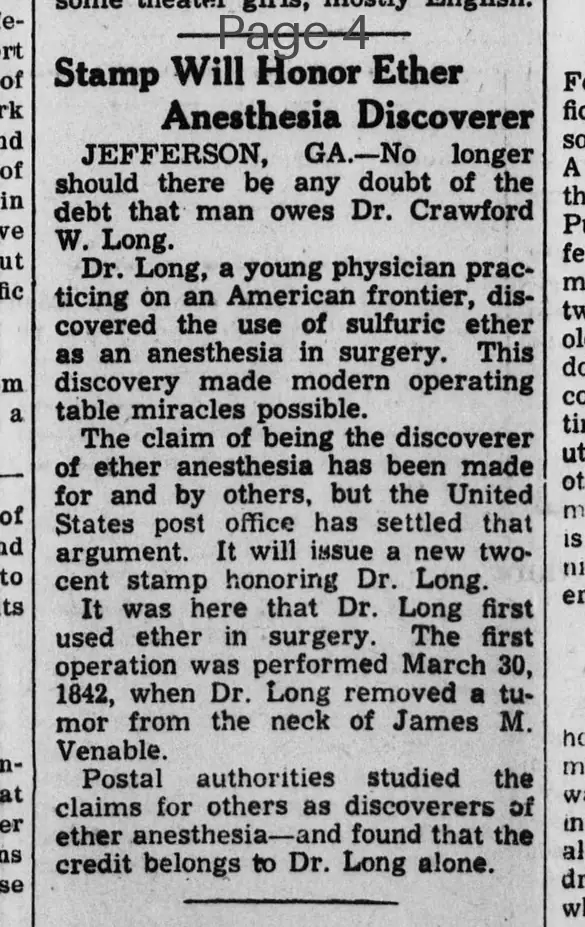
Stamp Will Honor Ether Anesthesia Discoverer
JEFFERSON, GA.-No longer should there be any doubt of the debt that man owes Dr. Crawford W. Long.
Dr. Long, a young physician practicing on an American frontier, discovered the use of sulfuric ether as an anesthesia in surgery. This discovery made modern operating table miracles possible.
The claim of being the discoverer of ether anesthesia has been made for and by others, but the United States post office has settled that argument. It will issue a new two-cent stamp honoring Dr. Long.
It was here that Dr. Long first used ether in surgery. The first operation was performed March 30, 1842, when Dr. Long removed a tumor from the neck of James M Venable.
Postal authorities studied the claims for others as discoverers of ether anesthesia-and found that the credit belongs to Dr. Long alone.
JEFFERSON, GA.-No longer should there be any doubt of the debt that man owes Dr. Crawford W. Long.
Dr. Long, a young physician practicing on an American frontier, discovered the use of sulfuric ether as an anesthesia in surgery. This discovery made modern operating table miracles possible.
The claim of being the discoverer of ether anesthesia has been made for and by others, but the United States post office has settled that argument. It will issue a new two-cent stamp honoring Dr. Long.
It was here that Dr. Long first used ether in surgery. The first operation was performed March 30, 1842, when Dr. Long removed a tumor from the neck of James M Venable.
Postal authorities studied the claims for others as discoverers of ether anesthesia-and found that the credit belongs to Dr. Long alone.
What sub-type of article is it?
Historical Event
Biography
Medical Curiosity
What themes does it cover?
Triumph
Justice
What keywords are associated?
Ether Anesthesia
Medical Discovery
Dr. Crawford Long
Us Stamp
Historical Recognition
What entities or persons were involved?
Dr. Crawford W. Long
James M Venable
Where did it happen?
Jefferson, Ga.
Story Details
Key Persons
Dr. Crawford W. Long
James M Venable
Location
Jefferson, Ga.
Event Date
March 30, 1842
Story Details
Dr. Crawford W. Long discovered ether anesthesia and first used it in surgery on March 30, 1842, removing a tumor from James M. Venable's neck in Jefferson, GA. Despite competing claims, the US Post Office honors him with a stamp, affirming his sole credit.