Thank you for visiting SNEWPapers!
Sign up free
Raftsman's Journal
Clearfield, Clearfield County, Pennsylvania
What is this article about?
Reports on U.S. congressional proceedings from February 19-25, covering Senate and House debates on diplomatic appropriations, Cuba acquisition bill, post-office reforms, tariff revisions, army and navy bills, and intense Kansas slavery disputes among Democrats.
Clipping
OCR Quality
Full Text
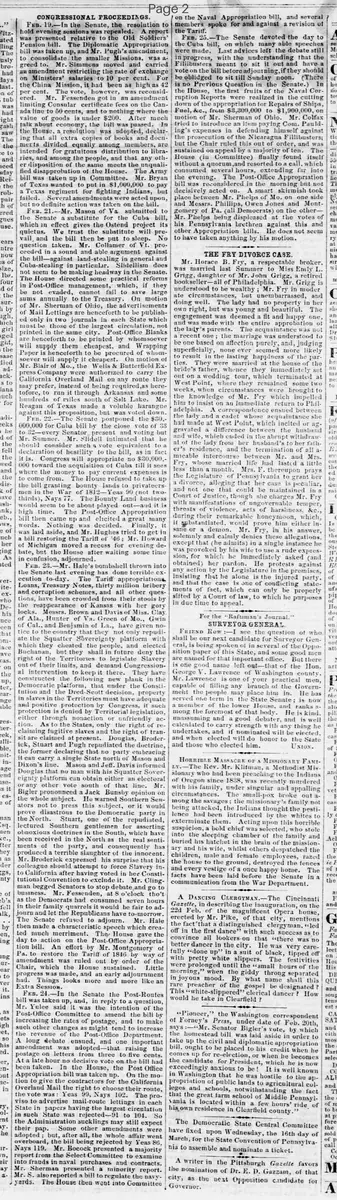
Feb. 21.—Mr. Mason of Va. submitted to the Senate a substitute for the Cuba bill, which in effect gives the Ostend project its quietus. We trust the substitute will prevail and the bill then be put to sleep. No question taken. Mr. Collamer of Vt. proceeded in a sound and able argument against the bill—against land-stealing in general and Cuba-stealing in particular. Slidellism does not seem to be making headway in the Senate. The House directed some practical reforms in Post-Office management, which, if they be not evaded, cannot fail to save large sums annually to the Treasury. On motion of Mr. Sherman of Ohio, the advertisements of Mail Lettings are henceforth to be published only in two journals in each State which must be those of the largest circulation, not printed in the same city. Post-Office Blanks are henceforth to be printed by whomsoever will supply them cheapest, and Wrapping Paper is henceforth to be procured of whomsoever will supply it cheapest. On motion of Mr. Blair of Mo., the Wells & Butterfield Express Company were authorized to carry the California Overland Mail on any route they may prefer, instead of being required, as heretofore, to run it through Arkansas and some hundreds of miles south of Salt Lake. Mr. Reagan of Texas made a voluble harangue against this proposition, but was voted down.
Feb. 22.—The Senate postponed the $80,000,000 for Cuba bill by the close vote of 33 to 32—every Senator present and voting but Mr. Sumner. Mr. Slidell intimated that he should consider such a vote equivalent to a declaration of hostility to the bill, as in fact it is. Congress will appropriate no $30,000,000 toward the acquisition of Cuba till it sees where the money to pay current expenses is to come from. The House refused to take up the bill granting bounty lands to privateersmen in the War of 1812—Yeas 90 (not two-thirds), Nays 77. The Bounty Land business would seem to be about played out—and it is high time. The Post-Office Appropriation bill then came up and elicited a great many words. Nothing was decided. Finally, it was laid aside, and Mr. Hughes tried to get in a bill restoring the Tariff of '46: Mr. Howard of Michigan moved a recess for evening debate, but the House after waiting some time in confusion, adjourned.
Feb. 23.—Mr. Hale's bombshell thrown into the Senate last evening has done terrible execution to-day. The Tariff appropriations, Loans, Treasury Notes, thirty million bribery and corruption schemes, and all other questions, have been crowded from their stools by the reappearance of Kansas with her gory locks. Messrs. Brown and Davis of Miss., Clay of Ala., Hunter of Va., Green of Mo., Gwin of Cal., and Benjamin of La., have given notice to the country that they not only repudiate the Squatter Sovereignty platform with which they cheated the people, and elected Buchanan, but they shall in future deny the right of the Territories to legislate Slavery out of their limits, and demand Congressional intervention to keep it there. They have constructed the following new plank in the Democratic platform, that under the Constitution and the Dred-Scott decision, property in slaves in the Territories must have adequate and positive protection by Congress, if such protection is denied by Territorial legislation, either through nonaction or unfriendly action. As to the States, only the right of reclaiming fugitive slaves and the right of transit are claimed at present. Douglas, Broderick, Stuart and Pugh repudiated the doctrine, the former declaring that no party embracing it can carry a single State north of Mason and Dixon's line. Mason and Jeff. Davis informed Douglas that no man with his Squatter Sovereignty platform can obtain either an electoral or any other vote south of that line. Mr. Bigler pronounced a Jack Bunsby opinion on the whole subject. He warned Southern Senators not to press this subject, or it would prove disastrous to the Democratic party in the North. Stuart, one of the repudiated, lectured Southern gentlemen for asserting obnoxious doctrines in the South, which have been received in the North as the real sentiments of the party, and consequently has produced a terrible slaughter of the innocent. Mr. Broderick expressed his surprise that his colleague should attempt to force Slavery into California after having voted in her Constitutional Convention to exclude it. Mr. Clingman begged Senators to stop debate and go to business. Mr. Fessenden, at 8 o'clock tho't as the Democrats had consumed seven hours in their family quarrels it would be fair to adjourn and let the Republicans have to-morrow. The Senate refused to adjourn. Mr. Hale then made a characteristic speech which created much merriment. The House gave the day to action on the Post-Office Appropriation bill. An effort by Mr. Montgomery of Pa. to restore the Tariff of 1846 by way of amendment was ruled out by order of the Chair, which the House sustained. Little progress was made, and an early adjournment had. Things looks more and more like an Extra Session.
Feb. 24.—In the Senate the Post-Routes bill was taken up, and, in reply to a question, Mr. Yulee said it was the intention of the Post-Office Committee to amend the bill by increasing the rates of postage, and to make such other changes as might tend to increase the revenue of the Post-Office Department. A long debate ensued, and one important amendment was adopted—that raising the postage on letters from three to five cents. At a late hour no decisive vote on the bill had been taken. In the House, the Post Office Appropriation bill was taken up. On the motion to give the contractors for the California Overland Mail the right to choose their route, the vote was: Yeas 99, Nays 102. The proviso to advertise mail-route lettings in each State in papers having the largest circulation in such State was rejected—91 to 104. So the Administration sucklings may still expect their pap. Some other amendments were adopted; but, after all, the whole affair went overboard, the bill being rejected by Yeas 86, Nays 119. Mr. Bocock presented a majority report from the Select Committee to examine into frauds in naval purchases and contracts. Mr. Sherman presented a minority report. Mr. S. also reported a bill to regulate the navy-yards. The House then went into Committee on the Naval Appropriation bill, and several members spoke for and against a revision of the Tariff.
Feb. 25.—The Senate devoted the day to the Cuba bill, on which many able speeches were made. Last advices left the debate still in progress, with the understanding that the Fillibusters meant to sit it out and have a vote on the bill before adjourning, if they should be obliged to sit till Sunday noon. (There is no Previous Question in the Senate.) In the House, the first fruits of the Naval Corruption Reports were realized in the cutting down of the appropriation for Repairs of Ships, Fuel, &c., from $3,300,000 to $1,900,000, on motion of Mr. Sherman of Ohio. Mr. Colfax tried to introduce an item paying Com. Paulding's expenses in defending himself against the prosecution of the Nicaragua Fillibusters; but the Chair ruled this out of order, and was sustained on appeal by a majority of ten. The House (in Committee) finally found itself without a quorum, and resorted to a call, which consumed several hours, extending far into the evening. The Post-Office Appropriation bill was reconsidered in the morning but not decisively acted on. A smart skirmish took place between Mr. Phelps of Mo. on one side and Messrs. Phillips, Owen Jones and Montgomery of Pa. (all Democrats) on the other— Mr. Phelps being displeased at the votes of his Pennsylvania brethren against this and other Appropriation bills. He does not seem to have taken anything by his motion.
What sub-type of article is it?
What keywords are associated?
What entities or persons were involved?
Where did it happen?
Domestic News Details
Primary Location
Washington
Event Date
Feb. 19 To Feb. 25
Key Persons
Outcome
diplomatic appropriation bill passed with amendments; army bill no definite action; cuba bill postponed 33-32; bounty lands bill refused; post-office appropriation bill rejected 86-119; naval appropriation cut from $3,300,000 to $1,900,000; intense democratic debate on kansas slavery protection, with divisions between northern and southern members.
Event Details
Daily summaries of U.S. Senate and House sessions: Feb 19 - Diplomatic bill amendments and passage, House resolution on documents, Army bill debate. Feb 21 - Senate Cuba bill substitute and arguments, House post-office reforms and California mail route change. Feb 22 - Senate postpones Cuba bill, House rejects bounty lands, debates post-office and tariff. Feb 23 - Senate Kansas slavery debate with Democratic splits, House post-office bill progress stalled. Feb 24 - Senate post-routes debate with postage increase, House rejects post-office bill, naval reports. Feb 25 - Senate Cuba bill debate ongoing, House naval appropriation cuts and quorum issues.